
For quite a long time, many of us have said that structured data, Schema, and JSON-LD are crucial for AI SEO, or what many people now call GEO. To say it more cautiously, people at least believed these things were positively correlated with AI search referrals.
That judgment sounds reasonable. AI seems to prefer structured, orderly, easy-to-parse content. Some people have even started rewriting articles into rigid machine-friendly formats: a definition under every heading, a list under every definition, and an FAQ block after that. Of course, some of them have probably paid a price for doing so.
We often underestimate the intelligence of Google Search, or more broadly the understanding ability of frontier AI models. In practice, you are not optimizing for a small 30B model. You are facing GPT, Claude, Gemini, and the search, retrieval, ranking, citation, and quality evaluation systems behind them. Structure matters to those systems, but if you interpret “structured” as flattening information, cutting it into fragments, and forcing it into templates, the problem begins. The simpler, more regular, and more machine-facing the content becomes, the more it often loses depth, judgment density, and real context.
The Ahrefs study I want to analyze here explains this problem to some extent. It does not say Schema is useless. It says that, at least in this dataset, adding JSON-LD Schema to pages did not clearly improve their citation performance in Google AI Overviews, Google AI Mode, or ChatGPT. The next time someone confidently tells you that “doing GEO means doing Schema first,” you do not have to argue immediately. You can simply show them this study.
What Exactly Did This Study Measure?
Ahrefs published this study on May 11, 2026. Its title is direct: “We Tracked 1,885 Pages Adding Schema. AI Citations Barely Moved.” It does not test the entire SEO value of Schema. It asks a more specific question: after a page adds JSON-LD Schema, do AI search citations increase meaningfully?
The key word is “adds.” Ahrefs first analyzed about 6 million URLs and found a pattern: pages cited by AI are indeed more likely to have JSON-LD Schema. According to Ahrefs, AI-cited pages are nearly three times as likely to use JSON-LD as uncited pages. This is the part many GEO articles love to quote. AI-cited pages more often have Schema, so Schema must be important. Sounds smooth, right?
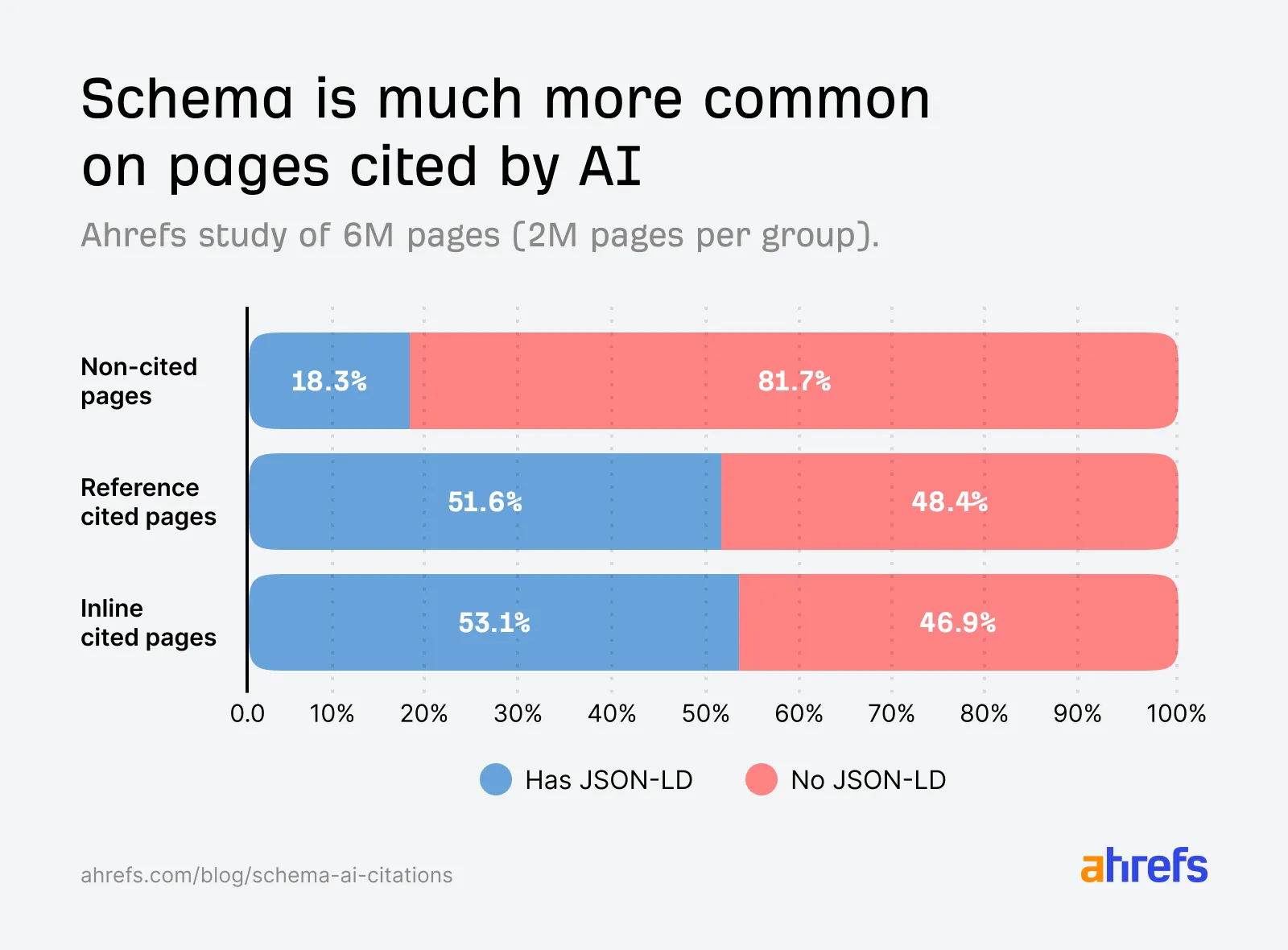
This chart is the easiest place to build the “Schema is important” argument. Among non-cited pages, only 18.3% had JSON-LD. Among reference cited pages, the figure reached 51.6%. Among inline cited pages, it rose to 53.1%. If you only see this, it is easy to draw a direct conclusion: AI likes citing pages with Schema.
But smooth does not mean correct.
Ahrefs also understood that this data shows correlation, not causality. A site that carefully implements Schema is often doing many other things well too: cleaner technical SEO, more frequent content maintenance, stronger site authority, more links, more stable updates, and a more credible brand. In other words, Schema may not be the cause. It may simply be a common feature of stronger sites. It is like seeing that many excellent students carry notebooks and then saying that buying a notebook will improve your grades. The notebook may help, but it is not learning ability itself.
To keep testing, Ahrefs took a second step. They used their crawler history to track page HTML and identified the moment a URL changed from having no <script type="application/ld+json"> to having JSON-LD. That moment became the treatment date. In the end, they found 1,885 pages that added JSON-LD Schema between August 2025 and March 2026, then matched them with about 4,000 control pages. The control pages came from different domains, had similar prior AI citation levels, but did not add JSON-LD. This is much more valuable than a simple correlation chart because it gets closer to the question we actually care about: if I add Schema to a page now, will I get more AI referrals?

The chart above shows the experimental design from the Ahrefs article. The core idea is simple: one group of pages added JSON-LD, a similar group did not, and then Ahrefs observed citation changes across Google AI Overviews, Google AI Mode, and ChatGPT.
The Results Are Calm, and Not Very Pretty
Ahrefs observed three platforms: Google AI Overviews, Google AI Mode, and ChatGPT. The approximate results were: in Google AI Overviews, pages that added Schema declined 4.6% relative to the control group; in Google AI Mode, they rose 2.4%; in ChatGPT, they rose 2.2%.
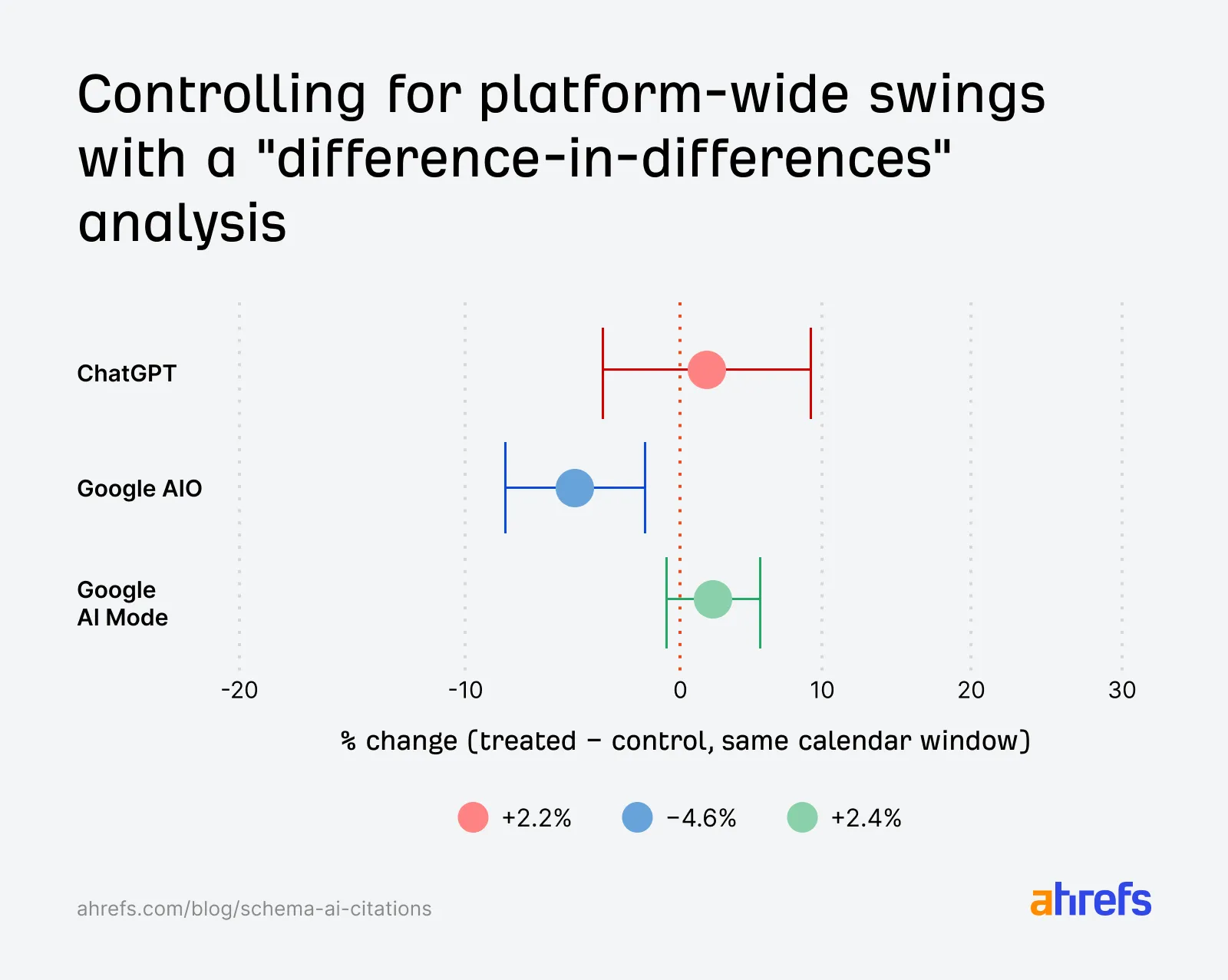
If you look only at the numbers, you might say: AI Mode and ChatGPT still went up, didn’t they? The problem is that those two increases are close to statistical noise. They are too small to know whether Schema caused the change, or whether it came from platform fluctuation, page changes, crawl timing, content freshness, or shifts in the citation pool.
The -4.6% in Google AI Overviews is statistically clearer. Ahrefs says the probability of randomly observing a difference that large is roughly 1 in 2,500. But they still do not interpret it crudely as “adding Schema hurts AI citations.” That restraint is one of the more admirable parts of the study. Ahrefs says the decline in AI Overviews was observed, but the absolute size is small, roughly 12 fewer citations per page per day, and it cannot be attributed to Schema alone. These pages and their control pages were already trending downward before Schema was added. Google AI Overviews may also have changed its citation strategy during that period; some content may have gone stale; or Google may not have recrawled pages quickly enough.
So the most stable conclusion is this: adding JSON-LD Schema did not bring a clear positive lift to these pages that were already being cited by AI. That sentence matters. It is more accurate than “Schema is useless” and closer to reality than “Schema is essential for GEO.”
Ahrefs Looked Beyond One Result Chart
This needs to be added, otherwise the study is easy to oversimplify.
Ahrefs did not only run a basic before-after comparison and read the direction of movement. They used four kinds of checks to separate platform-wide movement from the possible effect of Schema.
The first method was a direct comparison of average citation change before and after Schema was added for treated pages and control pages. This is intuitive, but it is also the most vulnerable to platform-level trends. If Google AI Mode citations are rising overall during a period, and you only look at pages that added Schema, it is easy to misread a platform-wide rise as a Schema effect.
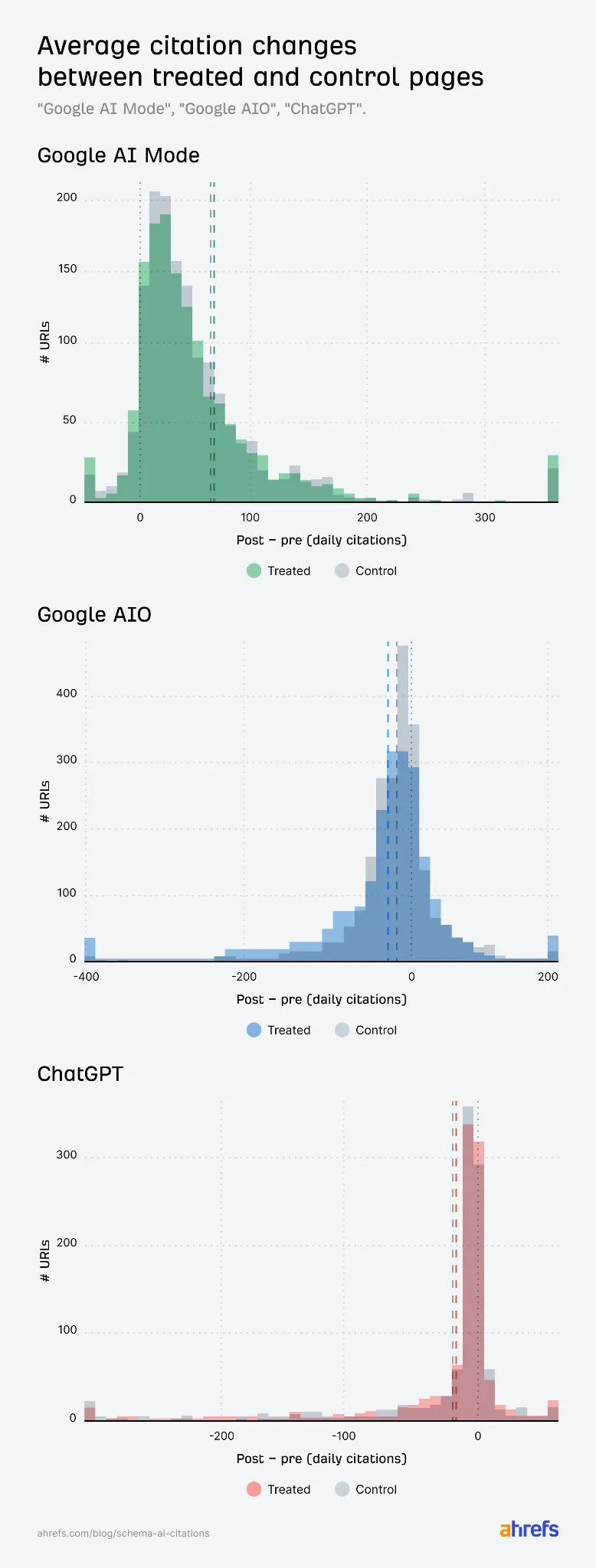
The second method, and the one Ahrefs emphasizes most, is difference-in-differences. In plain terms, do not just ask “did citations rise after Schema was added?” Ask instead: “did pages that added Schema rise more than similar pages that did not?” That gets closer to the causal question we actually want to answer.
The third method is an event study. It looks at weekly trends to see whether treated pages and control pages were already diverging before Schema was added. If the two groups were already moving differently before treatment, then attributing later differences to Schema becomes risky.
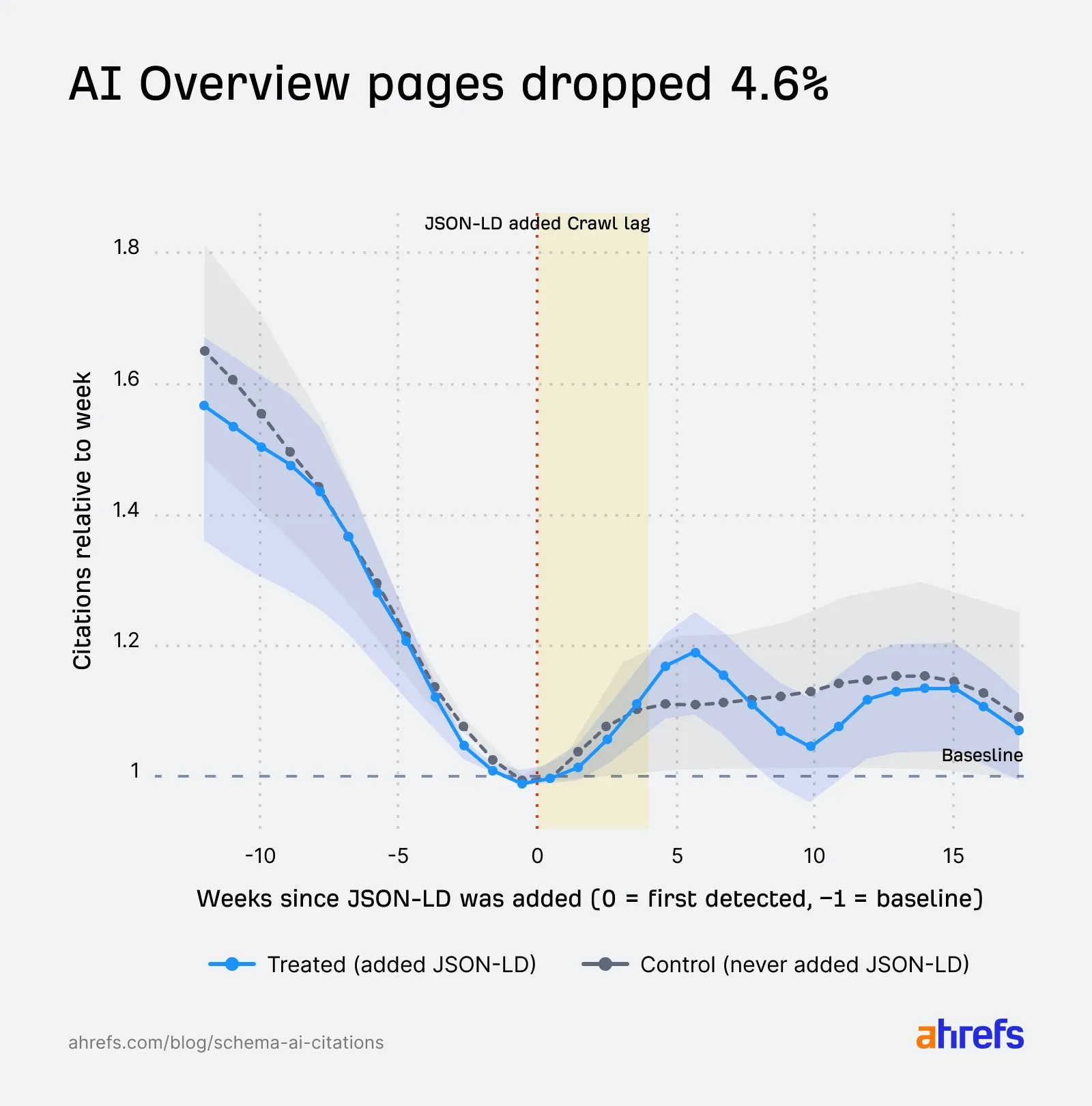
This chart corresponds to Google AI Overviews. You can see that before JSON-LD was added, both groups were already declining together. Afterward, treated pages performed slightly worse than the control group, but the broader context is that AIO citations were shrinking overall. That is why Ahrefs does not simply say “Schema hurt AI Overview citations.” It observed a small decline, but the reason cannot be nailed down.
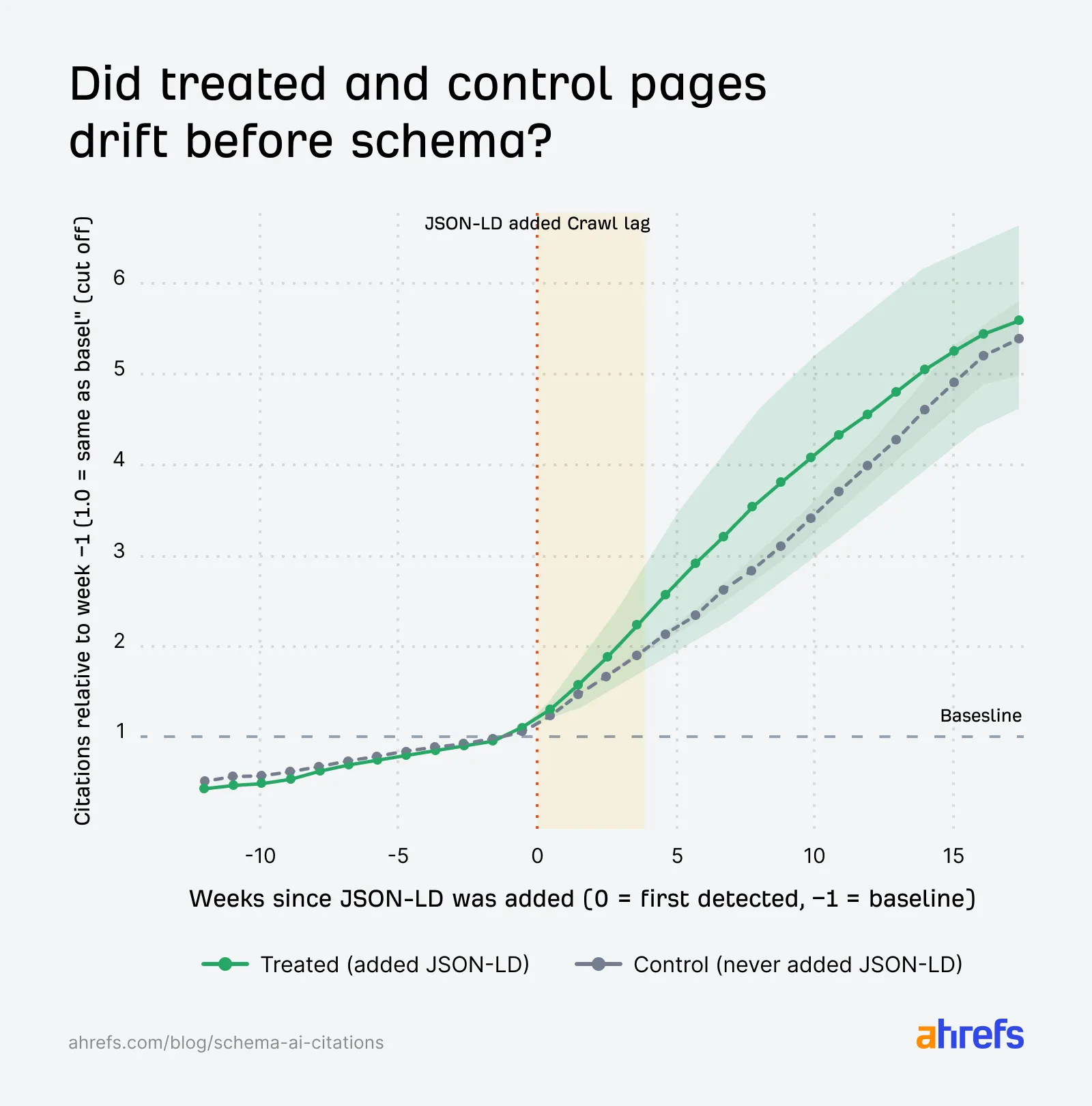
This chart checks whether treated and control pages drifted apart before treatment. The lines move in broadly similar directions before and after JSON-LD was added. In other words, if both groups rise or both groups fall later, you cannot immediately attribute that to Schema; it may simply reflect the platform environment.
The fourth check reruns DiD with different before / after time windows to see whether the result is stable. If the conclusion changes when the window changes, the study would be fragile. But the chart suggests that the broad direction remains similar: the confidence intervals for ChatGPT and Google AI Mode cross zero, while Google AIO remains negative.
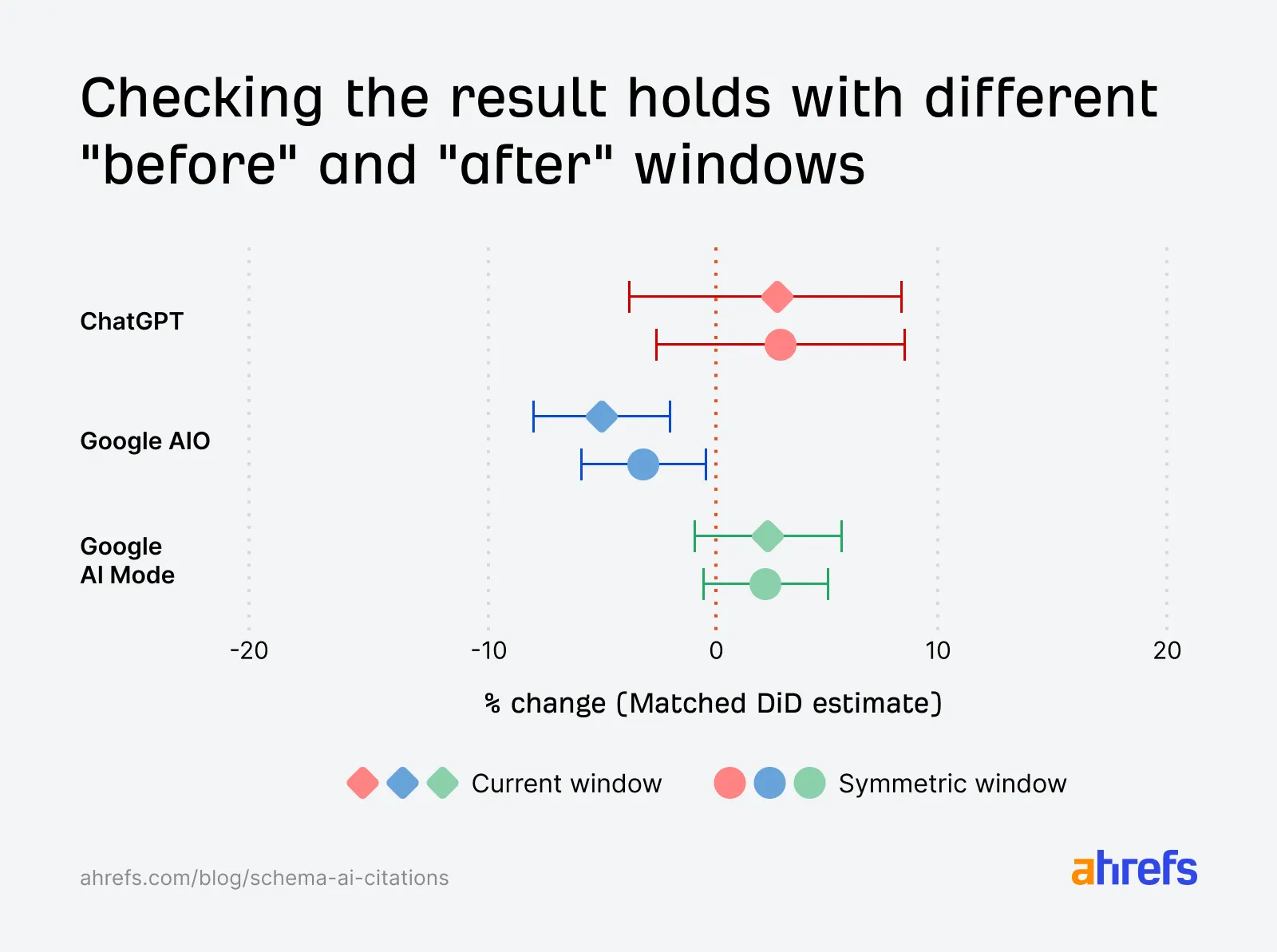
So the study’s real value is not just the conclusion that Schema produced “no obvious lift.” It also blocks several common misreadings. It does not merely ask whether citations changed before and after Schema. It does not isolate one platform during one time window and call that proof. It repeatedly asks the same question: did this intervention produce more incremental lift than a control group? The answer, so far, is not encouraging.
The Boundaries of the Study Matter
The limits of the study also need to be stated.
The pages in this Ahrefs dataset were not cold-start pages that AI had never seen. The original article says clearly that pages in the dataset already had more than 100 AI Overviews citations per page before February 2025. In other words, this study asks: “If a page is already in the AI citation pool, does adding Schema make it perform better?” It does not ask: “Can Schema help a page that has never been discovered by AI become discoverable?”
That distinction is important.
If a page has not been crawled, indexed, or admitted into any candidate set, this dataset cannot directly answer whether Schema helps search systems understand the page earlier in the pipeline. What it can answer is another, more practical question: if your page can already be cited by AI, the evidence does not support expecting a meaningful citation lift just by adding JSON-LD.
The original article also mentions several limitations. First, different Schema types were analyzed together. Article, FAQ, Product, HowTo, and Organization Schema may not behave the same way. Second, the observation window was mainly 30 days after Schema was added. If Schema has a slower delayed effect, this dataset may not fully capture it. Third, pages that added JSON-LD may also have changed content, links, or technical elements at the same time. The study uses controls, but it cannot strip away every co-moving factor perfectly. Fourth, the study mainly looks at JSON-LD in HTML; it is not a complete test of every structured data implementation.
These boundaries do not weaken the study. They prevent the opposite extreme: jumping from “Schema did not clearly improve AI citations” to “Schema is completely useless.” That would simply be another kind of clickbait.
Correlation Is Not Causation, the SEO Trap Everyone Keeps Falling Into
The SEO industry loves correlation. Correlation is easy to chart, easy to put in reports, and easy to sell. AI-cited pages more often have Schema. High-ranking pages have more words. High-traffic pages have more backlinks. Better-converting landing pages load faster. All of these observations may be true, but none of them automatically means causality.
The hard part is that many SEO variables do not happen in isolation. A site that takes Schema seriously often also takes content structure, internal links, page experience, author information, product information, brand visibility, external distribution, and technical maintenance seriously. A page that gets cited by AI often becomes a cited page not because one tag was written correctly, but because it already looks like a credible answer source.
So when you see that “AI-cited pages more often have Schema,” there are at least three possible explanations. First, Schema really helps AI understand the page and therefore brings more citations. Second, Schema does not directly bring citations, but it helps search engines understand entities, page type, and knowledge relationships, indirectly improving the page’s position in the broader search system. Third, Schema is merely a technical feature commonly found on stronger sites, while the real causes are content quality, authority, links, brand, and user-intent fit.
Ahrefs does not completely rule out the first or second possibility. But it does tell us this: if you already have pages that AI can see and cite, adding JSON-LD alone is unlikely to produce a meaningful lift. For many teams working on GEO, that is a necessary cold shower.
Why AI May Not Care About Your Version of “Structured Content”
I want to add one more point here. Many people’s imagination of AI search is still stuck on the idea that “machines are bad at reading web pages, so I need to feed them content in the most orderly format possible.” That judgment is partly right. Product price, inventory, rating, author, publish time, organization information, and breadcrumbs are naturally structured facts. Marking them up with Schema can help search engines, knowledge graphs, rich results, voice assistants, and downstream entity recognition.
But articles, opinions, experience, cases, and judgment are different. When AI search cites a piece of content, it is not only checking whether the format is neat. It is more likely judging whether the page answers the question, whether the source is credible, whether the semantics are complete, whether other sources can corroborate it, whether there is enough context, and whether the page has been cited or discussed elsewhere.
This explains why many pieces of content written “for AI” end up unpleasant and not very useful. They remove the human texture, delete context, compress judgment into lists, turn real experience into templates, and convert complex information into easy-to-copy paragraphs. You think this makes the page more suitable for AI, but frontier models may not need to be fed that way. They may even recognize that the content is low-density material produced to please machines.
AI search is not a tiny crawler that can only read tables. Behind it sits a search index, semantic understanding, entity relationships, page quality signals, citation networks, and user intent. If you give it a polished but empty Schema block, it will not suddenly decide you are authoritative. This is the biggest GEO reminder from the Ahrefs study: GEO should not be understood as “labeling things for machines.” It should be understood as making your content, product, brand, and evidence more credible inside systems that AI can retrieve, understand, verify, and cite.
Schema Still Has Value, but It Is Not an AI Citation Switch
This must be said clearly, otherwise the article will swing to the opposite extreme. Schema has not been proven to significantly increase AI citations. That does not mean Schema is useless. Those two statements are very different.
Schema structured data still has many practical uses. It can help search engines understand page types such as Article, Product, Organization, Breadcrumb, FAQ, and HowTo. It can support certain rich results in traditional search. It may participate in entity recognition, knowledge graphs, voice assistants, vertical search, and downstream data processing. For e-commerce sites, SaaS sites, local businesses, content sites, and product pages, Schema remains a part of technical SEO that deserves real attention.
But it should be put back in its proper place. It is structured markup that helps search systems understand a page. It is not a universal key that makes AI search cite you. It should not be packaged as the “core secret” of GEO. That sentence may make some people uncomfortable, but it needs to be said.
Many GEO services and courses now like to repackage basic SEO, content strategy, and technical standards into a new concept. Schema, FAQ, llms.txt, robots, sitemap, entity terms, and Q&A formats all get thrown into an “AI search optimization checklist.” Are these things useful? Some of them are. But if you do not discuss priority, evidence strength, use cases, and effect boundaries, and instead simply say “do this and AI referrals will rise,” the work becomes dangerous. It pushes teams to spend limited energy on actions that are easy to execute but may not create real incremental value.
What Actually Influences AI Citations May Be the Slower, Less Exciting Work
If Schema is not the magic switch, what should we do? The answer is less glamorous.
First, the content itself needs citable value. Not vague commentary, not a reorganization of public material, not ten articles blended into a longer one, but clear definitions, judgment, data, cases, comparisons, operating experience, and boundary conditions. Why should AI cite you? Because you provide an answer that is hard to find elsewhere, or clearer and more credible than what is elsewhere.
Second, key information on the page should be visible to humans. Do not hide the truly important information only inside JSON-LD. Product capabilities, price ranges, use cases, author background, company information, case results, and update dates should also appear clearly in the body. searchVIU ran a related experiment testing whether ChatGPT, Claude, Perplexity, Gemini, and Google AI Mode use hidden JSON-LD, Microdata, and RDFa during live page fetching. The results suggested that they mainly extract visible HTML content, while hidden structured data was not directly read. The experiment is not large enough to be a final conclusion, but it reminds us of one thing: visible content still matters.
Third, the site needs topical authority. You cannot write about AI search today, pet toys tomorrow, and weight-loss tea the day after, then expect AI to treat you as a reliable source in a field. Humans will be confused, search engines will be confused, and AI will be confused too. If you want to be cited under a topic, you need to keep producing deep, mutually reinforcing content around that topic. This is not keyword stuffing. It is the formation of a stable topical space.
Fourth, external signals matter. Brand mentions, natural links, industry citations, community discussion, media coverage, and user reviews are hard to fake and hard to accumulate quickly. Precisely because they are hard, they may become stronger trust signals. AI search does not only look at what you say about yourself. It also looks at whether the wider web talks about you, cites you, and verifies you.
Fifth, content needs freshness. AI search cites answers, not archives. A page that was good three years ago but has not been updated can easily be replaced by a newer, more specific, more current page in fast-moving topics. So GEO is not a one-off project. It is closer to long-term maintenance of content assets. That sounds unglamorous, but many effective things are exactly that.
What This Means for Global Teams and Independent Sites
If you run an English independent site, a SaaS website, a tool site, a content site, or are working on AI search visibility, this study offers at least three practical reminders.
First: do not mistake a technical checklist for a growth strategy. Schema should be implemented. Sitemap should be maintained. Robots should be checked. Page speed should be improved. Index status should be watched. But these are more like foundations. A weak foundation is a problem, but a good foundation does not automatically make people live in the house. If your content has no real information gain, your product page does not clearly explain what problem it solves, your cases lack credible details, and your brand has no external presence, technical SEO alone cannot support AI citations.
Second: the core of GEO is not “pleasing AI,” but lowering the risk for AI to cite you. This framing is more accurate. When AI cites a page, it is also taking a kind of risk. It uses your content as an answer source. If your page is vague, outdated, sourceless, authorless, and contextless, why should it trust you? So the goal is not to make the page look more machine-written. The goal is to make it look like a credible source: clear information, explicit sources, supported arguments, stated boundaries, and visible update status. These things help humans, and they help AI too.
Third: do not get pulled around by new terminology. In the SEO era, plenty of people sold magic links, magic keywords, and magic site networks. In the GEO era, there will also be people selling magic Schema, magic prompts, magic llms.txt, and magic AI citation formulas. I am not saying these things have no value. I am saying that the more something sounds like a switch, the more careful you should be. Real growth rarely comes from one switch. Especially in search and content distribution, it usually comes from dozens of basic actions compounding over time into systematic credibility. That process is harder to sell, but it is closer to the real world.
So, Should You Still Implement Schema?
Yes, but do not mythologize it.
If your site does not yet have basic Schema, especially for product pages, organization pages, article pages, breadcrumbs, author information, or local business information, you should implement it. That is basic technical SEO. But if the question is, “Should I invest heavily in complex Schema for every page primarily to increase AI search citations?” my answer is much more cautious.
You should ask a few questions first. Have these pages ever been cited by AI? Do they have obvious information gain? Is the key information visible to users? Do they include authors, sources, update dates, cases, data, and external verification? Do they have basic rankings and impressions in traditional search? Do you have a control group that can tell whether any change after Schema comes from Schema itself or from platform-wide movement?
Ahrefs gives a very practical suggestion at the end of the original article: do not simply listen to other people’s claims about whether Schema works. Run a small controlled test on your own site. For example, choose 5 to 10 pages where you plan to add JSON-LD, then choose 5 to 10 similar pages with comparable citation levels where you will not add Schema for now. First record their baseline citation data in AI Overviews, AI Mode, and ChatGPT.
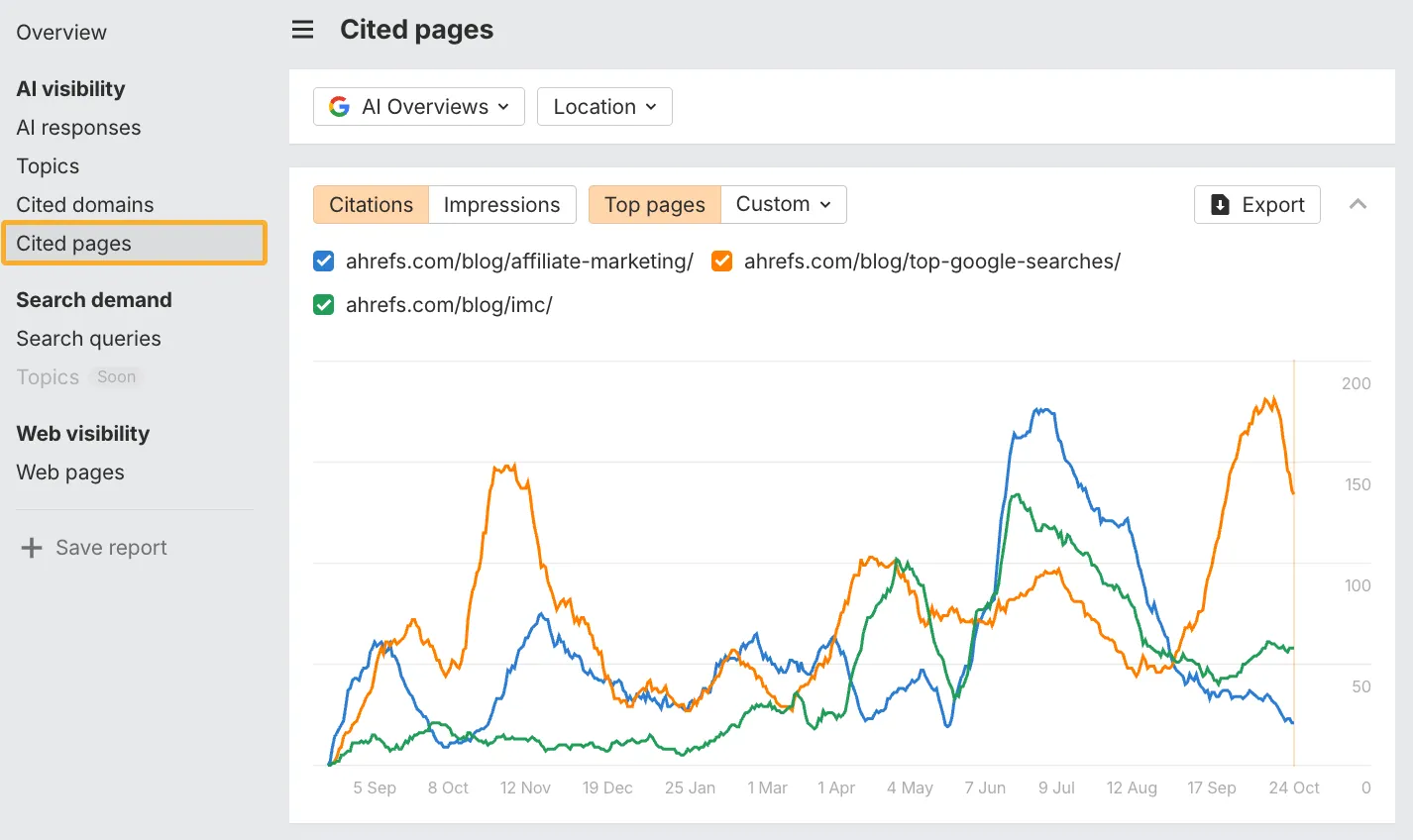
Then add Schema to the test pages, record the exact date, and avoid changing the body content, internal links, titles, and page structure heavily during the same window. After 30 days, or a bit longer, check whether the test group rose more than the control group.
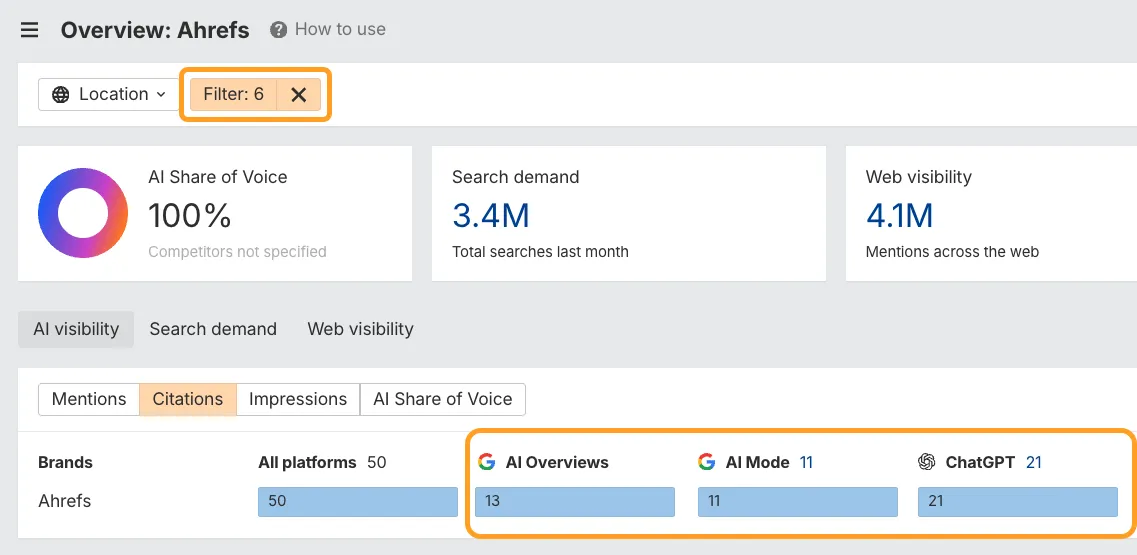
This sounds tedious, but it is much more reliable than reading one article and making changes across the whole site. Your site, page type, industry, and AI citation baseline may all differ from the Ahrefs sample. This is especially true for global sites, SaaS sites, tool sites, and e-commerce product pages. Do not turn someone else’s average conclusion directly into your own execution command.
If you cannot answer those questions, do not rush to make Schema the main strategy. First thicken the content, deepen the topic, strengthen the brand, connect the data, and maintain the pages. Then add Schema as supporting structure. That order is steadier.
Back to GEO
I have always felt that the biggest problem with the word GEO today is not that it has no value, but that it is too easy to mystify. Once people talk about AI search, it sounds as if search logic has completely changed. Once they talk about AI citations, it sounds as if traditional SEO has entirely failed. Once they talk about structured data, it sounds as if web pages only need to be repackaged for machines to be carried into answer boxes.
The Ahrefs study shows that things are not that simple. AI search is certainly creating new changes. Citation logic, answer formats, user paths, traffic distribution, and brand exposure will all shift. But it has not erased content quality, authority signals, brand credibility, page maintenance, and external citations. If anything, it may amplify those old problems.
AI search does not simply give users a link. It organizes an answer for them. Once it organizes an answer, it needs to judge who is credible, who is specific, who is outdated, and who merely looks structured while offering little information.
So the real lesson of this study is not “stop doing Schema.” It is: stop treating Schema as the core answer to GEO. Schema can be a tool, but content assets, brand trust, topical authority, and verifiable evidence are harder, slower, and more worthy of long-term investment.
In plain language: do not only think about writing web pages for machines. First make the page a source actually worth citing. That work is not new or mysterious, but it may be the basic discipline most easily forgotten in the AI search era.
