
Hello everyone, I’m Uncle Guo.
I’ve been looking into AI music tools over the past couple of days, prompted by the launch of ProducerAI from Google Labs. This product led me to re-examine the current landscape of AI music products like Suno, Udio, and Mureka, and I even put together a small research dashboard to track them.
I don’t want this article to be just another “product review.” Simply comparing which tool generates better-sounding music isn’t very meaningful. The more pressing question is: now that ProducerAI, Suno, Udio, and Mureka have each staked out their positions, is there still room for independent entrepreneurs and individual developers to enter the AI music space?
To be more specific: is there any commercial value left in building a “wrapper” site for a music generator?
My current assessment is this: the window for a generic “AI Song Generator” has largely closed, but small, vertical-focused music generator tools are still worth validating on a small scale. The difference lies in the value proposition: the former sells the idea that “I can generate a song too,” while the latter sells the promise that “I can help you complete a specific content production task.”
These two statements might sound similar, but the actual difference is massive. One is competing with Suno, Google, and Udio for the primary user entry point; the other is solving a specific delivery problem for podcasts, indie games, short-form video ads, brand content teams, and creator workflows. For an individual developer, the latter is much closer to a business that can actually be profitable.
Market Overview: AI Music Has Entered the Commercial Validation Phase
First, let’s look at some public data.
Grand View Research projects the generative AI music market to be worth approximately $569.7 million in 2024, potentially reaching $2.79 billion by 2030, with a CAGR of 30.4% from 2024 to 2030. While market reports shouldn’t be taken as absolute truth, they do indicate that this field is no longer just a novelty for social media.
Regarding Suno, TechCrunch reported in February 2026 that the CEO disclosed 2 million paid subscribers, an annual recurring revenue (ARR) of approximately $300 million, and a valuation of $2.45 billion. In their partnership announcement with Warner Music Group, Suno also mentioned having nearly 100 million “music makers.”
Mureka’s press releases mention serving nearly 10 million users, offering APIs, model fine-tuning, and content services. ProducerAI, meanwhile, has entered Google Labs, integrating Gemini, Lyria 3, Veo, and Nano Banana, with SynthID watermarking embedded in its output.
Looking at these together, AI music has achieved at least three things: user interest has been validated, subscription models have been proven, and copyright holders and platform regulations are beginning to intervene.

The chart above is a snapshot from my research dashboard, ranking market size and opportunities. Note that these scores are based on public data and my own product analysis, not external statistics. The most important takeaway isn’t the 2030 market size, but the fact that “mass-market generators” score significantly lower than “compliant brand safety,” “vertical workspaces,” and “API/embedding capabilities.”
This ranking aligns with my intuition.
It’s not that there is no market for AI music; it’s that competition for the generic entry point will only get tougher. Music generation capabilities will continue to be commoditized by model providers, platforms, and large-scale applications. If an independent developer simply builds a site where you “input a prompt, generate a song, and download the file,” it will easily be eclipsed by products that are larger, cheaper, and backed by stronger brands.
However, once generation capabilities are standardized, it opens up a different kind of opportunity: building lighter, narrower, and more delivery-oriented tools around specific business scenarios.
Competitive Landscape: Four Products, Four Different Battles
If you only look at “AI music generation,” Suno, Udio, ProducerAI, and Mureka seem to be on the same battlefield. But looking at their product forms, their focuses are quite different.
Suno’s value proposition is the clearest: an average person enters a sentence and gets a full song in seconds. It solves the problem of low-barrier creation and entertainment sharing. Suno’s strength lies in its mass-market reach and community mindshare; its weaknesses stem from the same place: a broad user base, copyright pressure, and a lack of professional workflows and commercial delivery features.
Udio leans more toward creator workflows. It offers features like audio uploads, Extend, Inpaint, Session, Remix, and Style. Users come to Udio not just for a one-off generation, but to edit, reference, extend, and manage versions. However, after its partnership with UMG, its download capabilities have faced a transition period, exposing the tension between copyright agreements and user experience.
ProducerAI’s signal is more platform-oriented. According to Google’s official description, it has integrated Songs, Playlists, Spaces, Music videos, Projects, and Turntable into a larger creative space, positioning itself well beyond a simple song generator. For Google, this is likely a combination experiment involving multimodal models, music generation, watermarking, and a creative workspace.
Mureka is closer to a “consumption tool + API/B2B platform.” It has both a front-end creation experience and capabilities like APIs, model fine-tuning, and content services for developers and enterprises. For independent entrepreneurs, Mureka’s path is more instructive because it hasn’t bet everything on the mass-market entertainment entry point.
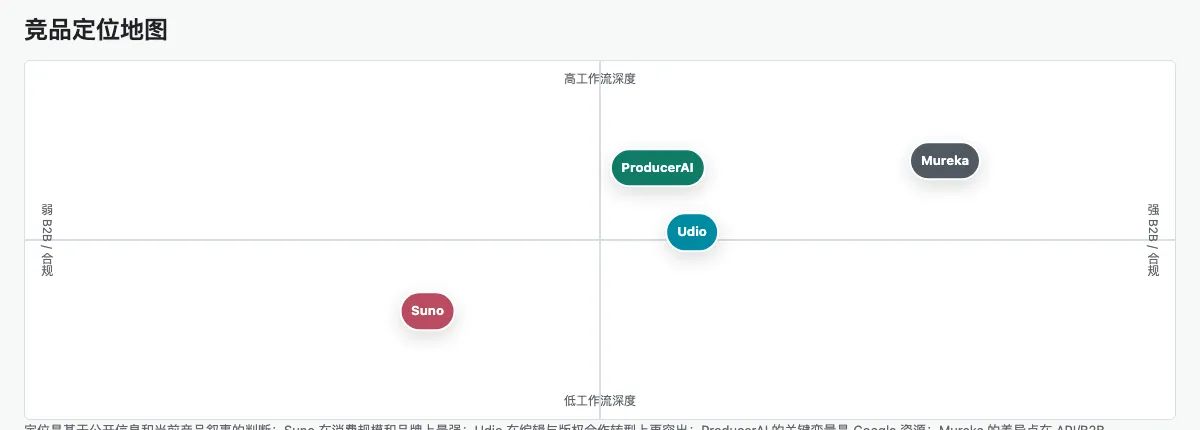
In this positioning map, I interpret the horizontal axis as the strength of B2B/compliance, and the vertical axis as the depth of the workflow. Suno leans toward the consumer entry point, Udio toward editing workflows, ProducerAI toward workspace and multimodal links via Google’s resources, and Mureka toward APIs and B2B.
This leads to a realistic conclusion: independent developers shouldn’t just focus on “who generates the best quality.” Generation quality is the reason a user visits for the first time, but not necessarily why they pay repeatedly. What affects commercial value more is what happens after generation: can it be edited, exported, tracked, reused, and can it provide peace of mind to clients and platforms?
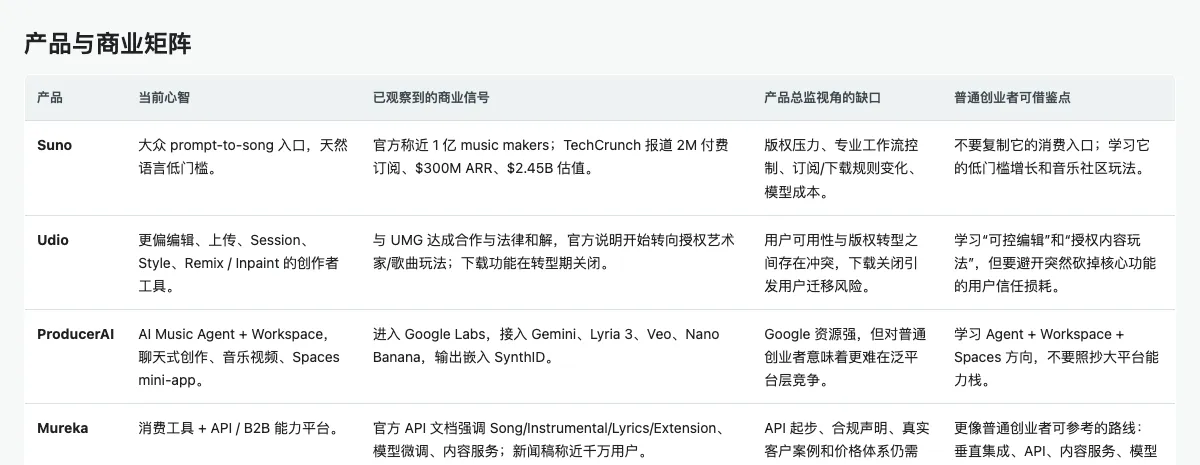
As seen in this competitive matrix, AI music products are moving from “generators” to “workflows.” Suno’s low-barrier entry is strong, Udio’s editing capabilities are prominent, ProducerAI’s strength lies in Google’s resources and workspace direction, and Mureka’s differentiator is its API, fine-tuning, and content services.
This explains why I don’t recommend simply copying ProducerAI.
Behind ProducerAI are Google’s models, brand, distribution, engineering resources, and ecosystem synergy. Modules like Spaces, Music videos, and Projects are platform experiments in Google’s hands; in the hands of an individual developer, they likely lead to scope creep. If a small team tries to build an “all-in-one AI music workstation,” they have to handle music generation, video generation, project management, version control, copyright disclosures, community management, billing, SEO, and customer support. The project will likely be crushed by its own feature list before it ever validates a single payment.
A more reasonable strategy is to learn from ProducerAI’s sense of direction, not its scale.
You can adopt the “Agent + Workspace” mindset, allowing a single generation to evolve into a project. You can save a user’s brand style, channel tone, BPM preferences, and use cases; you can also focus on versioning, exporting, and rights documentation for a specific task. But don’t try to build a full ecosystem from day one.
The question an independent developer should ask is: “Can I use existing music generation capabilities to serve a task that is narrow enough, clear enough, and for which users are willing to pay?” Whether you can build the next ProducerAI shouldn’t be your goal in the first phase.
Wrapper Sites: Low-Quality Wrappers Are Not Worth It, High-Quality Scenario Encapsulation Still Has Opportunities
Many people talk about “wrapper sites” with a fixed path in mind: find an API, apply a web template, write dozens of SEO articles, connect Stripe, and wait for Google traffic.
You should be cautious with this path in the AI music space.
The reason is simple: the costs and risks of music generation are heavier than those of text tools. Text tool users click a few times, and marginal costs are low; image tools can control costs via dimensions, counts, watermarks, and credits. Once music generation involves high quality, long duration, multiple versions, and downloads, costs rise significantly.
Even more troublesome is that music inherently carries copyright baggage. When a user builds an AI article title generator, they rarely ask, “Will this title infringe on a record label’s rights?” But when a user makes AI music, they naturally ask: Can this be used commercially? Can I post it to Spotify? Can I put it in a YouTube video? Can I use it for a client’s ad? Does it sound like a specific singer? Can it mimic a famous artist?
These are not minor questions. Spotify is already strengthening rules regarding AI voice mimicry, spam filters, and DDEX AI disclosure; the RIAA’s lawsuits against Suno and Udio show that copyright holders won’t stand on the sidelines for long. Independent developers lack the leverage to negotiate these issues, so you cannot treat “what users want” as “what the product should do.”
Therefore, if a Music Generator wrapper site is just “reskinning + API calls + generic SEO traffic,” I believe its commercial value is low. It will be squeezed by large sites, free users, API costs, and the gray area of copyright.
But if you interpret “wrapper” as using mature music generation capabilities to package a micro-product for a specific scenario, the opportunity changes.
For example, a Podcast Intro Music Generator. Users have a clear task: create a 10-second intro, 30-second transition, and outro for their podcast. The product could allow them to input the show name, content type, target audience, tone, duration, whether vocals are needed, and whether it needs to loop. Then, it provides 3 versions and saves the generation history, usage, export time, and links to the service provider’s terms.
Or a Game Loop BGM Generator. It prioritizes seamless loops, low intrusiveness, different emotional states for levels, export formats, file sizes, and copyright records. A full pop song is less important here. The target audience could be game jam developers, indie game teams, or Roblox/UEFN creators.
Or a Short Video Ad Jingle Generator. It could be designed around 15, 30, and 60-second ads, allowing users to input brand, product, platform, mood, and forbidden styles to generate background music suitable for TikTok, Reels, or YouTube Shorts.
These projects might not become giant companies, but for an individual developer, you don’t need to be a giant company from the start. Building a small tool that captures precise traffic from SEO long-tail keywords, manages API costs, and gets a small group of users to pay is a much more pragmatic validation.
The key phrase here is: The API is the supply chain; the user task is the product.
Don’t be ashamed to use APIs, but don’t treat “being a wrapper” as the business model. The valuable part is packaging the underlying music generation capability into a workflow that the user understands, finds useful, is willing to pay for, and can actually deliver.
Four Things Independent Developers Must Calculate
If you look at this from the perspective of an individual developer, I suggest calculating four things.
First, the Customer Acquisition Math. “AI Music Generator” is a high-volume keyword, and it’s definitely crowded. A new site can’t compete with big players on generic terms. Independent developers are better suited for scenario-based long-tail keywords, such as podcast intro music generator, game loop music generator, royalty-friendly background music for YouTube, AI jingle generator for small business, or meditation background music generator.
These keywords might not have massive traffic, but the user intent is clearer. Someone searching for “podcast intro music generator” has a much clearer task than someone searching for “AI music.” For a small SEO site, low volume isn’t scary; what’s scary is high volume where users don’t know what to do once they arrive, and you don’t know how to get them to pay.
Second, the Cost Math. If music generation APIs charge by count, duration, or quality, costs can spike if free users play around too much. You can’t just look at the subscription price; you have to look at how many times a single user generates, how long each generation is, how many retries occur, how many downloads happen, and whether there are batch tasks.
Therefore, such products need quota design from the start. Free quotas should be small, generation duration controlled, high-quality exports paid, batch generation part of a premium tier, and retries limited. This design might seem stingy, but if an individual developer isn’t stingy, they’ll quickly end up doing charity for “freeloaders.”
Third, the Rights Math. Here, I suggest being extremely conservative. Don’t casually write “copyright free,” don’t write “100% safe for commercial use,” and don’t encourage users to input real singer names, real song titles, or record label/film studio names.
A safer approach is to position the product as “providing a commercially friendly workflow based on the current service provider’s terms,” and clearly remind users that final usage must comply with platform and service terms. You can implement generation logs, project IDs, prompt logs, model/provider logs, export timestamps, and user confirmation checkboxes.
These records won’t solve all legal problems, but they push the product from “I only output songs” to “I help you create a more deliverable workflow.”
Fourth, the Retention Math. The problem with many AI generator sites isn’t a lack of visitors; it’s that users visit once and leave. This is especially true for music—users generate one song, think it’s fun, download it, and then might go straight to Suno, Google, or any free site.
Therefore, try to turn a single generation into a project. Save brand styles, channel configurations, podcast templates, BGM for different game scenes, client authorization records, and historical versions. If a user returns to continue a project rather than to generate a song from scratch, you have a foundation for a subscription.

This risk and MVP chart summarizes my assessment. Copyright/training data, platform spam/mimicry rules, competition from giants, model costs, and the decay of consumer novelty are five risks that individual developers must face. Corresponding to the MVP, the generation, editing, rights, and distribution modules all need a minimum configuration, but don’t build a complex DAW, and don’t try to build a music community from day one.
If I Were Testing, I’d Start with a Very Small MVP
If I were testing this as an individual developer, I wouldn’t start with a generic “AI Music Generator” site. I would pick a niche scenario, such as podcast intro/outro music.
The advantage of this scenario is that the task is clear, the duration is short, SEO content is easier to create, and users are more likely to pay for professional-looking show packaging. The MVP can be simple: a landing page explaining the service; a generation form for show name, content type, target audience, mood, duration, looping needs, and vocal preferences; a result page with 3 versions; a project log page saving prompts, exported files, usage, timestamps, and service provider terms; and a paywall—free for low-quality previews, paid for high-quality downloads or more versions.
Pair this with a set of SEO pages like how to make podcast intro music, best intro music for true crime podcast, podcast outro music generator, or royalty-friendly podcast background music.
These pages shouldn’t be junk content. They should genuinely help users make choices, such as what BPM or mood suits different show types, how long an intro should be, and when to use vocals. This way, the content isn’t just for keyword stuffing, but serves to acquire customers and educate them.
Technically, this might still be an API wrapper site. The backend likely calls existing music generation services, and the frontend could be very simple. But from a product perspective, it has surpassed a low-quality wrapper because it solves a specific content workflow.
I would avoid three directions:
- Generic AI Song Generators: High demand, but unfriendly to small teams. Hard to rank for big keywords, high user expectations, many free users, heavy generation costs, and complex copyright boundaries. Unless you have strong SEO resources or a ready-made traffic pool, it’s a cost black hole.
- Mimicking Singer Voices and Famous Styles: Short-term traffic, but high long-term risk. Platform rules, copyright lawsuits, and content moderation make this unsuitable for independent developers.
- All-in-One AI Music Workstations: These look advanced but are very heavy to build. Editors, versioning, assets, collaboration, exports, communities, video, permissions, and billing all pile up. Large companies do this to build an ecosystem; an individual developer doing this is likely just expanding their execution radius beyond their means.
Unless you have a team, budget, music industry resources, and existing distribution, I suggest cutting the product down to be very narrow: narrow enough to launch in two weeks, narrow enough to write 10 high-quality pages around a keyword cluster, narrow enough to clearly explain why a user should pay, and narrow enough to know exactly how much you lose or earn per generation.
Narrow does not mean no ambition.
For an individual developer, “narrow” is often how you survive first.
Bringing It All Together
My current assessment of the AI music tool space is: it’s worth writing about, worth researching, and worth testing on a small scale, but it shouldn’t be written as a “get-rich-quick” story about how an average person can copy ProducerAI and make a million a year.
Seeing Suno’s payment data and thinking you can build an AI music site is too simplistic; seeing Google’s ProducerAI and thinking there’s no opportunity left is equally simplistic.
Large platforms will eat the generic entry points, copyright and distribution rules will compress the gray areas, and user novelty will eventually fade. These pressures are real. At the same time, the demand from content creators, podcasters, indie game teams, short-video operators, and brand advertising teams for “faster access to usable music assets” is also real.
The opportunity for independent developers isn’t in “I’ll build a Suno too.” The opportunity lies in more specific tasks, clearer exports, more conservative rights disclosures, scenario-based pages that understand SEO, quota systems that account for costs, and a willingness to admit you are just a small tool, not the future entry point of the music industry.
Frankly, these small tools aren’t “sexy.” They don’t have the multimodal narrative of a tech giant like ProducerAI, nor the viral thrill of a Suno-generated song. They are more like a “clunky” business: find a specific group of people, solve a specific task, and calculate a specific bottom line.
But for an individual developer, you don’t need to be sexy to start.
You need to launch, get users, understand your costs, and validate whether you can break even.
So my conclusion is: if you want to build a generic AI Music Generator, I would be very cautious; if you are willing to start with a very narrow Music Generator tool, treat it as an experiment in SEO + API + vertical workflow, and don’t package it as a grand dream of an AI music platform, then I think it’s worth a try.
Don’t sell “AI can generate music.”
Sell “I can help you use this music in your specific work.”
That is where the opportunity for an independent developer lies.
References:
- Google ProducerAI Official Announcement: https://blog.google/innovation-and-ai/models-and-research/google-labs/producerai/
- TechCrunch report on Suno’s paid users, ARR, and valuation: https://techcrunch.com/2026/02/27/ai-music-generator-suno-hits-2-million-paid-subscribers-and-300m-in-annual-recurring-revenue/
- Suno and Warner Music Group Partnership Announcement: https://suno.com/blog/wmg-partnership
- Udio and Universal Music Group Partnership Announcement: https://www.udio.com/blog/a-new-era
- Udio Help on product changes after UMG partnership: https://help.udio.com/en/articles/12683565-changes-associated-with-the-universal-music-group-umg-partnership
- Mureka API Documentation: https://platform.mureka.ai/docs/
- Mureka Music Agent Studio and API Press Release: https://www.globenewswire.com/news-release/2025/10/14/3165896/0/en/Mureka-Unveils-Music-Agent-Studio-and-Enhanced-API-Capabilities-Bringing-Professional-Music-Creation-to-Everyone.html/
- Spotify AI rules and spam filter announcement: https://newsroom.spotify.com/2025-09-25/spotify-strengthens-ai-protections/
- RIAA announcement on lawsuits against Suno/Udio: https://www.riaa.com/record-companies-bring-landmark-cases-for-responsible-ai-againstsuno-and-udio-in-boston-and-new-york-federal-courts-respectively/
- Grand View Research Generative AI in Music Market Report: https://www.grandviewresearch.com/industry-analysis/generative-ai-in-music-market-report
- AP report on UMG/Udio settlement and product changes: https://apnews.com/article/udio-suno-ai-music-universal-b90f9f5f968101ef617e41c5369da02a
