
Digital Strategy Review | 2026
OpenClaw just finished educating the market, and Hermes is already here to swoop in
By Uncle Guo · Reading Time / 8 Min

A Note Before We Begin
The atmosphere these past few days feels eerily similar to the period right before OpenClaw (the “Crayfish”) exploded in popularity.
Various self-media outlets are once again frantically hyping up this thing called Hermes. It’s being shared on WeChat Moments, discussed in group chats, with headlines getting bolder and tones getting more urgent—as if, if you haven’t started researching Hermes this week, you’ll be obsolete in the Agent era by next week.
But when I see this kind of spectacle, my first reaction is actually quite calm.
OpenClaw has only just finished teaching a large group of people that “AI can actually act like a digital employee, staying online to work for me.” Now, people are already being urged to migrate to something newer, stronger, and more capable of learning. To me, this feels far too rushed.
To put it bluntly:
Many people haven’t even figured out whether that “crayfish” is actually a useful tool or just a toy. Now, here comes Hermes. So, what exactly should we be excited about?
If you only look at the landing page, it’s easy to get carried away. The narrative for Hermes is more complete and more alluring than OpenClaw’s. It isn’t satisfied with being just a coding copilot in your IDE, nor is it content to be a chatbot that just replies to your messages. It focuses on long-term operation, cross-platform capabilities, persistent memory, automatic skill generation, automated scheduling, parallel subagents, and it even cleverly puts the solution right in your face: if you’re coming from OpenClaw, migration is easy—just run hermes claw migrate.
You see, this isn’t just about building a product.
This is about swooping in to harvest the fruits of the previous wave of cognitive education.
What OpenClaw achieved, ultimately, was convincing more people for the first time that: AI isn’t just a chat box; it can be persistent, it can connect to channels, it can integrate with tools, and it can actually do some work for you. Why did the “Crayfish” become popular? Most people didn’t become fans because they seriously studied Agent architecture, nor because they understood context management, permission boundaries, rollback mechanisms, or tool security.
Not at all.
Many people simply felt, for the first time, that they could actually own a digital employee.
This step is crucial.
Without the education provided by OpenClaw, something like Hermes wouldn’t have caught the attention of so many people so quickly. What Hermes is competing for now is the next layer of problems: once you already have an AI assistant, do you start to feel it’s not smart enough, not stable enough, not continuous enough, doesn’t remember enough, and isn’t enough like a long-term partner?
In plain English: the first level of competition is, “Can it do the work?”
The second level of competition is, “Can it work more and more like your partner?”
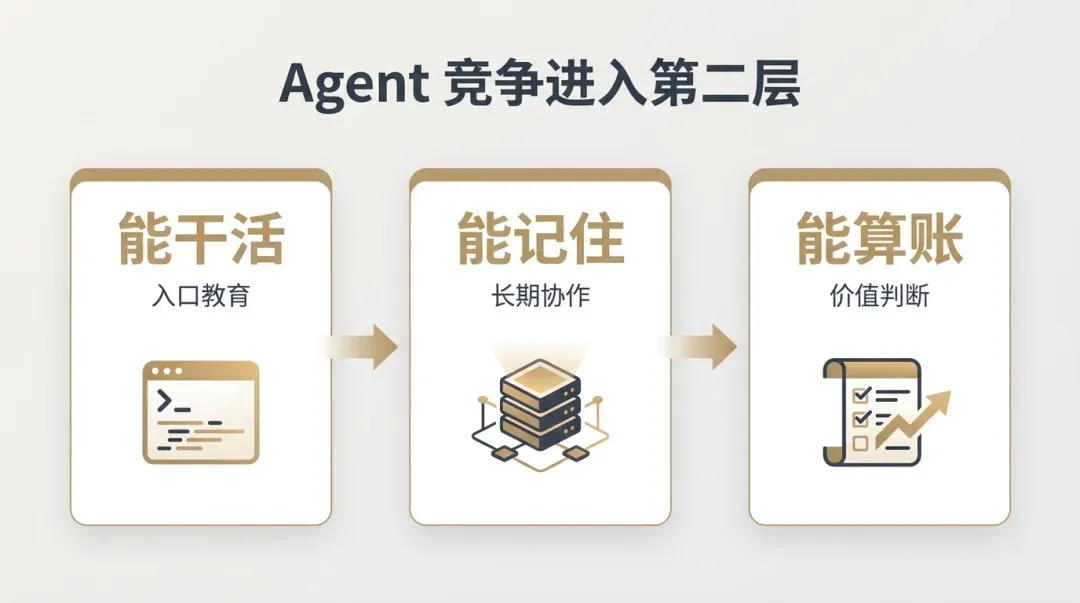
Hermes is worth watching precisely for this reason. It reveals a clear industry signal: the Agent track is shifting from “demonstrating capabilities” to “long-term collaboration capabilities.” Once terms like memory, skill accumulation, cross-session continuity, scheduled tasks, and parallel subagents start appearing in bulk, it means vendors are assuming you aren’t a first-timer anymore. They are no longer just selling you a flashy demo; they are starting to sell a long-term operating system.
That is certainly worth watching.
But being worth watching doesn’t mean it’s worth switching to immediately.
As of April 11, 2026, the latest public version of Hermes is v0.8.0 (released April 8), and the latest public version of OpenClaw is 2026.4.9 (released April 9). Both are moving at a near-daily pace. If you ask me to decide who wins right now, I honestly can’t. Because we are nowhere near the “final outcome” stage; rather, we are at the stage where Agent products are beginning to clearly stratify.
Some products are still solving the problem of “getting more people to try it for the first time.”
Other products have started solving the problem of “what happens after you actually start using it.”
Hermes is more like the latter.
But that is precisely the problem. Do you actually have a workflow worth running long-term?
This is what I really want to talk about.
I’ve said it repeatedly: business first, tools second. Without a business case, tools easily end up hanging in the air. Without high-frequency problems, efficiency tools are hard to justify. Without a process that truly needs to be compressed, you can tinker for days and end up just building yourself a very expensive toy.
This judgment holds true for OpenClaw, and it holds even more true for Hermes.
Because the more advanced an Agent is, the more it creates an illusion. It remembers, it grows, it develops its own skills, it manages subagents, and it runs scheduled tasks—so, am I finally closer to “owning a real digital employee”?
Maybe.
But maybe not.
If you don’t currently have any cross-platform, high-frequency, repetitive, long-term work that requires context continuity, what is the point of Hermes’ persistent memory for you? If you only occasionally let it reply to a few messages, look up some data, or run a few small tasks once a week, what real value can it deliver by “remembering” you? Without frequency, memory cannot turn into compound interest. Without a pipeline, automation cannot turn into profit. Without a continuous stream of work, even the most advanced subagents are just breaking up one-off chores into more complicated, noisy pieces.
Many people overlook this.
They see the accumulation of features, but they don’t see the prerequisite of value.
Whether an Agent will have long-term memory depends first on whether you are repeatedly dealing with the same type of problems with it. Whether an Agent will save you a lot of time depends on whether you actually have a pile of repetitive actions. Whether an Agent will truly become a digital employee depends, ultimately, on whether you are already constantly switching between multiple channels, workflows, and tasks.
Without these realistic prerequisites, the more powerful the features, the more dangerous they sometimes become.
Why?
Because they will burn through Tokens faster.
I’m not talking about technical complaints, but a very real business problem. A more powerful Agent often means longer context, heavier reasoning, more complex pipelines, more automatic calls, more background tasks, and more actions that you assume “it should just handle for me.” If OpenClaw is sometimes just a toy that burns tokens recklessly, Hermes has the potential to become a smarter toy that burns tokens even more recklessly.
I’m not trashing it.
I’m just reminding you that capability enhancement and value enhancement are never the same thing.
Some people should indeed take a serious look at Hermes now. For example, if you’ve been using OpenClaw or another Agent for a while and have clearly felt the pain points: it loses context across sessions, experience cannot be accumulated, repetitive tasks cannot naturally form skills, you have to cobble together scheduled tasks yourself, and you always have to manually monitor parallel tasks. Then, the Hermes route—which emphasizes long-term memory, automatic skill accumulation, and parallel agents—might indeed have value. Its appeal isn’t that it’s “flashier,” but that it’s closer to the real problems you’ve already encountered.
But conversely, just like in my previous article, If You Feel Nothing About the “Crayfish” Craze, You Are Definitely Not an Average Person, if your workflow is already running stably on OpenClaw or Codex, you don’t need to waste extra energy deploying new agents immediately.
This kind of tossing and turning is, most of the time, a pointless drain.
It doesn’t just burn Tokens.
It burns your energy, time, patience, and your focus on your existing workflow.
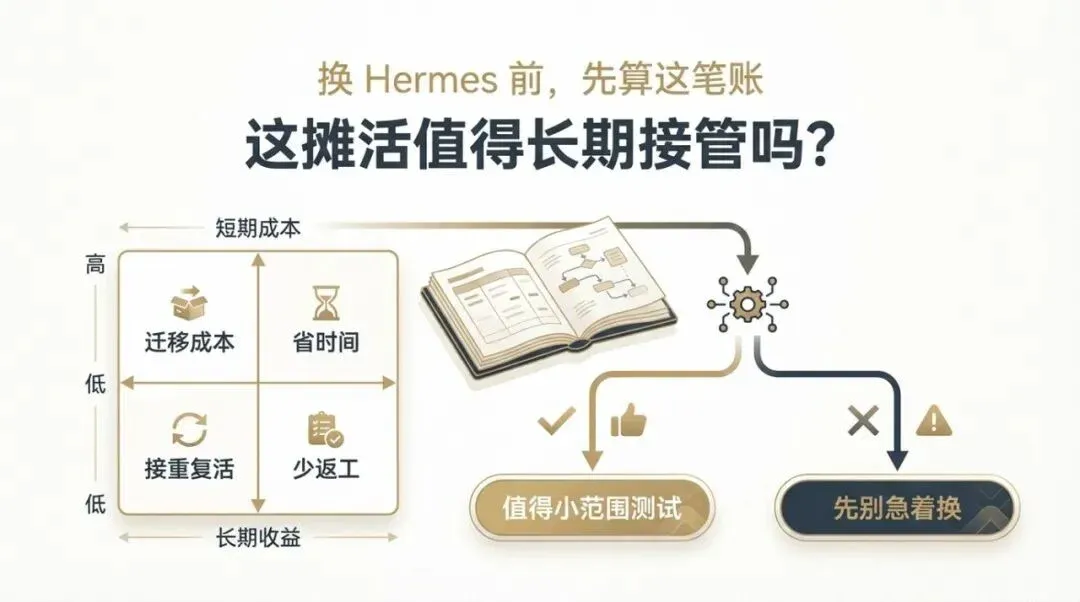
There is another group of people who should look at it: those who are already engaged in content production, client follow-ups, data organization, research synthesis, project advancement, and cross-platform message processing. This type of work naturally has continuity, context, repetitive actions, and a need for state accumulation. For them, an Agent isn’t just a Swiss Army knife to play with, but more like a collaboration system. At this stage, you should certainly start caring about second-layer capabilities like memory, skills, scheduling, and parallelism.
But if you are still in the “I’ll just install it and see,” “I want it to try things for me,” or “I haven’t actually run a successful pipeline, I’m just worried about missing the trend” phase, I actually think there’s no need to rush a migration.
Because the problem you should be solving right now is figuring out “Do I actually have a task worth being taken over by an Agent long-term?” rather than rushing to answer “Should I switch from OpenClaw to Hermes?”
These two questions look similar, but they are vastly different.
The former is a tool choice.
The latter is a value judgment.
Most people get stuck because of their value judgment. They enter the comparison phase too early and the review phase too late. They haven’t calculated the real ROI of the first generation of tools before being pushed along by the narrative of the second generation. Today you look at OpenClaw, tomorrow at Hermes, and the day after tomorrow, another new name will arrive that is better at memory, better at agency, and better at planning. If you stay at the level of “which one is stronger,” you will likely end up as someone who understands product launch cycles very well, but you will struggle to become the person who actually integrates Agents into their business.
To be honest, that’s a bit painful.
Because the one thing the AI circle doesn’t lack is new names.
A “Crayfish” today, a Hermes tomorrow, and something even better at learning, automation, and acting like a digital employee the day after—none of this is surprising. The most bustling part of this industry over the next year likely won’t be the model scores themselves; the real action will be the rapid stratification of Agent products. Some are competing on entry points and reach, some on long-term memory, some on security boundaries, some on browser execution, some on multi-channel control, and some on enterprise collaboration.
The noise will definitely get louder.
But your criteria for judgment shouldn’t heat up along with it.
In my view, the truly interesting thing about Hermes is that it has put a new problem on the table. The Agent track is no longer satisfied with proving “I can do work”; everyone is starting to compete on “Can I work with you long-term?” How much can it remember, how much can it accumulate, can it run more smoothly over time, and can it slowly grow into something that truly resembles a collaboration system? This certainly shows the track is moving forward.
But for most ordinary users, the lesson that still needs to be learned—which is very unglamorous and hard to skip—is: learn to do the math first.
Don’t rush to see how exciting the landing page is, and don’t rush to be convinced by words like “long-term memory” and “continuous growth.” Look back and see if it has actually saved you chunks of time, if it has reliably handled those repetitive and annoying chores, if it has made your fragmented processes smoother, and if it has helped you reduce rework, missed messages, lost clients, and low-value back-and-forth.
If you can’t calculate these numbers yet, I would be more inclined to advise you not to rush. You don’t necessarily need Hermes; to be more blunt, you might not have even fully realized the value of OpenClaw yet.
This isn’t a popular thing to say, but being realistic might be more useful. When many people see terms like “long-term agent,” their brains automatically translate it into “closer to a productivity revolution.” The real world is never that linear. Tools looking more like the future doesn’t mean the value will automatically fall into your lap.
What truly separates people is never the pretty copy on the tool’s homepage. What truly separates people is whether you have a pile of work that is worth an Agent watching over, remembering, and sharing the burden of for the long haul.
If you do, then by all means, take a serious look at Hermes now, or even run small-scale parallel tests. Use real tasks to stress-test it and see if it’s more stable, more worry-free, and more like a long-term collaboration system than OpenClaw.
If you don’t, then you don’t need to be anxious at all.
You don’t need to migrate just because it’s stronger. You don’t need to force yourself to keep up just because the “Crayfish” is popular. And you certainly don’t need to interpret every Agent product upgrade as a camp-switching event where you must immediately pick a side.
Sometimes, the most mature choice isn’t “switch immediately,” but “wait and see a little longer.”
Whether it’s OpenClaw or Hermes, they are ultimately just bridges for different stages. The former brought more people to the door of “AI can do work for me,” while the latter is attempting to answer “Can it not just do it once, but understand me better the more it works?”
Both questions are important.
But for different people, the order of importance is different.
Perhaps what you should be doing right now is continuing to integrate first-stage tools like OpenClaw into your real workflows and figuring out whether you can extract real value from them. Perhaps you have already moved to the next step and truly need an Agent that is better at remembering, capable of long-term accumulation, and able to collaborate in parallel. Then, things like Hermes are certainly worth your serious attention, or even worth placing an early bet on.
There is even a third possibility.
You don’t have to make a multiple-choice question at all.
OpenClaw continues to handle the entry point, matching, lightweight persistence, and mass-market reach, while Hermes takes on long-term memory, complex collaboration, background scheduling, and skill accumulation. Not every tool upgrade needs to be understood as a “replacement”; sometimes it’s more like a “division of labor.”
As for how to choose, I don’t really want to draw a conclusion for you.
Because the answer is likely not in the GitHub Stars, nor in the product launch copy, and definitely not in whose product looks more like the future.
The answer is in the work you have in your own hands.
Is that work worth an Agent remembering long-term?
Is that work worthy of a stronger Agent?
You should know that better than I do.
