
Vibe Coding Insights | Vol. 2025
Why 99% of AI App Generators
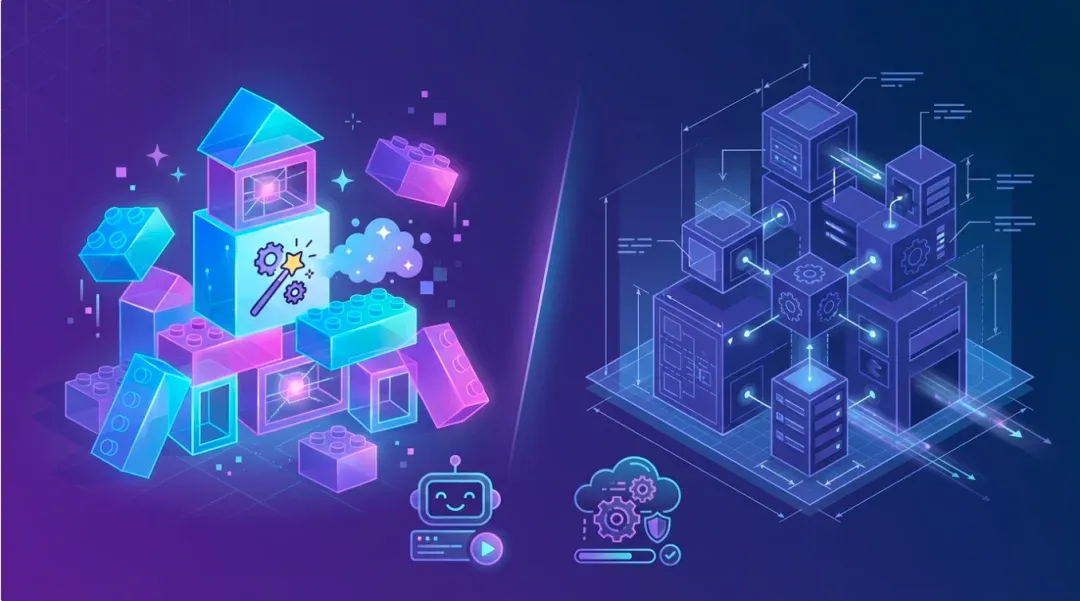
Will End Up as Adult Electronic Toys
By Mr. Guo · Reading Time: 8 Min
A Quick Note
Recently, countless tools have flooded the market claiming to “generate apps from a single sentence” or “ship a SaaS in 30 seconds.” As if you just need to type, and the next Uber or TikTok will be born in your hands.
As someone who started from zero coding knowledge — couldn’t even read HTML — I took a step-by-step journey. First learning Python to understand basic tech logic while doing data processing. Then understanding why HTML is hard to maintain, which led to the explosion of frontend frameworks. Then cramming JavaScript, reading Next.js and React documentation. Building my own websites and apps. Deploying products. Handling concurrency issues as traffic and users grew…
This experience gave me a deeper understanding: toys are toys, tools are tools.
I also want to splash some necessary cold water: code is easy, but “product” is hard. Those tools trying to convince you that you can “make commercial money without understanding tech at all” are mostly selling dopamine.
Today, let’s peel back the flashy exterior of App Generators and discuss why they’re destined to be toys, and what the real “Vibe Coding path” actually looks like in the AI era.
01: The Brutal “80-Point Trap” and Software Entropy
Current AI coding capabilities (whether Claude Code or various App Builders) can mostly deliver a 60-80 point product.
It runs, it clicks, the interface looks decent. For flexing on social media or pitching to VCs, that’s enough. But the brutal reality of business is: only 90+ point products survive.
Why is going from 80 to 90 so hard? Because software development follows the “law of entropy increase.”
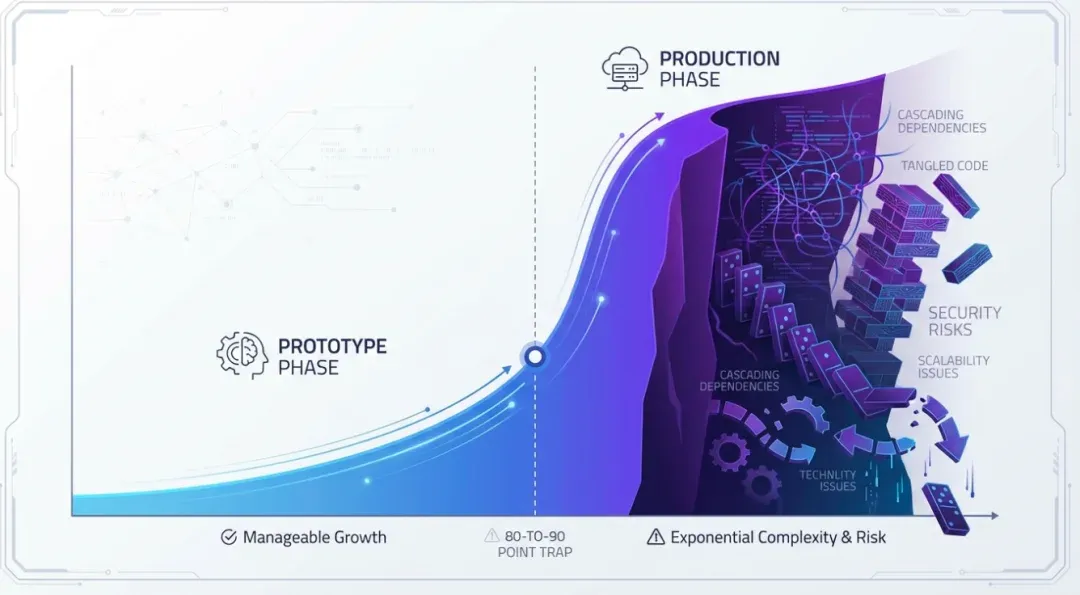
The First 80% (Prototype Phase)
Is linear. You add a button, that’s adding some code, AI can handle it in a vacuum.
The Last 10% (Commercial Phase)
Is exponential. One small requirement change (like “show different prices for different user tiers”) might trigger: database schema changes, auth logic rewrites, cache mechanism failures, even frontend state management avalanches.
For complete tech novices, they only see “changing a number” as a small thing. But AI often can’t handle this kind of “butterfly effect” in complex business logic. AI can write perfect functions, but it can’t manage system “complexity” for you.
02: The Invisible Chasm Called “Deployment”
Google’s App Builder products are actually quite good — early attempts at this category, even usable for free in AI Studio. They can quickly generate various Web App previews with React. This gives novices a “false sense of control from things going too smoothly.”
There’s a “deployment chasm” in between: Novices can easily tell AI: “Make me a running schedule planner.” But what AI often doesn’t proactively tell you:
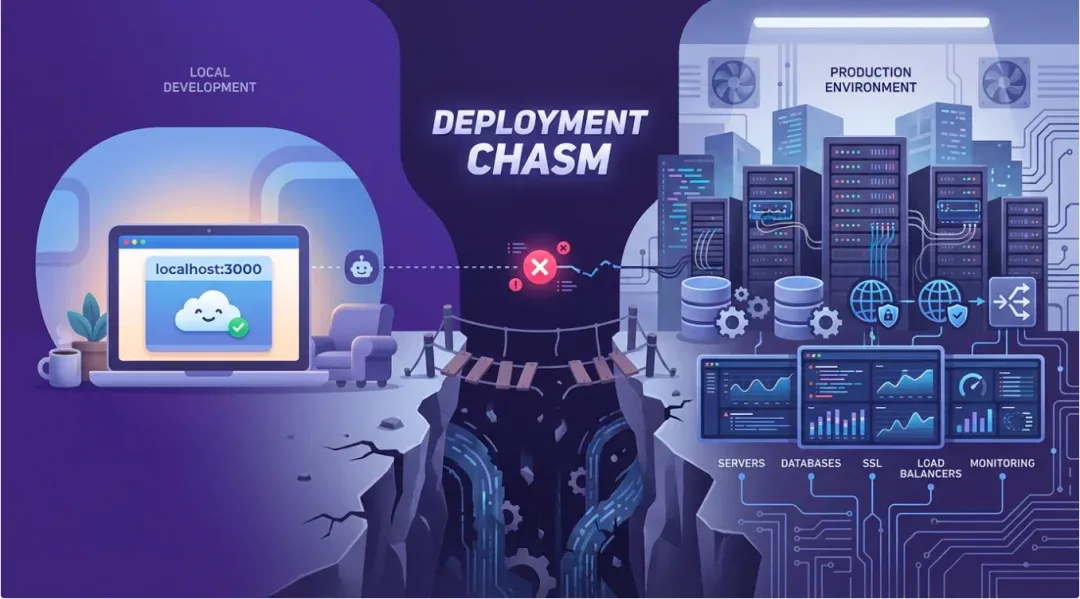
- When concurrent users spike, will your database connection pool explode?
- How do you configure SSL certificates? How do you set up DNS?
- If you want to list on the App Store, you need to rebuild in React Native or Swift, and pass app review.
- What’s your data backup strategy?
Running a demo in App Builder’s sandboxed preview window and running a product in production are two completely different species.
The distance between them is ten thousand times harder than writing that Prompt. Most App Generators have amazing first experiences that generate buzz. But when users try to turn them into real businesses, they discover they’re holding a beautifully drawn “architectural rendering” — not “construction blueprints.”
03: The Product Manager’s Curse — AI Is a Terrible Yes-Man
“When code becomes easy, requirements themselves become more valuable.” This can’t be overstated.
Transforming abstract ideas into concrete product logic — this hurdle alone stops 90% of non-IT people. AI models typically go through RLHF (Reinforcement Learning from Human Feedback) — they tend to “please” users. No matter how absurd or logically conflicting your requirements, AI will probably say: “Sure, generating for you.”
But a great product manager’s core capability isn’t “what to do” — it’s “what NOT to do.”
- What’s a pseudo-requirement?
- Which features are over-engineered?
- Is this requirement’s ROI worth the development cost?
These “arts of refusal” and “boundary sense” — AI can’t give you that. If you don’t understand tech or product and completely trust AI’s “compliance,” you’ll end up with a feature-stuffed, logically chaotic “Frankenstein’s monster.”
04: The Right Way to Use AI — Embedded > Generative
Since general App Generators are toys, where’s the real value of AI App Builders at the application layer? The answer is: Embedded AI.
Look at AI features in Shopify or Salesforce. Why do they work well?
Bounded Context
Tech stack, database structure, UI component libraries — the platform has already locked them down. AI doesn’t need to “guess” architecture; it just fills in blanks within established frameworks.
Real Needs-Driven
Operations teams using AI are solving specific pain points (like “quickly create a promo component”), not “making an app for fun.”
This combination of clear technical specs and specific workflows is what creates lasting productivity value. It’s not about replacing SaaS — it’s about multiplying SaaS value.
05: The Endgame for Vibe Coders Is “Demystification and Learning”
So are those toy App Generators completely useless? No — their greatest value is as “bait.” They’re the “newbie village gate” into the real Vibe Coding world.
Let me share my own path: I was once a complete novice who couldn’t even understand HTML <div> tags. But I didn’t stay stuck in the dopamine hit of “one-click generation.”
- To make simple HTML pages maintainable, I read through React’s official documentation to understand “what exactly is a frontend framework, what problems does it solve?”
- To get my website online, I was forced to learn about Vercel and DNS, understanding CI/CD.
- To do proper SEO, I was forced to learn Next.js, SSR, SSG.
Step by step, AI “held my hand” — from blind confidence, through confusion, to now being able to handle high-concurrency traffic.
This Is the True Essence of Vibe Coding
It’s not about staying a “freeloader” forever — it’s about using AI to dramatically flatten the learning curve.
You don’t need to memorize syntax, but you must understand logic. You don’t need to hand-write every line of code, but you must be able to read architecture.
Programmers won’t be replaced by AI. Similarly, an excellent Vibe Coder will never actually be a “complete novice.”
Final Words
If you truly want to build commercial products, close those one-click generation toys.
Open your IDE, open your CLI, let AI be your mentor — not your contract manufacturer.
Shortcuts are often the longest road, while learning is the shortest.
Found this analysis insightful? Give it a 👍 and share it with more friends who need it!
Follow my channel to explore the infinite possibilities of AI, going global, and digital marketing together.
🌌 Kant once said: “Freedom is not doing whatever you want, but being able to not do what you don’t want to do.” In the AI era, true freedom is seeing through the boundary between toys and tools.
