
A Quick Note
After my last article “Stop Hiring Media Buyers” went out, someone messaged me: “If not media buyers, what does it take to win in the AI era?”
My answer is two words: Brand. I know this sounds like tired advice from the past few years, but hear me out.
In the future, shopping might not happen in Google’s search box, but through agent-powered decision systems.
For users, the shopping intent will shift from: “Type ‘training shoes’ in search,” to: “Send an outfit photo to AI and say, give me shoe recommendations that match this look.” What “brand” represents will fundamentally change.
In the paid acquisition era, brand was nice-to-have; But in the AI era, brand is your “identity ID” — it’s make-or-break (must-have).
I’m introducing a slightly hardcore concept — “Corporate Ontology.” Understand this, and you’ll understand how AI perceives the business world.
01
The Algorithm’s Perspective: From “Traffic Pool” to “Ontology”
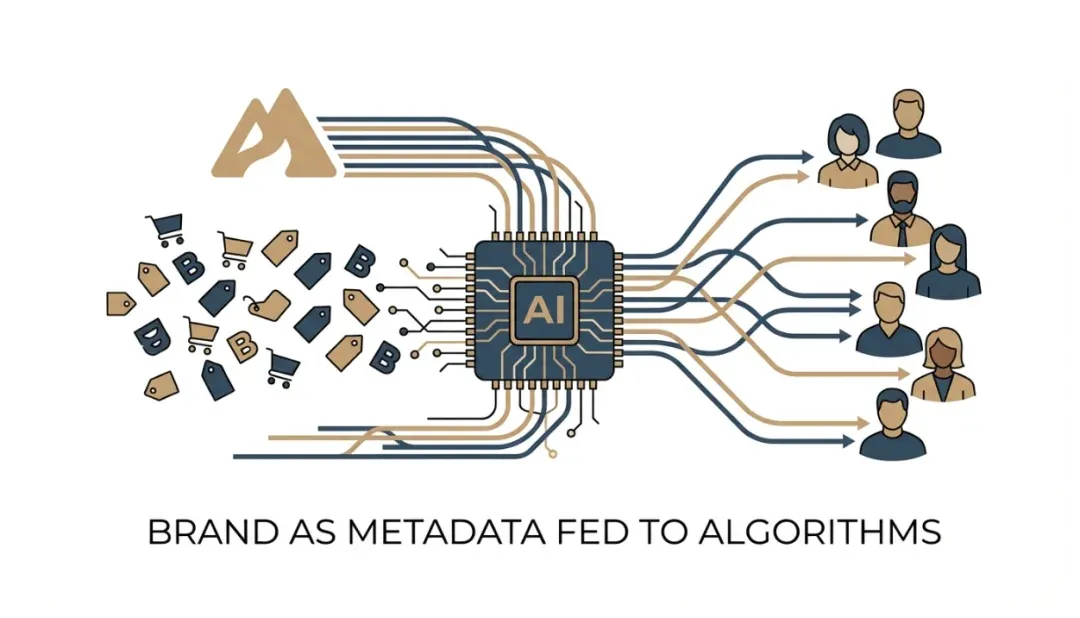
In philosophy, “Ontology” studies “the nature of existence.” In AI’s eyes, your company isn’t a money-making machine — it’s a node in a knowledge graph.
We used to run ads by fishing in “traffic pools.” Now AI (like Meta’s ASC or Google PMax) does semantic matching. It needs to first understand: “What exactly are you?”
- Companies without brand awareness
: Look like “weak ontologies” to AI. Your definition is fuzzy — you kind of sell shoes, kind of sell socks — AI can’t categorize you, so it matches you with generic traffic, tanking your ROI.
- Companies with strong brand awareness
: Are “strong ontologies.” Your entity, attributes, and relationships are crystal clear.
Conclusion: Brand building is essentially constructing your digital ontology. The clearer you define “what you are” and “what you are not,” the more accurately algorithms can map you to people with matching needs.

02
Moats Have Changed: Clearer Ontology Boundaries = More Survival Space
AI makes “passing grade” too easy. Copy, images, video — AI generates them instantly. When productivity overflows, “definition power” becomes the scarce resource.
Corporate Ontology’s core is defining “boundaries.” Brands that survive must answer ontology’s two ultimate questions:
- Existence
: What’s your unique Value Proposition?
- Exclusivity
: Who do you absolutely not serve?
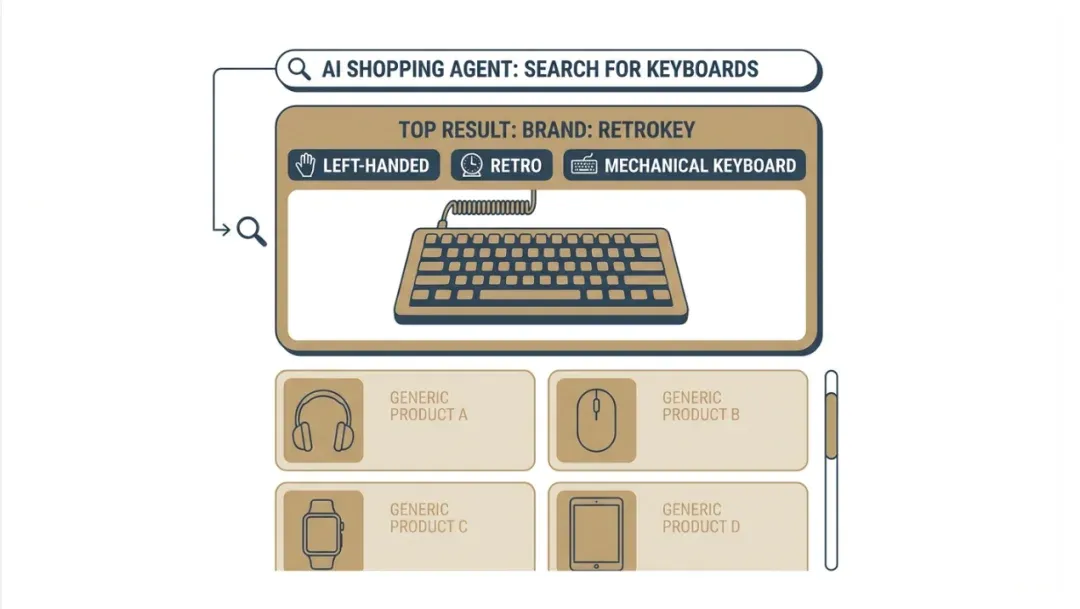
Niche Down is essentially “ontological convergence.” You don’t need the whole world to understand you — you just need AI algorithms to confirm: in this specific ontological branch of “left-handed vintage mechanical keyboards,” you’re the only root node.
03
Entry Points Have Changed: Shopping Agents Only Recognize “Standouts”
Future e-commerce entry points probably won’t be search boxes, but AI Agents (shopping proxies).
Imagine a user tells AI: “I want minimalist desk organizers.”
How does AI work? It searches its semantic network.
- White-label products
: Just data noise, no “minimalism” ontology tag attached. AI literally can’t see you.
- Strong brands
: You’ve successfully claimed the “minimalism” semantic symbol. Your ontology has strong associations with “minimalism.”
Simple logic: Brand = Ontology. Sharper ontology attributes → Higher AI indexing efficiency → Higher recommendation probability by Agents. Building brand is doing “semantic SEO for the AI era.”
04
Fuel Has Changed: Brand Makes LTV the Algorithm’s “Stabilizer”
What does AI model training fear most? “Dirty data.” One-time buyers who bounce or return are noise to AI.
Brand-driven fans have extremely high behavioral consistency. This consistency reinforces AI’s understanding of your “Corporate Ontology.”
-
More precise users = Clearer AI profile of you.
-
Clearer profile = More precise traffic recommendations.
This is a positive feedback flywheel. So, Brand = AI’s favorite high-octane fuel.
05
Endgame: What Prompts Can’t Generate Is What’s Valuable
Finally, something more emotional. In the AI era, traffic acquisition (Channel) becomes increasingly simple — money buys it. But Ontology Building gets harder.
Everyone can use AI to generate a beautiful poster, but AI can’t generate:
-
A specific community atmosphere.
-
A subtle emotional resonance.
-
Cultural symbols that belong to your tribe.
These things that can’t be Prompted are the most solid ontology you build as a “human.”
06
Action List for Small Teams (Actionable Advice)
If you’re a 1-person company or team under 10, don’t try to be Nike. Remember this survival rule:
👉 Sharp Ontology, Small Niche.
- Converge Your Ontology
: Don’t sell “women’s clothing,” sell “work outfits designed for petite plus-size women under 160cm.” Let AI see through your attributes instantly. Use visual symbol data to define your ontology.
- Unify Visual Language
: Make your Instagram, website, and ads use one consistent filter. You’re feeding unified signals to visual AI.
- Reject One-Size-Fits-All
: Explicitly write on your website “This product is NOT for [who].” Defining boundaries = Defining ontology.
I’m Mr. Guo. If you’re feeling lost in the AI era, unsure how to build your “Corporate Ontology,” or need a growth strategy that works with AI algorithms. Let’s chat. We don’t do the mediocre majority — we become that shining node in the knowledge graph.
