
Digital Strategy Review | 2026
AI ➕ Obsidian CLI: Effortless 30-Second Daily Journaling.
By Uncle Fruit · Reading Time / 10 Min

01
The Real Challenge of Journaling Isn’t Consistency
Everyone knows that keeping a journal is a good habit.
I remember in elementary school, our teachers required us to write a diary every day. Back then, it was mostly a mundane log: what classes we had, what we saw on the way home, or who scolded us. Looking back, the content wasn’t exactly profound, but it at least preserved a piece of my past. More importantly, it sparked a love for writing; in middle school, I even seriously considered becoming a writer.
But as we grow older, the cost of journaling actually increases.
Our minds are cluttered, and our time is scarce. After a long day of work, if you finally have 30 minutes of free time, most people would rather go for a run or scroll through their phones than sit down, open a note-taking app, and force themselves to write a “proper” journal entry.
That is exactly where the problem lies.
We’ve always assumed the barrier to journaling is “consistency.” But I’ve increasingly come to believe that the real barrier is the “activation cost.”
It’s not that you don’t want to record your thoughts; you just don’t want to spend an extra half-hour organizing, polishing, formatting, titling, and structuring them. Especially since what pops into our heads isn’t usually a complete essay—it’s just a spark: a single sentence, a judgment, a question, an unrealistic fantasy, or even a string of broken thoughts.
Yet, in the AI era, these sparks are exactly what is most valuable.
02
In the AI Era, Human Sparks Are the Most Valuable Asset
It’s not the formatting, the flowery language, or the polished, “proper” expression that matters most—it’s the raw thought that actually occurred in your mind. AI can help you organize, expand, polish, and even turn a stream of consciousness into a well-structured article. But what AI cannot replace is that initial “starting point.”
In other words, what is truly scarce isn’t the ability to write; it’s your observations, judgments, associations, emotional fluctuations, and those fleeting fragments of thought that only exist in your mind for a few seconds.
That’s why I believe we should be journaling more than ever.
Not for the sake of being “literary,” not for self-gratification, and not to maintain a “disciplined” persona, but because in the AI era, raw human thought is becoming increasingly expensive. Even if you only capture an unformed seed, the subsequent work of organizing, extending, and structuring can be delegated to AI.
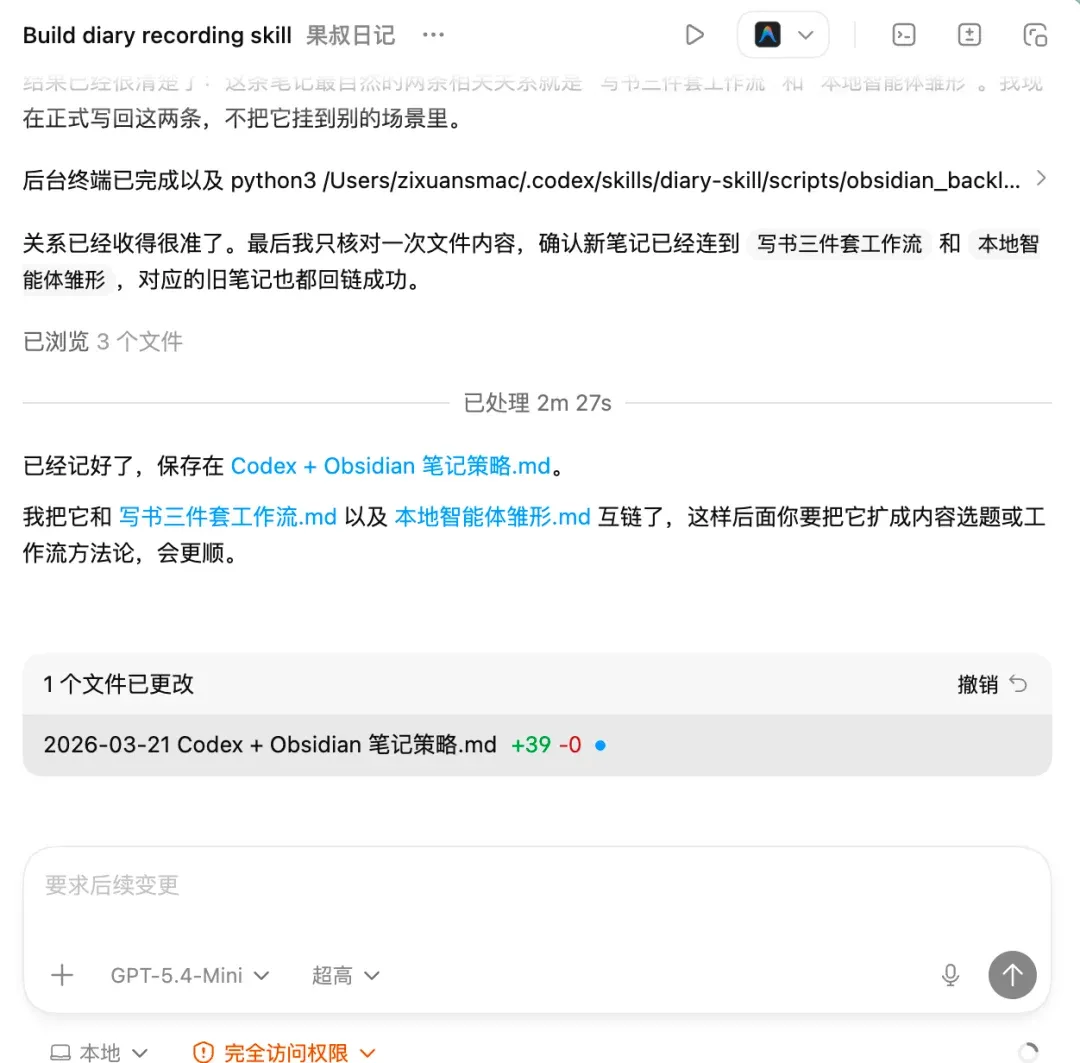
This is why I recently created a custom “Journaling Skill” in Codex. It doesn’t have to be Codex—I just happen to be comfortable with it—but you could achieve the same with other tools.
03
My Current Workflow: Letting Codex Catch My Thoughts
It does something very simple but incredibly practical: I just speak my thoughts directly. Even if it takes only 30 seconds, even if it’s messy, and even if it’s incoherent, it transcribes the audio and automatically organizes it into a journal entry suitable for my Obsidian vault.
While preserving the original expression as much as possible, it helps me fill in several key sections:
• Journal Summary • Key Records • Actionable Insights • Questions to Ponder • Tags
In short, what started as a fragmented, colloquial monologue—which I might not even understand the next day—becomes an Obsidian note that retains the original “flavor” while being ready for further processing. The most significant aspect of this is that it lowers the barrier to recording my thoughts to almost zero.
Previously, journaling required a dedicated half-hour of “I am going to write seriously” time. Now, I just need to speak for a few seconds. These are two completely different systems. The former requires carving out a block of time; the latter is about capturing inspiration anywhere, anytime. You don’t need to wait, you don’t need to save it up, and you don’t need to polish it into an essay in your head first.
Obsidian’s role here has evolved beyond just being a “note-taking app.” I wrote an article about Obsidian CLI before, and the core point is simple: its greatest value isn’t just giving you a few geeky commands; it’s that it allows your entire note repository to be queried, retrieved, organized, and orchestrated by an AI agent for the first time. Furthermore, Obsidian CLI provides highly token-efficient indexing. The true power of this workflow isn’t just “recording a diary in 30 seconds,” but the connectivity that follows.
04
The Real Value Isn’t Recording—It’s Connecting
My AI agent uses Obsidian CLI to search for the relevance between the current note and other content in my vault, then automatically adds backlinks. This way, a fragmented thought you spoke today won’t just sit in a folder gathering dust; it will be automatically linked to past projects, judgments, inspirations, drafts, and even old journal entries. In the past, I spent more time manually managing backlinks, formatting, and images than actually writing. But with the combination of an CLI-enabled Obsidian and an AI agent, that cost has dropped to zero. This means something crucial: your thought fragments are no longer just fragments. They slowly connect into lines, eventually growing into a continuously expanding “thought warehouse.”
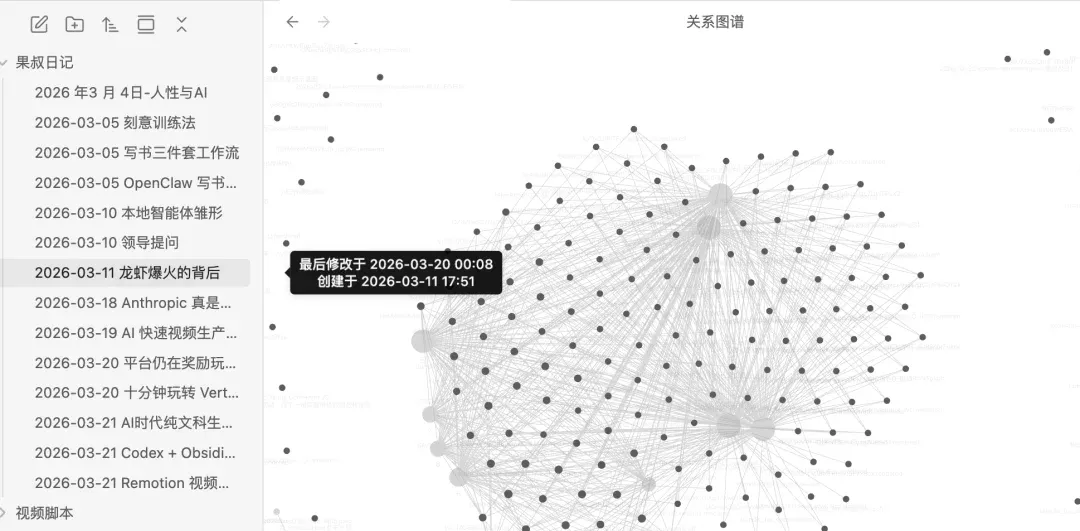
Journaling is more like a “thought sampling” mechanism. It doesn’t record a mundane log; it records what was worth keeping from your mind at a specific moment in time. As this content accumulates, its value becomes exponential.
• You can extract viewpoints for future articles. • You can find leads for video topics. • You can review your growth and see how your judgments evolved step-by-step. • Even fragments you thought were trivial might, weeks later, turn out to be the seeds for a product idea, a long-form essay, or even a book.
This is why I care so much about “low-cost recording” now. Most people don’t lack thoughts; they lack the habit of preserving them. It’s not that they don’t have sparks; it’s that the sparks go out before they hit the ground.
The emergence of AI makes this economically viable for the first time. Previously, you had to spend a huge amount of time organizing fragments into usable content yourself. Now, you only need to be responsible for capturing the spark; the “dirty work”—transcription, refinement, archiving, searching, linking, and even expanding—can be handled by an AI agent.
Of course, there is a cost, such as Tokens. But in my experience, it’s well worth it. Especially since the indexing and search methods of Obsidian CLI are much more efficient than simply dumping an entire repository into a model. As my vault grows, the consumption remains well within my acceptable range.
More importantly, I think it’s money well spent. My time is limited, and my high-quality thoughts are even more limited. Compared to that, spending a few tokens to preserve, organize, and amplify them is incredibly cheap.
05
Final Thoughts
So, if you ask me, why should we still write a diary in the AI era?
My answer is simple: because we finally have a way to do it without the high-cost methods of the past. You don’t need to sit down and write a formal essay, you don’t need to set a “must-complete” task for yourself every day, and you don’t need to have your thoughts perfectly clear before you record them. You just need to give yourself 30 seconds when a thought strikes.
Leave the rest to AI. AI cannot think for you, but it is perfect for catching the thoughts that would otherwise disappear. When these fragments are caught, organized, and connected, they are no longer just “today’s diary entry”—they slowly become your second brain, a continuously growing repository of intellectual assets.
I increasingly believe that AI’s power depends on the cognitive level of the person using it. And your cognition is built from the very first strokes you learned to write as a child. Recording is the assistant to memory, and memory is the cornerstone of cognition. (Writing this reminds me of the book Peak: Secrets from the New Science of Expertise; I highly recommend it to my friends. In the current era, AI actually places higher demands on our ability to continuously improve our cognition.)
So, stop thinking of “journaling” as a heavy burden. With the AI + Obsidian combination, it can simply be a 30-second casual recording. But what you leave behind might be the most valuable thing you own in the years to come. If you enjoy recording as much as I do, feel free to use this technique as a reference. Thanks for following me.
