
For about 80% of my complex searches now, I no longer start directly with Google.
Don’t rush to interpret this as “Google is failing.” I’m talking about complex, research-oriented searches. For checking official websites, prices, specific tool addresses, conducting SEO tests, or analyzing the SERP competitive landscape, I still go straight to Google. I even equip my AI assistants with SERP APIs to fetch Google results.
After all, to this day, Google SERP remains the bedrock of SEO. You can be skeptical of many new concepts, disbelieve the constant chatter about GEO, and remain wary of the citation quality of various AI search tools. But as long as you’re doing SEO, you can’t bypass Google SERP. It’s still the most authoritative, influential, and representative indicator of the real search competitive landscape.
But the act of research itself has truly changed.
The word “research” is quite interesting. Broken down, it’s “re” plus “search.” A rough interpretation is “searching repeatedly.” This aligns very closely with how we feel when conducting research. What we call research isn’t just a single search, looking at one result, and then being done. It’s a series of searches, jumps, cross-verifications, and repeated comparisons. You need to find evidence, see who said what, judge the reliability of the information source, and also consider the author’s, media’s, or institution’s bias.
When I used to work at a company, doing product research reports, I could genuinely make search engines ‘smoke’ in a single day. Hundreds of pages open, browser tabs like a military parade. First, find industry data, then look at competitor pages, then sift through media reports, then check comment sections, then research company backgrounds, then find user reviews. What’s more troublesome is that finding information isn’t enough; you also have to determine if it’s secondhand information, a PR piece, a vendor hyping themselves up, or a media outlet deliberately sensationalizing for traffic.
Back then, a large part of what was called “research ability” was essentially search endurance.
Now, a significant portion of this grunt work has been taken over by AI. AI doesn’t make the final judgment for me, nor would I entrust it with that. But it can already complete a large amount of the preliminary labor involved in “repeated searching.” I break down a research task into a dozen or even dozens of implicit search actions and let AI run with them. It helps me gather information, summarize clues, list sources, and perform initial comparisons. My role has shifted to filtering, questioning, verifying, and exposing its laziness and hallucinations.
This is already enough to change search behavior.
High-Income Users Migrate First, This Signal Is a Bit Painful
So, when I saw the signal that “high-income users are adopting AI search faster,” my first reaction wasn’t surprise.
To be honest, it’s quite reasonable.
Search Engine Land published an article on April 13, 2026, with a very direct title: “AI search adoption isn’t equal and income is driving the divide.” The author, Becky Simms, stated that her agency began tracking user search behavior in early 2025 and added household income as a dimension in their latest round of research.
The data presented is quite interesting. Overall, about 27% of people reported regularly using ChatGPT. When broken down by UK household income, the differences emerged: for households with an annual income of £25,000 to £30,000, the regular usage rate was about 18%; for £50,000 to £60,000, it was 30%; for £70,000 to £80,000, it was nearly 49%; and for £100,000 and above, it ranged between 48% and 58%.
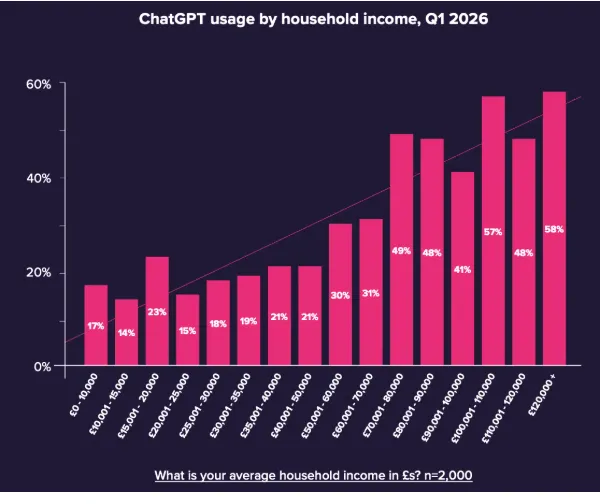
This data set should be used cautiously. It’s not a global ironclad rule, nor does it prove that income directly determines whether someone will use AI search. It’s primarily an observation of income stratification for regular ChatGPT usage within the UK context.
However, it gives us a very important hint: the migration to AI search is likely not happening uniformly. People easily imagine “AI search is here” as a widespread, undifferentiated process, as if all users, all keywords, and all industries will simultaneously migrate from Google to ChatGPT, Gemini, Perplexity, or Google AI Mode. I don’t quite believe in such an average migration.
Changes in search behavior are highly likely to occur in layers.
The simpler, clearer, and lower-risk a search is, the less necessary it is to hand it over to AI. If I need to check an official website, a software download link, a restaurant’s opening hours, or a product price, Google is sufficient. The logic for complex searches is entirely different. If you need to research a market, compare several SaaS products, determine if a certain AI tool niche is viable, analyze competitor positioning, find a cross-border service provider, check if a marketing method is outdated, or write a product report—these tasks are inherently research.
The more valuable someone’s time is, the more complex their decisions, and the higher the information density they deal with, the less they want to flip back and forth between a dozen tabs. They are more willing to delegate the first round of information processing to AI. The reasons aren’t mysterious: higher time costs, higher decision density, and greater confidence in using tools.
This is where “high-income users adopting AI search first” truly has its impact.
It certainly stirs up a bit of class anxiety, but the more critical point lies ahead: if the first to migrate to AI search are those with greater purchasing power, who are more research-savvy, and closer to business decisions, then SEO might not be losing average traffic, but rather the more valuable segment of search pathways.
This realization is critical.
What’s Truly Being Taken Over is the First Round of Filtering for Complex Searches
In the past, when we did SEO, it was easy to first look at search volume. How many searches does this term get per month? Can this page rank for it? How difficult is this keyword? What’s the click-through rate, and how does the conversion path connect?
This set of practices is, of course, still important. I don’t think SEO will suddenly become obsolete because of AI search. If anyone tells you Google is no longer important or SEO is useless, you might want to check if they’re selling a course.
The problem is that search volume as a metric might become increasingly insufficient. A keyword with high search volume might be backed by a group of users accustomed to traditional search, with low decision complexity, low average transaction value, and low trust costs. Another keyword with less search volume might be backed by a group of users with high average transaction value, high information needs, high decision costs, and who are already accustomed to using AI for preliminary research.
Previously, you might have preferred the first group. In the future, you might need to re-evaluate.
Because the second type of user might have already completed a round of filtering within AI’s answers before even clicking on your website. They might ask ChatGPT which tools are suitable for a certain scenario, ask Perplexity about mainstream solutions in a category, ask Gemini about the pros and cons of a service provider, or ask Google AI Mode for a purchase recommendation.
Is your brand mentioned? Is your product accurately understood? Does your page clearly state what problem it solves? Do you have third-party mentions, real case studies, user reviews, comparison content, and verifiable information sources?
These things were important before too. In the past, they primarily helped build trust after a user clicked. Now, they might determine whether you even qualify to be on AI’s shortlist before a user clicks.
When I was recently organizing the AI music product landscape, this feeling was very clear. To research products like Producer.ai, Suno, Udio, Mureka, simply searching for “AI music generator” is far from enough. You need to look at their product form, copyright risks, API capabilities, B2B potential, workflow differences, creator needs, platform policies, market size, and also assess if “ordinary developers still have a chance to build wrapper sites.”
If this type of research were done in the past, it would involve constantly switching keywords and opening numerous pages. Now, I’ll first let AI run through a round of materials, pulling out competitors, reports, policies, pricing, APIs, copyright disputes, and market data, then return to Google, original articles, product official websites, and community reviews for verification. AI here handles the first round of information filtering and path organization; the final judgment still needs to be made by a human.
Once these complex searches migrate, the value hierarchy of SEO will change accordingly.
Previously, you competed for whether users would click on you in the Google results page. Now, there’s an additional, more preliminary question: will AI include you on its shortlist when helping users with their initial research?
AI Search is a Disaggregated Path
Here, I must elaborate a bit. AI search has already split into several usage scenarios.
ChatGPT is better suited for complex problem deduction, summarization, and task decomposition. Gemini has its own ecosystem and multimodal entry points. Perplexity’s value lies in a purer search experience. Many times when I use Perplexity, what I value is that cleaner search interface, with sources, citations, and fewer ads and junk pages.
Sometimes I don’t want an AI that thinks it understands me perfectly to ramble on with a bunch of nonsense and analyze a bunch of principles. I just want to search. Perplexity is very comfortable in this scenario.
Google still controls the core web indexing, SERP distribution, and the real world of SEO. Conducting SEO tests, judging keyword competition, looking at ranking pages, ad placements, SERP features, related searches, and People Also Ask—these things still hold the most weight on Google today.
So, don’t imagine AI search as one tool winning over another. The change closer to reality is: users’ search paths have been disaggregated.
Something that might have previously started with Google, gone through a few pages, and ended up on a brand’s official website or e-commerce page, might now start with a research question on ChatGPT, go to Perplexity to check sources, then return to Google to see the SERP, then visit Reddit, TikTok, or YouTube for real-world experiences, and only then access the brand’s official website.
Along this path, the content needs at each step are different. The AI pre-research phase requires clear, credible, citable information that can be understood by the model. The Google verification phase requires rankings, titles, snippets, page authority, and presence in search results. The community phase requires real user experiences, word-of-mouth, complaints, and negative reviews. The brand’s official website phase requires final conversion trust.
If you only focus on a single keyword ranking, you might only be seeing a segment of the entire path.
This is why I say that SEO’s audience stratification has begun.
Previously, when we talked about stratification, it was mostly keyword stratification: informational, commercial, transactional keywords; broad, long-tail, brand keywords; high-difficulty, low-difficulty keywords. These classifications will continue to be useful. But next, we need to add another layer: what kind of search behavior is the person behind this search actually engaged in?
They might be an AI-first user, accustomed to letting AI filter complex tasks first; or an AI-assisted user, who uses AI for summaries and then returns to Google and communities for confirmation; and some users will continue to rely on traditional search, retail platforms, and familiar communities.
The same keyword can lead to completely different paths in the hands of different user groups. The same person will also vary their approach for different tasks. I’m like that myself. Checking the weather, I don’t use AI; looking for a specific website, I don’t use AI; checking SEO SERPs, I must use Google; but for researching a new niche, a product opportunity, an overseas expansion tool, or a content growth strategy, I’ll likely let AI run a preliminary round first.
Changes in search entry points are related to income, but also to task complexity, digital tool proficiency, and trust costs. High-income users are just an entry point that more easily stirs emotions. The truly noteworthy observation is: high-value searches are fragmenting first.
For Entrepreneurs, Don’t Just Calculate Based on Search Volume
For those in content and SEO, this has a very real consequence.
You can no longer just ask if a term has search volume. You also need to ask: will the person behind this term ask AI first? Does this term correspond to a complex decision? Does this user need to compare, filter, verify, and summarize? Does this query have commercial value? How will AI describe the players in this category? Is it possible for my brand to be recommended by AI, or at least correctly understood by AI?
If the answer is yes, then even if the search volume for this term isn’t that high, it might be more valuable than a bunch of general traffic keywords.
This is especially important for ordinary entrepreneurs. For example, if you’re building an AI tool site, a small SaaS, a B2B service, a cross-border marketing tool, or a niche product for overseas markets. If you constantly focus on broad keywords, you might not be able to compete with large sites, established domains, or have the budget to buy links.
But you can go after content positions that are more specific, closer to decision-making, and more easily used by AI for comparisons and recommendations.
Which tools are suitable for whom in a certain scenario. What are the differences between your product and alternatives. What are the real costs of use. When is it not suitable to use you. Compared to competitors, in which specific scenario are you more stable. Why would a customer switch from A to B.
This kind of content could also be optimized for SEO before. It’s just that previously, we often treated them as long-tail content, supporting content, or conversion content. Now, they might become pre-click trust material in AI search.
Because when AI helps users with research, this is exactly what it needs. It needs to know who you are, what problem you solve, who you’re suitable for, who you’re not suitable for, how others evaluate you, what the differences are between you and competitors, and if there are credible sources to support it.
If your content only consists of keyword stuffing, marketing jargon, and a few vague selling points, AI will struggle to understand you accurately. More realistically, people won’t understand it either.
At this point, when talking about GEO, don’t make it mystical.
Don’t turn GEO into mysticism. Writing a few “AI-friendly summaries,” adding an AI button, or turning your page into a robot-readable manual won’t save a poorly articulated product. GEO often just forces you to make up for past laziness: your positioning needs to be clear, page structure clear, facts verifiable, case studies specific, your brand consistently mentioned in multiple places, and your content must answer the questions real users ask during complex decision-making.
These aren’t mysterious. They are inherently what good SEO, good content, and good product marketing should be doing. It’s just that in AI search, they will be scrutinized earlier.
Previously, users might click through only to find that you weren’t clear. Now, AI might exclude you from the shortlist before the user even clicks.
This is the most brutal part. You might think the problem is a drop in ranking, but the reality might have occurred even earlier: you never even entered that round of comparison.
SEO Isn’t Dead, But the Most Valuable Searches Are Changing Entry Points
Of course, I shouldn’t overstate the case.
Traditional SEO will continue for a long time. A large number of simple searches, navigational searches, local searches, price searches, and image/video searches will still rely on Google. Many users won’t suddenly adopt AI search habits either. AI answers will still be wrong, citations will still be messy, and often, one will still need to return to the original webpage for verification.
Search Engine Land also reported on a survey by Eight Oh Two on January 7, 2026. That survey interviewed 500 active AI tool users, and several figures are worth looking at together: 37% said they start searches with AI tools, 47% use AI to assist purchase decisions, 54% use AI to compare products, and 85% still verify AI answers elsewhere.
Isn’t this how we actually use them?
AI first helps me narrow down the scope. Google and original sources then help me confirm. Communities and reviews then help me get a human feel. Only then do I decide whether to believe, buy, or write.
So, don’t say “search is being replaced by AI.” That statement is too crude. A more accurate way to put it is: search has been disaggregated into several segments.
AI takes over a portion of preliminary research. Google still handles a large amount of verification and authoritative ranking. Communities are responsible for providing real context and emotional evidence. And the brand’s own pages handle final trust and conversion.
For SEO, the most important questions have also changed.
Before, you asked, “How do I rank?” Now you also need to ask, “How do I get understood, cited, and put on the shortlist before the user clicks?”
Before, you asked, “How many searches does this keyword get per month?” Now you also need to ask, “Is this keyword part of the complex searches that high-value users are migrating away from?”
Before, you asked, “Will Google give me traffic?” Now you also need to ask, “Will AI filter for the user before they even open Google?”
This isn’t alarmist, nor does it mean everyone needs to switch to GEO tomorrow. My judgment is more restrained: if you’re dealing with low average transaction value, general entertainment, pure information, time-sensitive, or navigational needs, traditional SEO remains the main battlefield. But if you’re working with high average transaction value SaaS, B2B services, professional tools, cross-border solutions, AI products, content-based consulting, or complex purchasing decisions, then you need to incorporate AI search into your content strategy in advance.
What’s truly worth noting is that it might be influencing how the most valuable users make their initial judgments. As for how much traffic it’s already bringing today, that’s a secondary matter.
Furthermore, this impact is often invisible in GA.
A user asks ChatGPT a question, AI mentions three brands, but not yours. Then the user directly searches for one of those brand names, or goes to YouTube, Reddit, Google to check details. What you see in your data might just be “brand keywords didn’t grow,” “organic traffic didn’t come,” “conversions didn’t happen.”
The problem occurred earlier.
You didn’t make it onto AI’s shortlist.
This is also why I think the phrase “high-income users are adopting AI search first” is worth writing. It carries a certain sting. The painful part is that what SEO professionals fear missing most is never all traffic.
What they truly fear missing are the people who are willing to pay, have discernment, have decision-making power, and will actually make purchases.
You’re still waiting for them in the old place.
They’ve already asked AI first.
SEO isn’t dead. But the value hierarchy of SEO is changing.
Don’t just focus on search volume, don’t just focus on rankings, don’t just focus on clicks. Instead, focus on what decisions users are making, at what step they need trust, when they will ask AI, when they will return to Google, and when they will go to communities for real user reviews.
Then, place your content along that real path.
This isn’t abstract to talk about, but it’s tiring to do. But there’s no way around it; search has always been an arduous task. It’s just that before, the hardship was in your own repeated searching; now, the hardship is in making sure both humans and AI can understand you during their repeated searches.
This is where SEO will be truly troublesome, and also truly opportunistic, going forward.
References
- Search Engine Land: Becky Simms, April 13, 2026, “AI search adoption isn’t equal and income is driving the divide.” The data in the article comes from the author’s agency’s tracking of user search behavior since early 2025, with household income added as a dimension in the latest round. The article mentions that overall about 27% of people regularly use ChatGPT, and when broken down by UK household income, approximately 18% for £25-30k households, 30% for £50-60k, nearly 49% for £70-80k, and 48-58% for £100k+.
- Search Engine Land: Danny Goodwin, January 7, 2026, “37% of consumers start searches with AI instead of Google: Study.” The article relays a survey by Eight Oh Two of 500 active AI tool users, mentioning that 37% start searches with AI tools, 47% use AI to assist purchase decisions, 54% use AI to compare products, and 85% still verify AI answers elsewhere.
- The statement “I now delegate 80% of my complex searches to AI” in this article comes from the author’s personal experience, serving only as a personal trigger point and not to be extrapolated as an industry statistic.
