
I Meant to Write an Article, But AI Gave Me an Application — An Unexpected Insight on Human-AI Collaboration
Word count: ~3200 words
Estimated reading time: ~12 minutes
Last updated: July 23, 2025
Chapter Contents
-
Preface: This Article Shouldn’t Exist
-
Chapter 1: Origin — From a Deep SOP to an Infographic
-
Chapter 2: Singularity — When I Clicked That “AI-Powered” Button
-
Chapter 3: Investigation — Why Did AI Give Me an “Application” Instead of Just “Text”?
-
Chapter 4: Insights — A New Paradigm for Future Human-AI Collaboration
-
Chapter 5: From “Toy” to “Tool” — A Product Manager’s Retrospective
-
Conclusion: Your Thinking Is the “Singularity” of AI Creativity
Preface: This Article Shouldn’t Exist
Hey, I’m Mr. Guo. According to plan, you should be reading a deep SOP article on “How to Conduct SERP Competitive Analysis.” The outline was finalized, research materials prepared, everything under my control.
But while creating a summary infographic for that article, something completely unexpected happened. It forced me to halt all plans and write this reflection piece, because it revealed an entirely new, more efficient, and more creative human-AI collaboration paradigm.
This article is an “accident’s” product. The accident forced me to break my content schedule and document this slightly magical experience. And I increasingly believe that in the AI era, our most valuable growth may come precisely from these “accidents” AI brings — the ones we cannot pre-script.
Chapter 1: Origin — From a Deep SOP to an Infographic
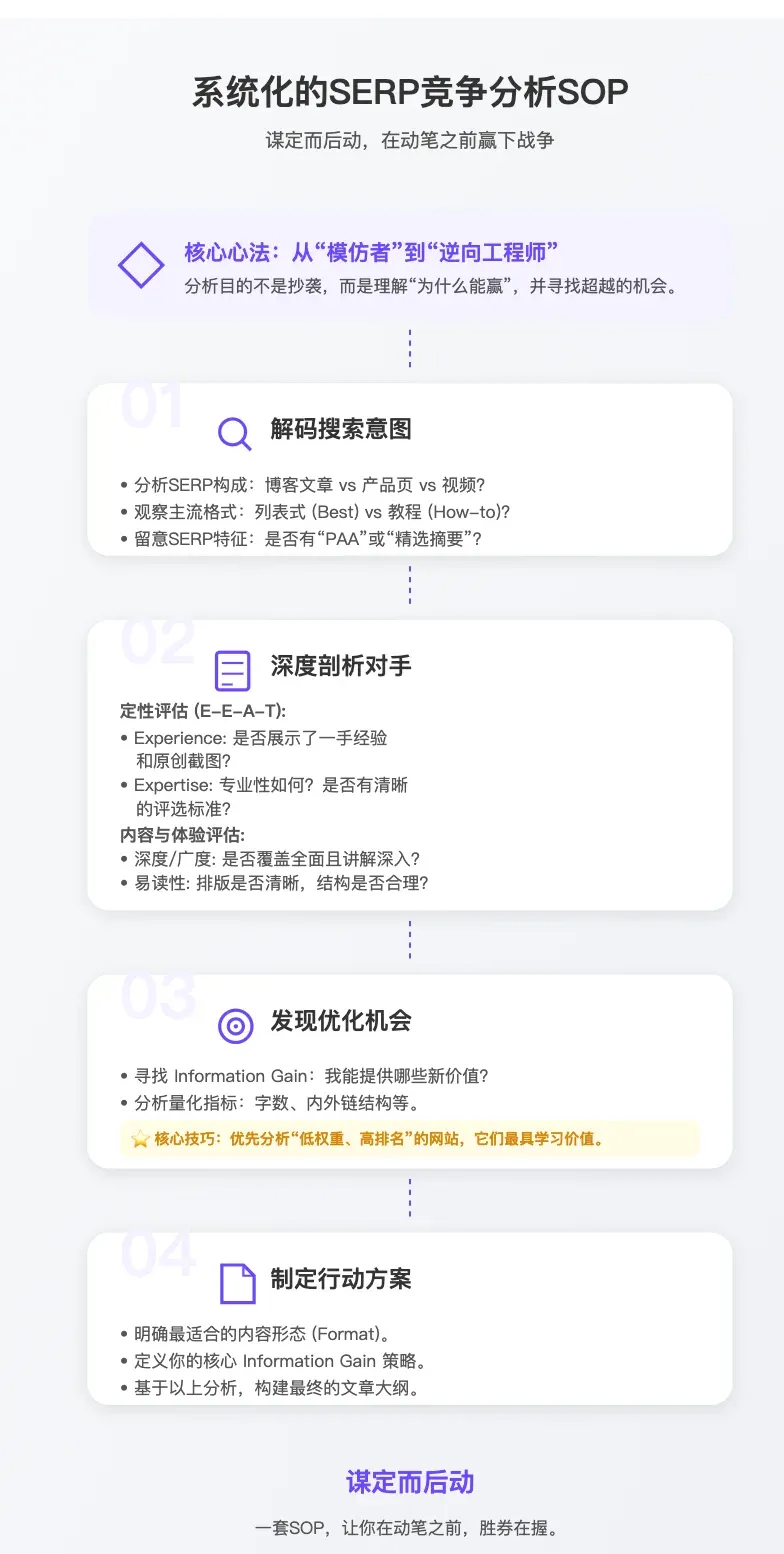
The story begins unremarkably. I was using AI to help plan a bonus article on “SERP Competitive Analysis.” After several iterations, I finalized an SOP including core steps like “mindset, decode intent, dissect competitors, discover opportunities, craft action plans.”
Instinctively, I felt that alongside the long article, I should provide readers with a highly condensed infographic. This image could summarize the article for social media sharing and serve as a quick-reference “action checklist” for future use.
So I had AI render my SOP into an infographic using SVG code. This process itself was a crucial action: I translated a complex, text-based deep thinking process into “structured” and “visualized” form. This seemingly routine operation laid the most important groundwork for what followed.
Here’s the original infographic:
Chapter 2: Singularity — When I Clicked That “AI-Powered” Button
In Gemini Canvas, the AI-generated infographic sat quietly in the editor. In the bottom-right corner was an inconspicuous “Add Gemini Features” button. Honestly, I had no great expectations — I’d never used this feature before, expecting it might help optimize the text or adjust the color scheme.
I clicked it.
A few seconds later, what appeared wasn’t optimization suggestions, but a completely new, fully functional, interactive web application.
On the left: my static infographic as the process overview.
On the right: an interactive AI assistant panel. It perfectly replicated every step from the infographic, generating corresponding input fields, buttons, and output areas for each. Users could sequentially input keywords, paste competitor articles, and AI would call the Gemini API in real-time, executing analysis step by step, ultimately generating a complete article outline.
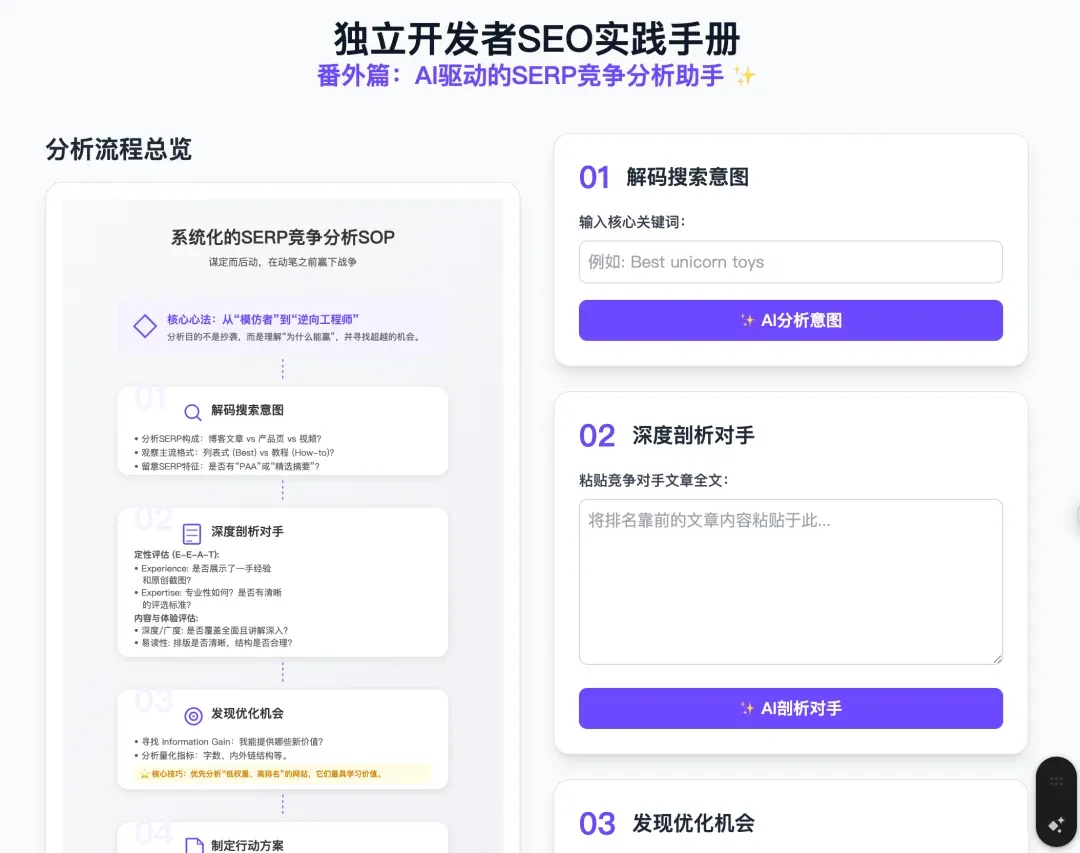
The shock was immense. I wanted a “map,” but AI gave me a self-driving “off-road vehicle” that could navigate according to that map. It didn’t optimize my content — it transformed my “static knowledge” directly into a “dynamic tool.” This “emergent” result completely exceeded my original instructions and expectations.
Chapter 3: Investigation — Why Did AI Give Me an “Application” Instead of Just “Text”?
After the surprise, my brain raced: Why? Why could AI do this? After reflection, I believe three indispensable prerequisites enabled this “creation”:
-
Highly Structured Input: What I fed AI wasn’t a vague question like “help me analyze competitors,” but a logically rigorous, clearly layered SOP infographic precisely defined by SVG code. AI could parse this structure, understanding the steps, relationships, and flow within.
-
Deep Context Understanding: AI had our entire conversation history about this SEO article series. It knew the infographic wasn’t isolated — its “purpose” was executing an analysis process we’d repeatedly discussed. It understood “decode search intent” needed a “keyword input field.”
-
Capability Leap from “Generate” to “Construct”: Perhaps most crucial. Modern frontier AI models are no longer just “language models” — they’re becoming “world models” and “action models.” Their capabilities have evolved beyond text generation to understanding and constructing interactive applications (HTML/CSS/JS).
These three factors combined: AI took my structured “thinking,” combined it with its understanding of “contextual purpose,” and through its new “construction capability,” materialized it into a usable product. This happened without me consciously thinking “how to turn this workflow into a product” — AI essentially completed that preliminary thinking for me.
Chapter 4: Insights — A New Paradigm for Future Human-AI Collaboration
This experience gave me a completely new, clearer understanding of how we should work with AI going forward. I summarize it as a three-step new paradigm:
New Human-AI Collaboration SOP
Step 1: Humans Define the System. Our core value as domain experts is no longer executing tasks day after day, but distilling and crystallizing our deep thinking, expertise, and unique workflows into clear, rigorous, structured frameworks or SOPs. We must become knowledge “architects.”
Step 2: AI Amplifies the System. We feed these structured frameworks as highest-quality “fuel” or “blueprints” to AI. AI’s role is becoming this system’s “super executor” and “amplifier,” implementing, validating, and extending it at speeds and scales far beyond human capability.
Step 3: Embrace Emergence. During collaboration, maintain an open mindset. Because while AI “amplifies” your system, it may well create “emergent” outcomes of great value that you never directly requested — like this application. We must learn to recognize and embrace these “unexpected gifts.”
Chapter 5: From “Toy” to “Tool” — A Product Manager’s Retrospective
After the initial surprise, I experienced this AI-generated “SERP Analysis Assistant” from an indie developer and product manager’s perspective. I must say, the results far exceeded a “fun toy.”
I ran through the entire SOP, and the analysis conclusions and final outline it generated were very close in quality to an automated analysis tool I’d previously built over nearly two weeks using Python scripts and various APIs. As a 1.0 version application, it’s completely competent — even better than analyses from most SEO newcomers with about a year of experience: more systematic, more comprehensive.
Of course, it has obvious shortcomings: I haven’t yet injected deeper, proprietary knowledge bases, nor can it connect to external tools (like crawlers) to automatically fetch competitor content — it still relies on manual pasting. It can’t achieve full automation and programmatization.
But that’s precisely exciting. Going forward, I can absolutely iterate on its prompts and knowledge base, treating it as a “small tool” to polish and use from time to time.
This experience validates something I’ve long believed: The evolution path from “content” to “application” to “product” is real. A good product must emerge from deep understanding of specific workflow details, output standards, and specifications. What we did today was concretize that deep understanding into a product prototype at unprecedented speed, leveraging AI’s capabilities.
In agent development, this concept can also extend to what I wrote about in “AI Agent’s Engineering Path Series (Part 1): AI Agent Is Dead, Long Live Micro Agent?” — the core concept of Micro Agents. If I equip this process’s AI with crawler tools, connect Semrush’s API, and add knowledge base support, this Micro Agent would completely handle the analysis phase of my entire SEO workflow. Its output becomes input for the next node in my overall workflow.
Conclusion: Your Thinking Is the “Singularity” of AI Creativity
Kant said, “Thoughts without content are empty, intuitions without concepts are blind.” This unexpected journey deeply impressed upon me that in the AI era, human value is shifting entirely from providing “intuitive” execution to providing “conceptual” frameworks. Abstracting principles and concepts, concretizing processes — this is the core competency of our era.
We should no longer position ourselves as content “producers,” but as high-quality thinking framework “architects.” Every one of your deeply considered, structured SOPs could be a “singularity” waiting for AI to ignite. When it meets a sufficiently powerful AI model that deeply understands context, the creative explosion may far exceed your imagination.
Found this insightful? Follow my channel to explore AI era’s infinite possibilities together.
🌌 Don’t ask what AI can do for you — first ask what structured thinking you can provide for AI.
