I recently saw an interesting update. Paul Graham, the co-founder of Y Combinator, said he has been receiving many founder emails lately that sound polished, complete, emotionally calibrated, and confident. He can often tell the same thing at a glance: they were written by AI. And then he skips reading them.
What makes this surprising is that AI is not necessarily writing poorly. In fact, a lot of AI output is cleaner and more complete than what many people write on their own. The issue is exactly that it is too polished. It can feel as if the letter has no real person behind it.
Not Because AI Sounds Unhuman, but Because It Imitates Human Writing Too Well
When people talk about AI writing, a strange reaction often appears: should we write sloppier on purpose? Should we add more spoken phrases, include grammar mistakes, or local expressions so it feels more human?
I think that path is dangerous. A human voice is not simply a set of mistakes. A founder writing to investors, a salesperson writing proposals, or a creator writing an article is not proven human by showing a few awkward phrases or incomplete sentences.
The real test is whether there is genuine judgment in the words: how do you evaluate the situation, why are you asking for this now, what are you promising, and can you defend your claims under scrutiny? These are the parts that matter most in business writing and creator content.
AI is very good at writing polite, smooth and professional sentences. It knows how to open a funding email, how to phrase respect in a partnership request, how to build resonance in a public post. Its biggest limitation is that it does not bear consequences. This is similar to the accountability problems companies face when AI-generated outputs produce decisions.
It can write, “We deeply value long-term value.” but it cannot tell you who in your team owns this claim, how this was prioritized, and what was sacrificed to pursue it. It can state, “I have a different take on this market,” but it cannot tell you whether that view came from data, customer interviews, personal loss, or just a few quick reads. The model does not know.
So the fault is not style; it is responsibility and personalization.
In Business Communication, People Read for Commitment, Not Rhetoric
What Graham disliked about AI-written founder emails was not mere taste. He was likely responding to a polluted relationship signal.
A founder’s first email to an investor is not just information transfer. It is a tiny trust test. The reader checks whether the person is clear about what they are doing, whether they can prioritize, whether they understand why this matters, and whether they show real urgency.
Clumsy writing can still work if it carries real judgment and clarity. A perfectly polished message can fail if it feels like a shortcut.
AI drafting often blurs this signal. It can improve tone and structure, but if you only feed rough ideas and let AI produce a supposedly founder-like email, the result may look professional on the surface while signaling laziness underneath.
It can even be worse: the reader begins to wonder whether your apparent decisive positions are also prompt-ready text.
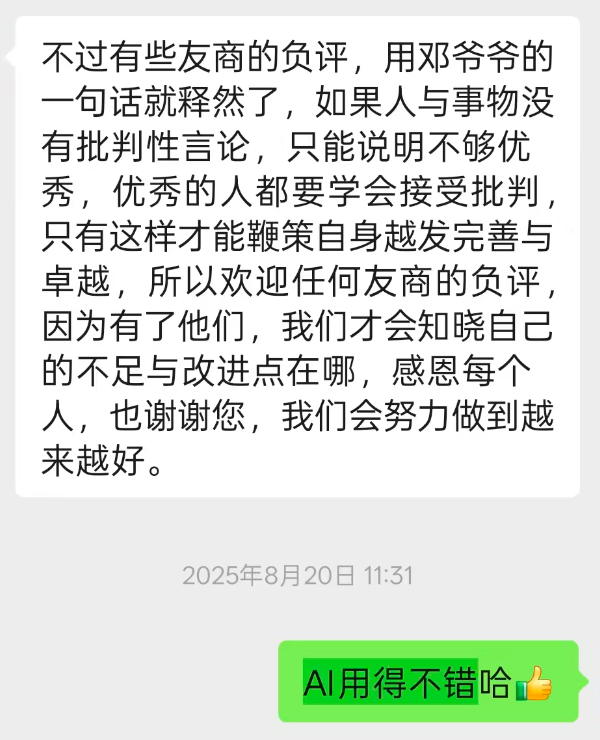
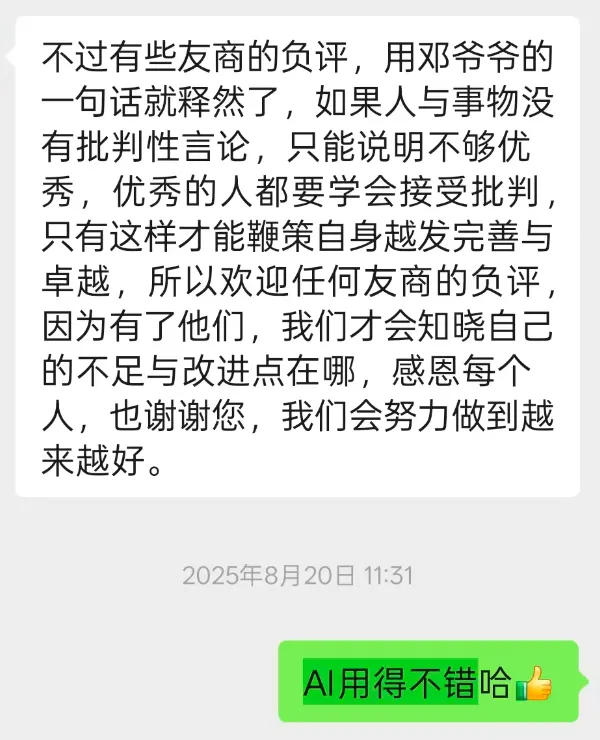
I was reminded of this by a business client whose reaction to my comments made me quickly lose my patience. He thanked me for saying “AI is useful”, and yet trust did not increase.
Open: Pasted image 20260527160715.png
That is the trust tax of AI-assisted writing. It lowers production cost but raises verification cost for the receiver. Before, a reader only needed to judge whether the project was interesting. Now they also judge whether there is an actual author behind the message. In an information-heavy world, one more layer of doubt is enough to close the door.
This Does Not Mean Academic Writing Should Pretend to Be Messier
A different extreme is tempting: if polished commercial writing should not be over-AI-like, then all writing must be intentionally rough. I do not think so.
Different text genres carry different responsibilities. Business communication, public posts, sales outreach, and founder statements rely on human position-taking, relationship context, trust, and future commitments. Academic papers, technical documentation, and research reports are first and foremost about clarity of logic, accuracy, evidence, and reproducibility.
In those domains, AI can be genuinely useful. It often outperforms people in coherence, grammar, logical order, and structural clarity. It can turn messy material into clearer arguments and align tone to formal standards.
If a research paper is already clear and methodologically sound, then forcing AI-detection dodges by inserting awkwardness or vague language actually lowers quality.
Academic writing does not prove human authorship through defects. It proves reliability through evidence, method, citations, and reasoning.
AI Detection Scores Should Not Become New Orthodoxy
I have long thought the main problem with AI detection tools is not only precision. The bigger problem is the lack of interpretability.
Is the score detecting model-generation traces, overly regular style, probability distributions, or some blend of both? Why does one paragraph score high while another does not? Can it be challenged with counterevidence? What are its known blind spots? If these questions cannot be answered, detection rates cannot serve as a final truth standard.
In academic settings this is especially risky. People have put classic Chinese essays into AI detectors and received high AI scores. If a tool can flag canonical human texts as machine-like, we should question whether it is detecting AI, or simply enforcing a narrow stylistic pattern.
When everyone treats AI scores as the only metric, writers optimize to evade the metric rather than clarify ideas. We end up writing not for readers but for a black-box.
This is absurd, but it is already happening. It pushes standards of valuable expression downward and replaces quality with style camouflage.
Better Standards Are About Responsibility
So we cannot reduce AI writing to a binary: use it or ban it, human-like or not human-like. We need scenario-based standards.
In business emails, the core is not sentence beauty. It is whether there is real intent and accountability. AI can help with grammar and structure, but judgment must stay with the author: why this outreach, what outcome is expected, what value is offered, and what tradeoffs are accepted.
In public posts, the core is not whether the tone sounds casual. It is whether the author is actually deciding and synthesizing.
In research papers, the core is not detector score. The core is whether the method and evidence hold.
In technical docs, the core is whether users can execute, whether boundaries are clear, and whether edge cases are covered.
A good text should not be judged first by “Could this be AI?” but by whether it fulfills the responsibility of its context.
If AI helps you fulfill that responsibility, it is a useful tool. If it substitutes responsibility, it is the problem.
Closing
The claim “the more human it sounds, the less it is trusted” sounds like an anti-AI line, but it is actually a critique of us.
We tend to treat writing as a surface task: make it polite, make it smooth, make it polished. But what matters is whether there is real thought, real assessment, and genuine willingness to stand behind each line.
AI can imitate tone and structure and even mimic apparent sincerity, and can sometimes mimic small awkwardnesses too. But it cannot be the person making that judgment. For humans, trust is not low-level polish; it is the feeling that someone is truly deciding in the background.