
Amid AI hype, who’s actually enjoying the efficiency dividend? Anthropic research reveals the tip of the iceberg.
AI Fever and “Cost-Cutting Anxiety”: What Does the Data Say?
Countless enterprises and individuals have pinned high hopes on AI, expecting revolutionary efficiency improvements and cost reductions. However, a somewhat awkward reality is: many enterprises find after initial trials that AI’s actual cost-cutting effects fall far short of expectations. I recently came across an Anthropic paper titled “Which Economic Tasks are Performed with AI?” which I’ll interpret while sharing my perspective.
The research analyzed millions of real Claude.ai conversations, revealing current AI usage patterns in economic tasks. A striking finding: AI usage is currently highly concentrated in software development and writing tasks—these two categories account for nearly half of total AI usage.
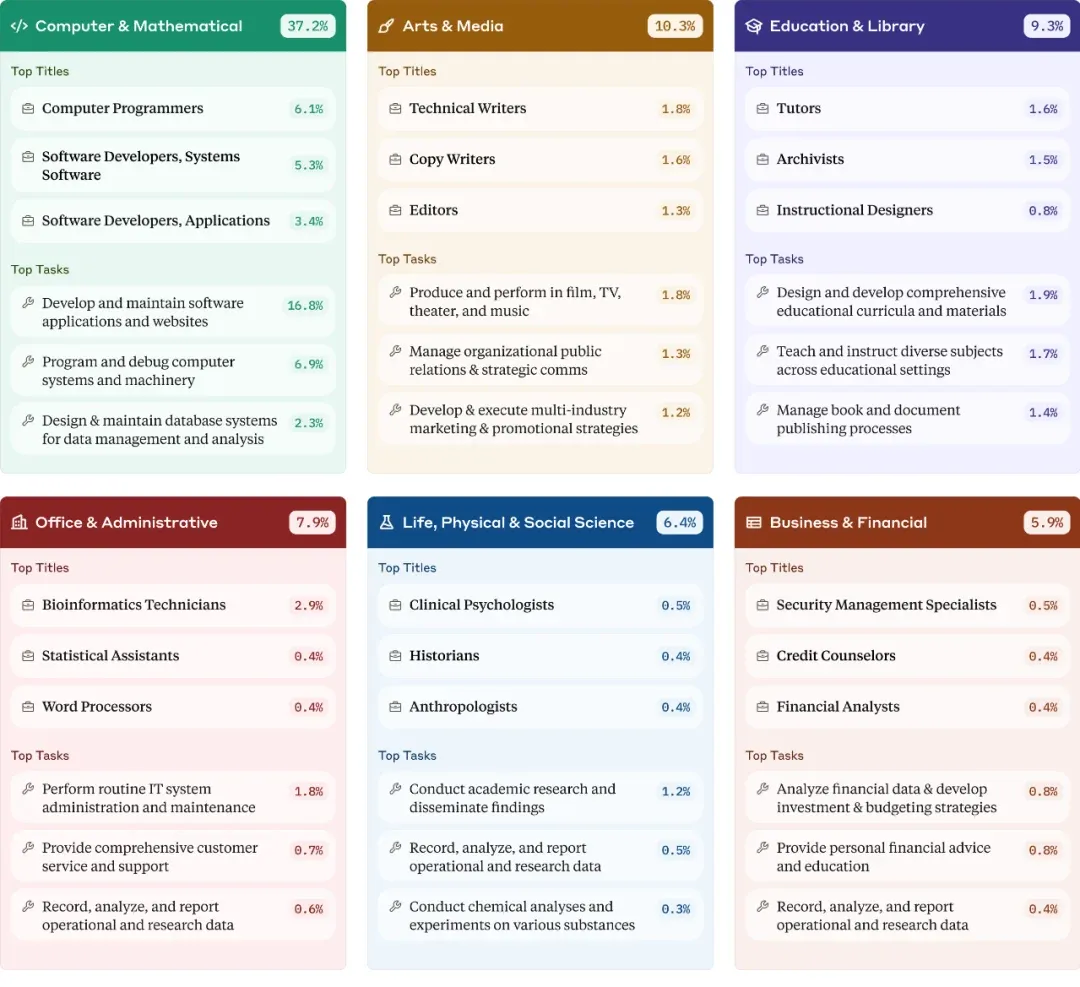
Caption: Anthropic research shows AI is most frequently used in computing, arts/media, and similar fields (Source: Anthropic, 2025)
However, examining AI application depth reveals another picture: only about 4% of occupations use AI for more than 75% of related tasks, while about 36% of occupations have AI touching at least a quarter of tasks. This reveals a key phenomenon: AI penetration shows a “wide but shallow” pattern.
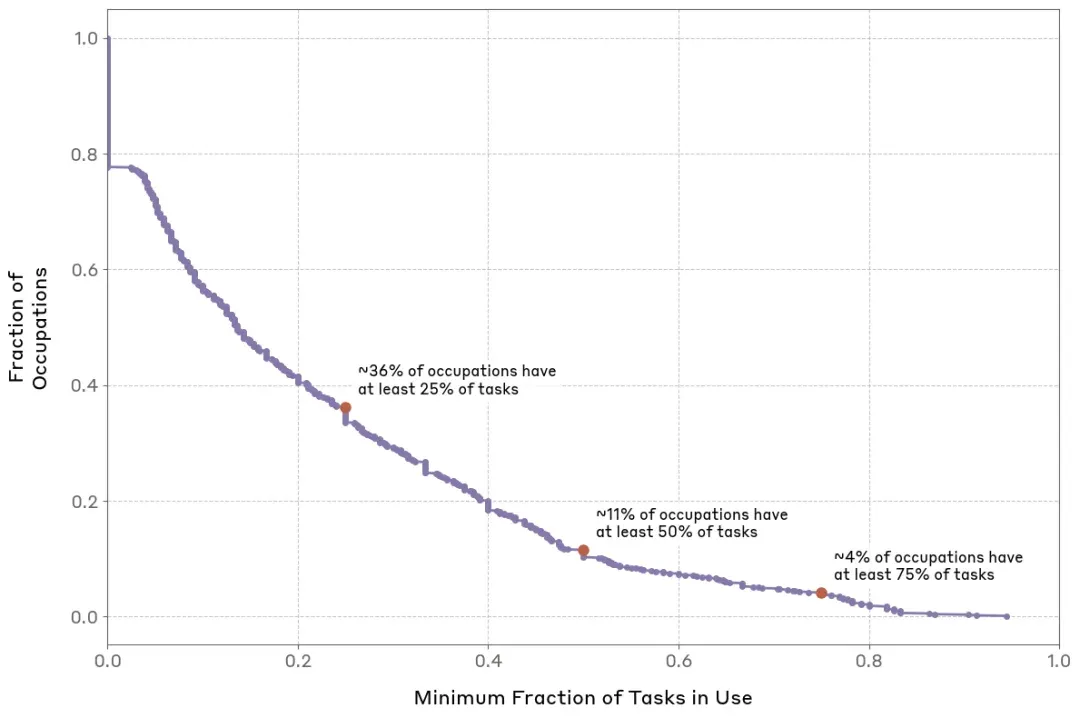
Caption: AI task penetration depth varies significantly across occupations, with room for deeper integration (Source: Anthropic, 2025)
More interestingly, research found current AI application is more about Augmentation (57%) rather than complete Automation (43%). This means AI appears more as an assistive tool and collaborative partner. This real-world frontline data collectively paints the complex landscape of early AI application, providing important clues for understanding “why cost-cutting falls short of expectations.” Achieving large-scale, fully “automatic” workflows is still premature.
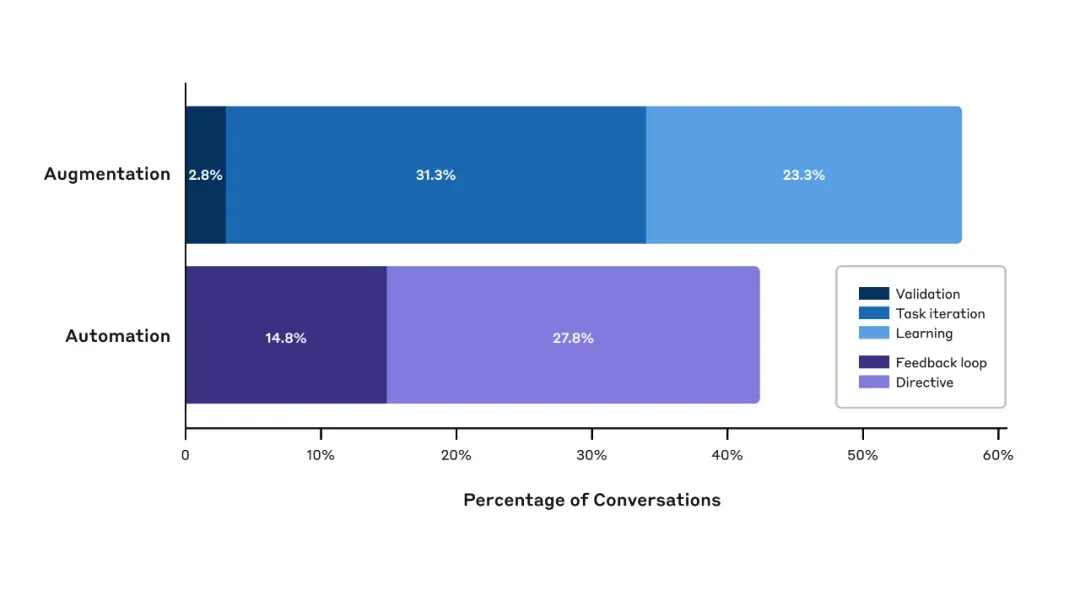
Caption: Research shows nearly 60% of AI applications aim to augment human capabilities, not fully automate (Source: Anthropic, 2025)
The Data’s “Subtext”: Claude’s “Specialization” and Paper’s Boundaries
In interpreting this data, I think it’s necessary to point out the research’s potential limitations. The data comes from Claude.ai conversations, and Claude is renowned for its exceptional programming and logical reasoning capabilities, with strong associations to developer tools like Cursor IDE. This may partly explain why “computing and mathematics” tasks lead by far. In other words, the data distribution may partly reflect Claude’s “capability strengths” and user base’s “usage preferences”, rather than AI technology’s universal penetration across all economic tasks. Understanding this helps us view conclusions more objectively and avoid over-generalization.
Crux One: AI’s “Instruction Dependency” and Workflow “Integration Pains”
Even considering these limitations, Anthropic’s data still reveals AI application’s “surface tension.” So what’s blocking AI from deeper penetration into core enterprise business with significant cost-cutting effects? In my view, the first challenge is AI’s high dependency on refined instructions and the resulting workflow integration pains. Unlike experienced human employees, current AI needs extremely detailed, well-structured instructions for task execution—what I call “ten-thousand-word essay” Prompts. These include massive background information, context, constraints, expected output formats, and more. Just preparing these materials to “feed” AI is itself time-consuming work.
Furthermore, seamlessly connecting AI outputs into existing enterprise workflows—often designed for human collaboration—is a systematic project. This initial high communication cost, configuration cost, and trial-and-error cost largely offsets AI’s potential efficiency gains on individual tasks. This explains why many enterprises don’t feel expected cost-cutting effects shortly after adopting AI.
Crux Two: Knowledge Bases—“Starving” AI and “Stalling” Business
If workflow integration is the visible challenge, enterprise knowledge base “poverty” is the more hidden but more fatal bottleneck. AI’s capability boundaries largely depend on what knowledge it can access and understand. General-purpose large models are powerful, but to deliver exceptional value in specific enterprise business scenarios, they must “thoroughly digest” that enterprise’s unique knowledge and data DNA.
Unfortunately, from my exchanges with many enterprises, most companies’ knowledge assets exist in fragmented, unstructured, or even “word-of-mouth” states. These valuable “digital minerals” aren’t effectively mined and organized, and naturally can’t be efficiently “fed” to AI. Without high-quality, AI-friendly knowledge bases as “fuel,” even the most powerful AI engine struggles to run at full speed on specific business tracks. This is the awkward reality of “smart AI” meeting “stalling business.”
Salary and AI: Elites’ “Ceiling” and Ordinary People’s “Skill Wings”
Another interesting Anthropic finding concerns salary: AI usage rate peaks in the upper salary quartile but is lower for both highest-paid (like doctors) and lowest-paid positions. This suggests AI may currently struggle to provide disruptive help at elite levels requiring deep experience and complex judgment, but performs well assisting mid-to-senior professionals.
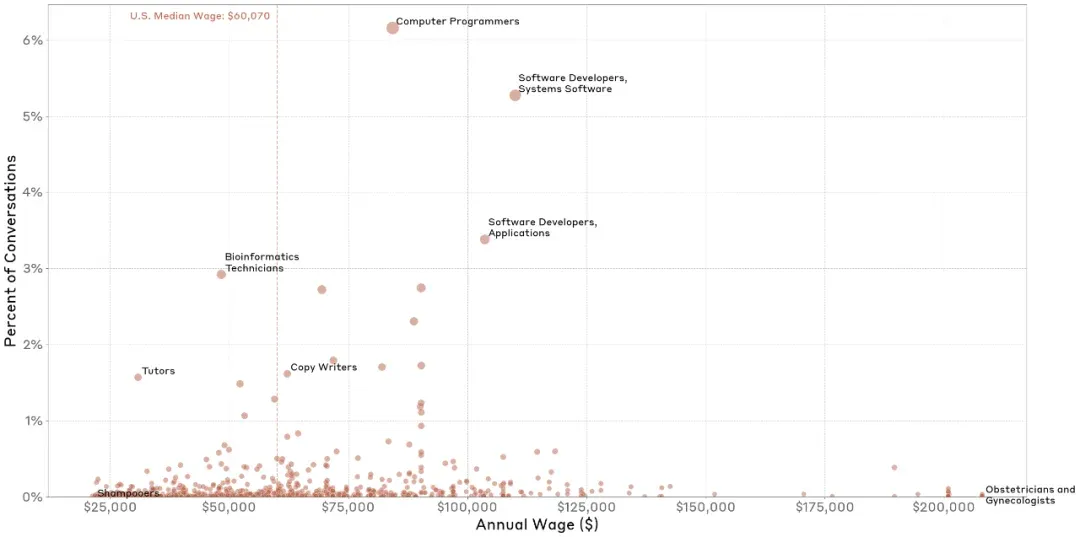
Caption: AI usage rate peaks in specific salary ranges, not linear growth (Source: Anthropic, 2025)
This aligns with my personal experience. For example, I often use Suno AI for music creation. Suno can quickly generate music of decent quality, even exceeding average human levels in some aspects. But reaching top human music producer standards—AI still has obvious gaps. The insight: even if AI can’t help you reach the summit of your profession’s “depth”, it can likely expand your “skill breadth” at extremely low cost. A product manager might use AI to quickly generate marketing email drafts; an indie developer might use AI to assist with UI prototype design. AI is becoming a powerful booster for ordinary people to cost-effectively acquire “generalist” capabilities.
Enterprise Antidote: Systematically Build “AI Fuel Libraries,” Gradually Reshape Workflows
Facing these challenges, enterprises wanting true AI benefits must escape the “treating symptoms not causes” trap and implement systematic deployment. First, elevate enterprise knowledge base construction to strategic importance. The core goal is building a dynamically updated, well-structured, AI-friendly “enterprise brain.” Second, AI-workflow integration should adopt “small steps, fast runs, iterative validation” strategy. Choose 1-2 scenarios with clear pain points and value as breakthroughs, continuously optimizing through practice, then gradually expanding. Also, emphasize cultivating employee AI literacy.
Enterprise Action Checklist
-
1️⃣ Knowledge Inventory and Strategic Planning: Make knowledge base construction a company-level strategy.
-
2️⃣ Standards First, AI-Friendly: Establish unified knowledge input, management, and format standards.
-
3️⃣ Pilot Breakthrough, Value-Driven: Choose scenarios with quick wins for AI application pilots.
-
4️⃣ Empowerment Culture, Human-AI Collaboration: Cultivate employee AI application capabilities and data literacy.
-
5️⃣ Continuous Investment, Dynamic Optimization: Treat knowledge bases and AI applications as long-term iterative system projects.
Individual Breakthrough: Use “Second Brain” to Master AI, Not Be Defined By It
Enterprise challenges and opportunities also project onto every professional. Facing the surging AI wave, rather than anxiously fearing replacement, proactively embrace it—build your own “Personal Knowledge Operating System.” This isn’t just note-taking, but systematically collecting, organizing, linking, internalizing, and creating knowledge. The more complete and structured your knowledge system, the more AI can become your powerful cognitive extension and creativity catalyst, helping you learn faster, think deeper, decide better, and easily expand skill breadth. In this era, the ability to master information and knowledge will be your core competitiveness in dancing with AI.
Conclusion: Farewell “AI Quick Fix Theory,” Embrace “Knowledge Compound Interest” and “Skill Generalization”
Anthropic’s research is a sobering reminder, bringing us back from AI frenzy to rationality. Achieving AI-driven significant cost reduction and efficiency gains isn’t overnight work. It highly depends on enterprise and individual sustained deep cultivation in knowledge management—a “slow variable”—and clear understanding of AI capability boundaries. Bid farewell to blind AI worship and unrealistic expectations. Solidly build your own “knowledge foundation,” and skillfully use AI to expand skill breadth—that’s how to enjoy the double dividend of “knowledge compound interest” and “AI empowerment” in future competition.
Found this analysis insightful? Give it a thumbs up and share with more friends who need it!
Follow my channel to explore the infinite possibilities of AI, going global, and digital marketing together.
Source paper link: https://arxiv.org/html/2503.04761v1
AI expands capability boundaries, while knowledge defines how far we can go.
