
Anthropic’s Founder Playbook Is Not About Starting a Startup With AI
Anthropic did something interesting this time.
When people talked about it before, most conversations focused on Claude, Claude Code, API, tokens, and model capability. This time, however, it went beyond a tool release and published a guide for founders: “The Founder’s Playbook: Building an AI-Native Startup.”
In plain language, it is a practical AI-native startup primer for founders in 2026.
But after reading it, my first reaction was not, “Wow, AI finally lets me replace an entire company by myself.”
Quite the opposite.
What this guide seems to be saying is this: AI makes building easier, but it does not make judgment easier.
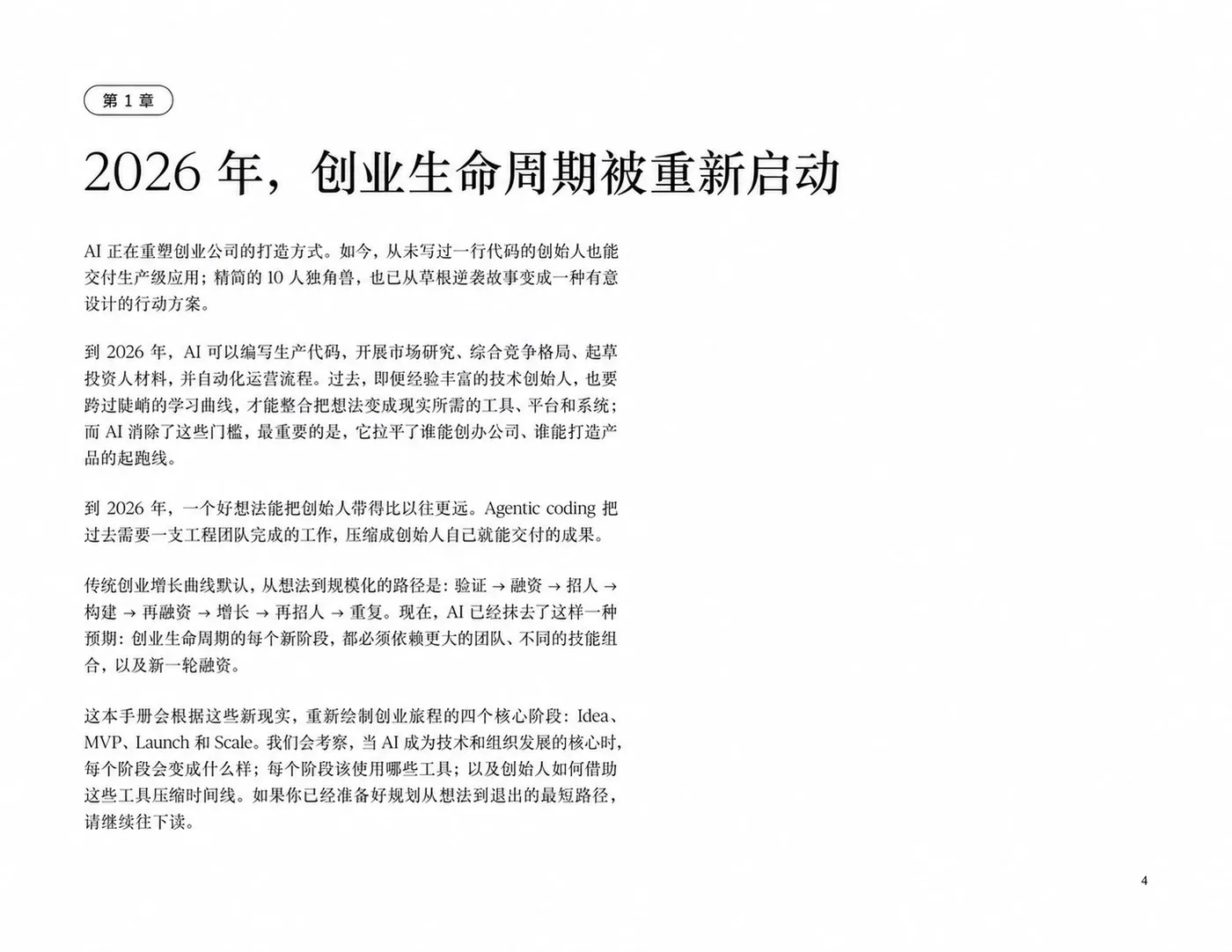
The guide breaks a startup into four phases: Idea, MVP, Launch, and Scale.
These four words are familiar; they appear in almost every startup framework. The shift here is important: instead of adding a little AI at each stage, it asks you to redesign how each stage is executed.
At the Idea stage, it is not telling you to ask AI to generate endless ideas first.
It suggests the opposite. The earliest question for AI should be to challenge you.
That part resonates with me.
Many people today begin an AI startup by asking AI to write specs, code, landing pages, and ad copy. It looks fast, but often this only accelerates movement toward something no one really needs.
The best early use of AI is not to prove how smart you are. It is to puncture your own illusions.
Do these problems truly exist? Do users actually feel pain there? How are they solving it today? Why has nobody done this well before? If you build it, would people pay for it?
If these questions are not answered, the faster you run, the farther you may crash.
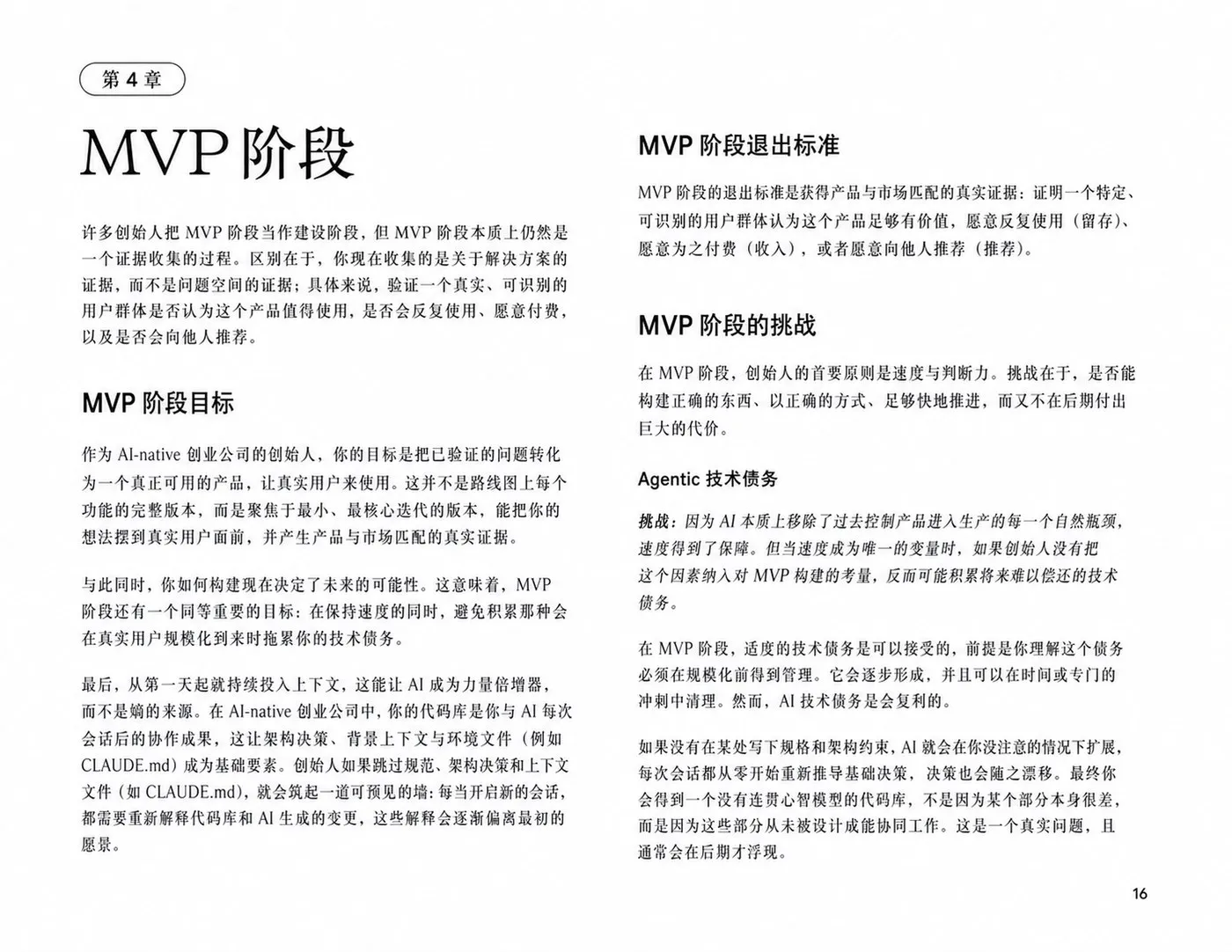
By the time you reach MVP, the guide is still very disciplined.
It does not frame MVP as a coding sprint where Claude Code and Cursor are enough to ship a product in days.
Instead, it insists MVP is evidence collection.
Evidence of what?
Evidence that real users will use it, return, pay, and even recommend it.
That sentence sounds simple, but it is actually severe.
The biggest illusion in the AI era is the assumption that “I built it” equals “I am building a startup.”
It is not the same.
Building becomes easier with AI. What remains scarce is your ability to choose the right problem, understand users deeply, and judge commercial value.
Moving to Launch and Scale, the guide introduces a bigger shift: the founder role is no longer mainly the person doing hands-on execution.
You are less the one writing code, writing copy, handling support, running sales, and fixing bugs yourself.
You become the person orchestrating agents, tools, data, process, and a few key team members so the company operates like a coherent system.
It sounds empowering, but do not over-romanticize it.
Once systems grow more complex, a new type of technical debt emerges. I found this idea exact: AI technical debt is often context drift.
One agent changes one part today, another fills in a gap tomorrow, and you patch something personally the day after. Without clear specs, architecture, and persistent memory, a codebase can lose a coherent mental model very quickly.
So AI can help you write faster, and it can also help you break things faster.
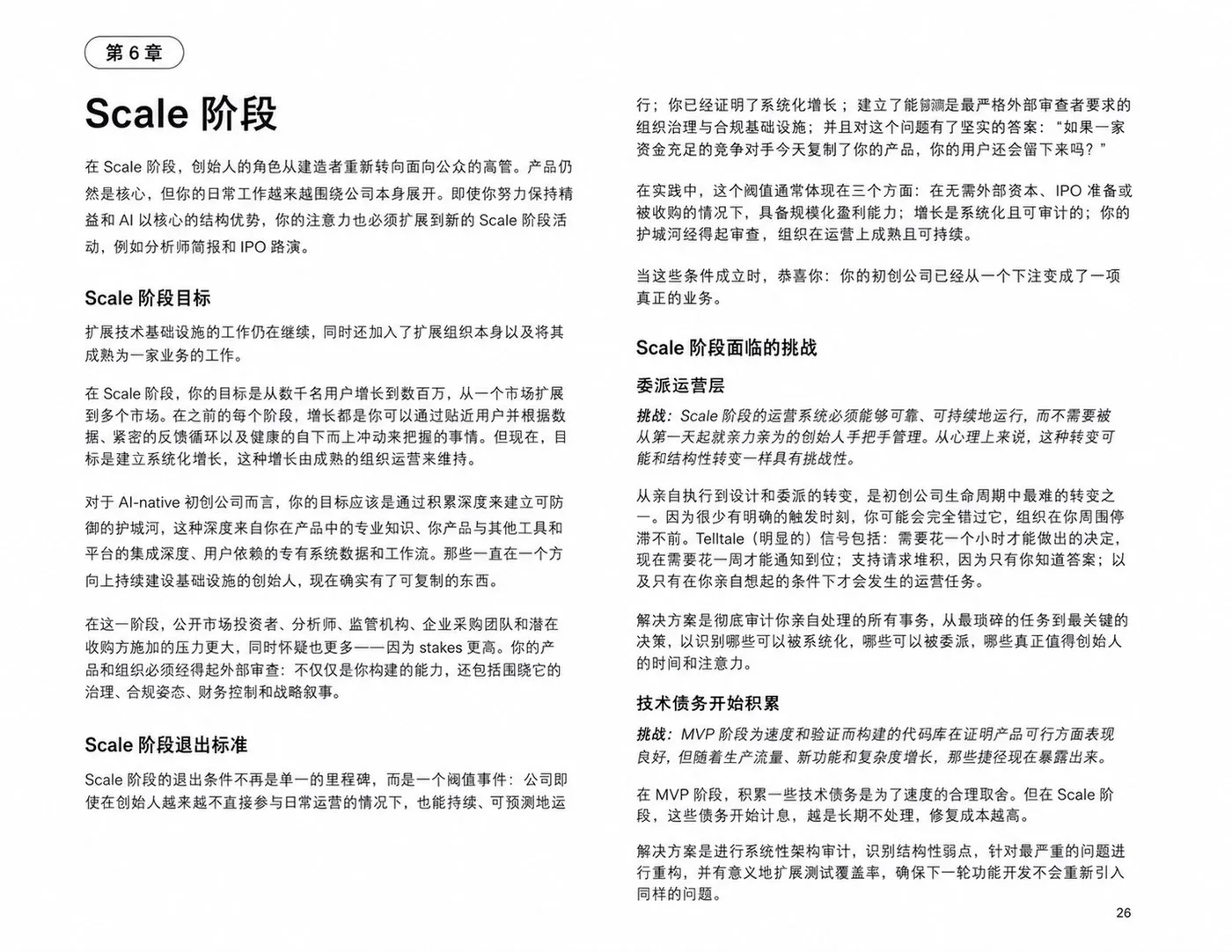
In the final Scale stage, the guide does not hype features.
Its core argument is that the true moat is no longer how many features you can stack. It is domain knowledge, user data, depth of integration, and workflow lock-in.
That is the hard reality.
As AI makes features cheaper, “I also have that feature” becomes less meaningful.
Real value comes from whether you understand your domain deeply, whether you hold data others cannot easily get, whether you are embedded in users’ daily workflow, and whether switching away from you is inconvenient for them.
After reading the guide, my strongest takeaway is this: in 2026, “I cannot build it yet” may no longer be the strongest excuse.
But “I do not know what to build”, “I do not know who will buy it”, and “I do not know how to retain users” are still very real and may be even more critical.
AI-native startup is not putting a layer of AI onto old startup workflows.
It is more like asking founders to relearn the basics: how to find the right problem, how to validate, how to launch, and how to convert one person’s skill into system-level capability.
This is both exciting and sobering.
Exciting, because one person can indeed do much more.
Sobering, because doing more does not automatically mean doing the right things.
Guo Shu produced a native Chinese version of the original PDF. If you are interested, you can download it from my site:
https://mrguo.life/zh/resources/founders-playbook-ai-native-startup-zh
