
App or Web? The “Fork in the Road” for Indie Developers Going Global—One Wrong Step and It’s Game Over
Before every indie developer’s overseas journey begins, a ghost-like “meta-question” lingers: Should I build a native App or a Web application? This is far from a simple technical choice—I see it as a high-stakes strategic bet. Your choice will profoundly affect product acquisition paths, revenue ceiling, iteration speed, and ultimately success or failure.
As a veteran who’s navigated the digital world for years, I must tell you: this question has no standard answer. But fortunately, there’s a decision framework. This article is the “decision compass” I’ve drawn for you—it will cut through the fog and help you make the clearest judgment between App’s “walled garden” and Web’s “open universe.”
Traffic and Acquisition: Passive Waiting for “Store Recommendations” vs. Active Hunting via “Search Engines”
First, we must consider: where will your first users come from? App acquisition heavily depends on App Store and Google Play—your fate partly rests in store algorithms’ hands. Web applications live in a “decentralized” open universe, with main traffic from SEO, content marketing, and social media. You build from zero, actively capturing traffic by creating value. Though slow to start, you have 100% autonomy, and the traffic channels you build are truly your private assets.
Remember Wordle, which went viral globally in 2022? It was just a simple web page, yet through easily shareable links on social media, it achieved viral spread and was eventually acquired by The New York Times at a premium. Imagine if it had been a downloadable App—how much friction would that have added to the sharing chain? For budget-limited indie developers, Web’s openness and low sharing barriers are the most precious assets during cold start.
Development and Iteration: Long Waits for “Version Reviews” vs. Agile “One-Click Deployment”
As developers, we know time is the lifeline. Native App development, even with cross-platform frameworks like React Native or Flutter, faces complexity adapting to different systems. More critically, app store review mechanisms. Fixing an urgent bug or launching a new feature often means waiting days—such delays are extremely painful for startup projects.
Web development perfectly embodies “Agile” and “Lean” philosophies. After git push through CI/CD, your updates reach all global users within minutes. This “one-click deployment” immediacy lets you rapidly A/B test, fix issues, and respond to user feedback. For indie developers needing fast iteration to find PMF (Product-Market Fit), this speed is survival itself.
Business Model and Monetization: 30% “Platform Tax” vs. “Build Your Own Toll Booth” Freedom
Now let’s talk about the most practical issue: money. App built-in payment channels (In-App Purchase) offer smooth experiences, but the cost is 15% to 30% “toll fees” to platforms. Though Apple and Google offer discounts for small developers (15% commission under $1M annual revenue), it’s still a huge expense.
Web gives you 100% revenue autonomy. Through Stripe, Lemon Squeezy, and other tools, you easily build your own “toll booth”—whether subscription or one-time payment, just 2-3% payment gateway fees. Giants like Spotify and Netflix guide users to pay on official websites to avoid “Apple Tax.” For indie developers, this is nearly profit-doubling temptation—but note, overly direct in-app guidance may violate store policies.
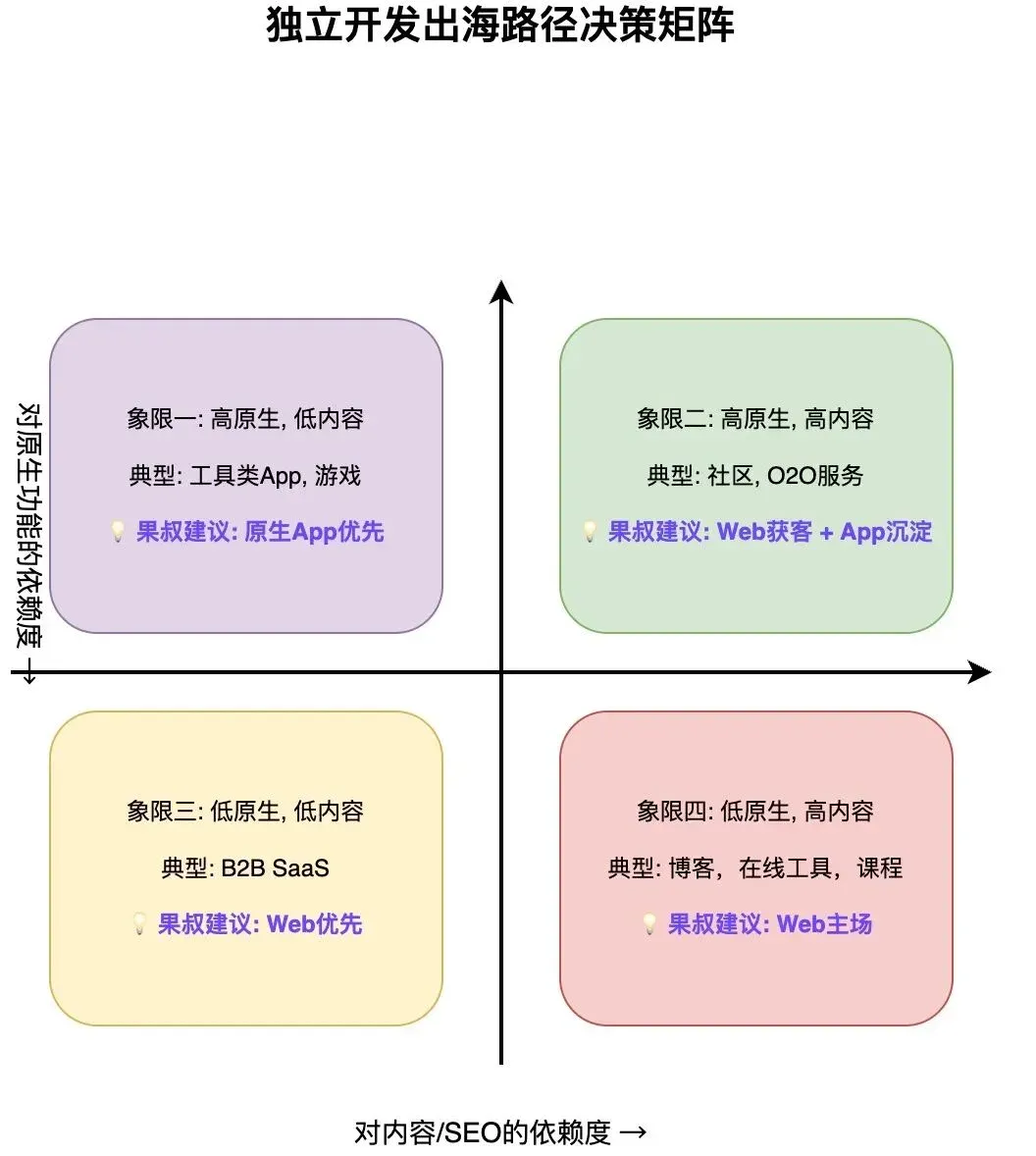
Decision Matrix: Use This “Four-Quadrant Matrix” to Position Your Optimal Path
Theory done, here’s the practical stuff. Based on your product vision, find your position in this matrix. X-axis represents “content/SEO dependency,” Y-axis represents “native feature dependency”:
2025 Trends: Farewell “Either/Or,” Embrace Convergence
Web vs. App isn’t a fight to the death—instead, they’re showing convergence and complementarity. First, platform policies are loosening. Under global antitrust pressure, Apple and Google have made concessions. The EU’s Digital Markets Act has forced Apple to open app sideloading in Europe—reaching users without App Store becomes possible. This means both “channel tax” and “review system” mountains may be shaken.
Second, PWA (Progressive Web Apps) is rising. It gives websites App-like experiences: add to home screen, work offline, receive push notifications (yes, iOS now supports this too). For indie developers, PWA offers the ideal “one development, Web coverage plus near-native experience” solution, perfectly avoiding store commissions and listing reviews. Giants like AliExpress and Twitter have achieved huge success in emerging markets through PWA.
Conclusion: Your First Step Should Be Web MVP
Overall, Web and App each have strengths. Web emphasizes broad reach and low-barrier experimentation; App emphasizes deep experience and high retention. Nietzsche once said: “What doesn’t kill you makes you stronger.” But in resource-limited startup phases, one wrong choice could knock you out entirely.
Therefore, for most indie developers, my final recommendation: adopt the “Web MVP → Native App Upgrade” progressive strategy. First launch a Minimum Viable Product (MVP) with Web, testing overseas market response at lowest cost and fastest speed. When data proves your product found PMF and core users need deeper experiences, develop native Apps for them. This is lean startup thinking’s best practice in the going-global wave.
Found this analysis insightful? Give it a thumbs up and share with more friends who need it!
Follow my channel to explore the infinite possibilities of AI, going global, and digital marketing together.
Strategy’s essence isn’t choosing what to do—it’s choosing what not to do. Start from the smallest cut to move the biggest world.
