
Digital Strategy Review | 2026
AAO (Assistive Agent Optimization) on the Rise: SEO is Shifting from “Human” to “Agent” | Uncle Fruit’s SEO Daily
By Uncle Fruit · Reading Time / 8 Min
Foreword
If you define SEO as “getting pages to rank higher in search results,” you will encounter frustration with increasing frequency: you’ve optimized the content, the technical aspects, and the links, yet the traffic remains difficult to explain.
The reason is simple: the entry point for search is changing.
More and more users are moving away from the “enter keyword, click blue link” method of information retrieval. Instead, they are delegating their queries to an assistive agent: a browser assistant, an OS-level assistant, or even an AI within a vertical application. These agents filter, synthesize, and recommend, ultimately providing a result that “looks more like an answer.”
In this new paradigm, the object of SEO optimization is no longer just the search engine’s ranking system, but these “choosing” agents.
01
Today’s Headline News
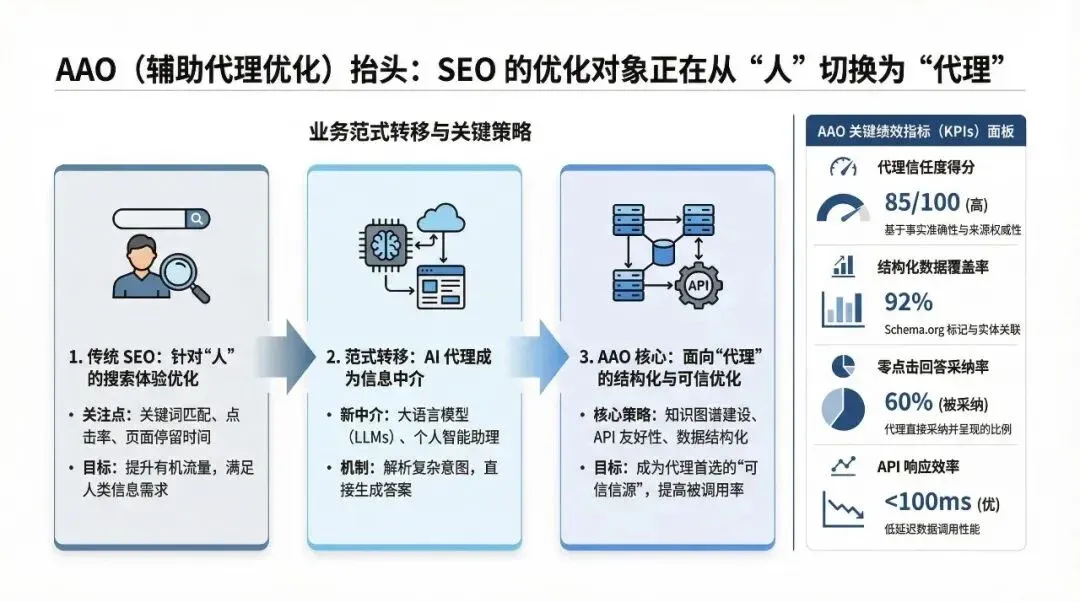
“Assistive Agent Optimization” (AAO) is becoming a more realistic framework for the SEO field: it shifts the optimization goal from “getting humans to click” to “getting agents to choose.”
The underlying changes are:
-
•
Traditional SEO assumes the decision-maker is a human searcher; humans look at titles, read snippets, and click links.
-
•
In agent-mediated search, the decision-maker becomes an AI agent; it retrieves, evaluates, synthesizes, and makes recommendations on behalf of the user.
Consequently, the optimization problem has been rewritten:
-
•
It is no longer “Can I be retrieved?” but “Can I be consistently judged by the agent as credible, usable, and citable?”
-
•
It is no longer “Can I rank first?” but “Can I win in the agent’s candidate set?”
The value of AAO lies in bringing this concept back to an actionable process, breaking down “how an agent discovers and chooses” into a chain that can be discussed, reviewed, and optimized by teams.
02
Headline Analysis: Why This Matters More
AAO deserves the headline not because it’s a new buzzword, but because it cuts to the core contradiction of SEO: when the decision-maker shifts from human to agent, many old experiences become obsolete, while new capabilities become the price of admission.
1) “Visibility” in the Agent Era is More Like a Screening Process
In the blue-link era, you could at least see 10 results; even if you ranked 5th, you still had a chance.
In the agent era, users are more likely to see only one answer or 2-3 recommendations.
This means:
-
•
Even if your content “can be retrieved,” it may be rejected by the agent if it is not clear, citable, or verifiable.
-
•
Even if your brand “has traffic,” it may be downranked by the agent if your signals are fragmented or your entity is unclear.
In other words, AAO is closer to “recommendation system competition”: agents favor sources with clear structures, verifiable facts, comprehensive coverage, and consistent context.
2) Technical SEO Standards are Being “Defaulted” by Platforms and Plugins
Another reality that is easily overlooked is that technical SEO is increasingly becoming “infrastructure.”
As a vast number of sites run on CMS platforms, capabilities like sitemaps, canonical tags, and basic structured data are provided out-of-the-box by platforms and plugins.
This leads to a very direct consequence:
-
•
It is difficult to form a long-term advantage solely by “making technical details more standard.”
-
•
The advantage shifts to “which platform you choose, how you configure plugins, and how you turn business signals into machine-readable data.”
The significance of AAO is that it forces teams to look up from “tactical execution” and see that “underlying defaults” are changing the competitive structure.
3) AI-SEO is More Like Organizational Change, Not Skill Upgrading
Many teams treat AI-SEO as “buying a new tool to speed up the content team.” It works in the short term, but in the long term, it gets stuck on organizational synergy.
Because AAO requires not just single-point output, but cross-departmental consistency:
-
•
Brand entity and product information must be consistent.
-
•
Content and customer service scripts must be consistent.
-
•
On-site structure and off-site mentions must be consistent.
-
•
Data definitions and acceptance metrics must be consistent.
When an agent is making choices for the user, any inconsistency becomes “uncertainty,” and uncertainty is usually judged by the agent as a risk.
To put it bluntly: in the past, SEO was often a “battle for the content team”; now, it is more like a “battle for the organizational community.” Every piece of information you publish will be compared against other signals within the agent system. As long as sales scripts, product page promises, and social media expressions clash, the agent will lower your credibility. The essence of AAO is not writing a few more articles, but turning brand facts into a consistent system that can be reliably recounted by machines.
This is why “unified terminology, unified fact databases, and unified evidence links” will become the underlying engineering that future SEO leads must manage, rather than optional documentation work.
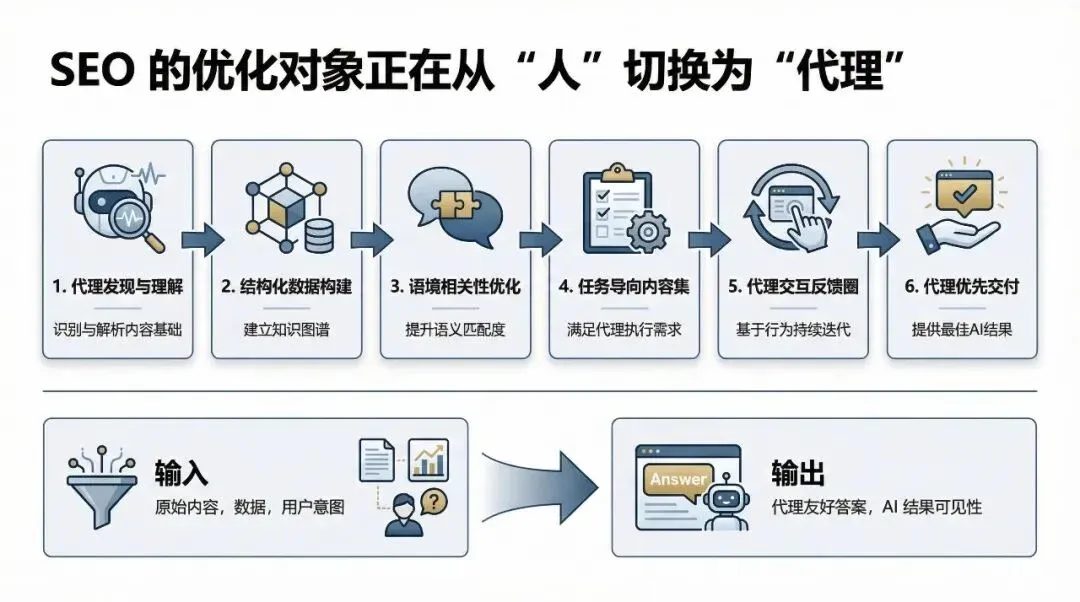
Flowchart used to explain the methodological execution path.
03
Uncle Fruit’s Perspective
If you want your team to be proactive in the AAO era, I suggest starting with three “engineering actions” rather than “writing more content.”
Action 1: Map Out the “Agent Decision Chain”
Write down the chain from discovery to selection as a process the team can discuss, rather than leaving it to intuition:
-
•
Through which entry points does the agent discover you (search, knowledge graph, citations, social media, business profiles, in-app search)?
-
•
What signals does the agent use to judge your credibility (entity consistency, author authority, citation relationships, reviews and reputation, structured data)?
-
•
In what scenarios does the agent recommend you (what type of questions, what intent, what region/demographic)?
Only after mapping the chain will you know where to invest your optimization resources.
Action 2: Turn Content into “Citable Components,” Not Long-form Prose
Agents prefer content formats that can be decomposed and reused:
-
•
Clear definitions and conclusions
-
•
Comparisons and trade-offs
-
•
Steps and checklists
-
•
Tables and structured data
-
•
Verifiable data points and sources
What you need to do is turn core pages into a “component library”: let the agent use it directly, rather than making it struggle to summarize.
Action 3: Establish a “Visibility Engineering” Monitoring System
Don’t just stare at rankings; monitor the process signals of “being chosen”:
-
•
Whether your brand is mentioned in answer systems and in which questions.
-
•
Whether your page is cited and what the cited sentences are.
-
•
Whether your entity information is consistent (on-site, off-site, business profiles, social media).
When you can monitor these signals, optimization will return from “metaphysics” to “engineering.”
One more pragmatic implementation tip: pick the 10 core questions that drive the most inquiries or conversions, and check one by one whether “the agent consistently mentions you.” If it doesn’t, fix entity consistency and citation materials first; if it mentions you but the description is distorted, fix componentized content and evidence chains. Doing this small closed loop well is more effective than blindly expanding a content library and is more in line with the essence of AAO.
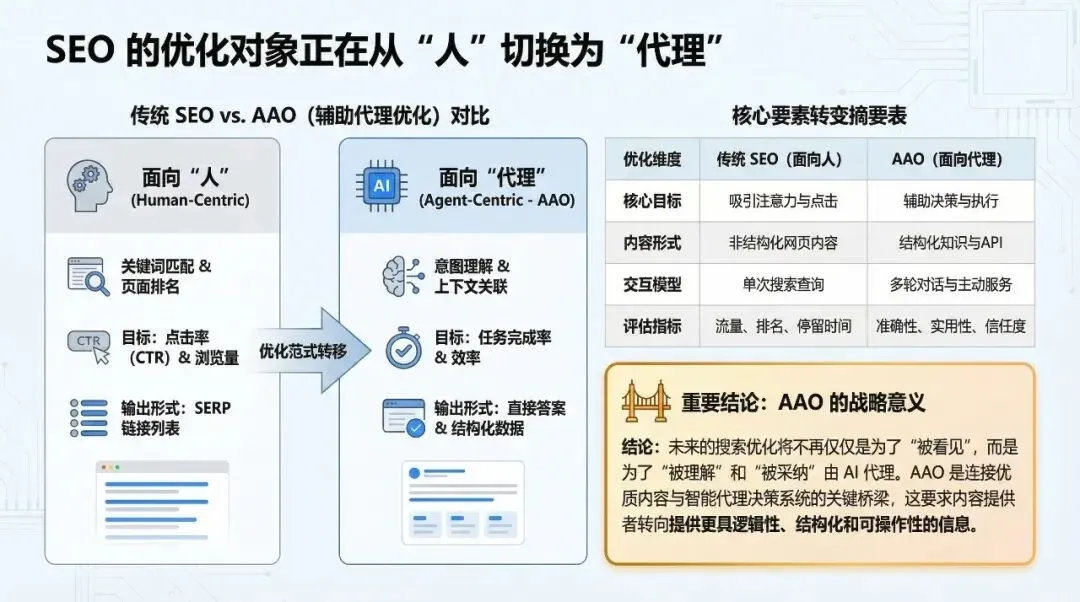
Data chart used to explain key comparisons and conclusions.
04
Other Key News Briefs
Extra | HubSpot Media Acquires Starter Story, Further Integrating Content Distribution and Tool Conversion
HubSpot announced on its official blog that HubSpot Media will acquire the entrepreneur content brand Starter Story, clarifying that this acquisition is part of its “owned media assets” strategy. Public information shows that Starter Story currently covers 100M+ annual content views and has accumulated 4,500+ entrepreneur case studies; after the merger, the HubSpot Media network’s YouTube subscriptions will reach the 2.9 million level.
Why it matters: The key to this deal is not just “buying a media channel,” but moving “high-intent entrepreneur content scenarios” further up the funnel. For SEO/AAO, this means future brand competition will rely more on “whether you are repeatedly cited and trusted in the user’s pre-decision learning scenarios,” rather than just ranking on result pages.
-
•
https://blog.hubspot.com/marketing/hubspot-starter-story-acquisition
AI-SEO Success is More Like Change Management, Not Tactical Execution
More and more teams are finding that AI tools can make content faster, but if organizational goals, processes, and acceptance criteria are not upgraded synchronously, the output becomes noise.
Why it matters: SEO in the AI era is not “writing faster,” but “delivering real value more consistently.” If the organization is not aligned, the stronger the tools, the greater the chaos.
-
•
https://www.searchenginejournal.com/ai-seo-is-a-change-management-problem/568103/
Web Almanac Data Suggests: CMS Plugins are Setting Technical SEO Defaults
A large number of technical SEO practices are being defaulted by platforms and plugins. The technical baseline of a site is increasingly becoming a result of “selection and configuration” rather than an individual engineering decision for each site.
Why it matters: The advantage will shift from “knowing how to execute a technical detail” to “which platform you choose, how you configure defaults, and how you turn business signals into machine-readable data.”
-
•
Microsoft Mitigates Prompt Injection Attacks in Copilot
Spammers are trying to use “AI summary” features to induce models to trust malicious content, and Microsoft has begun implementing protections at the product level.
Why it matters: As search and office assistants are more deeply embedded in workflows, prompt injection will shift from a security edge case to a large-scale risk, directly affecting the credibility assessment of content and brands.
-
•
https://www.seroundtable.com/microsoft-ai-prompt-injection-attacks-40980.html
Google Tests Removing Article Publication Dates in Discover
Discover is testing hiding dates, which will change users’ intuitive judgment of “freshness” and also change how content teams design update strategies.
Why it matters: When platforms weaken “time clues,” the structure, authority, and verifiability of content will become more important; it will also affect the topic selection rhythm of sites that rely on Discover.
-
•
https://www.seroundtable.com/google-discover-no-dates-articles-40975.html
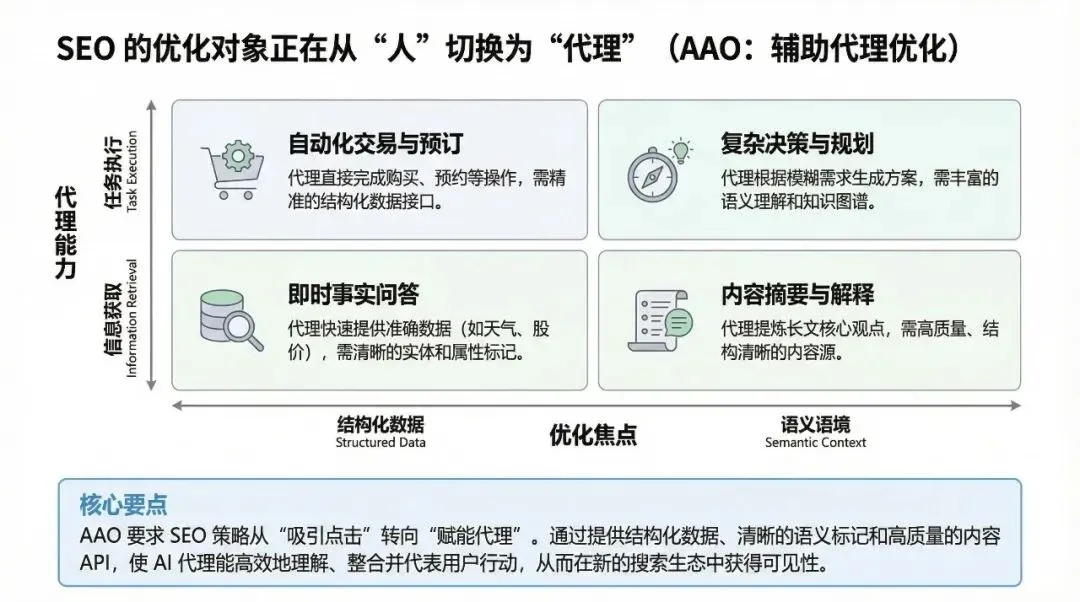
Matrix chart used to illustrate applicability boundaries and strategy selection.
05
Trends and Opportunities
-
SEO will migrate from “Ranking Engineering” to “Visibility Engineering”: You are optimizing not just blue-link sorting, but the agent’s selection logic and citation logic.
-
Entity consistency will become the new infrastructure: The consistency of on-site structured data, off-site mentions, business profiles, and social media information will directly affect the agent’s confidence in you.
-
Platform and plugin defaults will reshape competition: Once the technical baseline is defaulted, differentiation will come from selection, configuration, and the expression of business signals; teams that understand “systemic design” will have a greater advantage.
