
Digital Strategy Review | 2026
Bing Integrates GEO into Official Guidelines: SEO Officially Enters the “Citation Eligibility Era” | Uncle Guo’s SEO Daily
By Uncle Guo · Reading Time / 8 Min

Foreword
Over the past year, the industry has used various buzzwords to describe the same phenomenon: users are increasingly completing their “initial screening and understanding” within AI, search engines are providing direct answers on results pages, and traffic metrics are looking more and more like lagging indicators. However, these discussions have shared a common pain point: the lack of an “officially aligned rulebook.” Today’s update from Bing moves this from “industry consensus” to “policy level”: GEO (Generative Engine Optimization) has been officially written into the Webmaster Guidelines, with clear boundaries defined for Copilot/AI answer-related meta directives and abuse.
01
Today’s Headline News
The conclusion first: Microsoft has rewritten the Bing Webmaster Guidelines, officially incorporating GEO (Generative Engine Optimization), expanding the definition of AI abuse, and providing instructions for Copilot/AI answer meta directives. SEO is shifting from “ranking optimization” to a dual-track era of “citation eligibility and controlled presentation.”
This update carries at least two “hard signals” that can be cross-verified:
-
01 Third-party industry media have provided structured interpretations (For quick key takeaways):
-
• Search Engine Journal has summarized the key points (including GEO definitions, meta directives, and abuse expansion): https://www.searchenginejournal.com/bing-adds-geo-to-official-guidelines-expands-ai-abuse-definitions/568442/
-
• Search Engine Roundtable’s daily recap also covered this change: https://www.seroundtable.com/recap-02-27-2026-41007.html
-
01 The “official documentation chain” from Microsoft is emerging systematically (This is more important than any single news piece):
-
• Bing Webmaster Guidelines (Entry page): https://www.bing.com/webmasters/help/guidelines-30fba23a
-
• Bing Webmaster Blog (Series of articles on AI presentation/citation):
-
• Introducing AI Performance: https://blogs.bing.com/webmaster/february-2026/introducing-ai-performance
-
• How to get your content cited by Copilot: https://blogs.bing.com/webmaster/february-2026/how-to-get-your-content-cited-by-copilot
-
• Robots meta directives: https://blogs.bing.com/webmaster/february-2026/robots-meta-directives
Breaking this down into “four key points you can use today”:
-
01 GEO is officially defined as a matter of “citation and grounding eligibility”: Bing explicitly notes that GEO does not guarantee citation, just as SEO does not guarantee ranking. This phrasing is critical; it brings “AI visibility” back from the realm of mysticism into an actionable engineering context.
-
02 Control over AI presentation is now in meta directives: Directives like
NOARCHIVE,NOCACHE, andNOSNIPPETare now explained in terms of how they affect the Copilot/AI experience. This means websites can make clearer trade-offs between “maximizing citations” and “protecting content from AI usage.” -
03 The attitude toward AI content has shifted from “source is original sin” to “quality and oversight as core”: Instead of blanket penalties for machine-generated content, the focus is now on “large-scale generation lacking oversight, quality control, or editorial review.”
-
04 Abuse definitions have been upgraded to the AI-era attack surface: Prompt injection and AI manipulation are now clearly defined. Future “gray-hat” tactics designed to “write for the sake of triggering citations” will be penalized much faster.
Why I’ve placed this as the headline: It marks the first time GEO has moved from “methodological discussion” to “official rulebook,” providing actionable control switches. This will directly change content strategy, technical implementation, and KPI design.
02
Headline Analysis: Why This Matters
Many teams treat such updates as mere “documentation revisions,” but in the search industry, official guidelines often represent the redrawing of “debatable boundaries.” This brings at least three profound changes.
First, the SEO objective function is splitting into two curves: Ranking and Citation. In the past, you only had to chase one result surface: SERP rankings. Now, you must simultaneously face two:
-
• “Clicks and rankings” in traditional search results.
-
• “Eligibility and presentation” for being cited/grounded/summarized in AI results. These two curves sometimes align and sometimes conflict. For example, “protecting content” might reduce AI citations, while “pursuing citations” might force you to emphasize factual expression and structured information over narrative writing.
Second, “whether content is used by AI” has shifted from passive to a selectable strategy. Previously, many publishers worried: “Will my content be consumed by AI?” Now, at least within the Bing ecosystem, you have a clearer strategic surface:
-
• If you want citations, avoid restrictive directives and instead improve “cite-ability” (clear facts, entity consistency, single-topic pages, and front-loading important information).
-
• If you want protection, use
NOARCHIVE/NOCACHEto narrow the scope of Copilot’s access. This will push content strategy from “one-size-fits-all” to “layered governance based on page type/business value.”
Third, the Dark Funnel is forcing a redefinition of KPIs. When users complete their “initial screening” in AI and then move to search for “verification,” traditional reports attribute the credit to brand keywords and direct traffic. Search Engine Land calls this the “dark SEO funnel” and provides a data and explanation framework: Source: https://searchengineland.com/the-dark-seo-funnel-why-traffic-no-longer-proves-seo-success-470334. This is why Bing wrote GEO into the guidelines: it acknowledges that “a drop in clicks does not equal a drop in influence,” because that influence may have occurred via citations or summaries.
I believe this news is significant because it pushes SEO from “traffic engineering” to “knowledge presentation engineering.” You are no longer writing just for humans; you are writing for retrieval and generative systems, and you must be able to control how they use you.
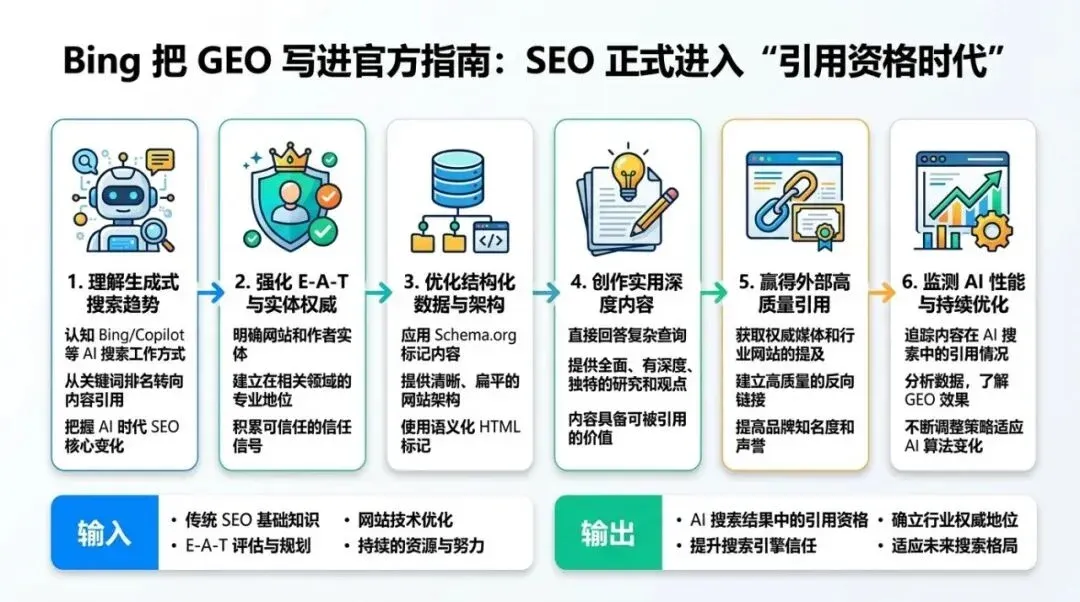
Flowchart used to explain the methodological execution path.
03
Uncle Guo’s Perspective
I suggest treating today’s changes as an “organizational-level” upgrade rather than an “optimizer’s trick” upgrade. What you really need to do is turn GEO into an actionable content and technical governance process.
Here is a “three-stage approach” I believe is executable; you can use it to launch your projects:
-
01 Strategy Stage: Define stance, then define rules
-
• Which pages do you want to be cited by Copilot/AI (e.g., solution pages, research data, authoritative definitions)?
-
• Which pages do you want to avoid being summarized by AI (e.g., paid content, core tutorials, high-copyright assets)? With this layering, meta directives won’t become a “randomly added” disaster.
-
01 Content Stage: Treat “cite-ability” as a writing standard
-
• Factual statements: Avoid implications; let the machine extract conclusions directly.
-
• Entity consistency: Don’t swap terms for the same concept; reduce ambiguity.
-
• Single-topic pages: Make every URL a searchable knowledge unit.
-
• Front-load key information: AI often decides whether to cite you within the first screen. These sound like “writing tips,” but in an AI context, they are “retrieval usability engineering.”
-
01 Technical Stage: Build “AI presentation control” and “abuse risk defenses”
-
• Make directives like
NOARCHIVE/NOCACHE/NOSNIPPETauditable configurations rather than scattered template elements. -
• Introduce a minimum editorial review process for generative content to avoid being classified as “large-scale generation lacking oversight.”
-
• Strictly prohibit any “prompt injection” tactics. If it’s in the guidelines today, it will be in the penalty cases tomorrow.
One final reminder: The true scarcity in GEO is not “can you be mentioned once,” but “can you consistently be a citable source on a topic.” From this perspective, SEO has returned to the most fundamental competition: Do you provide information gain, and are you an authoritative source?
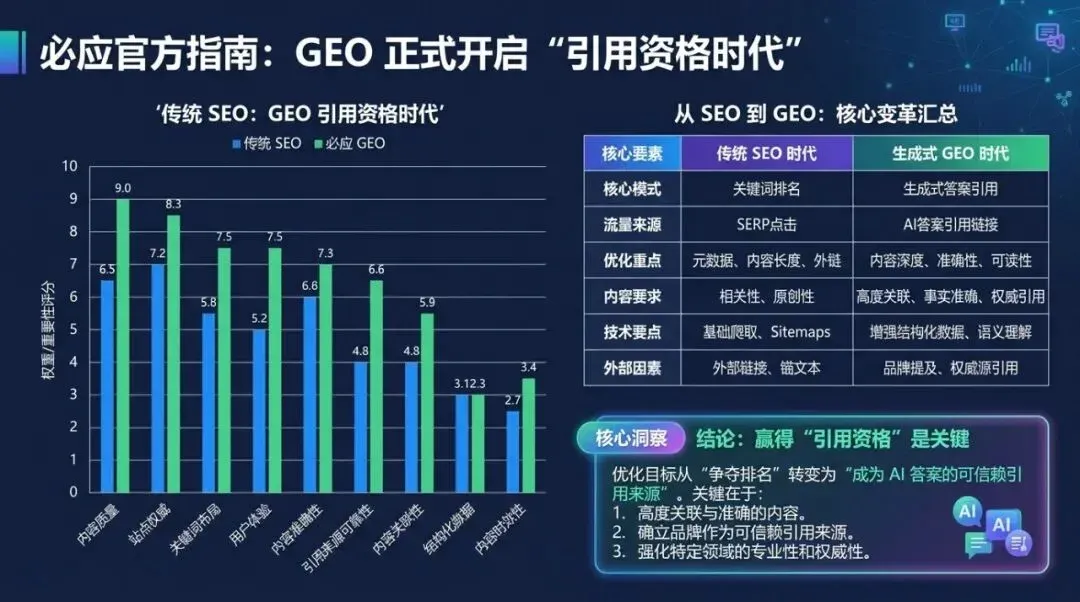
Data chart used to explain key comparisons and conclusions.
04
Quick Glance at Other Key News
The Dark SEO Funnel: 84% of B2B buyers use AI for vendor discovery, distorting traffic metrics
AI completes “discovery and evaluation” before a click occurs, blurring attribution and turning brand keywords and direct traffic into leading indicators. Source: https://searchengineland.com/the-dark-seo-funnel-why-traffic-no-longer-proves-seo-success-470334
Rise of Context-First Strategy: Content optimization shifts from keywords to semantic fields and structural signals
Search Engine Land provides a “context-first” framework, emphasizing chunk-level searchable structures, entity relationships, and site architecture. Source: https://searchengineland.com/context-first-publishing-strategy-ai-search-470359
Google Patent Hints: Future searchers may land on AI-generated pages instead of original webpages
Such patents don’t mean immediate implementation, but they reveal Google’s long-term direction of keeping users within its own ecosystem. Source: https://searchengineland.com/google-patent-hints-searchers-will-land-on-ai-generated-pages-and-not-web-pages-470499
Google publishes Google Ads Passkey help document, bringing ad account security to the forefront
Passkeys and account security directly impact ad delivery continuity, especially amid rising credential attacks. Source: https://searchengineland.com/google-publishes-new-google-ads-passkey-help-doc-470505
Microsoft Ads launches self-serve negative keyword lists, improving campaign management efficiency
More granular negative keyword governance will become one of the “daily engineering” tasks for ad teams. Source: https://searchengineland.com/microsoft-ads-launches-self-serve-negative-keyword-lists-470517
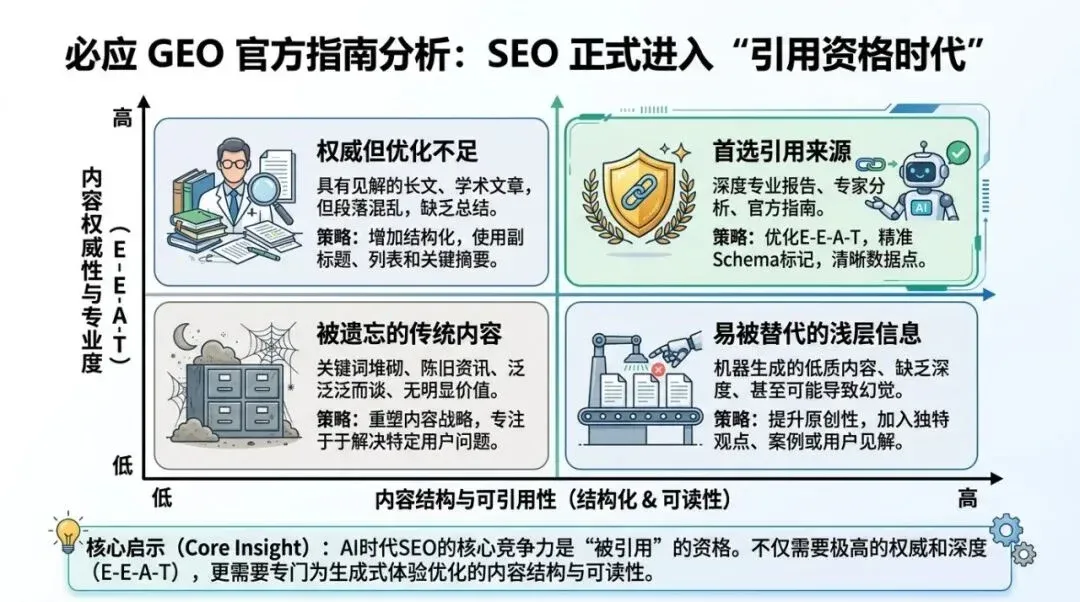
Matrix chart used to illustrate applicability boundaries and strategy selection.
05
Trends and Opportunities
Bringing today’s headline down to “opportunities,” I see three lines worth betting on immediately:
-
01 GEO Engineering: Content structuring, entity consistency, versioning, and review processes centered around “citation eligibility” will become the basic skills of the new generation of content teams.
-
02 Control and Compliance Productization: Meta directive strategies, content-layered governance, and AI usage boundaries will spawn a batch of “AI visibility governance” tools and services.
-
03 Measurement System Reconstruction: As clicks increasingly become lagging indicators, organizations will need to incorporate “citations, recommendations, brand search changes, and self-reported lead attribution” into a unified dashboard.
If you are working on global expansion and B2B growth, I suggest writing this into your quarterly OKR: Shift from chasing rankings to becoming a source. In the AI era, the eligibility to be cited is, in essence, the new right to distribution.