
ChatGPT Ads Are Coming, But They Are Not the Next Google Ads
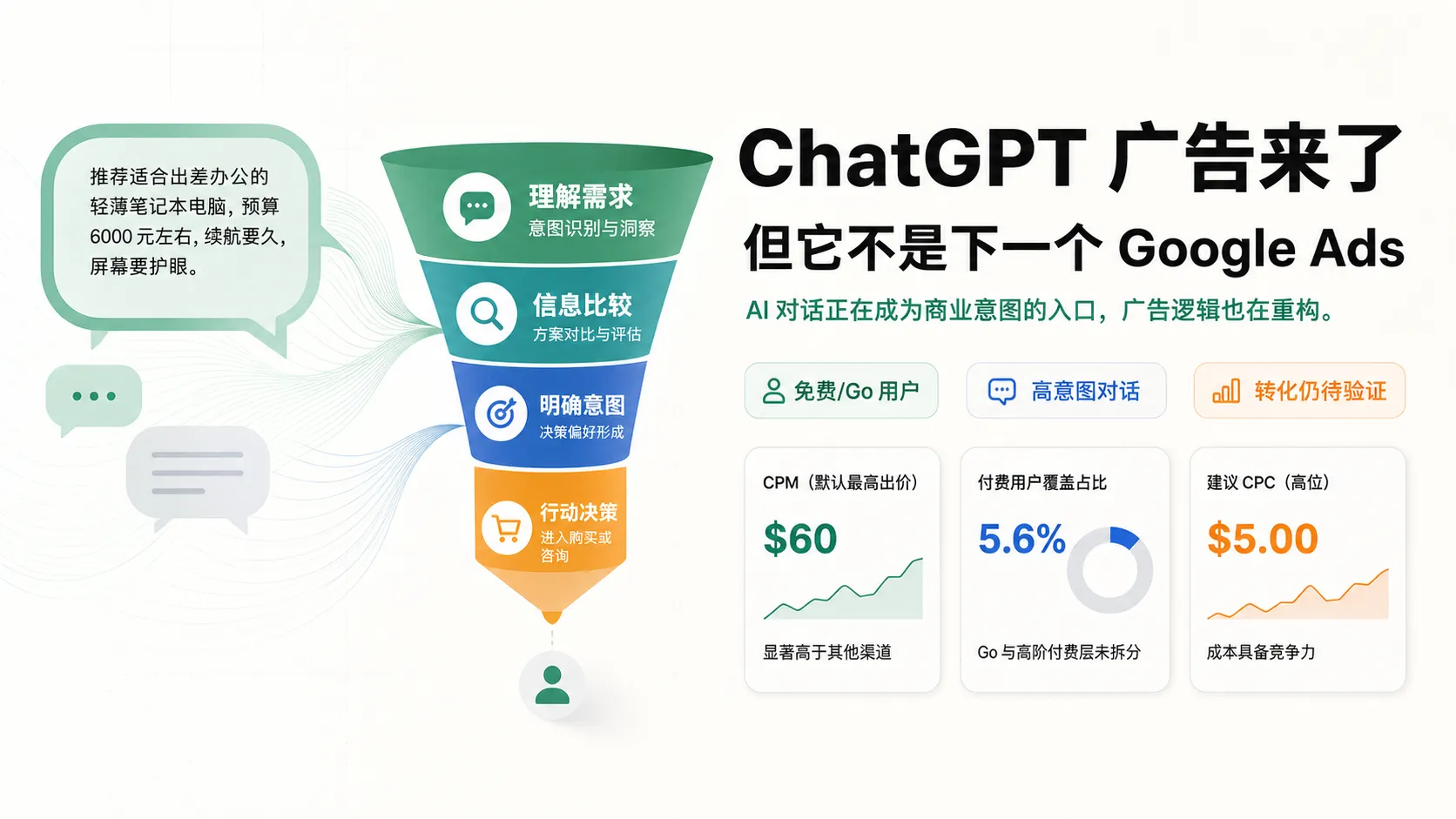
Are ChatGPT ads suitable for what kind of products?
Who exactly do they reach?
Are they expensive?
Is there a new channel bonus?
Do they represent a new generation of search ads, or is this just high-priced display wrapped in an AI aura?
Do they work better for B2B or for B2C?
These are the questions you are probably asking. Today, I want to break this down clearly.
Let me put the conclusion first. ChatGPT ads are already moving toward performance marketing, especially after June 5, 2026, when OpenAI opened conversion-optimized campaign types for advertisers who pre-connect Pixel or the Conversions API. This is a key signal. It shows OpenAI is no longer only selling exposure near AI chat answers. It is trying to let advertisers buy by conversion, CPA, and ROAS the same way old channels do.
But that does not mean it has become Google Search Ads.
It looks more like a new high-intent ad entry point. Users ask questions, compare options, and do pre-purchase research in ChatGPT, and ads can appear beside that decision context. The catch is this: ChatGPT ads currently do not cover the highest-paying, highest-value professional users. They mainly reach Free and Go users.
That is why this is subtle but important.
OpenAI may hold a huge traffic pool, but the users who can truly be monetized may not be the priciest segment.
First, let us clarify who is actually covered by ChatGPT ads
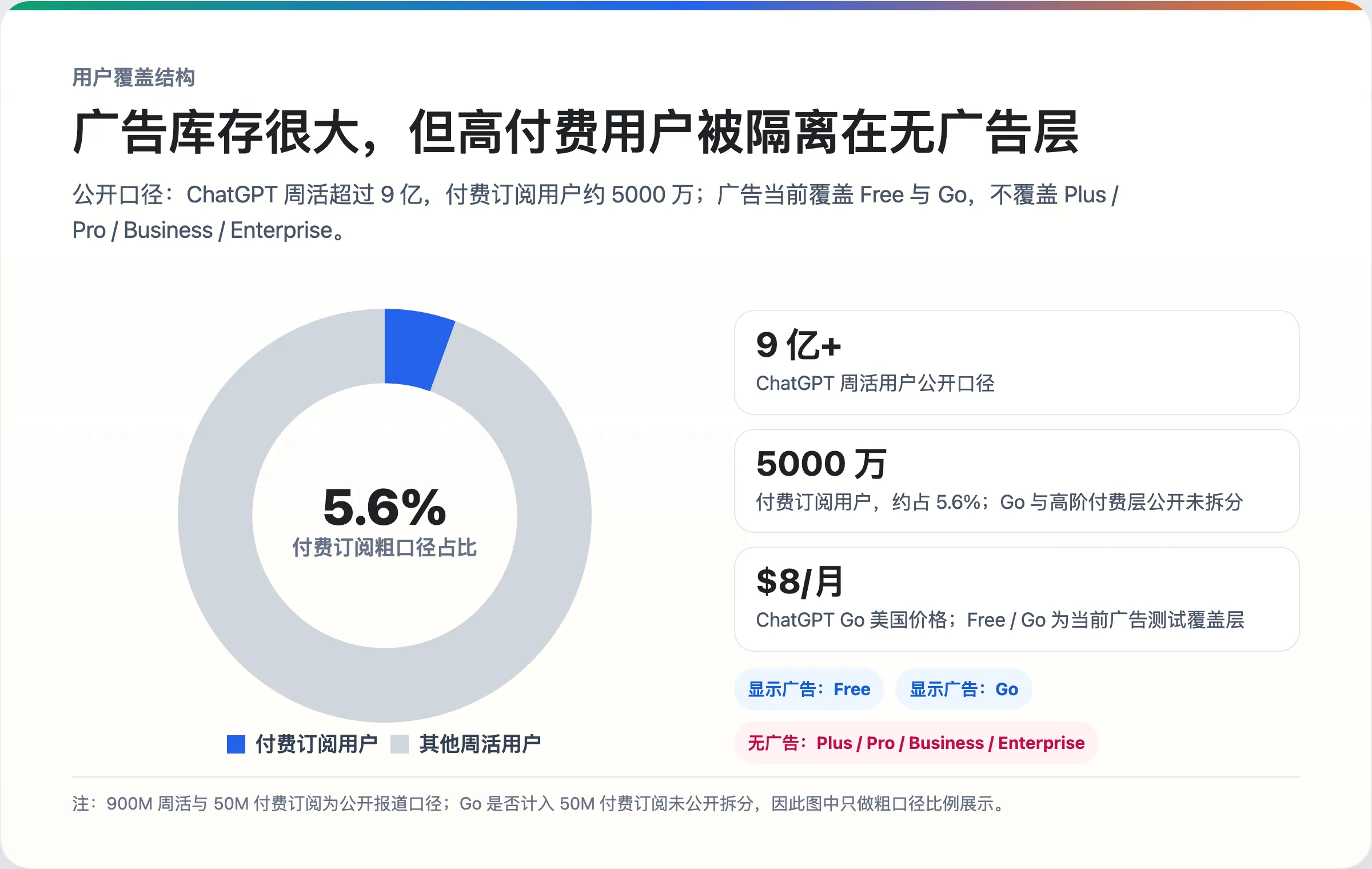
According to OpenAI official help docs, ChatGPT ads are currently shown to Free and Go users in the US, Canada, Australia, and New Zealand. Plus, Pro, and Business users do not see ads, and users under 18 do not see ads either. OpenAI also clarified at the ChatGPT Go launch that in the US, Go is priced at $8 per month and ads are first tested for Free and Go tiers, while Plus/Pro/Business/Enterprise remain ad-free.
This combination of facts is the first commercial layer of judgment.
OpenAI is not selling ads to every ChatGPT user. It is selling ad inventory mainly within free users and lower-tier paid users.
In public numbers, Nick Turley said in February 2026 that ChatGPT had over 900 million weekly active users and 50 million paying subscribers. That implies a rough paid-subscription share of about 5.6%. But there is one caveat: public reports do not clearly break out how many of those subscribers are Go users. If Go users are included, the truly high-paying Plus, Pro, and Business/Enterprise segment is even smaller.
So we can only infer one strong direction now:
Most ChatGPT users are still free or low-paid users. Ad inventory is large, but higher-paying, highly productive, commercially valuable users are likely isolated by ad-free plans.
This is where the difference from Google becomes clear.
Google Search ads are tied to search intent and are not heavily gated by tier. A CEO searching for “enterprise CRM pricing” and a student searching for “cheap CRM tool” both can trigger ads. ChatGPT works differently: the more people pay heavily for AI, the more likely they are excluded from its ad system.
That is not a small detail.
It directly changes how advertisers evaluate audience value.
Price is not cheap, but you should not read CPM alone
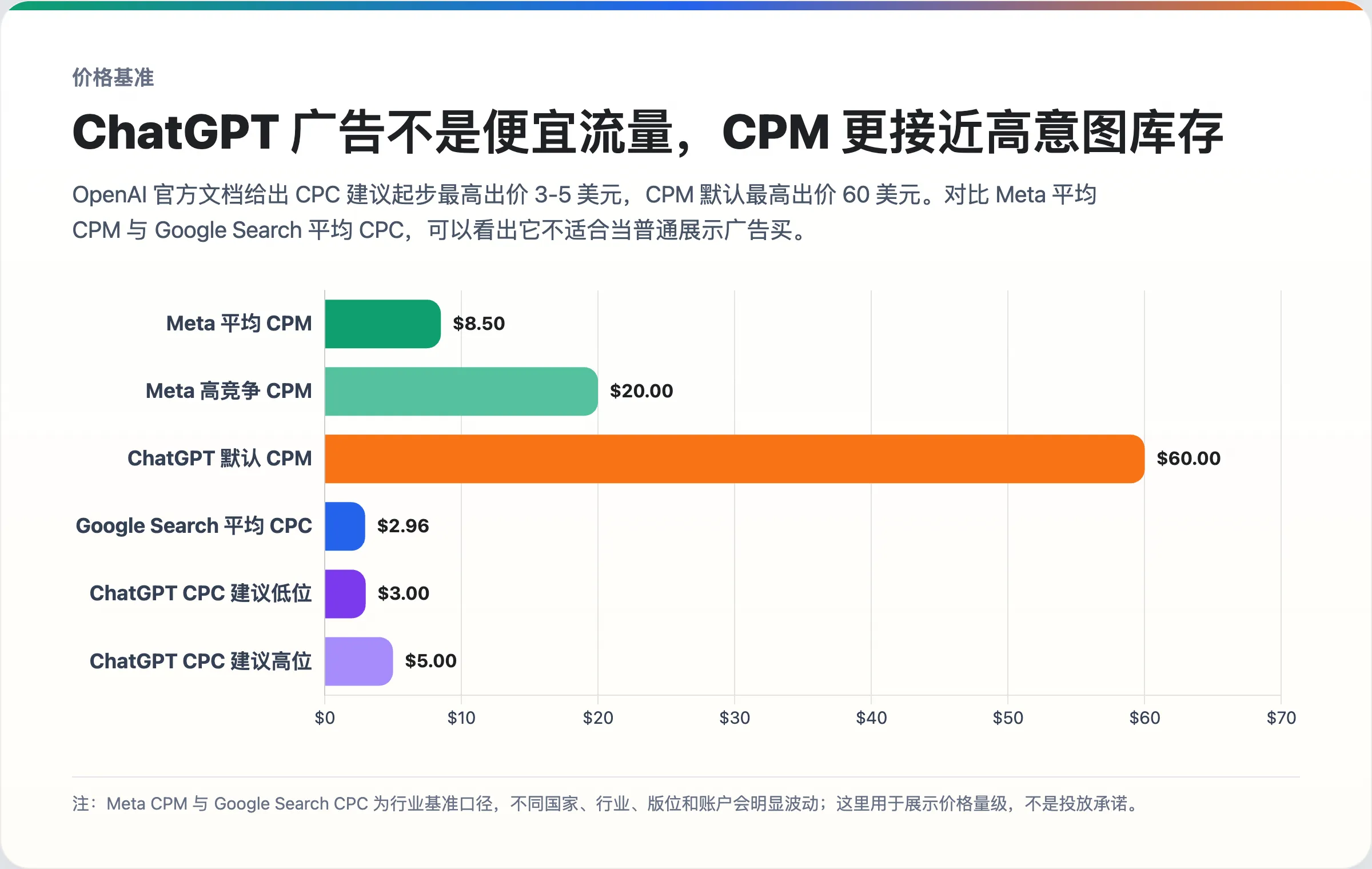
OpenAI docs currently list important pricing mechanisms: ChatGPT ads support both CPM and CPC buying models. CPC can set a custom max bid, with OpenAI suggesting a starting upper range of $3 to $5. CPM campaigns have a default max bid of $60 CPM.
That $60 CPM looks high on paper.
For comparison, Meta average CPM in 2026 has been around $8.5, with broad variation by region, placement, and audience. Narrow audiences and B2B in US/UK may push it over $20. In other words, the default $60 CPM is not a normal social ad price, and is more in the mental range of premium streaming, LinkedIn, or high-intent B2B inventory.
Now compare with Google Search CPC. The benchmark varies by report, but one common 2026 average is around $2.96 CPC, with average conversion near 4.40% and CPA around $53.89 per conversion. Some industry benchmarks report even higher CPCs. No matter which baseline you use, OpenAI’s suggested $3 to $5 CPC is not absurd, but it is far from cheap traffic.
The real metric is effective CPC.
If you buy at $60 CPM and CTR is 0.68%, 1,000 impressions yield about 6.8 clicks, so effective CPC is about $8.82.
If CTR reaches 1%, effective CPC is $6.
If actual market CPM drops to $42 with 1% CTR, effective CPC becomes around $4.20.
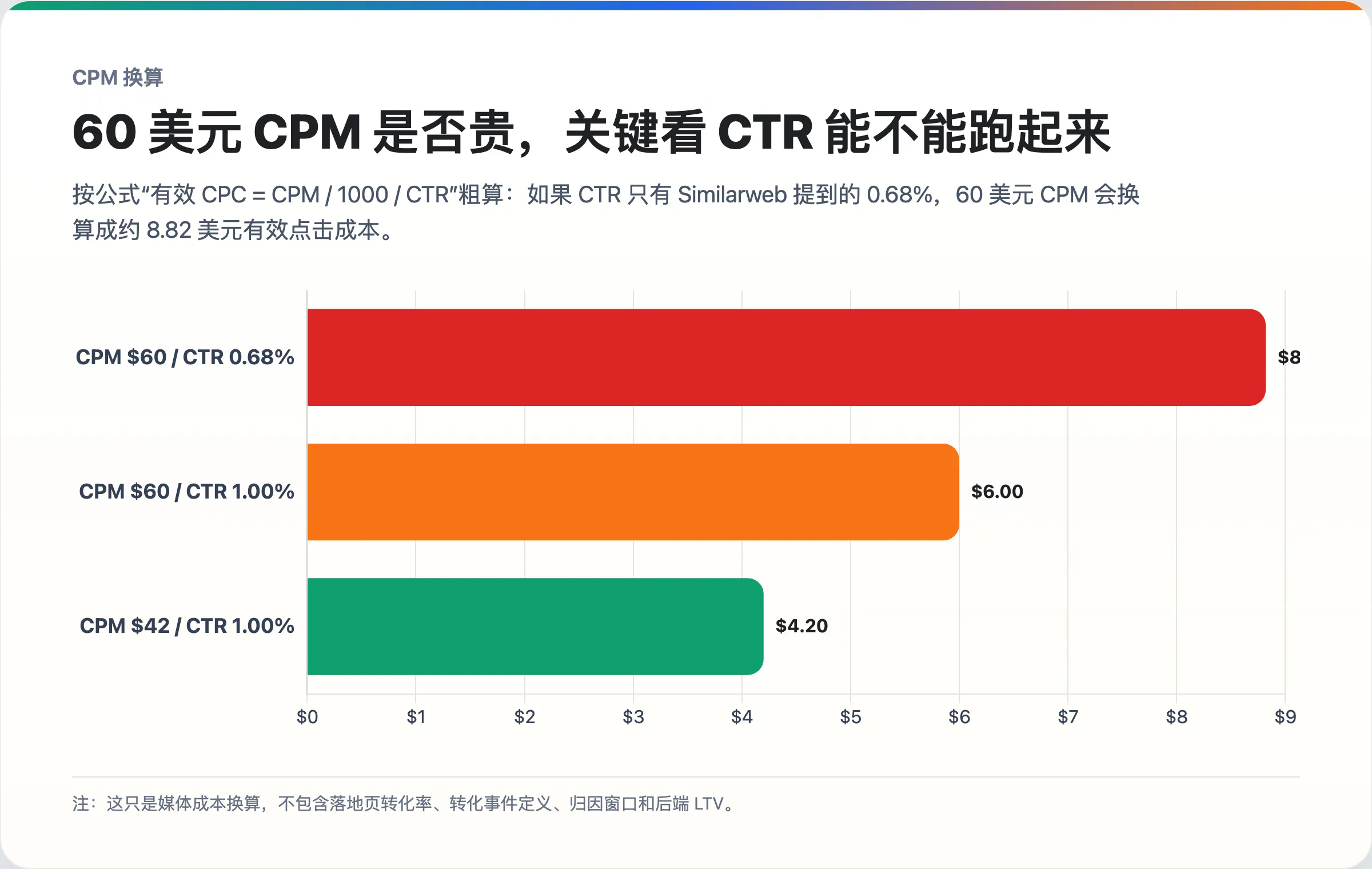
As I will mention again below, Simlarweb-type data also puts ChatGPT ad CTR around 0.68% on average, which is still relatively expensive at that benchmark.
If you treat it as pure display, $60 CPM is risky. But if you get truly high-intent conversation context—users comparing tools, options, purchases, or service choices—it can behave more like recommendations that happen before or during search, not passive display.
That is why I say it should not be simply compared to Meta, and not simply compared to Google.
Meta interrupts users while they scroll. Google catches users while they actively search. ChatGPT inserts a sponsored option after an AI assistant has already processed your question and is offering answers.
Those are three very different user mindsets.
Is there a channel advantage?
My judgment: there is a channel advantage for some products, but it is not a broad platform windfall like the old mass scaling era of FB ads. For complex, high-ticket categories, there may be an early-phase advantage now, but coverage and pricing constraints still dominate risk if you overbet this single lever.
Now let us separate AI referral traffic from ChatGPT ads
Many people argue that ChatGPT ads must be efficient because AI-driven traffic has high conversion rates. That logic needs care.
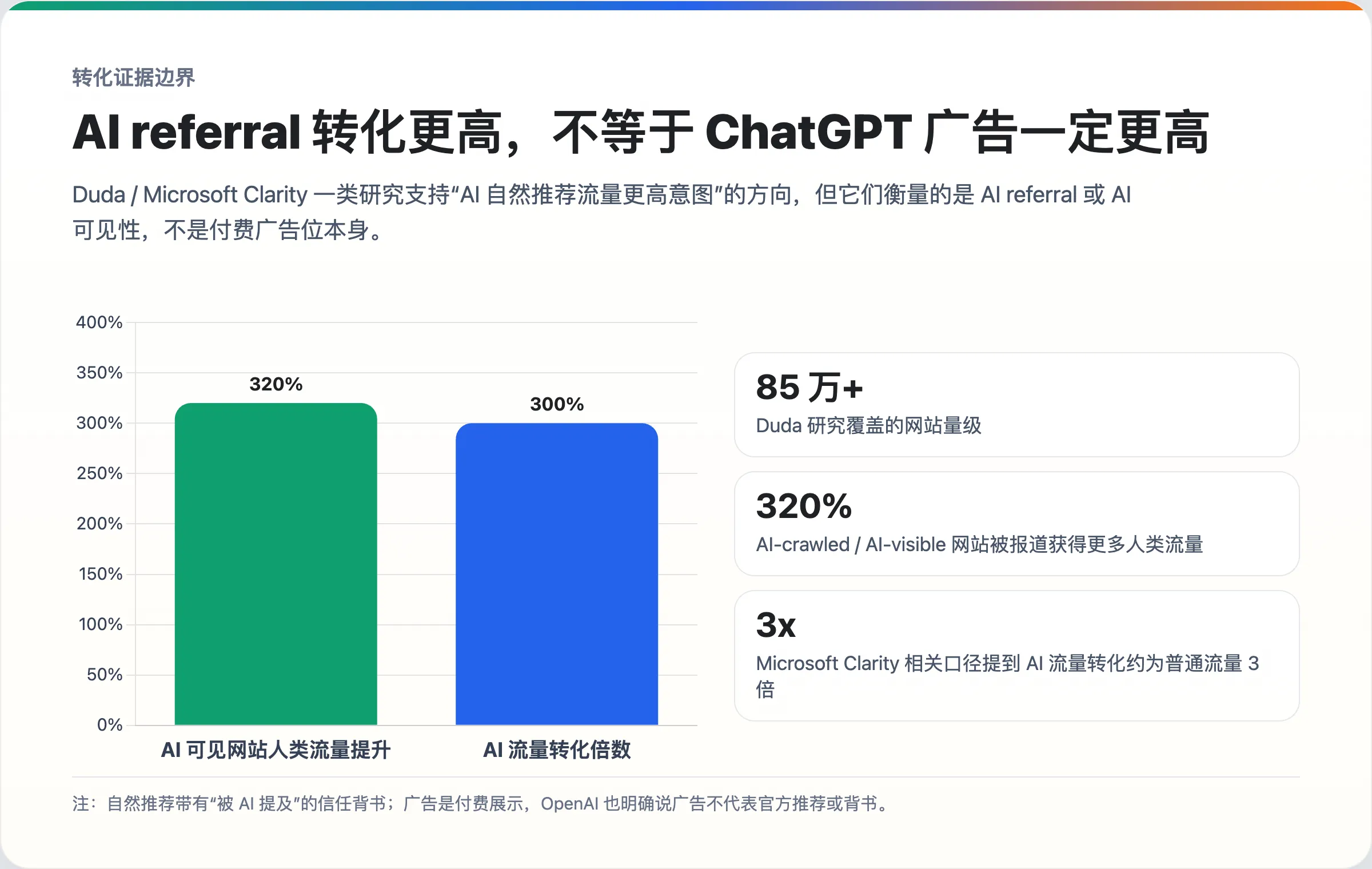
Current signals do suggest that organic traffic from AI search or AI recommendations often converts better than generic organic search. For example, Duda’s analysis of over 850,000 websites found AI-visible sites getting more human traffic and higher form and phone-click activity. Microsoft Clarity-type studies are also cited with claims of roughly triple conversion versus normal traffic. TechRadar’s interview highlighted that AI search may reduce low-intent browsing traffic since users have been pre-screened by an assistant.
I agree with this direction.
From a behavior perspective, users asking ChatGPT “What should I buy” or “Which option suits me” are already much closer to decision stage than generic information traffic.
But this is the key caveat:
AI referral conversion is often boosted by “being recommended” by ChatGPT, Perplexity, or Gemini. Users may click because the model mentioned a brand directly and gave implicit trust cues.
Ads are a different mechanism.
OpenAI documents state clearly that ads are paid placements and do not imply recommendation or endorsement. Appearing below an answer and being naturally referenced by the model are psychologically different paths.
So we cannot conclude “AI-recommended traffic converts well” means “ChatGPT ads also convert equally well”.
Think of it this way: a creator who recommends a product with genuine belief may get good conversion. It does not imply paid placements by that creator will automatically convert at the same rate. Audiences are not naive, and users are not naive either.
ChatGPT ads themselves still have limited public conversion data. Search Engine Roundtable cites Similarweb figures: overall CTR around 0.68%, top 25% around 1%, best brands up to 1.57%, and peaks near 5.4%. This is somewhat better than generic display, but still not a clear dominance over high-intent search-style channels.
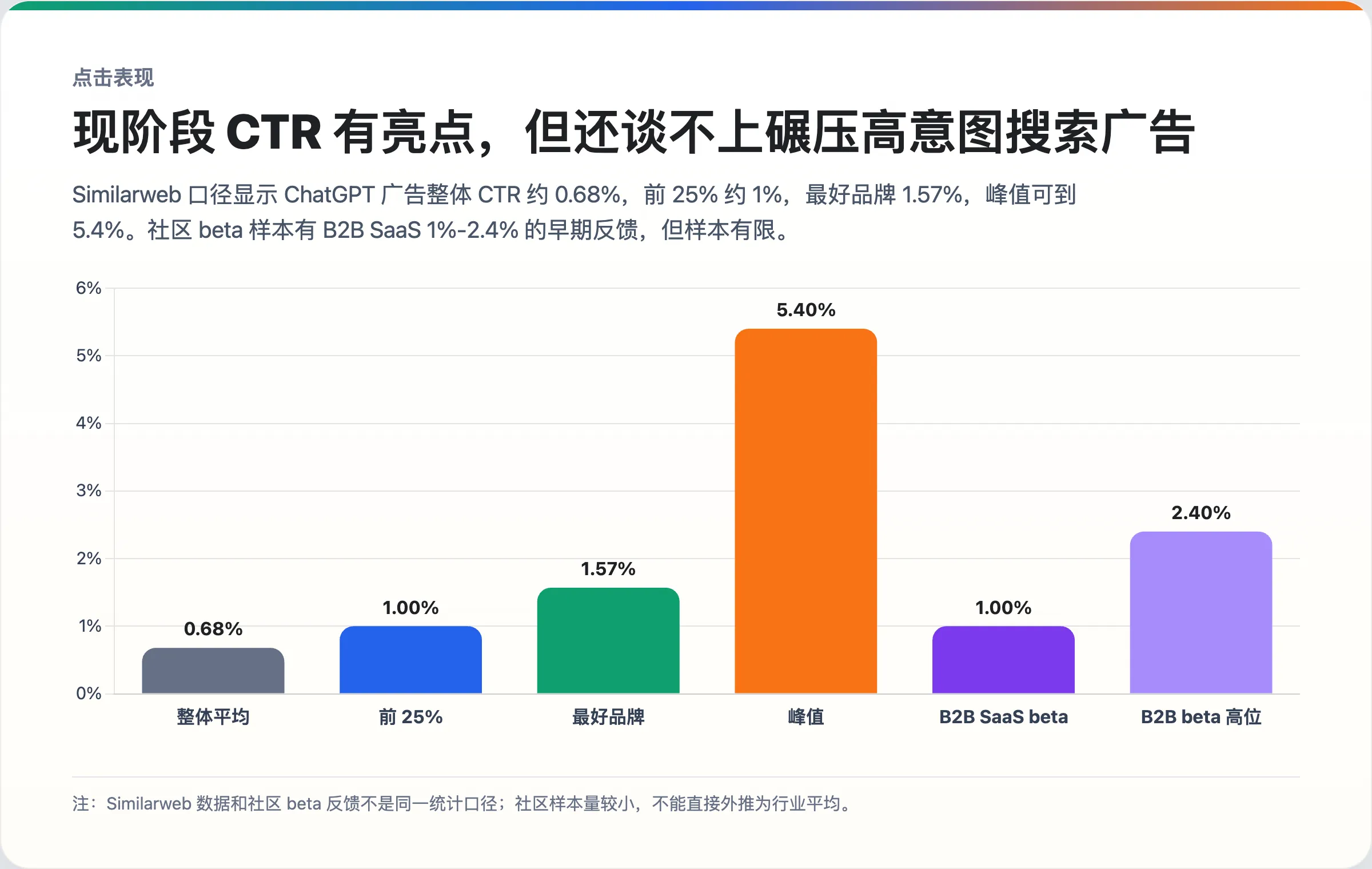
Reddit PPC users also shared early beta examples. Some B2B SaaS ad groups showed roughly 1% CTR, with some cases near 2.4%, but sample sizes were only a few hundred impressions. Comments also mentioned conversion cost being two to three times Google Ads in some cases. These insights are useful anecdotes but not industry-level proof.
So my phase judgment is this:
The “intent quality” of ChatGPT ads is worth testing, but its “conversion efficiency” is not yet proven at scale.
The most sensible use today is hypothesis-driven testing, not large blind budget bets.
Where it fits better: high-consideration and comparison-heavy products
What kinds of sectors fit best?
Start with policy boundaries. OpenAI ad policy says initial testing supports mainly lifestyle and home goods, local services, travel and experiences, digital products, and education. Sensitive regulated sectors like finance, healthcare, or legal are case-by-case and generally cautious. Dating, sexual content, health-effect claims, alcohol and drugs, and politics are not preferred in early rollout.
This already narrows the map.
ChatGPT ads are not for “every ad”. They are better for products where users genuinely ask AI questions, compare alternatives, and weigh differences.
Examples:
- Digital products, SaaS, productivity tools, AI tools, education courses, career training, travel planning, home improvement, local professional services, and subscription offerings with clear explanatory value.
What are they not good for?
- Very low-ticket, impulse, and purely visual products. For example, low-priced fashion trinkets, cheap consumables, pure emotion-led discovery products. Those may perform more naturally on TikTok, Meta, or Instagram Reels, where users are already in a mood-driven browsing loop. Most users in ChatGPT are not there for emotional stimulation; they are there to solve problems.
That sentence matters:
ChatGPT ads are not a “discovery spray”. They are more like a “consultation layer”.
If your value proposition needs explanation, ChatGPT can help. If you rely mostly on visual impulse and short emotional persuasion, ChatGPT may not be your best fit.
Low-ticket products struggle under current cost structure
Let us run a rough math model.
Assume you buy by CPC at $3 to $5. At 3% landing page conversion, 100 clicks cost $300 to $500 and produce 3 conversions, so CPA is about $100 to $167.
If conversion is only 1%, CPA becomes $300 to $500.
With CPM at $60 and 0.68% CTR, effective click cost is around $8.80. At 3% conversion, CPA is near $294. At 1% conversion, CPA can approach $882.
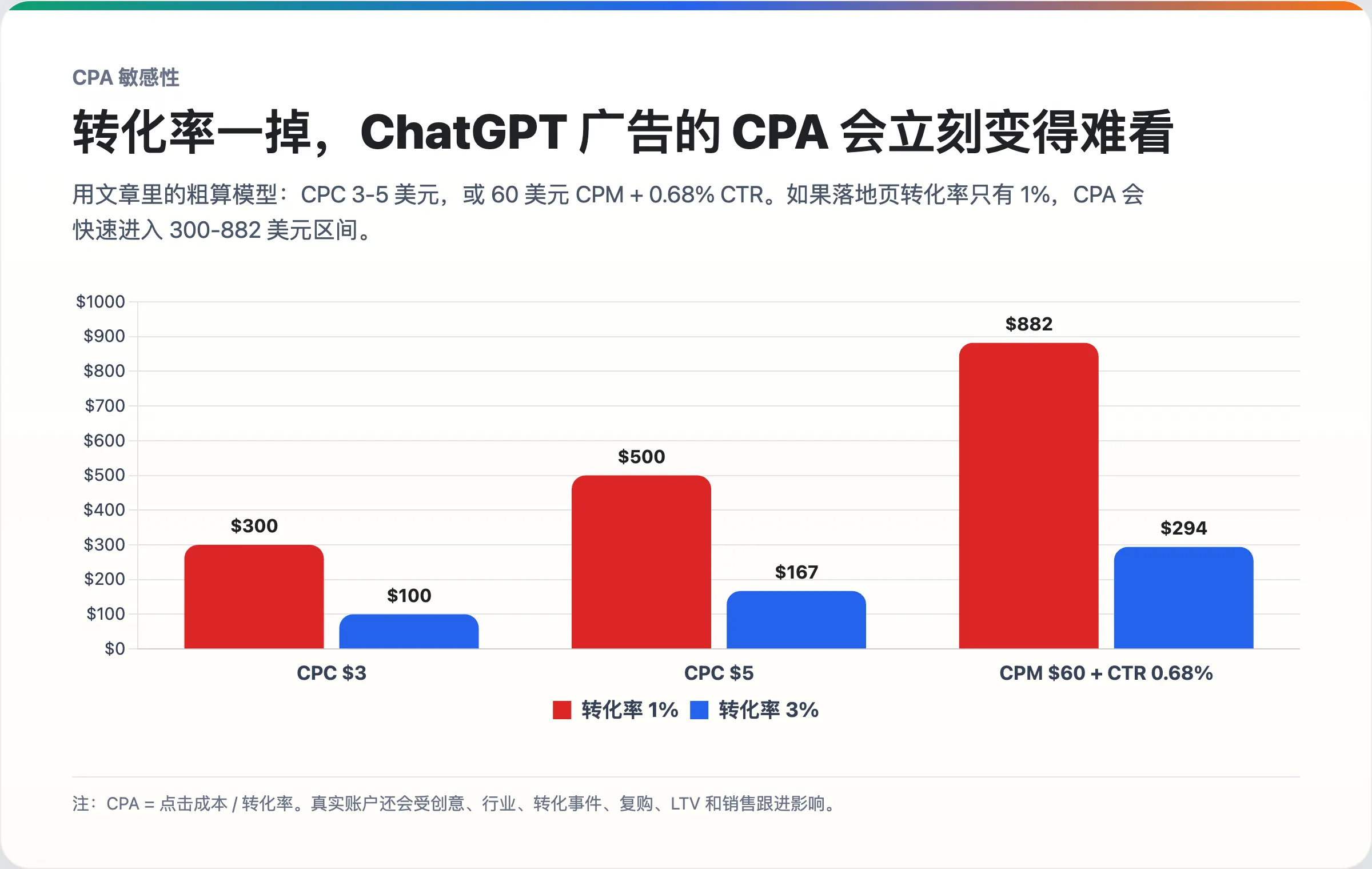
This is rough math only; real account outcomes vary by industry, creative, bid strategy, landing-page quality, and conversion definitions. But it reveals the core reality:
ChatGPT ads are hard to support for low-margin, low-ticket, low-repeat models.
If your product is around $30 to $50 and margins are average, unless your lifetime value and repeat behavior are much stronger, clicks can quickly eat economics.
By contrast, for $300+ courses, local services at several hundred to thousands per lead/customer value, SaaS annual contracts in the hundreds to thousands, or B2B leads with high value, this channel is worth testing seriously.
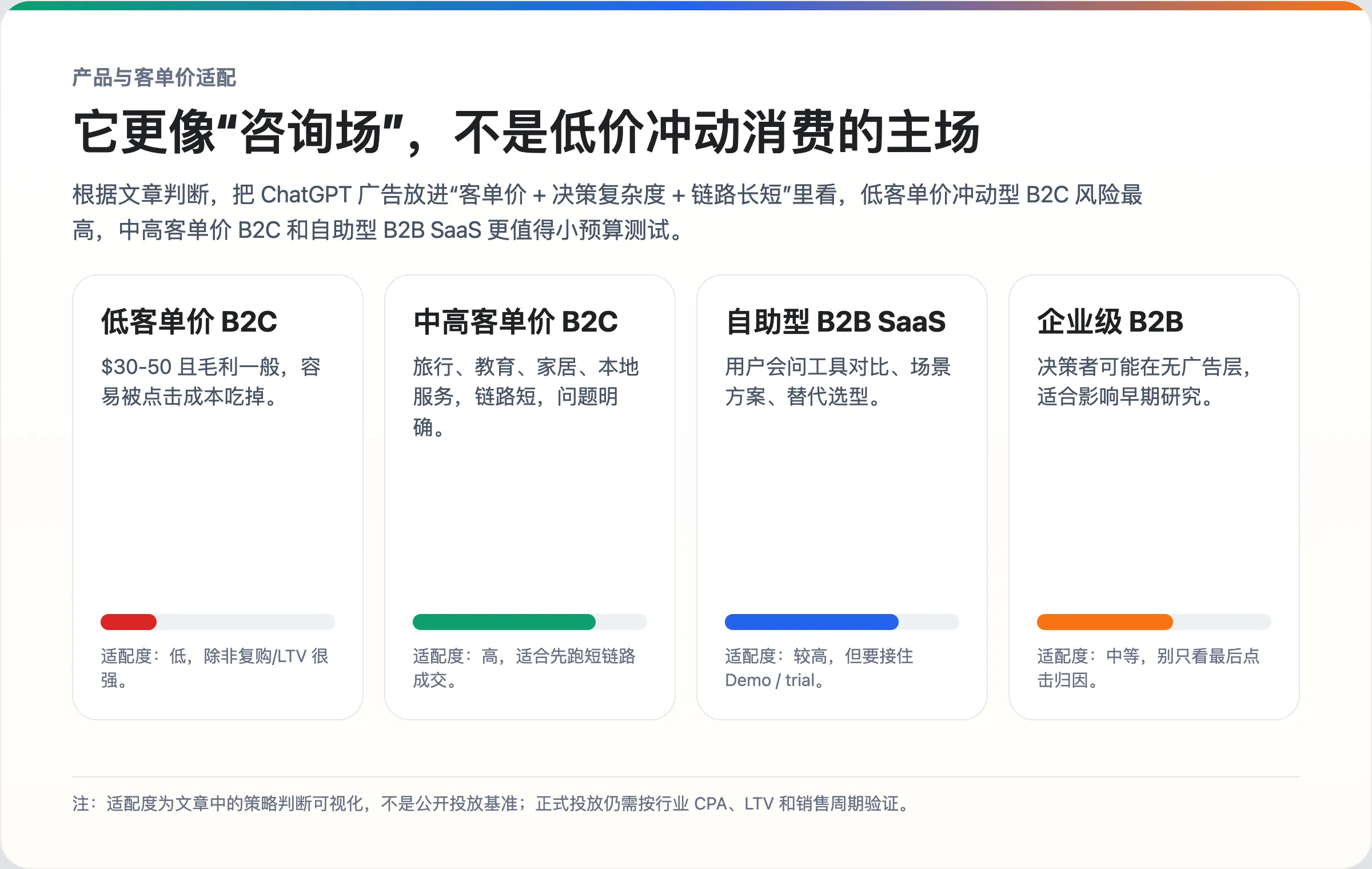
A rough segmentation:
- Low-ticket B2C: proceed carefully unless subscription LTV and repeat cycles are very strong.
- Mid-to-high-ticket B2C: worth testing, especially travel, education, home, local services, and complex consumer products.
- Self-serve B2B SaaS: testable, especially for products users compare inside ChatGPT conversations.
- Enterprise B2B: more cautious. The reason is not ‘unsuitable’ but because real decision-makers may be Plus/Pro/Business/Enterprise users with no ads. You may reach researchers, operators, and consultants rather than final approvers.
This is critical for B2B.
ChatGPT ads can influence the “problem definition” stage, not always the final procurement decision stage. It can place you into a user’s consideration set during solution research, but website, case studies, comparison pages, demos, and sales follow-up still need to convert.
So for B2B, you should judge not only last-click conversion. Think of it as early-intent capture + list-inclusion.
B2B vs B2C: who has the stronger edge?
If you only evaluate short-term direct conversion, mid-to-high-ticket B2C and local services may produce results earlier because the chain is shorter.
Example queries in chat often convert faster if ad placement is natural and the landing page is strong:
- “Should I stay in Shinjuku or Ginza next month?”
- “Which air purifier works in a small apartment?”
- “How do I choose a reliable orthodontic consultation nearby?”
- “Is there a beginner AI course for me?”
For B2B, the long-term value is larger.
B2B users do substantial pre-research: tool comparisons, tech stack decisions, vendor shortlists, implementation scope, ROI math, and alternatives analysis. These activities used to happen in search as high-value keyword behavior. Now a portion is moving into conversational research.
However, B2B has two hard constraints.
First, ChatGPT ads currently lack LinkedIn-like firmographic targeting. You cannot target by company size, title, or seniority with the same precision. OpenAI mainly uses conversation context and advertiser-provided context hints, which is closer to intent targeting than identity targeting.
Second, many B2B high-value users may remain on ad-free plans. Plus, Pro, and Business/Enterprise users do not see ads, which weakens direct reach to budget decision-makers.
So my judgment is simple: B2C should test for quicker CPA and order-rate signals; B2B should test for longer-cycle impact.
B2C tracks CPA, ROAS, and checkout rate. B2B tracks lead quality, demo rate, candidate-list inclusion, and whether later brand search or organic AI mentions rise together.
If a B2B team treats ChatGPT ads as a substitute for Google Search Ads, disappointment is likely. If it integrates ChatGPT ads with AEO/GEO, comparison pages, product docs, and case content, it may claim a larger share of AI research-stage minds earlier.
The real shift is not ads alone, but the buying scene
In the past, buying flow looked like this:
Search a keyword, read ads, read SEO articles, watch evaluations, check Reddit, watch YouTube, visit official site, then decide.
Now users may instead ask directly:
Which one fits my situation? Which differences matter between these options? Are there hidden risks? Which choice is best within my budget?
If ChatGPT can influence a user’s candidate set during this stage, ads can be useful. But ad visibility is just the top layer. Below that are bigger levers: whether your brand is visible to AI systems, whether your product info is understandable, whether your website has clear comparison pages, whether price and features are explained clearly, whether reviews and third-party proof feel credible.
So ChatGPT ads are not a standalone channel.
They work together with GEO, AEO, brand mentions, product feeds, content architecture, landing pages, and conversion tracking.
OpenAI now enabling Pixel, Conversions API, CPC, CPM, and conversion-focused campaign types is effectively turning ChatGPT from a question-answer interface into an ad system that can capture commercial intent.
This direction is definitely worth watching.
But it is not a mature solution yet.
How I would suggest teams test this in practice
If I advised a global-growth team, I would not start with a huge budget. I would ask these questions first:
First, is your product something people naturally ask AI about? If users do not search your category in ChatGPT, do not rush. For items like “a pair of socks” or “a phone case”, users are more likely to be activated on e-commerce, short video, or social feeds. ChatGPT may not be the battlefield.
Second, can your unit economics support CPA tests in the $100 to $300 range? Do not be misled by the seemingly low starting CPC of $3 to $5. If conversion does not scale, CPA can deteriorate quickly.
Third, do you have landing pages that can handle AI-research traffic? Users arriving from ChatGPT often need comparisons, pricing clarity, target audience fit, real use cases, FAQs, constraints, and refund rules. A Meta-style emotional landing page may not match this stage.
Fourth, is conversion tracking already wired correctly? Search Engine Land clearly states OpenAI conversion-optimized campaigns require Pixel or Conversions API setup in advance. Without measurement, ROI is meaningless. New channels can look glamorous but remain opaque.
Fifth, are you also improving natural AI visibility? This is easy to miss. If users have not seen you in model recommendations, ads alone are a weak insert. If the model already mentions you, ads can reinforce. If the model mentions competitors, and you only buy placement below, outcomes become less certain.
So the right testing posture is not isolated ad spend.
It is “ads + citeable content + comparison pages + structured product info + conversion instrumentation” as one bundle.
That is the only way this looks like an actual system rather than a shot in the dark.
Final quick takeaway
My view: ChatGPT ads are worth studying and worth small controlled tests, but not worth overhyping into a full replacement narrative.
It is not the next Google Ads, at least not yet.
Google Ads has strength from active search intent, mature bidding ecosystems, conversion attribution depth, long-standing ad optimization patterns, and commercial infrastructure. ChatGPT ads are only now beginning to assemble those components. It has a powerful entry position, but not a fully mature advertising market yet.
It also has a structural tension.
ChatGPT is valuable because users trust it. Once ads sit in that trust relationship, OpenAI has to keep trust signals intact. OpenAI repeatedly states that ads do not alter answers, chats are not sold to advertisers, and ad labels are explicit. All of that is important. But in business reality, the test is not whether policy text is beautifully written. The test is whether the platform can preserve trust while ad revenue scales.
AI chat is now clearly entering serious performance-ad spend.
But it is not simply consuming traditional ad budget.
It is consuming trust during the decision-making stage. And that is much more expensive than raw traffic.
References
- OpenAI Help Center: Ads in ChatGPT: The Basics
- OpenAI: Our approach to advertising and expanding access to ChatGPT
- OpenAI: Introducing ChatGPT Go, now available worldwide
- OpenAI Policies: Ad policies
- Search Engine Land: OpenAI confirms conversion-focused ads are coming to ChatGPT
- Search Engine Roundtable: ChatGPT Ads Conversion-Optimized Campaigns Coming June 5th
- Search Engine Roundtable: Similarweb Data: ChatGPT Ads Click-Through Rates
- Axios: OpenAI launches self-serve ad platform
- Economic Times: ChatGPT crosses 900 million weekly users, 50 million paying subscribers
- TechRadar: AI-crawled sites generate 320% more human traffic
- arXiv: Ads in AI Chatbots? An Analysis of How Large Language Models Navigate Conflicts of Interest
