
Digital Strategy Review | 2026
ChatGPT E-commerce Conversion Rates Surpass Organic Search: SEO Shifts from “Traffic Competition” to “Intent Competition” | Uncle Fruit’s SEO Daily
By Uncle Fruit · Reading Time / 8 Min

Foreword
This daily report is based on the latest four-hour bulletin (2026-02-26 16:00, SEO Trend Bulletin), combined with extended research from the same day’s SEO Trend Daily and the past 24 hours of updates.
If we look solely at traffic volume, ChatGPT is still far behind organic search; however, when looking at conversion efficiency, a critical shift has occurred. The latest milestone sample shows that across 94 e-commerce sites and 12 months of GA4 data, the conversion rate for ChatGPT-referred sessions reached 1.81%, higher than the 1.39% for non-branded organic search—a 31% relative increase. This means the core challenge of SEO is shifting from “bringing more people to the site” to “bringing people closer to a decision to the site.”
01
Today’s Headline News
Today’s headline: ChatGPT e-commerce traffic conversion rates have surpassed non-branded organic search, marking the entry of SEO into an era of “intent-compression-driven” efficiency.
Let’s pin down the key facts first.
Based on Visibility Labs’ analysis of GA4 samples from 2025-01 to 2025-12 (94 e-commerce sites, 135,000 ChatGPT sessions, 9.46 million non-branded organic search sessions), the core metrics are as follows:
-
01
Conversion Rate: 1.81% (ChatGPT) vs. 1.39% (Non-branded Organic Search)
-
02
Traffic Growth: Monthly visits via ChatGPT grew from 1,544 to 18,202, an increase of 1,079%
-
03
Revenue per Session: $3.65 vs. $3.30 (+10.3%)
-
04
Average Order Value (AOV): $204 vs. $238 (-14.3%)
In other words, the “probability of purchase” for ChatGPT-referred traffic is higher, though the “average order value” has not yet surpassed traditional organic search. This is not a contradiction; rather, it reveals a more accurate structure: AI-driven traffic is first gaining traction in categories with lower ticket prices, high intent, and clear decision-making paths, before gradually scaling into higher-ticket scenarios.
Why does this data exist? The core mechanism is “intent compression.”
When users clarify questions, compare solutions, and filter parameters within ChatGPT before clicking through to a site, they are already closer to the “confirm purchase” stage. In traditional SEO, many sessions stall in the early information-gathering phase; ChatGPT, however, front-loads a portion of the “education cost,” reducing friction at the top of the on-site conversion funnel. This isn’t just “AI stealing search traffic”; it is “AI rewriting the state of the user when they arrive at the website.”
However, we should not be misled by a single high conversion rate. Currently, ChatGPT’s share of organic search revenue is still only 1.48% ($474,000 vs. $32.1 million), rising to 2.2% in the second half of 2025. In short, it is not yet the volume leader, but it is already a strong signal of efficiency. For management, these signals are the most valuable because they indicate that the next phase of the budget should be invested in “leverage of quality” rather than the “illusion of scale.”
Core sources used for headline verification and extended research:
-
01
https://searchengineland.com/chatgpt-vs-non-branded-organic-search-conversions-470321
-
02
-
03
https://searchengineland.com/chatgpt-seo-drive-growth-revenue-469966
These three pieces of information, when combined, do not just provide “hot news,” but a management judgment: the growth logic of SEO is shifting from “keyword coverage priority” to “intent hit-rate priority.”
02
Headline Analysis: Why This Matters More
First, it directly changes the logic of budget allocation.
Previously, we often used “more clicks = better growth” for monthly reviews. Now, if we ignore “value per session” and “session maturity,” teams will be misled by inflated traffic. The gap of 1.81% vs. 1.39% is not a minor optimization; it represents a change in channel attributes: one channel acts more like a “demand filter,” while the other acts like a “demand collector.” When budgets are limited, the marginal value of a filter is usually higher.
Second, it reorders SEO team KPIs.
When AI-driven traffic enters the conversion funnel, traditional KPIs (rankings, clicks, organic sessions) are no longer sufficient. At least three layers of metrics should be added:
-
01
Conversion rate and conversion cycle of AI-referred sessions
-
02
Category differences between AI-referred traffic and non-branded organic search (which categories are scaling first)
-
03
“Question types” and “buying motivations” corresponding to AI-referred sessions
If a team only looks at “how much traffic AI brought,” they will underestimate the opportunity; if they look at “which questions brought by AI are closer to a transaction,” they can develop a replicable methodology.
Third, it changes content production goals.
Old SEO pursued “covering keywords”; new SEO (especially AIO/GEO) must pursue “covering decision nodes.” That is:
-
01
What are users comparing?
-
02
What are users worried about?
-
03
What is the final step users confirm before placing an order?
When content directly answers these three types of questions, AI is more likely to cite it in its responses, and the site is more likely to capture high-intent traffic. This change is particularly critical for e-commerce, as e-commerce revenue is ultimately determined by “whether they order,” not “whether they visit.”
Fourth, it is a “slow-variable inflection point,” not a short-term fluctuation.
This data is not single-week noise, but a 12-month span. Furthermore, the traffic gap has narrowed from 70x to 47x in Q4, indicating that structural changes are continuously advancing. Scale and efficiency do not arrive on the same day, but efficiency usually leads, and scale follows. For operators, the truly high-value action is not “waiting for scale to arrive,” but “perfecting the methodology while the scale is still small.”
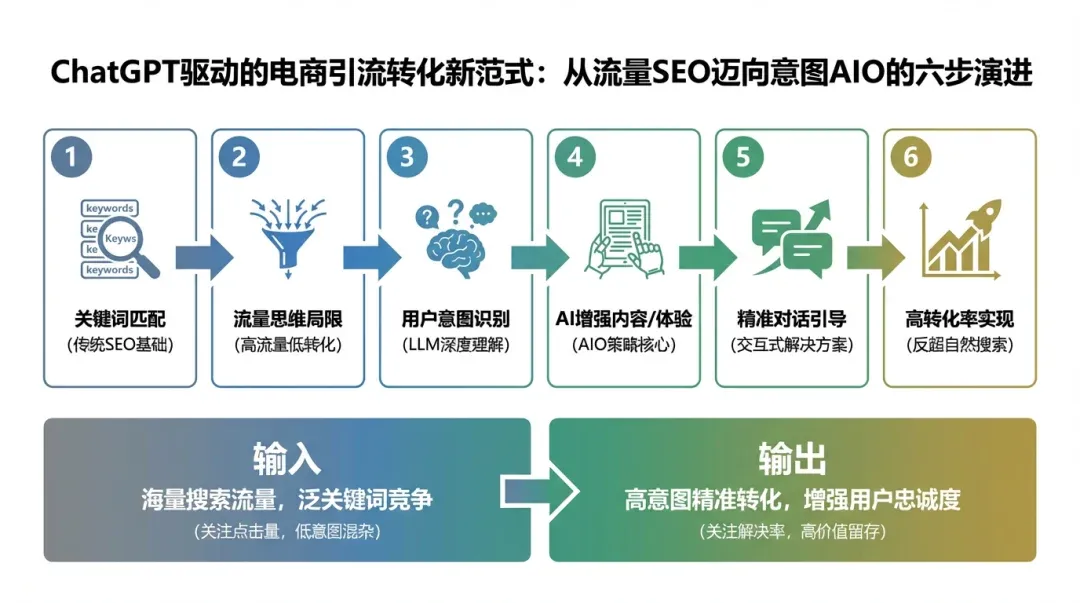
The flowchart is used to explain the execution path of the methodology.
03
Uncle Fruit’s Perspective
My conclusion is clear: The key to winning in 2026 SEO is not “who gets more keywords,” but “who gets the user intent at a later stage.”
If you are an e-commerce team, I suggest taking three steps immediately.
Step 1: Break down by “intent layer” rather than just “keyword layer.”
Divide current organic search terms into four layers: Awareness, Comparison, Filtering, and Decision. Then, cross-check: which two layers does ChatGPT traffic primarily fall into? If you find that AI traffic is concentrated in the filtering and decision layers, you should shift resources from generic traffic content to “high-intent response content.”
Step 2: Create “AI-referral-specific landing pages” instead of using old category pages.
Many sites currently funnel AI traffic directly into traditional category pages, which have high information noise and high conversion resistance. A more effective approach is to build “decision pages”:
-
01
Start with 3 lines of conclusions
-
02
Provide a comparison table
-
03
Define the boundaries of the target audience
-
04
Provide a clear call-to-action (CTA)
This structure essentially seamlessly connects the pre-conversation already completed in ChatGPT to the site, preventing users from having to do their homework all over again.
Step 3: Redo your attribution dashboard.
Stop lumping AI traffic into “other referrals.” A dedicated dashboard should at least include:
-
01
AI channel session share
-
02
AI channel conversion rate, AOV, and revenue per session
-
03
AI channel 7-day and 30-day return/repurchase rates
When you start seeing a combination of “high conversion rate but low AOV,” you can further optimize your product structure: front-load explanations, comparisons, and risk information for high-ticket items to gradually increase the order value of AI-driven traffic.
In one sentence: ChatGPT will not immediately replace the volume of organic search, but it is already rewriting “who closes the deal first.” If you don’t change your methods today, you will continue to receive traffic that “looks high in volume but is actually worthless.”
04
Other Headline News at a Glance
1) Google AI Overviews Impact Paid CTR, Structural Decline of 68%
Fact: Industry samples show that between 2024-06 and 2025-09, after the introduction of AI Overviews, paid CTR dropped from 19.7% to 6.34%, with the most severe decline around 2025-07; however, conversion rates in some industries actually increased. Impact: Fewer clicks do not mean lower value; advertising strategy must shift from “grabbing clicks” to “grabbing high-intent clicks.” URL: https://searchengineland.com/paid-search-pivots-google-ai-overviews-470193
2) AI Response Pattern Optimization Framework Enters Practical Phase (AIO/GEO Focus)
Fact: A new content strategy framework proposes that “whether the brand is mentioned” should no longer be the primary goal. Instead, systematically track three types of reusable patterns: structural patterns (headings, lists, comparison tables, decision frameworks), conceptual patterns (recurring topic clusters), and entity patterns (brand-feature-category relationships). It is recommended to configure 3-5 prompt variants for each key topic and run 20-30 responses across multiple LLMs weekly, extracting patterns that consistently appear in over 75% of outputs. Impact: AIO/GEO is upgrading from “guessing model preferences” to an “observable, reviewable, and iterative” content engineering process. URL: https://searchengineland.com/use-ai-response-patterns-build-better-content-470213
3) LLM Referral Traffic Maintains High Conversion, Coexistence of Scale and Efficiency Mismatch
Fact: A 13-month tracking study shows that while the overall share of LLM referral traffic remains low (less than 2% of total referral traffic), its growth and conversion efficiency remain consistently impressive, with some companies seeing significant traffic growth in the second half of the year. Impact: AI-driven traffic is not an “immediate channel replacement,” but a sentinel signal that “breaks through in high-value scenarios first.” URL: https://searchengineland.com/what-13-months-of-data-reveals-about-llm-traffic-growth-and-conversions-470115
4) OpenAI Confirms ChatGPT Advertising Rollout Will Be Iterative
Fact: OpenAI’s COO stated that commercialization of advertising will be rolled out in phases, emphasizing user experience and privacy constraints. Impact: Commercialization of AI search entry points is highly probable; brands should prepare assets and attribution capabilities for AI scenarios in advance. URL: https://searchengineland.com/openai-coo-says-chatgpt-ad-rollout-will-be-iterative-470231
5) Google AI Mode’s “See More” Mechanism Continues to Affect Product Exposure
Fact: Industry observations show that AI Mode is strengthening the “See more” entry point on some results pages, particularly affecting results related to shopping information. Impact: The completeness of product structured data and comparable information will directly affect extended exposure in AI display slots. URL: https://www.seroundtable.com/google-ai-mode-see-more-button-40746.html
05
Trends and Opportunities
Over the next 2-4 weeks, I believe SEO teams should focus on two main lines of execution: one centered on “intent compression” and the other on “response patterns.”
Main Line 1: Make “High-Intent Capture” a standard operating procedure.
Based on the headline conclusion, an “AI-referral landing template” should be established for every key category:
-
01
Start with conclusions (who it’s for / who it’s not for)
-
02
Follow with comparisons (price, performance, risks, alternatives)
-
03
Provide evidence (real cases, reviews, parameters)
-
04
Drive action (order, consult, save)
This can directly convert the high-intent traffic brought by ChatGPT into transactional actions, reducing bounce rates.
Main Line 2: Turn “AI Response Pattern Analysis” into a weekly rhythm.
I suggest emphasizing this point, as it has clear time value for AIO (GEO): whoever builds a pattern library first will be the first to form compound interest.
A minimal executable closed loop:
-
01
Select 10 high-priority topics
-
02
Prepare 3-5 prompt variants for each topic
-
03
Run 20-30 responses on 3 mainstream LLMs weekly
-
04
Calculate structural/conceptual/entity patterns that consistently appear in over 75% of outputs
-
05
Incorporate these patterns into content templates and launch A/B tests
-
06
Observe changes in AI-driven conversion after 2 weeks
Many teams lose today because they “don’t write enough content,” but they are actually losing because they “lack a stable pattern-learning system.” Models will iterate and citations will drift, but as long as you have a weekly pattern-tracking mechanism, your organization will not be passive.
The ultimate goal is not “being cited by AI once,” but “being consistently selected across a set of key topics.” The former relies on luck; the latter relies on systems.
The one thing this SEO daily report wants to convey is:
From now on, AIO/GEO is not a supplement to SEO, but the main battlefield that will determine the quality of growth over the next 12 months.