
Content Playbook | Chunking · 2025
Structure Your Articles This Way and ChatGPT Will Prioritize Recommending Your Content
A Quick Note
I’ve been chatting with friends in traffic generation lately, and we all agree: traffic entry points are irreversibly migrating from “search boxes” to “chat boxes.”
We used to obsess over SEO to please Google; now we need to start thinking about how to please ChatGPT, Claude, and Perplexity.
This creates a brand new challenge: When users ask AI directly, does your content deserve to be cited?
While running my AI music project, I did an A/B test and discovered something counterintuitive: AI doesn’t like flowery “essays” — it likes chopped up, semantically clear “building blocks.”
Today, I’m sharing this battle-tested “Content Chunking” strategy. If you want to keep traffic in the AI era, this is the foundational logic you must master.

Chunking helps readers, search engines, and AI “lock onto” answers instantly
01
Harsh Reality: AI Doesn’t “Read” Your Article
First, let’s de-mystify this. When ChatGPT answers questions (especially in RAG mode with web search), it doesn’t read from start to finish like humans.
It works more like a “semantic miner”:
-
Scan: It rapidly scans massive text.
-
Slice: It cuts long articles into small “semantic chunks.”
-
Match: It checks which “chunk” best answers the user’s question.
-
Reassemble: It pulls matching chunks and reorganizes them into answers.
Here’s the key: If your article is traditional “long paragraphs, lengthy logic, beginning-middle-end,” AI struggles to slice it cleanly. It’s like trying to cut a bowl of mixed congee with a butter knife — it doesn’t work.
Result: AI can’t understand you, so you fail its “recommendation algorithm” — your content is invisible in AI’s world.
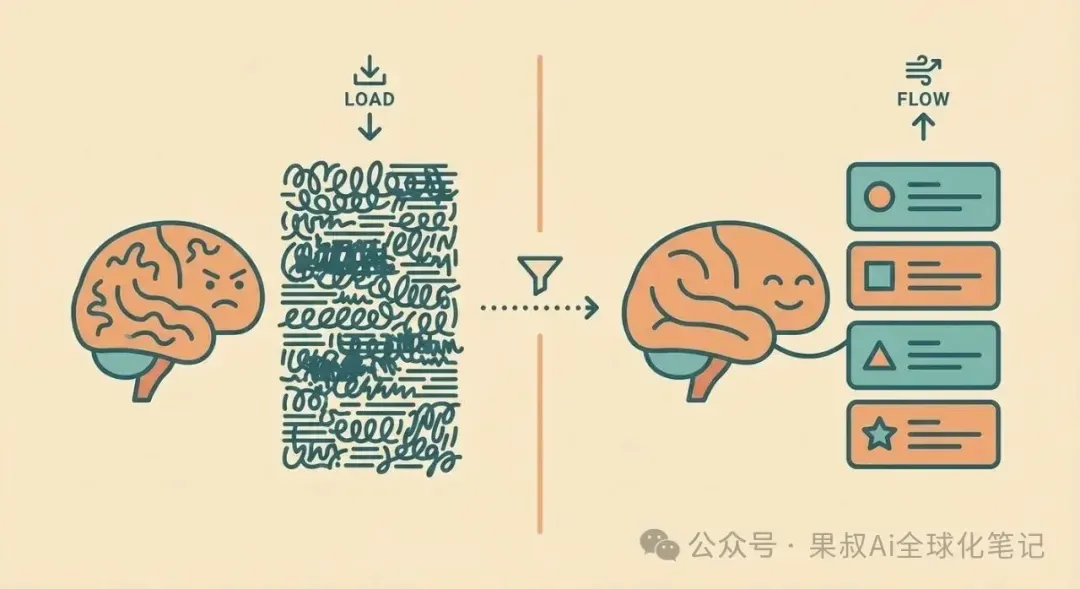
Left: Information walls explode brains; Right: Chunking reduces noise
Research findings: Short-term memory handles about 7 information points simultaneously (Miller’s Law); NVIDIA experiments show page-level semantic chunking makes RAG/AI retrieval more accurate. In other words, chunking is both readability and AI visibility insurance.
02
How Chunking Boosts SEO / AI Visibility
- Lower Bounce & Higher Dwell Time: Clear headings + short paragraphs stop users from “bounce-closing” back to SERP.
- Enables Internal Linking: Each chunk is a natural anchor point for precise linking, strengthening entity and topic networks.
- Crawling & Entity Recognition: Clear H2/H3 outlines let search and AI quickly determine “what this section covers.”
- Capture SERP Features: Definition paragraphs, step lists, table structures are more likely to become snippets/AI Overviews.
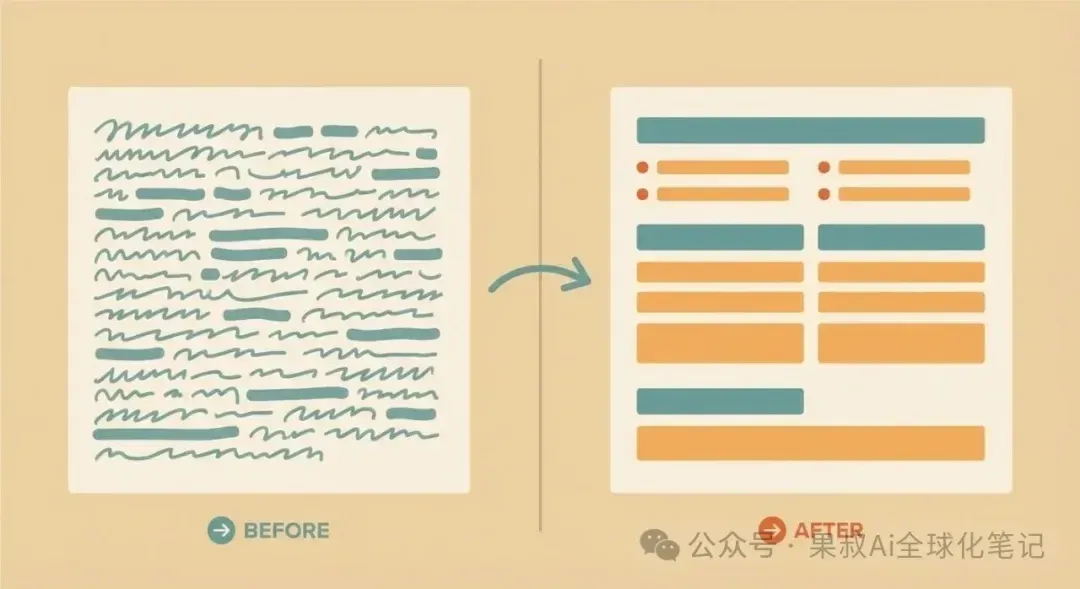
Left: Dense blocks; Right: Structured chunking
For AI, chunking prevents “misjoined” content and “hallucination associations”; for users, chunking is the minimum threshold for consuming content seamlessly on mobile.
03
The Solution: Turn Articles Into “LEGO Blocks”

Macro = H2 main topics; Micro = H3 support; Atomic = paragraphs/points
To get ChatGPT, Google AI Overview, and other AI models to prioritize your content, write articles like “LEGO blocks” — each section is independent, detachable, and semantically complete.
I’ve developed a “Three-Layer Burger” writing model that noticeably improves AI citation probability:
Layer 1: Macro Block (Context) — H2 Headings
-
Signal to AI: “What core problem does this major section solve?”
-
How to Write: Don’t use vague words like “Introduction/Background.” Use “Melogen’s Copyright Mechanism Explained” or “Three Pricing Traps for SaaS Products” — titles with entity nouns.
-
Function: Helps AI build its index.
Layer 2: Micro Block (Answer) — H3 / Strong Paragraphs
-
Signal to AI: “There’s a specific answer fragment here.”
-
How to Write: 100-200 words, structure must be “Conclusion First + Explanation.”
-
Function: This is what AI loves to grab directly as a “citation source.”
Layer 3: Atomic Block (Evidence) — Lists & Data
-
Signal to AI: “This is evidence supporting the answer.”
-
How to Write: Use Bullet Points, numbered steps (1.2.3.), comparison tables.
-
Function: AI extracts structured data with nearly 100% accuracy.
04
Reject “Information Walls”: Live Editing Demo
Theory is abstract — let’s do a real revision.
❌ Before (Traditional writing — humans struggle, AI can’t grab the point):
“About choosing AI music tools, there are actually many options on the market, like Suno and XXXX which are both pretty good. If you’re a beginner, Suno might suit you better because it’s simple to use, but if you need MIDI export for further editing, or you’re a professional producer, then XXXX would be better because it supports multi-track control, plus clearer copyright for commercial use…”
(AI’s view: This is mush — can’t distinguish entity relationships.)
✅ After (Chunked writing — AI loves this):
### Suno vs. XXXX: How to Choose?
The key is your use case.
1. Casual Users -> Choose Suno
Advantage: One-click generation, ultra-low barrier.
Best For: Social media posts, funny video soundtracks.
2. Professional Producers -> Choose XXXX
Advantage: Supports MIDI export (this is the key differentiator), clear copyright ownership.
Best For: Film scoring, commercial projects needing further arrangement.
(AI’s view: Crystal clear structure — when users ask “which tool supports MIDI,” it directly hits the product you want to recommend.)
05
Lazy Hack: Use Prompts to Have AI “Structure” for You
I don’t manually restructure every time. After drafting, I throw it to Claude or ChatGPT with this prompt.
Save this Prompt:
“You are my SEO and AI semantic optimization expert. I’ve written a draft about [topic]. Goal: Make this article easier for search engines and AI chat models (like ChatGPT) to understand and cite. Requirements:
Break up long paragraphs: Split paragraphs over 4 lines, keep ‘one topic per paragraph.’
Structure it: Convert all steps, elements, comparisons into Bullet Points or Markdown tables.
Enhance semantics: Ensure each H2/H3 heading has a direct conclusion statement below it. Output the optimized version directly.”
Here’s a content chunking example from my own project blog: (partial)

Conclusion · Chunking Is Strategy and Delivery Standard
In the past, good articles meant “eloquence”; in the AI era, good articles mean “structure.”
This isn’t just about pleasing machines — it’s respecting readers too. In the fragmented attention era, nobody has patience to dig for gold in piles of fluff. Chunking means serving the gold on a platter.
Starting with your next article, try turning your “essay” into “blocks.” You’ll find not only better engagement metrics, but your “digital footprint” in the AI world becomes increasingly clear.
This is exactly the philosophy we hold while building Melogen AI and Redol AI: leave complexity to the system, deliver clear “blocks” to users.
I hope this pure-value “Chunking Guide” helps you capture the next AI traffic wave.
Found it useful? Share it with colleagues struggling with “information walls.” Got cases to break down? Let’s chat.
