
Digital Strategy Review | 2026
ChatGPT Shopping: The Next Traffic Blue Ocean for DTC Brands
By Mr. Guo · Reading Time: 8 Min
A Quick Note
For those running DTC ecommerce businesses, 2025 was anything but easy. On a macro level, exports kept growing, but in reality, we faced Trump’s tariff wars, rising logistics costs, skyrocketing ad spend, and that brutal year-end RMB appreciation against the dollar — all eating into our already thin margins.
But here’s the flip side: when it comes to fighting Amazon and other platform giants for traffic, we just got a new opportunity. OpenAI launched ChatGPT Shopping at the end of 2025. When Amazon chose to block OpenAI’s crawlers in their robots.txt to protect their turf, they actually handed every DTC brand a gift: in this AI traffic gateway with hundreds of millions of users, the giant monopoly voluntarily sat out.
Part 1: The Eve of Opportunity — This Time, the Rules Really Changed
1.1 Finally, It’s Not About Who Has the Biggest Ad Budget
We’re used to “paying for placement.” But in the ChatGPT Shopping world, OpenAI made a promise that should bring tears to every small seller’s eyes: rankings are based entirely on query relevance, with no paid placements (at least for now — OpenAI is focused on fierce competition in foundation models and has no short-term plans for advertising in ChatGPT Shopping).
What does this mean? It means if your niche product truly addresses user pain points, you can stand on the same starting line as Nike and Anker. Here, for the first time, your “dedication” is worth more than your “budget.”
1.2 Amazon’s “Self-Isolation” Is Our Celebration
Amazon blocking AI crawlers is about building their own walled garden (Rufus) and protecting data sovereignty — a reasonable choice for a giant. They’ll definitely roll out their own AI shopping features with their massive product data. But for ChatGPT, when users ask questions, it must provide answers. And for power ChatGPT users, their first instinct for any question is to open the ChatGPT app.
When it can’t recommend Amazon products, where will it look? It’ll turn to Walmart, Target, and more importantly — DTC sites with open data and quality content.
OpenAI has announced integration with over 1 million Shopify merchants. This isn’t just a traffic backup — it’s ecosystem restructuring. Amazon closed the door, but AI opened a window.
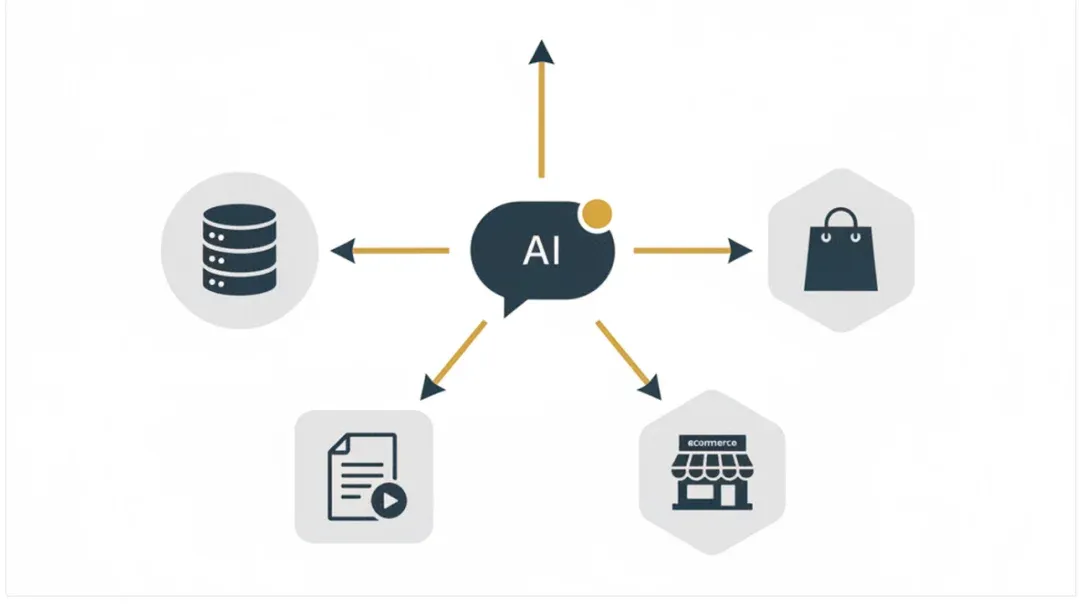
AI shopping recommendations typically come from multiple data sources: search indexes, product feeds, platforms, and DTC sites
Part 2: Know Your Enemy — Where Does AI Actually “Source” Products?
Many sellers feel anxious about AI, thinking it’s an uncontrollable black box. Not true — ChatGPT’s data sources are crystal clear, even simpler than traditional SEO.
2.1 Microsoft’s “Welcome Gift”: Bing Merchant Center
Despite OpenAI going independent, Microsoft’s Bing remains its foundation. There’s a huge misconception: you must run Bing ads for it to work. Wrong! Just register with Bing Merchant Center and upload your Feed — your data becomes “organic results” that ChatGPT can access. For budget-conscious sellers, this is zero-cost “positioning.”
2.2 The High-Ground for Authority: OpenAI Product Feed
To better understand products, OpenAI built its own data standard. This is currently the highest-weight data integration method. Unlike Google, OpenAI wants products, inventory, and reviews integrated together. It acts like a real shopping assistant, weighing “review scores” and “in-stock status” simultaneously. If data sync issues lead to recommending out-of-stock items, your store gets flagged as “unreliable.”
2.3 Official “VIP Channels”
If you’re on Shopify or Etsy, congratulations. Through official integrations, your product data has an express lane directly to ChatGPT.
Part 3: Product Selection Philosophy — What Makes AI’s “Perfect Match”?
Under “intent-first” logic, not all products fit. Rather than casting a wide net, focus on areas where AI excels.
3.1 Products That Make Users “Overthink”
Nobody asks AI about buying tissues, but when facing complex trade-offs, AI is the perfect advisor. Think “home projectors” or “ergonomic chairs.”
Traditional search just shows spec sheets that make your head spin. But AI can answer: “Which projector is quieter for bedroom use?” or “I have a herniated disc — is this chair supportive enough?”
High-ticket items with long decision cycles don’t just survive in AI’s logical reasoning — they thrive.
3.2 Detail-Rich Non-Standard Products
AI’s biggest advantage is understanding natural language. Users no longer search cold keywords (like “running shoes”) — they search scenarios (like “breathable shoes for wide feet that can handle half-marathons”).
If your product copy includes these “warm details,” AI can precisely fish you out of the vast ocean.
Part 4: Algorithm Logic — Forget SEO, Embrace AIO (AI Optimization)
In AI’s world, what determines rankings isn’t backlink counts — it’s trust.
4.1 Trust > Traffic
- Intent First: Officials emphasize relevance as the top metric.
- Merchant Authority: AI prefers recommending brand direct sales or authorized stores. This is the biggest reward for brand-focused sellers.
- Transaction Convenience: Merchants supporting Instant Checkout get preferential treatment under equal conditions.
4.2 Feedback Loop: Reviews Are the Best Fuel
AI reads through reviews. If your users write “solved my pain point,” AI notes that. Next time someone with a similar pain point asks, your product gets recommended. This is the “feedback loop” — good products speak for themselves, AI just hands you the megaphone.
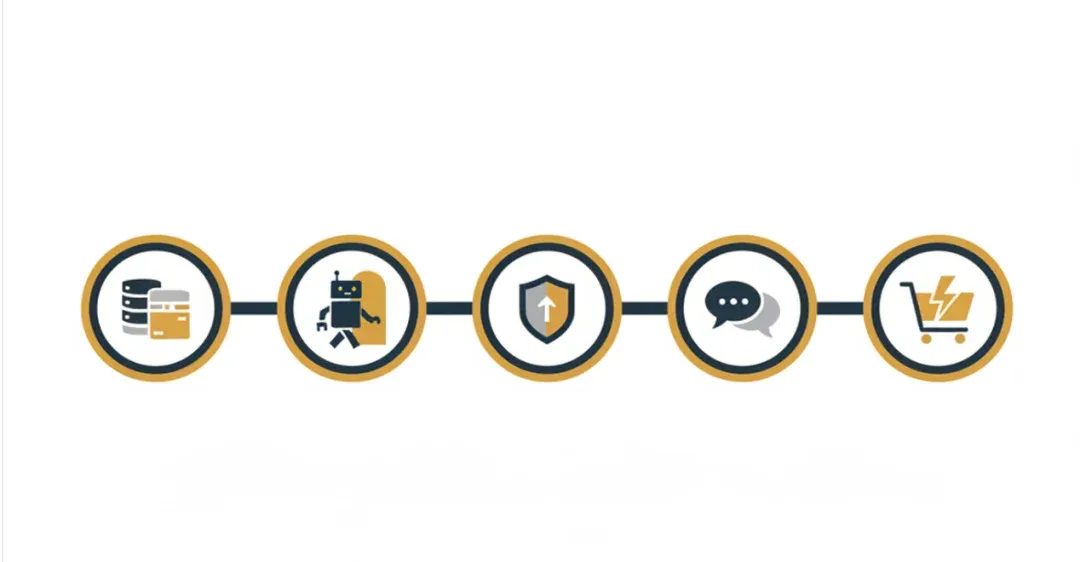
Five Steps: Data Entry → Technical Trust → Authority Rebuilding → Content Restructuring → Transaction Closure
Part 5: Action Guide — The “Five-Step” Battle Map for DTC Sellers
Don’t wait. By the time everyone’s talking about AI SEO, the opportunity window closes.
Step 1: Data Entry (Free Ticket)
Do it now: Register with Bing Merchant Center and upload your Feed. Even without running ads, get your data “alive” in Bing’s knowledge graph. This is AI’s first step in recognizing you.
Step 2: Technical Trust (Remove Barriers)
Do it now: Check your website’s robots.txt. Don’t follow Amazon’s lead blocking OAI-SearchBot — open your arms to welcome it.
Key action: Complete Schema markup (especially Product and Offer). Tell AI in code it understands: “Who I am, what I sell, what my prices are.”
Step 3: Authority Rebuilding (Build Your Persona)
Key additions: AI doesn’t like “anonymous shops.”
- Return Policy: Make sure your website has complete
MerchantReturnPolicySchema. Clear after-sales policies are key to AI judging “merchant reliability.” - Consistency: Ensure your brand information (N.A.P.) is identical across your website, social media, and Bing. Let AI confirm you’re a real business entity, not a fly-by-night operation.
Step 4: Content Restructuring (Talk Like a Human)
Change now: Stop stuffing meaningless keywords on product pages. Rewrite your product descriptions in “conversational style.” Answer users’ top concerns: “Why is this good for camping?” “How is it better than competitors?”
Guide reviews: Encourage users to write usage scenarios. One review saying “ran 10km in these shoes with no knee pain” beats a hundred “good quality” comments.
Step 5: Transaction Closure (The Final Push)
Strategic positioning: Watch the Agentic Commerce Protocol (ACP). Shopify merchants should closely monitor the official Instant Checkout feature. When AI can directly help users “one-click order,” that seamless experience will crush competitors on conversion rates.
Conclusion
Every generational shift in ecommerce reshuffles the deck. The search era made Amazon. The social era made TikTok. Now, the conversational era is here.
This isn’t just a new traffic channel — it’s a rule reset. Amazon chose to close up, trying to keep users inside their walls. AI chose openness, trying to connect every valuable node. That node is you.
Every action you take now — every line of Schema code, every genuine review, every data sync — is accumulating chips for the next 5 years of survival. Don’t hesitate. Get in the game.
