
Word count: ~4100 words
Estimated reading time: ~15 minutes
Last updated: August 3, 2025
Is this article for you?
✅ You want to understand “why” Claude Code is so powerful, not just “how” to use it.
✅ You’re interested in AI technical principles and want to understand its differences from traditional paradigms like RAG.
✅ You’re evaluating multiple AI programming tools and need in-depth comparative analysis.
✅ You’re a developer pursuing ultimate efficiency, wanting to seamlessly integrate AI into your workflow.
Chapter Contents
-
Preface: A Paradigm Revolution in “Human-AI Collaboration”
-
Mental Model: Forget “Code Completion” — Embrace Your “Terminal Guru”
-
Core Engine I: Agentic Search — The Codebase’s “Marauder’s Map”
-
Core Engine II: Stateful Toolchain — The “Hands” Connecting Virtual and Reality
-
Full-Process Deep Empowerment: Claude Code’s Practical Applications Across Development Phases
-
From Beginner to Master: Best Practices and Advanced Techniques
-
Strategic Comparison: Claude Code vs. Gemini CLI — “Deep Executor” vs. “Broad Researcher”
-
Conclusion: Building Your AI Collaborative Workflow
1. Preface: A Paradigm Revolution in “Human-AI Collaboration”
Hey, I’m Mr. Guo. This article’s inspiration comes from Anthropic engineer Cal Rueb’s official technical talk published on YouTube on August 1st. This sharing’s value goes far beyond introducing a new tool — it’s more like a manifesto announcing the arrival of an entirely new “human-AI collaboration” programming paradigm.
Claude Code best practices
Every developer has a “project graveyard” in our hearts — where countless brilliant ideas were buried due to tedious setup and difficult maintenance. Cal Rueb’s sharing tells us the AI Agent era might revive these graveyards. This article isn’t just a retelling of his thoughts but a deep analysis and extension combining my personal practical experience. We’ll dive into Claude Code’s underlying logic — how it actually works and how we should harness it.
2. Mental Model: Forget “Code Completion” — Embrace Your “Terminal Guru”
At the talk’s opening, Cal Rueb used a vivid metaphor to characterize Claude Code: “It’s like that teammate who does everything in the terminal and never touches a GUI.” This metaphor instantly elevates our cognition from passive “tool” to active “partner.”
Traditional code completion is essentially “instruction-level” assistance — you type code, it predicts and completes. Claude Code’s design philosophy is “task-level” delegation. You’re no longer telling it “how to write” but “what to do.” This mental model shift is crucial — it determines whether you can unleash this tool’s full power.
3. Core Engine I: Agentic Search — The Codebase’s “Marauder’s Map”
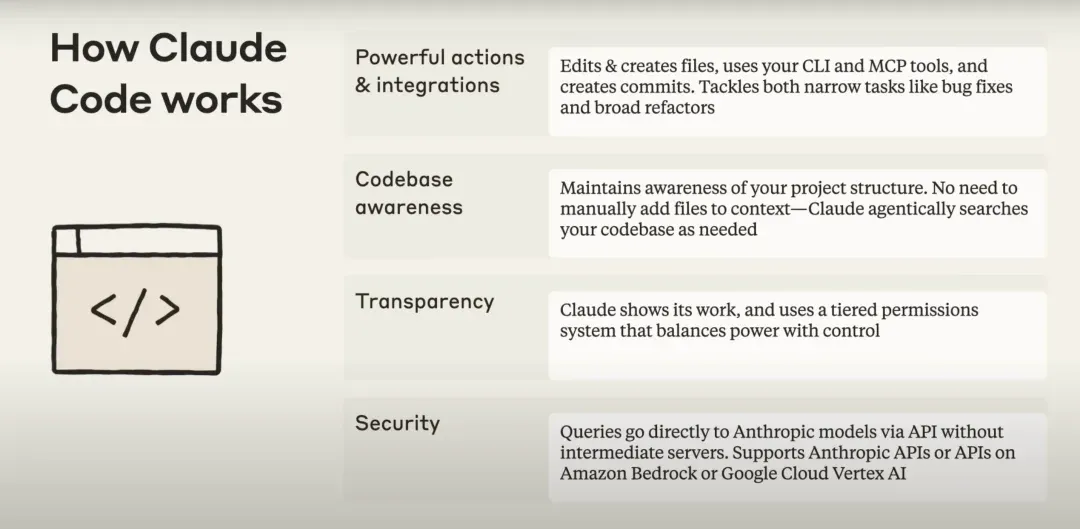
Claude Code’s most revolutionary feature is how it understands codebases. It doesn’t use currently popular RAG (Retrieval Augmented Generation). Traditional RAG requires pre-indexing and vectorizing the codebase — a method that suffers from timeliness issues and context loss when handling dynamic, structurally complex codebases.
Claude Code employs a completely different strategy Cal calls “Agentic Search.” It fully simulates how a human engineer explores a new project: using ls to view directories, read key config files, grep to search key functions, following imports to trace dependencies… It dynamically, on-demand explores your file system, building a real-time “Marauder’s Map” of the codebase.
Agentic Search vs. RAG
-
Real-time: Agentic Search directly interacts with the file system, always getting the latest information; RAG relies on indexes with data lag.
-
Structure Awareness: Agentic Search understands directory hierarchy and file relationships; RAG treats code as unstructured text chunks, easily losing context.
-
Global Vision: Agentic Search builds macro understanding through purposeful exploration; RAG excels at local fragment matching but struggles to form global perspective.
4. Core Engine II: Stateful Toolchain — The “Hands” Connecting Virtual and Reality
If Agentic Search is Claude Code’s “eyes,” then its powerful toolchain is its “hands.” It can invoke a series of tools for “stateful” interaction with your local environment. This means its operations are real and it can decide next actions based on previous operation feedback.
For example, it can run npm install. If it sees errors, it reads the error messages, searches for solutions, even modifies package.json and retries. This is a complete, closed-loop problem-solving process — not one-shot stateless text generation.
Mr. Guo’s Practice: Connecting Development and Knowledge Management
I personally rely heavily on this toolchain to connect my development and knowledge management workflows. I use Obsidian as my second brain. When I make important decisions in a project or complete a complex module, I instruct Claude Code:
“Please summarize the core design decisions from the
PLAN.mdfile and append them to/Users/guoshu/ObsidianVault/MyProject/Summaries.md.”
It uses read_file and run_shell_command (using echo "..." >> file) to complete this task. This keeps my project documentation synced with the development process in real-time, greatly reducing knowledge capture friction.
Currently, my work basically revolves around Claude Code and Gemini CLI. Even though code represents only one-tenth of my work, thanks to their powerful tool-calling capabilities, I even use Claude Code to invoke Gemini CLI, having Gemini help with research, search, and information synthesis while Claude handles execution and management.
However, using Claude Code domestically still has high barriers. Due to wildcard services shutting down, I had to find good alternatives. Fortunately, I met the owner of code.yoretea.com, who provides stable domestic Claude Code proxy service. Direct domestic connection without any VPN, with very low latency. Here’s a special 30% off code for Mr. Guo’s readers: GUOSHU. All plans get 30% off when purchasing on the website — they’ve recalled all other channel 30% discounts, only providing this discount through Mr. Guo’s channel. Interested friends can try a daily pass first — Cursor feels like last century’s product compared to Claude Code.
5. Full-Process Deep Empowerment: Claude Code’s Applications Across Development Phases
A truly powerful tool should integrate into and optimize your entire workflow. Cal divides software development into five phases, showing how Claude Code plays key roles in each. Below, we’ll expand on each phase in detail with scenario simulations.
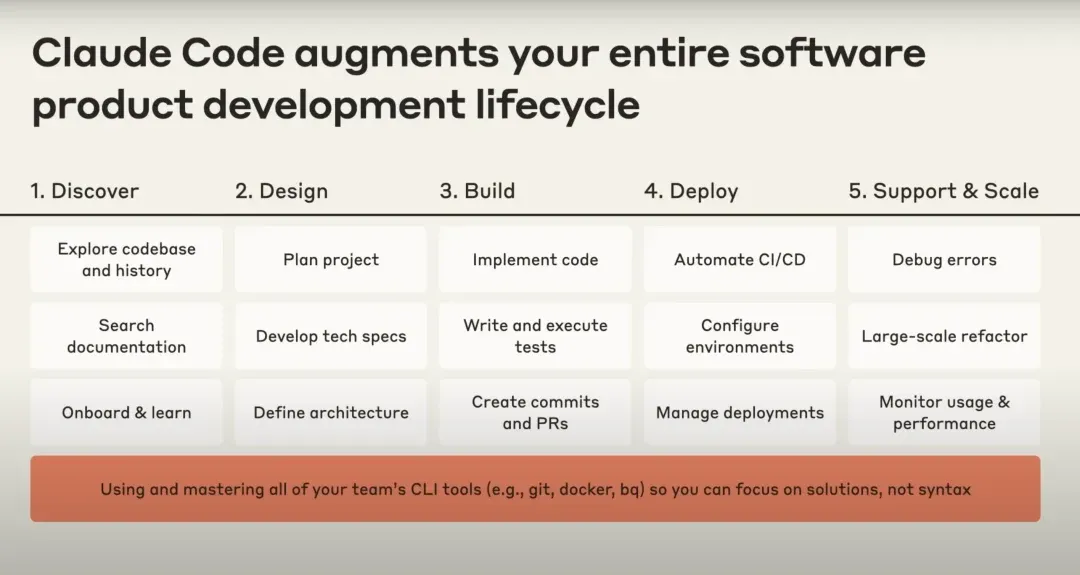
5.1 Discovery Phase — Your Personal Project Tour Guide
Core Pain Point: Information overload, lack of guidance, difficulty quickly building macro understanding of the codebase.
Practical Scenario: You just joined a large e-commerce project needing to fix an order-related bug. You can directly delegate to Claude Code: “Help me quickly understand the order processing module, starting from overall architecture, locating the core order creation code.” It automatically explores directories, reads key files, and ultimately generates a clear module overview report — far more efficient than manual reading or asking colleagues.
5.2 Design Phase — Your Pair Programming Thought Partner
Core Pain Point: Incomplete solution thinking, path dependency, lack of different perspectives for review.
Practical Scenario: You need to add a “coupon” feature. You can have Claude Code design a technical proposal based on the current codebase, including database models, API endpoints, and impact on existing flows — even comparing different design patterns (like strategy pattern) pros and cons. This equals completing a deep design review with a senior architect before coding.
5.3 Build Phase — Your Coding and Testing Accelerator
Core Pain Point: Writing boilerplate code, time-consuming test writing, ensuring code quality.
Practical Scenario: After approving the design, you can have Claude Code complete coding, generate Javadocs, write unit tests, run tests, even auto-generate standardized Git commit messages in one go. Internally at Anthropic, because Claude Code writes tests so efficiently, their projects have “unusually high” test coverage.
5.4 Deploy Phase — Your DevOps Engineer
Core Pain Point: Complex CI/CD configuration, error-prone deployment script writing.
Practical Scenario: You can describe your CI/CD requirements in natural language (like “On every push to main branch, build, test, and deploy to Staging environment”) and have Claude Code generate complete, syntactically correct GitHub Actions or Jenkinsfile configurations — greatly lowering DevOps barriers and error rates.
5.5 Support & Scale Phase — Your 24/7 Operations Partner
Core Pain Point: High refactoring risk, accumulating technical debt.
Practical Scenario: Facing a massive legacy system refactor, you can use “multi-agent collaboration” strategy. Have one Claude instance deeply analyze old code and extract language-agnostic business logic; then have another instance implement everything fresh with modern tech stack based on that logic spec. This approach decouples complex tasks, ensuring accurate logic migration.
6. From Beginner to Master: Best Practices and Advanced Techniques
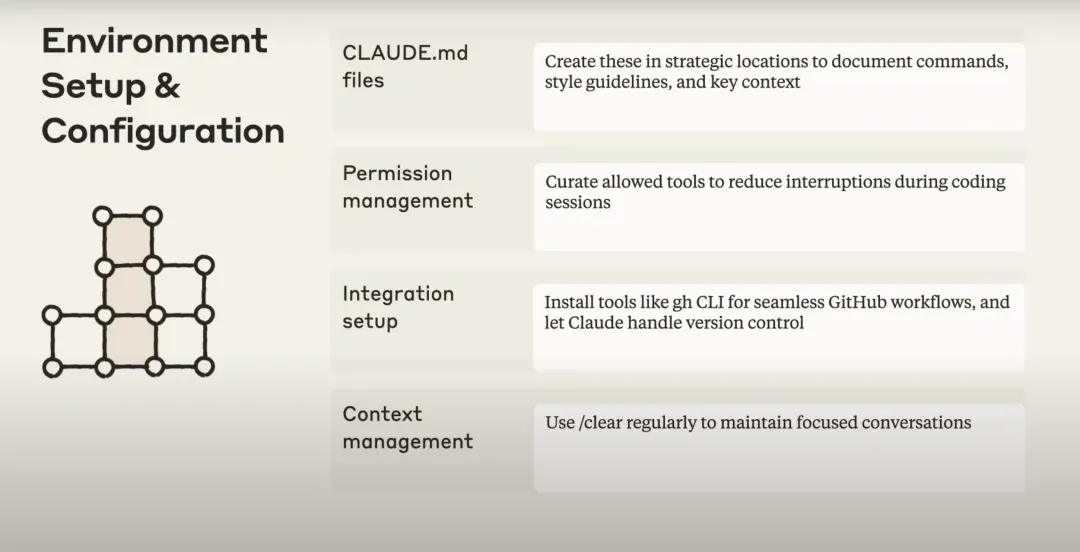
After mastering basics, how do you get 120% power from your “terminal guru” partner? Cal summarized some crucial practices and techniques.
-
The Art of CLAUDE.md: Create
CLAUDE.mdin both your home directory and project root to define global preferences and project-level standards — the best place for team knowledge capture. -
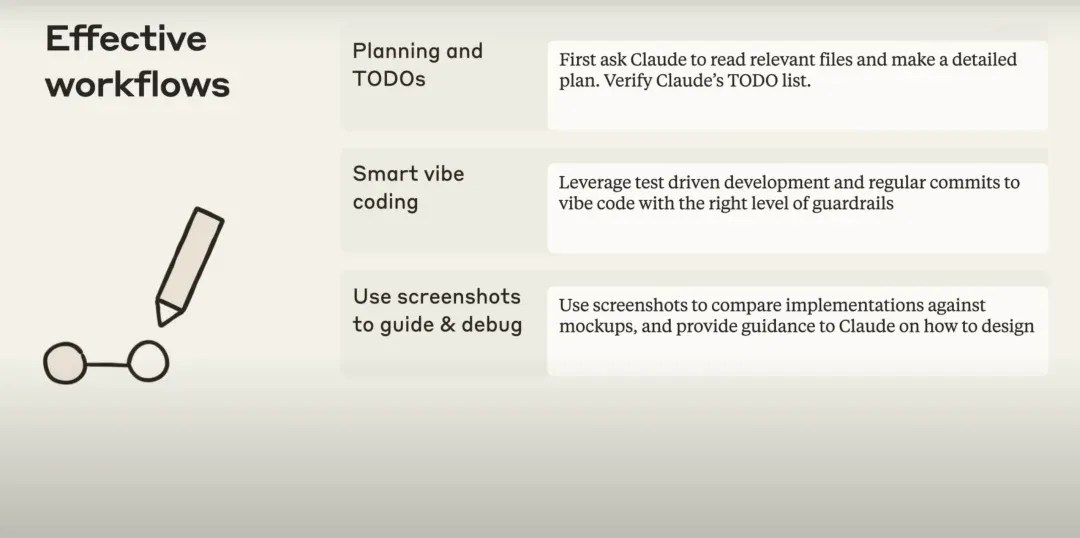
Planning and TODOs: Cal repeatedly emphasized this. Develop the habit of “plan first, execute second” — have AI generate step-by-step
PLAN.md. -
Smart Vibe Coding: The core is “small steps, continuous verification.” Define goal → Write tests → Have Claude code → Verify passing → Commit immediately. This loop provides numerous “safety checkpoints.”
-
Use Screenshots: For frontend tasks, dragging design mockups or bug screenshots directly into the terminal is the most intuitive communication.
-
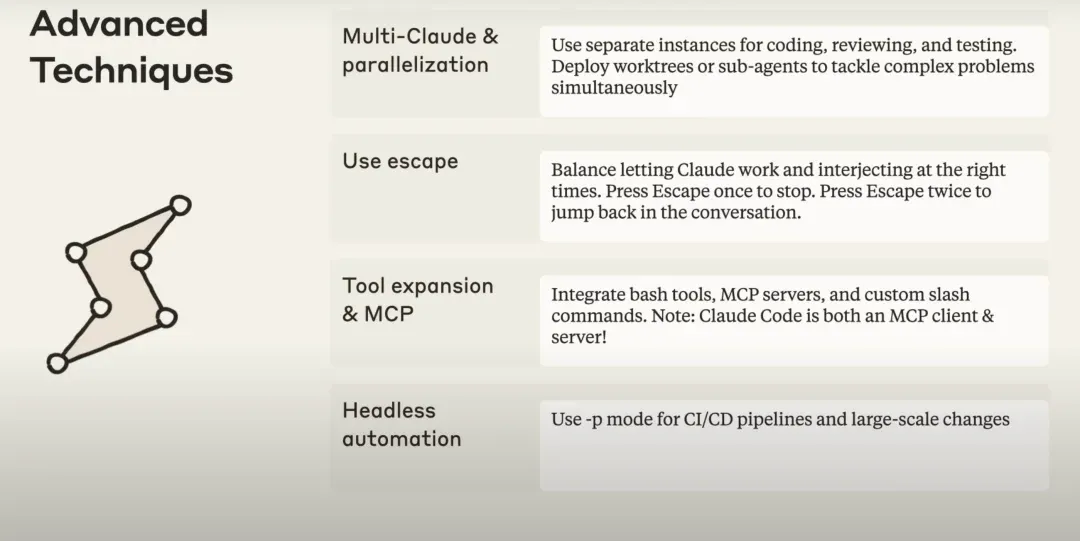
Multi-Claude and Parallelization: True “team battle” mode. Open multiple terminal tabs, or use
git worktree, letting different Claude instances work in parallel on different branches without interference.
7. Strategic Comparison: Claude Code vs. Gemini CLI — “Deep Executor” vs. “Broad Researcher”
A mature engineer never has just one hammer in their toolbox. In my workflow, Claude Code isn’t the only choice. In certain scenarios, Google’s Gemini CLI is more appropriate. Understanding their strategic positioning differences is crucial.
Claude Code: Deep Executor Its core advantage is deep understanding and stateful execution of local project context. Its search is “inward,” aimed at understanding your existing code. When you need large-scale refactoring, adding new functionality tightly coupled with existing modules, or automating complex local workflows, Claude Code is unmatched.
Gemini CLI: Broad Researcher Its core advantage is its connection capability with external world information. Its native Google Search tool is a “super addon.” When my tasks involve extensive external information gathering and deep research, I choose Gemini CLI without hesitation. For example:
“Please compare FastAPI and Flask’s differences in async performance, providing the past year’s community benchmark data and mainstream opinions.”
Therefore, my view is: They’re not zero-sum competitors but complementary strategic partners. A mature workflow should use Gemini CLI first for broad technical research and solution pre-study, forming initial knowledge input; then switch to Claude Code for deep, context-aware building and implementation in the local project. Of course, Gemini CLI’s free policy and accessibility still deserve super praise! Generous Google daddy!!! Its open-source strategy also provides excellent reference for our agent development — see my co-created “Learning Agent Development from Gemini CLI” series with Tam.
8. Conclusion: Building Your AI Collaborative Workflow
Understanding Claude Code’s core principles — Agentic Search and Stateful Toolchain — lets us fundamentally change how we collaborate with AI. We’re no longer its “prompt operators” but its “project managers” and “architects.”
Maintaining open horizons, recognizing different tools’ strategic positioning, and learning to organically combine them into workflows suited to ourselves will be one of our generation’s core competencies as developers. By mastering these increasingly powerful AI partners, we can truly escape the “project graveyard” trap and build those truly exciting futures.
Found Mr. Guo’s analysis insightful? Drop a 👍 and share with more friends who need it!
Follow my channel to explore AI, going global, and digital marketing’s infinite possibilities together.
🌌 Your value is no longer how many lines of code you write, but how many lines of code generation you direct.
