
Digital Strategy Review | 2026
Claude Code Top 10 Highlights 04 | In-Process Teammate Runtime: Striking a Better Balance Between Performance and Isolation
By Uncle Fruit · Reading Time / 8 Min
Foreword
As multi-agent systems move toward the collaboration layer, the biggest bottleneck is often choosing the execution model: too heavy, and it drags down the user experience; too light, and the boundaries become chaotic. Claude Code’s approach is worth examining because it isn’t just a compromise in name—it is a genuinely functional middle-ground strategy.
01
In-Process Teammate Runtime: Striking an Excellent Balance Between Performance and Isolation
When multi-agent systems reach the collaboration stage, they usually get stuck on an old dilemma:
- Each Agent runs in an independent process: Strong isolation, but high cost and complex synchronization.
- Everything stuffed into the same main context: Low cost, but chaotic boundaries.
Claude Code’s answer is: Introduce the in-process teammate.
It is neither an independent OS process nor a simple sub-call of the main agent; it is a teammate running within the same process, equipped with its own identity and task state.
Key implementation files include:
src/utils/swarm/spawnInProcess.tssrc/utils/swarm/inProcessRunner.tssrc/tasks/InProcessTeammateTask/*
02
I. Why build an in-process teammate?
If you only use standard sub-agents, you can already achieve some level of delegation. But Claude Code aims to solve more advanced problems:
- Long-term collaboration between multiple agents.
- Clear team identities for each participant.
- Unified visibility via the UI.
- Maintaining low operational costs.
If you were to use tmux panes or independent child processes for everything, the system would become bloated.
Consequently, Claude Code chose a highly pragmatic compromise:
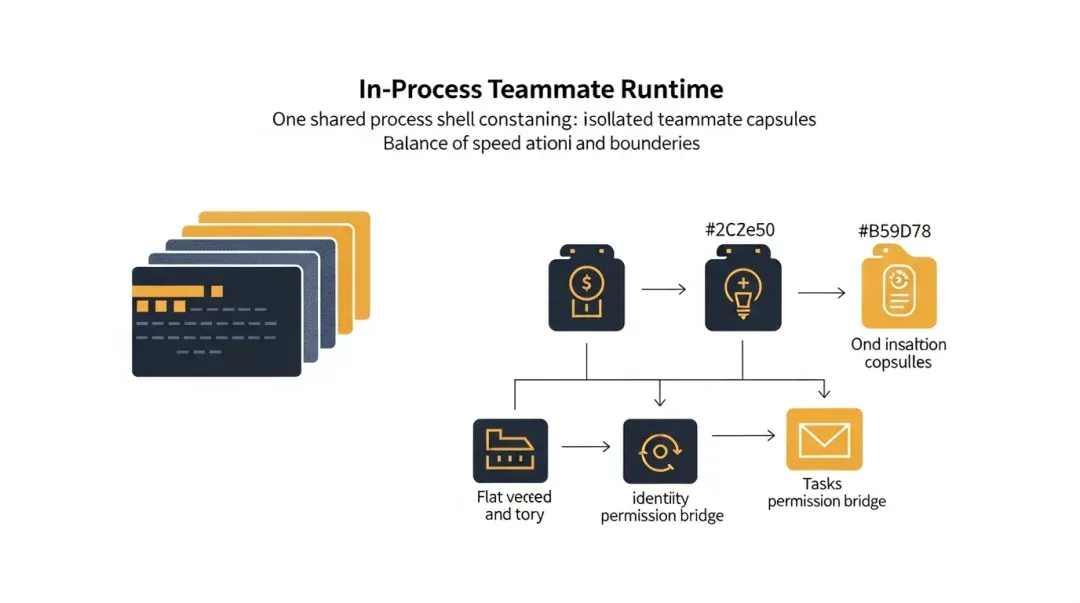
Run in the same process, but implement dedicated isolation for identity, permissions, tasks, and messages.
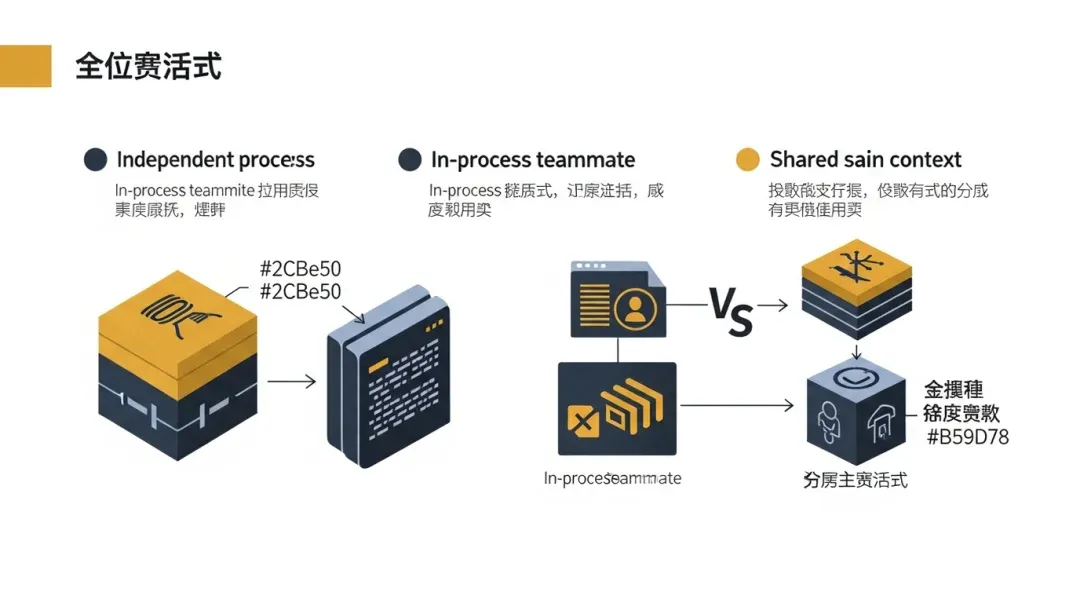
Claude Code chose the third path: avoiding heavy processes without blurring the boundaries entirely.
03
II. The brilliance of this design: It’s not just “lazily sharing a process”
Some systems claim to be “lightweight multi-agent,” but in reality, they just stuff multiple logic branches into a single event loop, which hardly qualifies as isolation.
Claude Code is different.
It implements many specialized mechanisms for the in-process teammate:
- Independent
AbortController - Teammate identity
- Independent task state
AsyncLocalStorage/ Teammate context- Independent pending user messages
- Dedicated permission bridge
- Collaboration via a mailbox with the leader
Therefore, its essence is not “multiple agents happening to be in the same process,” but rather:
Multiple agents running in the same process, each with a dedicated context and state shell.
04
III. What spawnInProcessTeammate solves
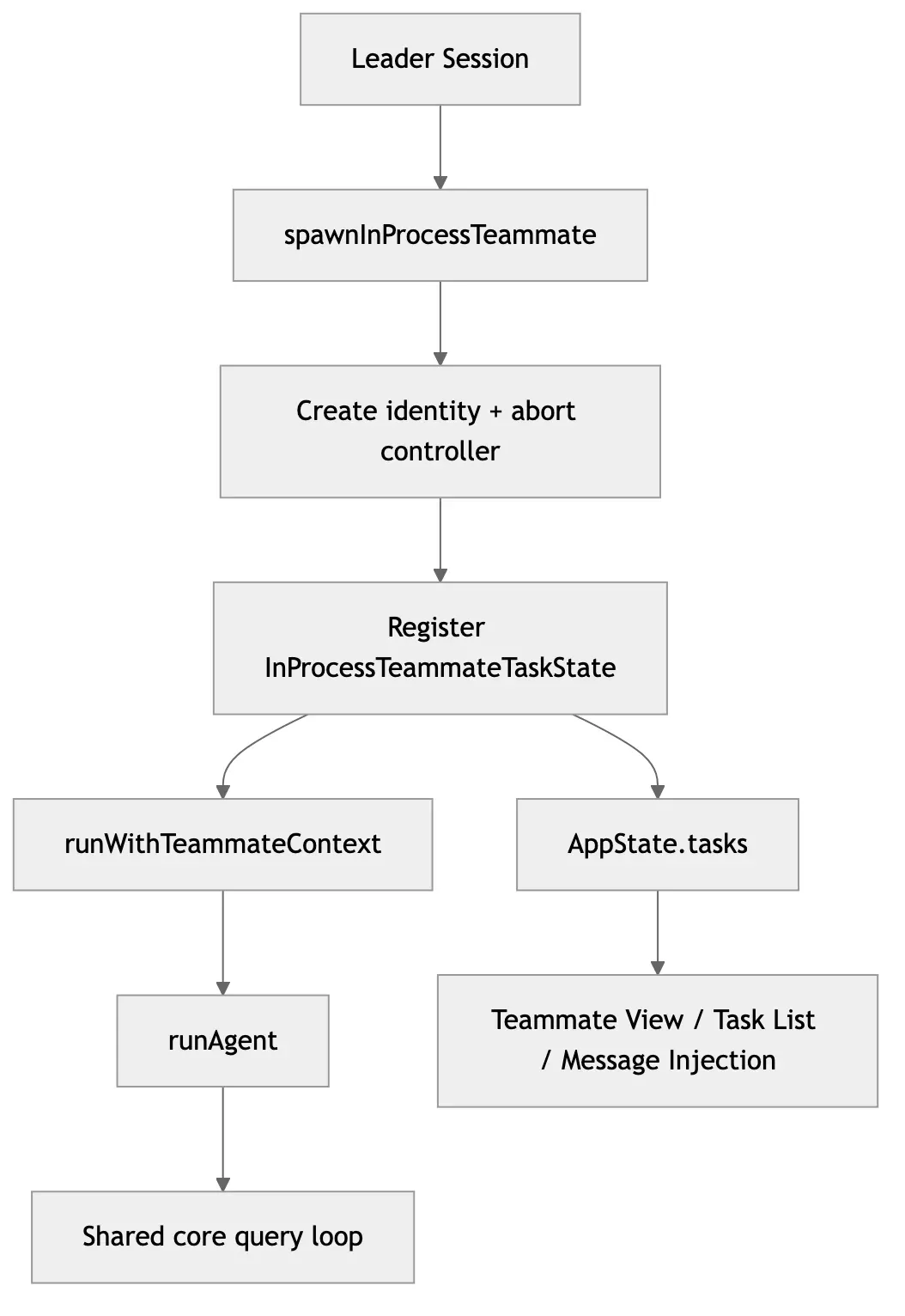
The spawnInProcess.ts layer is primarily responsible for:
01 Generating a stable identity for the teammate.
02 Creating an independent abort controller.
03 Creating the teammate context.
04 Constructing the InProcessTeammateTaskState.
05 Registering it to the AppState.
This is crucial because it means the teammate is not just a parameter of runAgent, but a first-class execution object that exists and is trackable within the system.
05
IV. inProcessRunner.ts is where the teammate actually runs
The significance of this file is that it doesn’t create a separate, special agent engine; instead, it ensures the teammate ultimately returns to the same runAgent(...) flow.
In other words:
- The in-process teammate has its own outer shell.
- The core reasoning execution remains the standard Claude Code agent loop.
This is a very mature architectural trade-off:
- The outer layer differentiates based on the execution model.
- The inner layer maximizes reuse of the execution engine.
This prevents the issue where “standard sub-agents have one set of behaviors, while teammates have another set of strange behaviors.”
06
V. Why this design is UI-friendly
Because the teammate is ultimately a task, the REPL can naturally support:
- Teammate lists.
- Transcript viewing.
- Injecting user messages into a specific teammate.
- Monitoring the pending and running states of teammates.
If the teammate were just a collection of background Promises, these experiences would be extremely difficult to implement.
Through the in-process teammate design, Claude Code incorporates “other agents in collaboration” into a unified visualization object system. This is one of the reasons its UI feels more like a “collaborative workstation” than a standard terminal agent.
07
VI. The performance advantages are very real
1. Fast startup
No need to repeatedly spawn new processes or build excessive IPC infrastructure.
2. Shared runtime environment
Within the same process, many foundational capabilities can be shared:
- Initialized runtime environments.
- Partial caching.
- State bridging.
- Permission interaction channels.
3. Suitable for massive lightweight collaboration
Some tasks only require:
- Quick code searches.
- Running a few read-only analyses.
- Performing short, fast validations.
In these scenarios, using an in-process teammate is more cost-effective than using heavy, isolated agents.
08
VII. Of course, it’s not a silver bullet
The boundaries of this design are quite clear.
1. Isolation is not as strong as independent processes / worktrees / remote
If a task is extremely heavy, long-running, or requires stronger environment isolation, an in-process teammate may not be the best choice.
2. Permissions and control planes must be handled carefully
Because it shares the main process, it requires more rigorous leader permission bridges, mailboxes, and context isolation to prevent conflicts.
3. Lifecycle management must be meticulous
Interrupts, backgrounding, user message injection, and shutdown requests must all be handled robustly, or the system will easily end up in a hung state.
Claude Code is successful precisely because it handles these details with such rigor, making this path viable.
09
VIII. Understanding it at a glance
10
IX. Conclusion
The in-process teammate runtime is a highlight not simply because it “saves resources,” but because it strikes an excellent balance between:
- Operational cost.
- Identity isolation.
- Unified control plane.
- Collaborative experience.
Many systems in the multi-agent space are either too heavy or too chaotic. Claude Code provides a third answer with the in-process teammate:
Not every agent needs to be an independent process, but every agent must be an independent object.
