
Digital Strategy Review | 2026
Decoding Claude Code: Top 10 Highlights 09 | First-Class Isolation: Why Worktree and Remote are Runtime Semantics
By Uncle Fruit · Reading Time / 8 Min
Foreword
Once an Agent actually starts modifying code, isolation is no longer just a “nice-to-have”—it is a prerequisite for the system’s long-term viability. In this article, I want to break down how Claude Code elevates worktree and remote from mere tricks to first-class runtime capabilities.
01
First-Class Isolation: Worktree and Remote are not tricks, but runtime semantics
When it comes to “modifying code,” many AI Coding Agent systems default to a single approach:
• Directly operating within the current working directory.
This works fine for simple tasks, but as soon as you enter more complex, real-world workflows, the risks escalate rapidly:
• Sub-agents stepping on each other’s files. • The user’s main workspace getting cluttered or corrupted. • Long-running tasks polluting the current session. • Conflicts between different environmental requirements.
The brilliance of Claude Code lies in the fact that it treats isolation as a first-class runtime capability.
The two most typical isolation semantics are:
• worktree
• remote
02
I. Why “Isolation” is more critical in Coding Agents than in general chat
Because a coding agent actually modifies the environment.
Once a system is allowed to:
• Edit files • Run shell commands • Install or build packages • Generate patches • Execute long-running processes
It is no longer just an assistant operating at the text layer, but an executor within a real environment.
Without isolation, the product easily shifts from “useful” to “dangerous.”
Claude Code clearly acknowledges this reality.
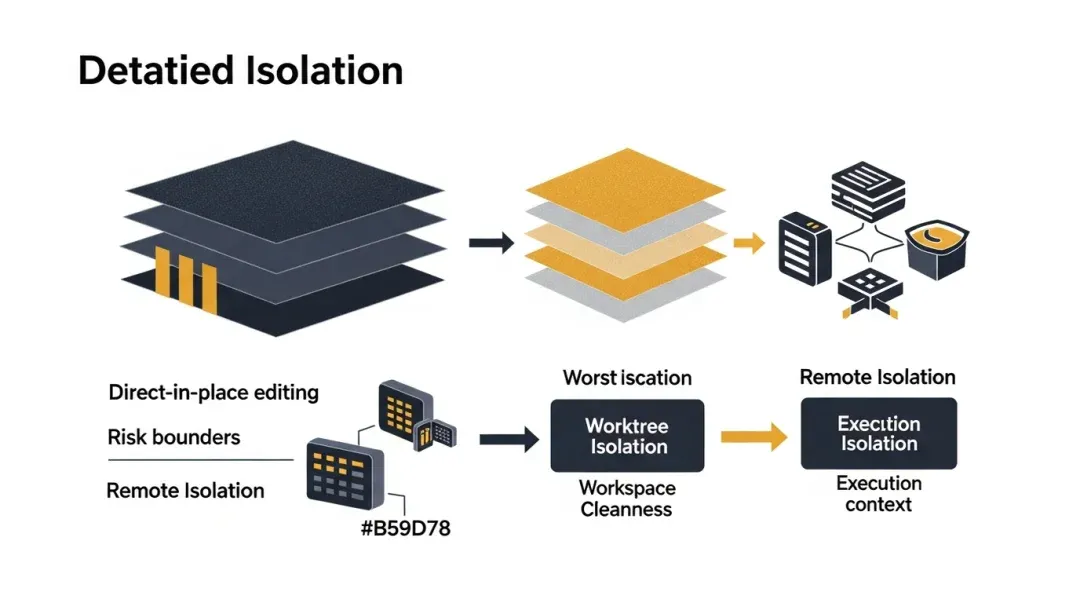
The strength of Claude Code is not just that it can create a worktree, but that it incorporates worktree and remote into the same set of runtime languages.
03
II. The significance of worktree: Not just another directory, but an independent working copy for the Agent
Claude Code allows Agents to run in isolated git worktrees. The value of this is immense:
• The main workspace remains clean. • Multiple Agents can make changes in parallel without stepping on each other. • Users can allow Agents to perform heavier modifications with greater peace of mind.
Crucially, this isn’t just about forcing users to manually switch directories; it’s about incorporating worktree into the runtime as an official isolation mode for the Agent.
This means:
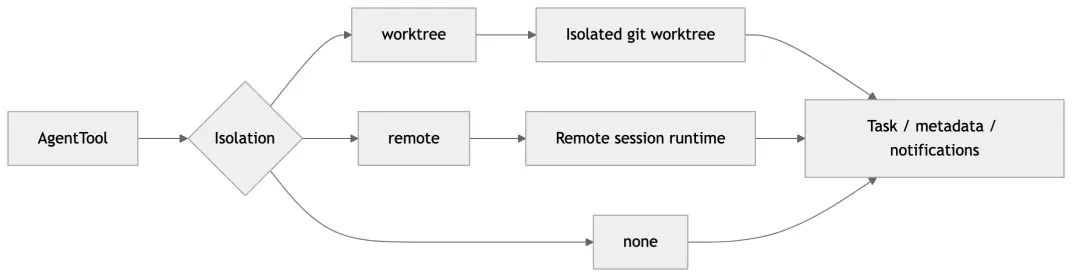
• Agent definitions can declare isolation.
• AgentTool can route based on isolation branches.
• The runtime records relevant metadata.
• worktree paths are integrated into the Agent’s execution context.
This is no longer a “trick”—it is architectural capability.
04
III. The significance of remote: Moving the execution environment entirely off-site
Claude Code supports not only local isolation but also remote agents.
The significance of this step lies in:
• Certain long-running tasks can run independently of the current terminal. • Certain environmental dependencies can be offloaded to a remote host. • Local interactive sessions do not need to bear the entire execution burden.
At the same time, remote tasks retain their “Task” identity, ensuring they do not escape the control of the main system.
This is a very strong point for Claude Code:
Isolation does not mean losing control.
Although the backends for remote and local execution differ, they remain unified task objects in the eyes of the user.
05
IV. Why I call it “First-Class Runtime Semantics”
Because it doesn’t just appear in a single utility; it permeates multiple layers of the system:
• Agent definition • AgentTool • runAgent metadata • Task system • Recovery logic • Notification logic
“First-class semantics” means:
• Every layer of the system acknowledges it. • Users don’t need to manually piece it together. • It’s not just “you can do this if you want,” but “the system natively supports this execution mode.”
Claude Code’s handling of worktree / remote fits this definition perfectly.
06
V. Why this is highly valuable for real development workflows
1. Safer experimentation
By letting the Agent make changes in a worktree, users are more willing to let it experiment.
2. Easier parallelism
Multiple isolated execution entities can advance changes in different directions simultaneously, rather than crowding into a single working copy.
3. Better for long-running background tasks
Certain remote tasks are inherently ill-suited to being bound to the current terminal or process.
4. Closer to real engineering collaboration
In engineering, “try it in an isolated environment first, then decide whether to merge” is the standard. Claude Code simply incorporates this convention into the Agent runtime.
07
VI. Why this is not just a pile of features
On the surface, it looks like just two extra modes, but in reality, it requires the system to handle many additional complexities:
• How are paths interpreted? • How is the transcript associated? • How are tasks recovered? • How are outputs notified? • How does the user view them? • How are remote tasks archived/polled?
Claude Code is commendable because it doesn’t leave these problems to the user; it handles them at the runtime layer as much as possible.
08
VII. Understanding this highlight in one diagram
09
VIII. Conclusion
The true value of first-class isolation is that it makes Claude Code not just “willing to modify code,” but “willing to modify code within controlled boundaries.”
This sets it apart from many agent systems that “operate directly in the current directory.” While the latter can also modify code, risks and chaos accumulate rapidly as tasks become larger, more numerous, and longer-running.
Claude Code’s answer is clear:
Isolation is not an advanced user trick; it is an execution semantic that an Agent runtime must natively support.
