
Digital Strategy Review | 2026
Claude Code Top 10 Highlights 05 | Leader-Centered Permissions: The Most Overlooked Control Design in Multi-Agent Systems
By Uncle Fruit · Reading Time / 8 Min
Foreword
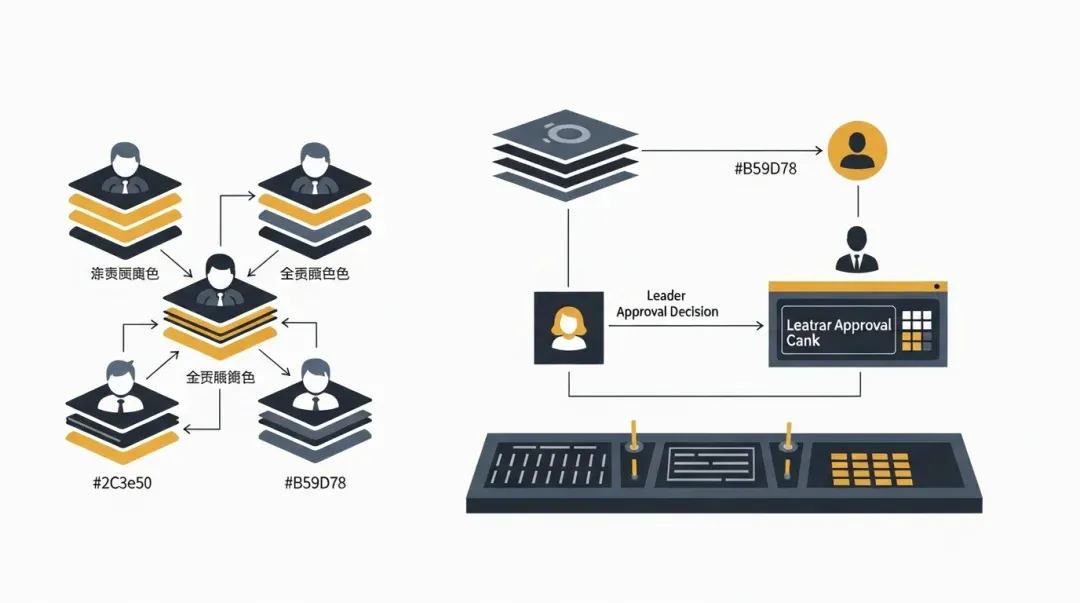
Many multi-agent products focus initially on “how many workers can run concurrently.” However, those who truly stabilize their systems focus first on how to consolidate permissions. The most valuable aspect of Claude Code lies in its ability to return control to a point that the user can actually understand.
01
Leader-Centered Permissions: The Most Overlooked, Yet Critical, Control Design in Multi-Agent Systems
It is easy to make a multi-agent system look “highly concurrent.” But as soon as multiple agents start calling tools, problems arise immediately:
• Who approves the permissions?
• Which agent is the user interacting with?
• How does the interface prevent crashing when multiple workers request permissions simultaneously?
Claude Code’s answer to this is remarkably mature: execution can be decentralized, but permission adjudication must return to the leader’s unified control plane.
This approach is primarily reflected in:
• src/utils/swarm/inProcessRunner.ts
• src/screens/REPL.tsx
• Permission-related bridge / mailbox mechanisms
02
I. Why This Is Where Multi-Agent Systems Most Often Fail
If you have built multi-agent products, you quickly realize a harsh reality:
It is easy for multiple agents to work concurrently, but it is very difficult for humans to understand multiple permission requests from multiple agents simultaneously.
Common pitfalls include:
• Each worker pops up its own approval dialog
• Users cannot distinguish who is requesting what
• One worker’s permission mode pollutes another’s
• Permission requests are scattered across multiple different UIs
The end result is usually:
• Users disable permissions
• The product becomes uncontrollable
• The team is forced to cripple the multi-agent capabilities
Claude Code clearly addresses this issue with serious intent.
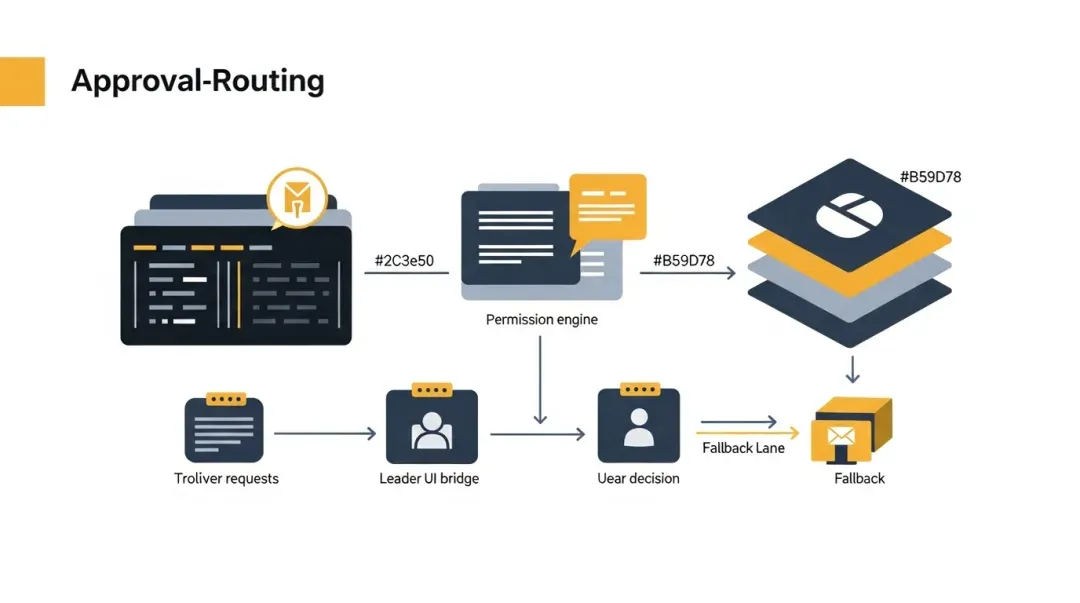
Execution can be decentralized, but approval should be centralized; the existence of a fallback determines whether this design is sustainable in the long run.
03
II. The Basic Principle: Decentralized Execution, Centralized Control
Claude Code’s multi-agent permission design can be summarized in one sentence:
Workers are responsible for proposing actions, while the Leader is responsible for unified interaction with the user.
This principle is crucial because it prevents the multi-agent system from losing its “single user control plane.”
Specific Implementation
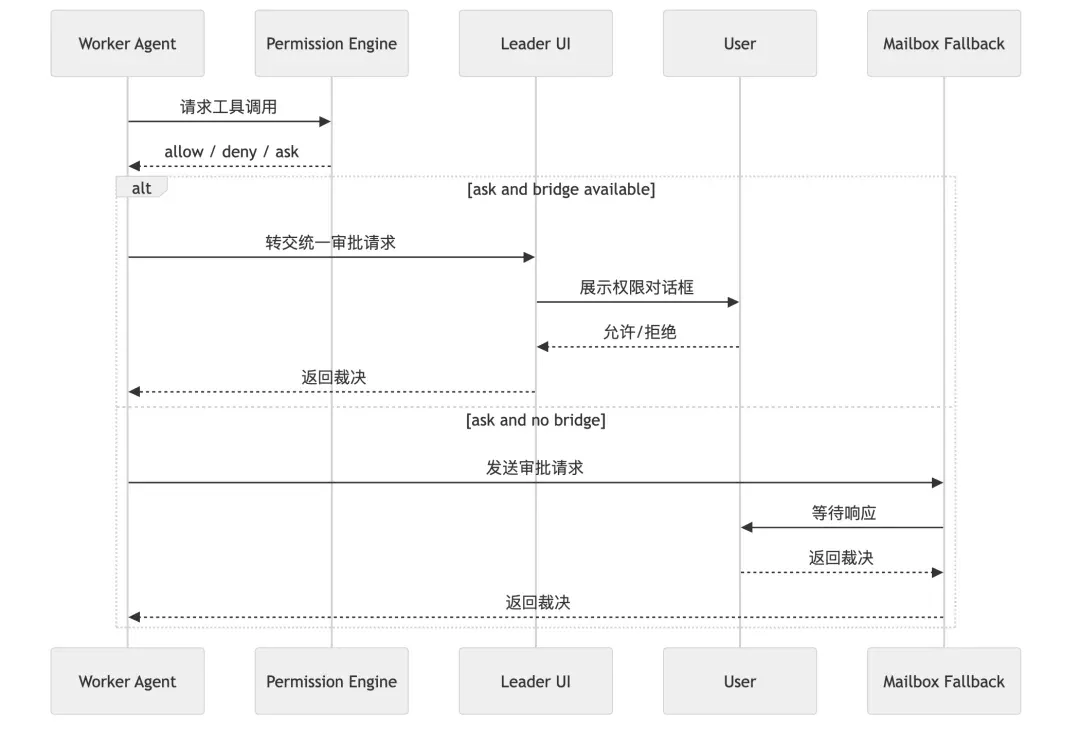
In the in-process teammate path, a worker’s canUseTool(...) does not simply decide to ask/allow on its own. Instead:
01 It first runs a permission check.
02 If it is allow/deny, it returns immediately.
03 If it is “ask,” it prioritizes the Leader’s ToolUseConfirm UI.
04 If the bridge is unavailable, it falls back to the mailbox process.
This means workers do not have the “right to pop up windows”; they only have the “right to initiate requests.”
04
III. Why This Design Is Correct
1. Users only need to understand one approval entry point
Regardless of which worker triggers the request, the user sees a unified permission approval experience.
This significantly reduces the cognitive load of the multi-agent system.
2. Each request can be tagged with worker identity
The source code includes worker badges, identity, and other information. This allows the user to know “who is requesting” without having to jump out of the main control plane.
3. It maintains the consistency of permission policies
If every worker maintained its own permission state, rule drift would occur quickly. Claude Code’s approach is to write permission updates back to the leader’s shared context whenever possible, thereby maintaining a unified policy surface.
05
IV. The Mailbox Fallback Demonstrates System Maturity
Many systems stop at the first step: using a unified popup when the UI is available. Claude Code takes it a step further: if the UI bridge is unavailable, it falls back to the mailbox.
This is vital because, in real-world environments, there will always be:
• Modes without a direct UI bridge
• Workers running in different contexts
• Paths where only message synchronization is possible
Without a fallback, the multi-agent permission model would fail in edge cases. Claude Code achieves:
• Optimal path: Leader UI
• Degraded path: Mailbox request-response
This ensures the system doesn’t just “work in some scenarios,” but “maintains unified control across different collaboration forms.”
06
V. It Is Not Just UI Design, It Is Security Design
Many people interpret this highlight as an interaction optimization. In essence, however, it is also a security boundary design.
One of the greatest risks of multi-agent systems is:
• A worker gains tool capabilities beyond user expectations
• The user does not know who made the decision
• Permission updates are inconsistent across multiple execution entities
The benefits of leader-centered permissions are:
• Final decisions return to the user’s primary interface
• Workers are only responsible for requesting, not for making final decisions themselves
• Permission updates are anchored in a shared context
This significantly reduces the risk of “loss of control due to excessive multi-agent autonomy.”
07
VI. Why This Directly Impacts Product Usability
Multi-agent products are not about who can run more workers simultaneously, but who can remain usable while multiple workers are running.
The permission system is precisely the link most likely to drag down product usability. Claude Code’s approach represents a key trade-off:
• It does not aim for every worker to be as autonomous as an independent terminal
• Instead, it keeps autonomy at the execution layer while retaining control at a level understandable to humans
This makes the system much more “stable” in real-world usage.
08
VII. Understanding This Highlight at a Glance
09
VIII. Conclusion
Leader-centered permissions are the classic type of design that is “not flashy, but determines success or failure.”
It does not solve a local function; it solves whether a multi-agent system can truly be controllable in the long term:
• Execution can be concurrent
• Permissions cannot be fragmented
• There can be many workers
• The user control plane must have only one core entry point
Claude Code’s answer here is clear:
The freedom of multi-agents must be built upon a unified human control plane.
