
If you are already running your coding agents, cron jobs, content production, browser automation, and script pipelines using Codex, my current judgment is clear: I would not rush to migrate to Hermes just yet.
Note that I said “hold off on migrating” and “continue to observe.” There is a significant difference.
Hermes has been trending heavily over the last few days. It’s being discussed in every group chat and tech blog. They call it an “open-source agent,” boasting long-term memory, self-learning capabilities, and the ability to run gateways, cron jobs, browser tasks, and profiles. It even supports multi-channel integration like Slack, Telegram, Email, and WeChat Enterprise. Doesn’t that sound like something much closer to a “digital employee”?
To be honest, I’m a bit excited too.
I have always been interested in this kind of long-running agent runtime. When something grows beyond a simple chat box and starts seriously handling the messy, real-world problems of memory, scheduling, browser interaction, message entry points, and task isolation, it ceases to be just a new toy.
But excitement is one thing; migration is another.
Yesterday, I threw this question at ChatGPT, and for every round of conversation, I used the most powerful GPT 5.4 Pro available. I spent several rounds in deep discussion, with the model taking over 10 minutes of reasoning time for each response. Why emphasize 5.4 Pro? Because I wanted the most comprehensive and credible answer within my cognitive reach. These types of questions require balancing product form, engineering boundaries, operational automation, and long-term maintenance costs. A generic answer would easily devolve into “Codex is for coding, Hermes is for long-term agents, so use both”—a useless platitude.
I wanted a harder answer.
What I really wanted to know was: If I am already running a bunch of agents and operational tasks primarily on Codex, is there any actual necessity to migrate my entire system to Hermes?
I started with a direct question:
“My current agents are primarily built on Codex. Is there any necessity for me to migrate to Hermes, the trending open-source agent on GitHub?”
GPT 5.4 Pro’s initial answer was a stable, middle-ground judgment: There is no urgent necessity to fully migrate existing Codex agents to Hermes right now. A more reasonable path is to keep Codex as the primary coding executor and only incrementally introduce Hermes in scenarios that truly require long-term memory, cross-channel entry points, scheduled tasks, persistent remote operation, or multi-model switching.
That statement is fine on its own, but it’s not enough.
For someone like me, the question is never just “what capabilities does Hermes have in theory?” I care about whether the work I have on my plate justifies adding another layer of system complexity.
I have a pile of non-coding work to manage.
I have 50 daily outreach emails, daily blog updates to the CMS, automated website operations, Remotion video production, and WeChat Official Account content creation, formatting, and uploading. Codex has been handling much of this for me. If you want to convince me to move to Hermes, you can’t just say it’s a better “long-running agent runtime”; you have to tell me if it will make these tasks more stable, more efficient, and less prone to rework.
So, I pressed further.
GPT provided a task-level judgment table, which looked roughly like this: Daily outreach—stick to pure Codex; daily blog CMS updates—Codex-led, mixed only when the backend is heavily browser-dependent; automated website operations—best suited for a Codex + Hermes hybrid; Remotion video production—stick to pure Codex; WeChat content creation/formatting/uploading—Codex-led, mixed only when necessary. Full migration to Hermes is not recommended.
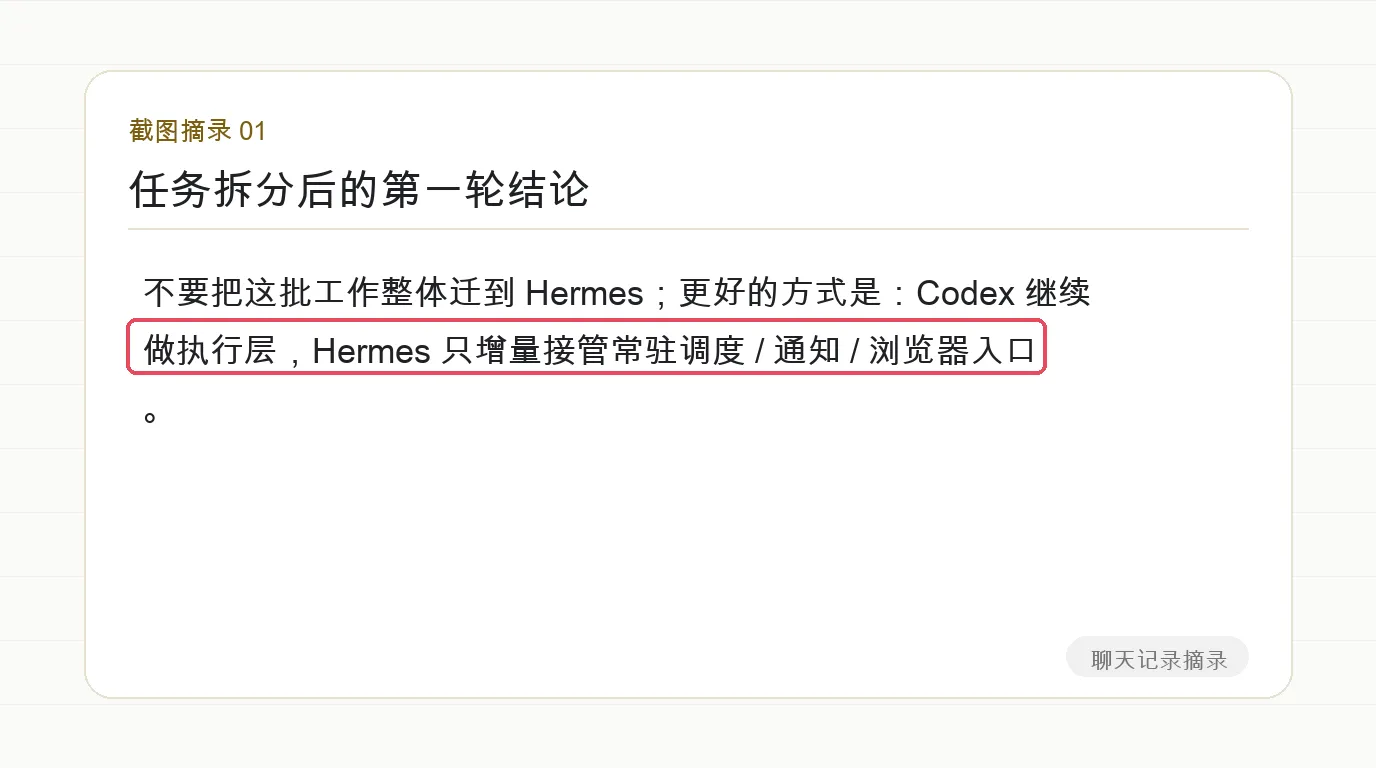
This table was getting closer to the answer I wanted. It broke Hermes down from a “you’re falling behind if you don’t use it” platform into specific workflows.
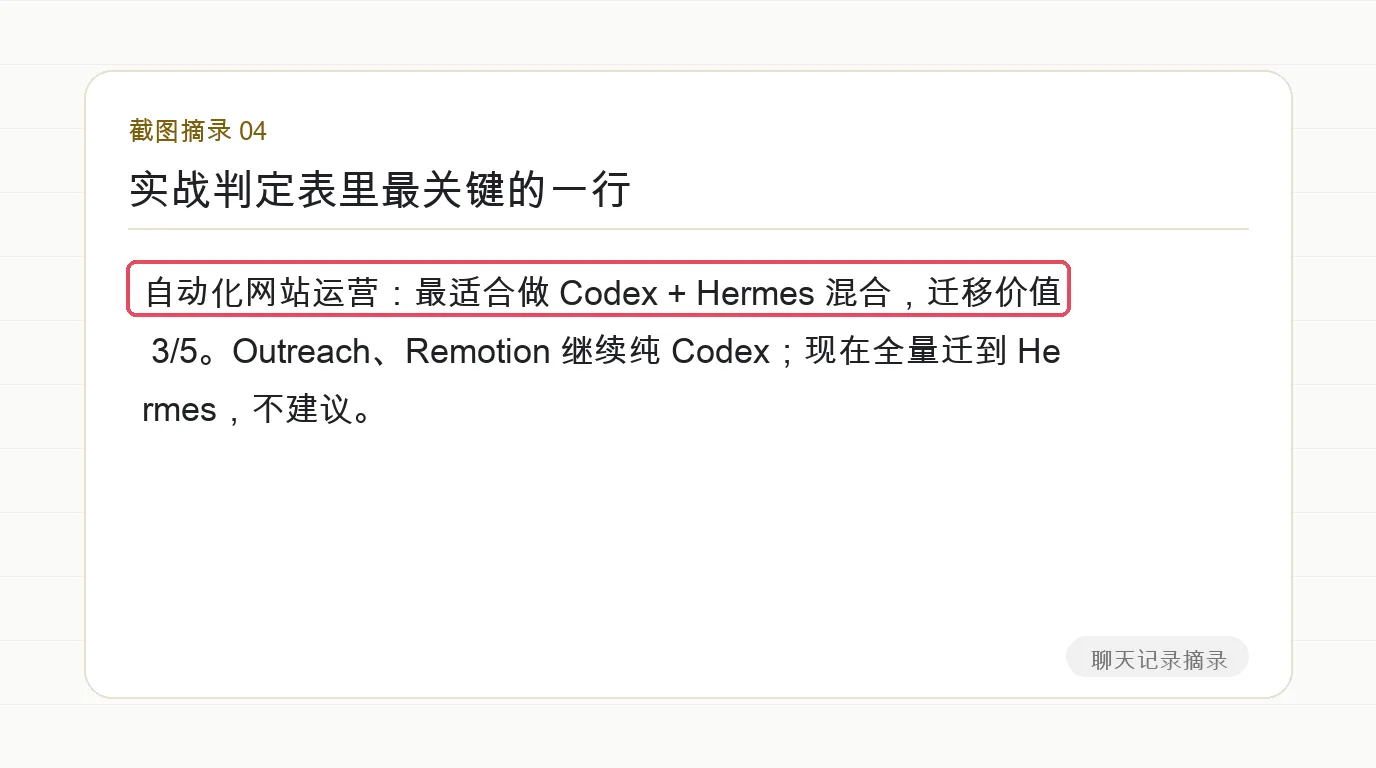
For 50 outreach emails, the real difficulty lies in list quality, personalized openings, sending strategy, compliance, receipts, and your final manual review. Even if Hermes can handle persistent scheduling, it won’t suddenly make your emails higher quality. At best, it sends an exception alert to a channel. Codex handles this perfectly well; there is no need to migrate just for a “duty shell.”
Remotion is even more obvious.
Remotion video production is ultimately an engineering problem involving codebases, assets, timelines, builds, rendering, error troubleshooting, and browser previews. Codex is perfectly suited for this. Migrating it to Hermes won’t make the video look better; it might just add a layer of complexity regarding scheduling, permissions, paths, and environment variables.
WeChat content creation, formatting, and uploading are similar. Creation, rewriting, Markdown-to-HTML conversion, cover prompts, image lists, and style templates—Codex already handles these smoothly. Only the final step, which relies heavily on web login states, browser backends, manual spot checks, and cross-channel receipts, might have some value in Hermes. Note: some value, not a necessity.
At this point, the article could have ended.
But something felt off.
I realized that GPT’s answer contained a common “new tool recommendation trap.” It said Hermes could handle persistent scheduling and notifications. But I immediately realized that this reason is actually quite weak.
I countered:
“If these tasks ultimately still require me as a human to audit them, what is the difference—or the advantage—between auditing a notification report from Hermes versus a daily scheduled report from Codex? Why would it be worth migrating?”
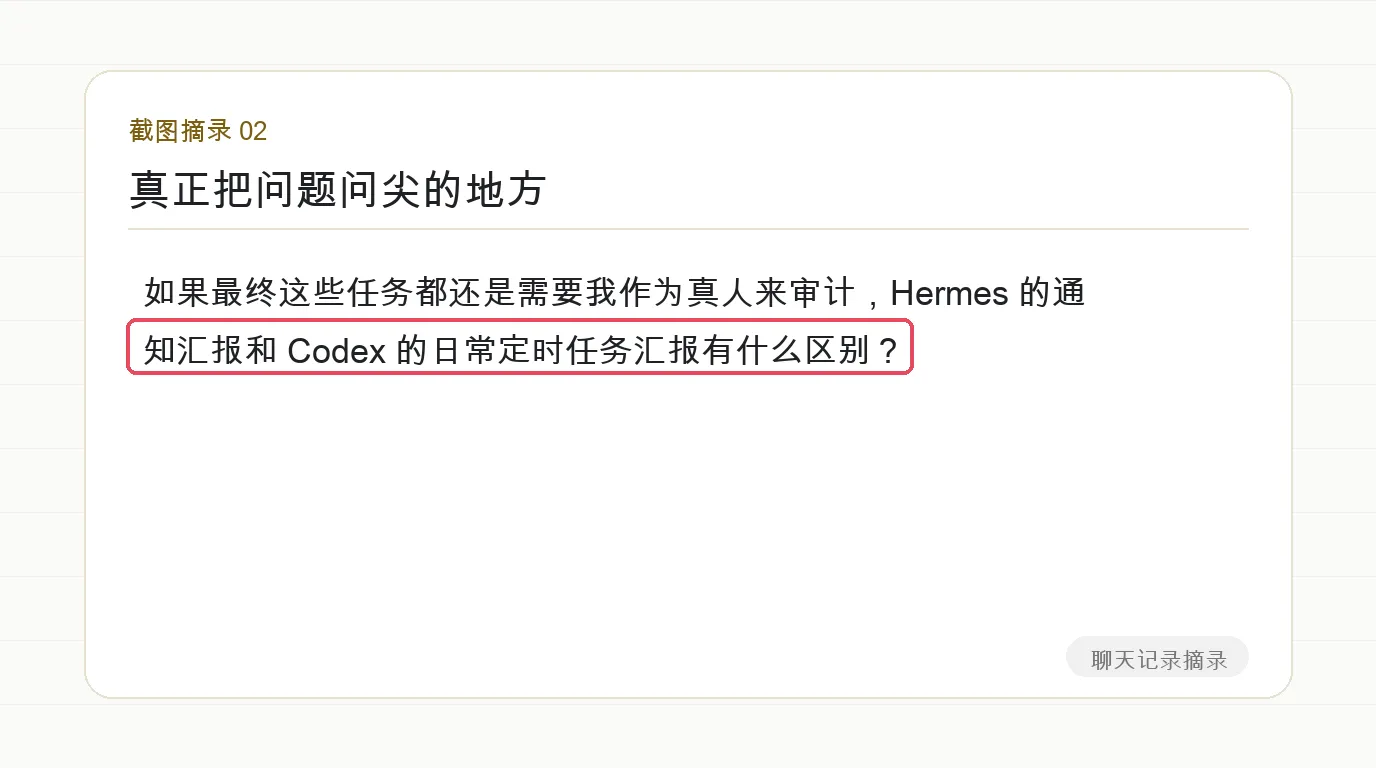
This question is the crux of the entire conversation.
Many people looking at new tools are easily attracted by “it runs automatically,” “it notifies me,” and “it connects to many channels.” But if you have ever done operational automation, you know that notification itself is not value. Notification just puts the problem in front of you.
What actually takes time is judging whether it was done correctly: Is the content okay to publish? Will the email offend the client? Is the CMS page broken? Did the video render incorrectly? Is the WeChat formatting messed up? Did the browser click the wrong button? As long as you have to audit these steps, the difference between a notification from Hermes and one from Codex is negligible.
After being pressed, GPT 5.4 Pro’s answer tightened significantly. It was direct:
If you have already streamlined your Codex scheduled tasks, notification callbacks, and browser automation, and you still need to personally audit before sending or publishing, then migrating to Hermes purely for “persistent scheduling and notifications” is likely not worth it.
I think this is a very important point.
It pulls Hermes out of the halo of being a “next-generation agent” and brings it back to a very mundane question: Does it actually reduce your real burden?
In plain English: If Hermes is just helping you send the same review material from a different channel, that is not “migration value.” That’s just changing where you look at your notifications.
That’s not very interesting.
Of course, Hermes still has value.
As I continued to break this down with GPT, we basically confirmed one thing: the place where Hermes is truly worth watching isn’t “it writes code better than Codex” or “it writes WeChat articles better than Codex.” It is worth watching because it acts like a long-running ops runtime.
That term sounds a bit abstract, so let me translate it.
Codex is more like a highly skilled worker. You give it a repo, a task, a script, an error, and it can go in, modify, run, test, fix, explain, and summarize.
Hermes is more like a shift supervisor. It cares more about whether the agent can stay online, receive external messages, handle webhooks, isolate different projects by profile, retrieve cross-session information, send results to channels like Slack, Telegram, or Email, and integrate browsers, cron, memory, and API servers into a relatively complete runtime.
So, the key to the whole judgment shouldn’t be “who is stronger, Codex or Hermes?” The more realistic question is: Do you need a worker, or do you need a shift supervisor?

If you need a worker, keep using Codex. If you need a shift supervisor, Hermes starts to make sense.
This is why, in that task table, the only thing truly worth considering for a hybrid architecture is “automated website operations.”
Website operations can easily grow from a simple scheduled task into a continuously running operational system.
For example, you need to monitor if pricing pages, landing pages, competitor pages, campaign pages, or form pages have changed. A single page scrape isn’t hard; Codex can write a script for that. The hard part is: once a change occurs, who decides if it’s worth bothering you? Who silences valueless changes? Who delivers valuable changes to a fixed channel? Who logs the results so you can check them later?
That’s where Hermes starts to shine.
Its advantage isn’t necessarily that it scrapes pages better; it’s that it turns the chain of “scrape, compare, judge, silence, notify, log” into a long-running pattern.
Take webhooks, for example. A deployment event, a Stripe payment exception, a GitHub PR, a ticket system update, a form error. Codex can certainly handle these, but you would likely have to build a service layer for receiving, routing, triggering, and notifying yourself.
Hermes acts more like an off-the-shelf duty station here. Its value lies in the runtime: once an external event comes in, it can perform an initial round of understanding, triage, drafting, and delivery. In other words, you can let Hermes receive the information and use a “Codex skill” to arrange for Codex to execute the work. It’s more like a shift manager.
And then there’s the browser.
I asked GPT: What can Hermes do in the browser that Codex can’t? Because I currently use Codex to schedule Agent Browser, Playwright CLI/MCP, or even the Agent mode of the Atlas browser, and I can complete a lot of browser automation.
GPT’s answer was quite honest. It didn’t claim there was an absolute “cannot do.”
In other words, Hermes doesn’t have some mysterious capability that Codex can’t touch. The path of Codex + Agent Browser / Playwright / MCP is the right one.
The difference with Hermes is mainly in its integration form.
It bundles things like Browserbase, Browser Use, local Chrome/CDP, Firecrawl, Camofox, and local agent-browsers into a unified browser layer. It also places more emphasis on session recording, persistent browser sessions, anti-scraping, proxies, CAPTCHAs, and task-level isolation—all those messy operational requirements.
For your own site, standard backends, or simple Playwright flows, this isn’t necessarily a qualitative leap. But if you are doing a lot of backend inspections, ad backends, affiliate backends, competitor page scraping, or web operations with complex account environments, the Hermes browser runtime feels more like an “operational browser automation foundation.” Especially session recording—it’s valuable for manual auditing. You aren’t just looking at what it says it did; you can re-watch exactly what it clicked.
That is where Hermes might be more comfortable than Codex.
The focus is on the out-of-the-box form and runtime experience.
But you see, by this point, the conclusion is actually more restrained. Hermes is not suitable for directly replacing Codex. It is more suitable for hosting operational processes you have already polished.
Producing and fixing these processes is still Codex’s home turf.
You can even see this in Hermes’ own design. It has a direction where it delegates programming tasks to the Codex CLI. The signal is clear: Hermes is more like an upper-layer runtime, and Codex is more like a strong executor.
So, I compressed this into one sentence:
Codex continues to be the worker; Hermes is, at most, the shift supervisor.
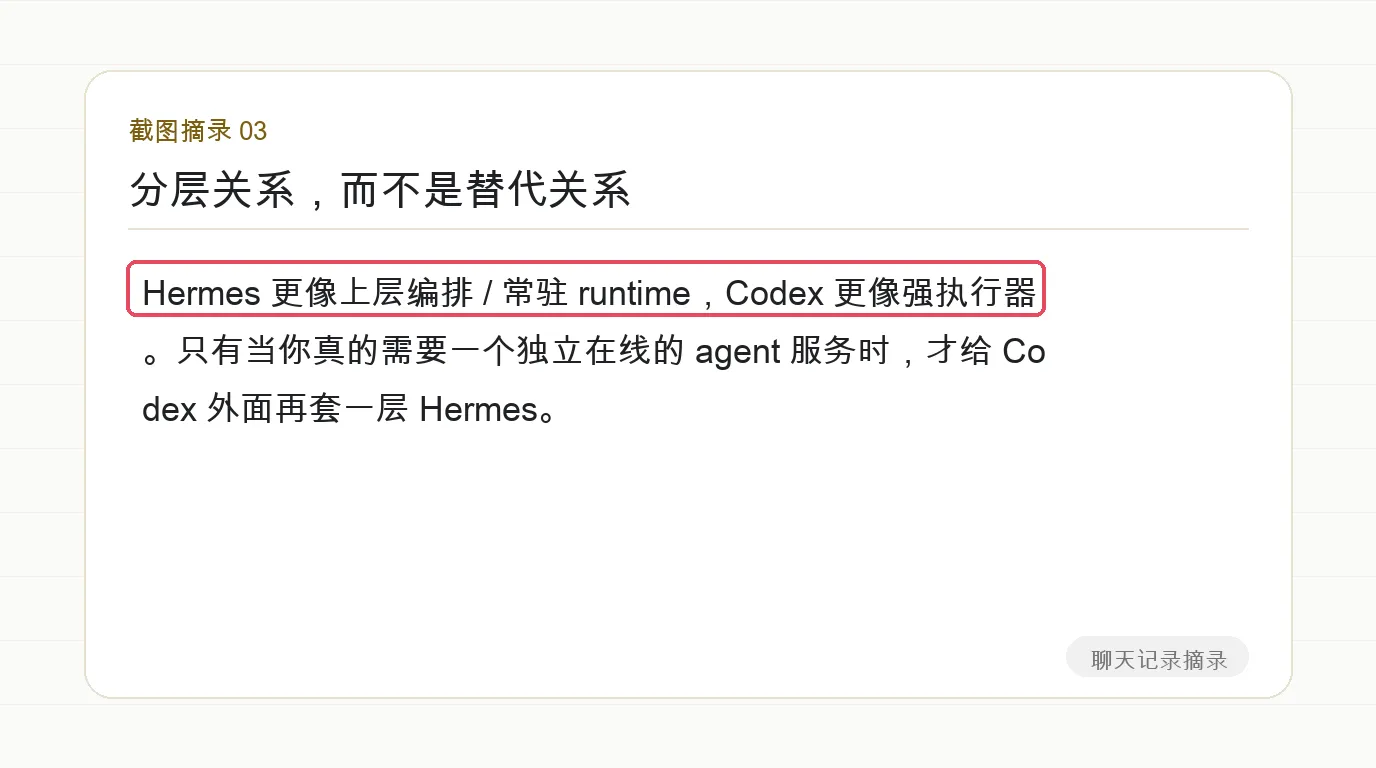
This judgment has been very helpful to me.
It avoids a common AI tool pitfall: misinterpreting “adding a layer of capability” as “must replace the existing system.” Often, tool upgrades are more about changes in the division of labor.
You have a very capable worker, and now a role has arrived that looks suitable for a shift supervisor. You don’t need to fire the worker and then have the supervisor tighten every screw themselves. You need to ask: Does this work of mine really need a shift supervisor?
If it doesn’t, don’t hire one.
Hiring one just adds another person to the meeting.
Another critical issue is so-called “self-evolution.”
The most appealing thing about products like Hermes is that they remember, learn, and accumulate skills, sounding like a long-term partner that understands you better the more you use it.
This is certainly fascinating. But the third question I asked GPT 5.4 Pro was sharp: Will this “self-evolution” eventually lead to chaos due to information entropy?
Its answer was: Yes.
And I agree.
Many people imagine an agent’s “self-evolution” as it becoming smarter, understanding you better, and becoming more like a reliable employee the longer it runs. But in engineering and operations, more long-term memory is not always better. Often, more memory means more pollution; more summaries mean more bias; more automatically generated skills mean more outdated processes.
Without governance, “evolution” quickly becomes a context landfill.

Hermes can’t escape this problem, and neither can other systems. As long as you allow any agent to automatically write long-term memory, summarize you, accumulate processes, and modify skills, it will face the same entropy risk. The only difference is that Hermes has turned this into a more formal product capability, so you need to set rules for it even more strictly.
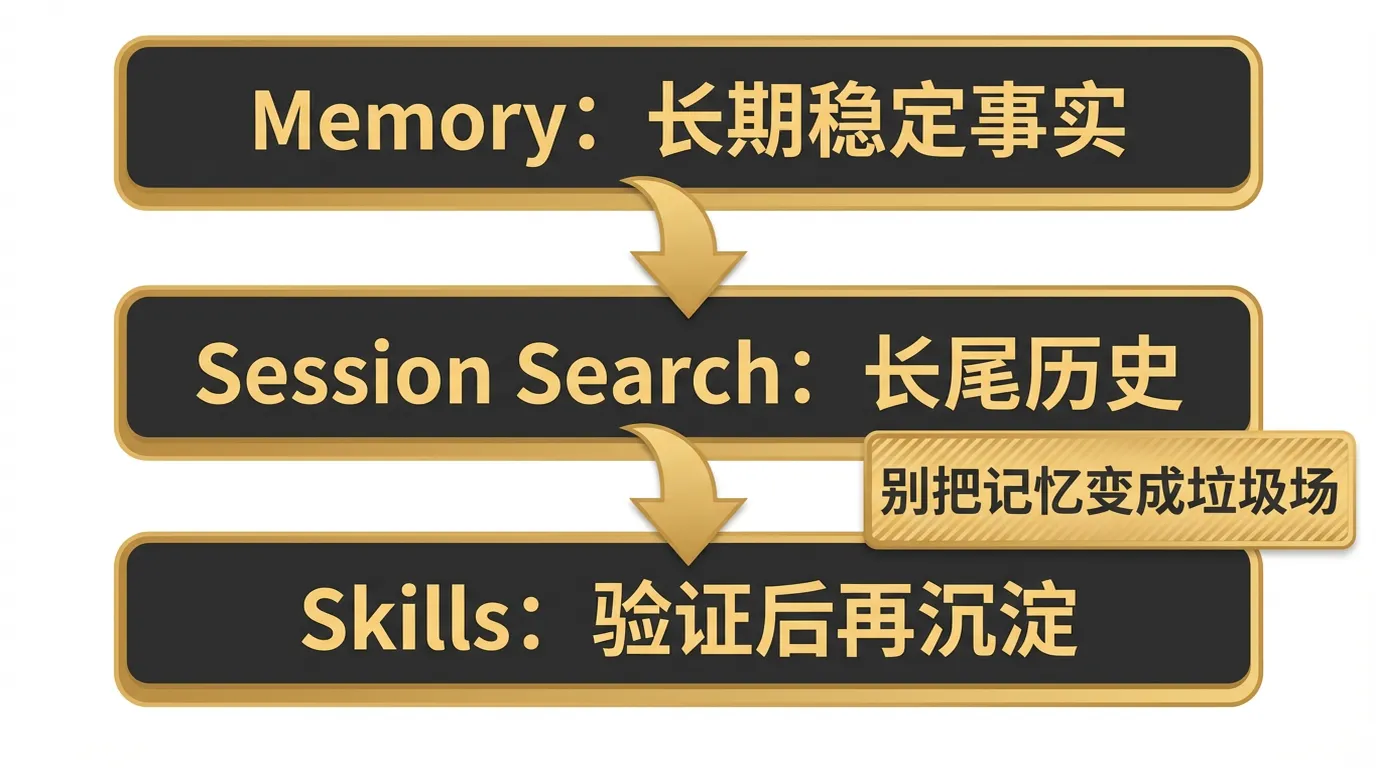
My understanding is that truly usable “self-evolution” should be split into three layers:
- Memory: Only store long-term stable facts, such as a site’s deployment location, backend login constraints, fixed operational no-go zones, and your review preferences. It shouldn’t become a running log.
- Session / Log / Search: All long-tail history, one-off failures, temporary discussions, and exceptions during a specific campaign should stay in logs and searchable sessions, not be stuffed into current memory.
- Skills: Only when a process is repeatedly verified, stable enough, and truly recurs should it be promoted to a skill. And in a production environment, it’s best not to let the agent silently overwrite key skills automatically. It can suggest updates, but you should know what it changed.
This is actually very similar to content creation, SEO, and automation. Accumulation doesn’t automatically make you stronger; you have to be able to categorize, expire, delete, and isolate. Otherwise, all “long-term memory” will eventually become a long-term burden.
When talking about deployment, I also asked a very practical question: If I use Hermes incrementally, do I need a separate Mac mini?
GPT’s judgment was: Not yet. I agree with this.
Don’t set up an independent machine for Hermes during the verification phase. Just run a small ops profile on your existing MacBook and test it with one real workflow. Only when it truly enters 24/7 persistent operation—requiring a gateway, local Chrome login states, and you frequently closing your laptop and taking it away—should you consider a dedicated machine.
And it doesn’t even have to be a Mac mini.
If the task doesn’t rely on local login state browsers, remote machines, Docker, SSH, or cloud sandboxes might be more rational than buying a new machine.
Don’t underestimate this deployment issue. The cause of death for many automation systems is often not model capability, but the laptop lid closing, network switching, path changes, environment variables not loading, browser login states expiring, or background processes hanging without anyone knowing.
“Long-term online” status ultimately comes back to operations. If you just want to try Hermes, don’t treat it as a production system right away. Let it prove itself first.
Having said that, I think this article can wrap up.
If you are a Codex user, should you migrate to Hermes?
My answer is: Most people shouldn’t migrate yet.
If you are currently writing code in a repo, fixing bugs, running tests, doing reviews, and modifying automation scripts, Codex is great. If your current operational tasks are “run on a schedule, generate results, I manually review,” Codex is also great. If your browser automation is already running through Codex + Playwright / Agent Browser / MCP / Atlas, you don’t need to migrate just for a browser entry point.
If you don’t yet have a high-frequency, long-term, cross-channel, event-driven workflow that requires memory accumulation, don’t be anxious. Hermes might just be a more advanced, energy-draining new toy for you.
But conversely, if you already have multiple websites, multiple channels, and multiple automation processes; if you have events like deployments, payments, forms, content, tickets, and competitor changes flooding in every day; if you truly need an agent to stay online, receive webhooks, make preliminary judgments, route tasks, and push results to a fixed home channel; if you need to isolate different sites, brands, and roles into profiles to avoid memory and context pollution; if your website operations involve a lot of messy web pages, backend login states, anti-scraping browsers, session recording, and manual audit replays—then Hermes starts to exceed the scope of “just another agent.”
It starts to look like an ops shell.
But even then, I don’t recommend a full migration. The more stable approach is: Codex continues as the worker, and Hermes only acts as the ops shell.
In other words, writing scripts, fixing scripts, creating content, calling APIs, modifying pages, running Remotion, and handling repos—keep giving those to Codex. For external event entry points, duty notifications, profile isolation, long-term memory, browser runtime, and cross-channel messaging, consider letting Hermes handle a portion.
So, don’t make it an “either-or.”
It’s about layering.
I am increasingly feeling that the biggest mistake in AI tool selection isn’t necessarily picking the wrong tool, but interpreting all problems as a need for replacement. When a new tool gets hot, people ask if they should migrate. When a new model comes out, people ask if they should switch everything. When a new agent explodes, people ask if their existing system is obsolete.
But in real business, the question can change from “Should I replace it?” to “Where should it stand in the stack?”
If Hermes stands next to Codex and tries to steal the worker’s job, I don’t think it’s necessary. If Hermes stands above Codex and acts as a shift supervisor, it starts to get interesting in certain website operation scenarios.
That is the most valuable conclusion I reached from my deep dive with GPT 5.4 Pro.
Don’t get carried away by words like “long-term memory,” “self-evolution,” “open-source agent,” and “trending GitHub project.” Look back at your own work.
Do you lack a stronger executor, or a long-running runtime?
Are you letting Codex produce stable output daily, which you then review and move on from, or are you already being dragged down by cross-channel events, backend inspections, page changes, team notifications, and long-term memory management?
If the former, stick with Codex.
If the latter, try Hermes on a small scale.
As for a full migration?
Don’t rush.
Mature automation doesn’t depend on how fast you switch tools.
It depends on whether you have truly pressed that work into a system.