
Word count: ~3900 words
Estimated reading time: ~13 minutes
Last updated: August 22, 2025
Is this article for you?
👉 If you’re an Amazon, Temu, or other platform cross-border seller, deep in traffic involution and profit decline.
👉 If you’re planning brand globalization, thinking about strategic positioning between platform e-commerce and independent sites.
👉 If you want to fundamentally understand “brand” value and how to build real brand moats in overseas markets.
👉 If you want to leap from “selling goods” mindset to “building brand” strategic altitude.
Core Structure
- Introduction: The global e-commerce ecosystem and the fate of “traffic tenants.”
- Platform vs. Merchant Zero-Sum Game: You value growth; they value monetization.
- The Trust Paradox: From “borrowed trust” to “owned trust.”
- Platform Dependency’s “Slow Poison”: Brand path “hijacked” by algorithms and rules.
- Brand Globalization’s Growth Ladder: From independent survival to cultural resonance.
- Conclusion: Abandon symbol worship, embrace full-journey experience.
1. Introduction: The Global E-commerce Ecosystem and “Traffic Tenant” Fate
Hey, I’m Mr. Guo. Today I don’t want to talk about AI — just some thoughts about the broader global e-commerce space. Writing this essay on impulse, I chose the very primitive method of hand-typing on keyboard, expressing pure writing desire, nostalgically experiencing raw keyboard-based text creation that might disappear in the future. Fair warning: this article may contain some sharp commentary — purely personal views; if you disagree, that’s fine.
As someone who’s mixed in various global e-commerce circles for years, I’ve noticed an interesting phenomenon: Those doing TikTok Shop trending product dropshipping today are essentially the same people doing Facebook/Google independent site trending product dropshipping ten years ago. They’re obsessed with chasing traffic arbitrage, rushing wherever it’s cheap. Platforms switched from PC to mobile, traffic goldmines from Facebook to TikTok, maybe next is RedNote, but their identity as “traffic tenants” never changed.
This phenomenon is just one microcosm of the broader global e-commerce ecosystem. From my observation, this circle has highly differentiated: those claiming “cross-border e-commerce” are mostly platform sellers; “TK” players are one wave; “independent site” folks often do counterfeit brands; “DTC” practitioners are commonly factory second-generation; while those truly discussing “brand globalization” are another group entirely. Add B2B foreign trade, gaming, software, SaaS, and this year’s hottest AI globalization — each circle is self-contained, logic self-consistent, collectively exporting the ancient Eastern wisdom of “involution” to the entire world.
I’m probably among the few who’ve mixed in all kinds of products and circles. My biggest takeaway: no matter how tracks shift, the ultimate question points the same direction — Are you “renting traffic” or “building brand”? Are you working for platforms or constructing assets that belong to you? Today, let’s discuss why true brand globalization must complete this identity leap from “traffic tenant” to “brand landlord.”
2. Platform vs. Merchant Zero-Sum Game: You Value Growth; They Value Monetization
A cruel but necessary truth: Platforms and merchants are fundamentally opposed in interest, not mutually beneficial — at most limited reciprocity. Platform business models are “secondary traffic monetization.” They don’t produce goods; they’re traffic “subleasers,” profiting by collecting rent (sales commission) and property fees (advertising fees) from “tenants” like you.
When platforms are in high-growth phases with endless new traffic flowing in, landlords and tenants can coexist peacefully. But when markets saturate and user growth peaks, transforming platforms into stock markets, landlords must find ways to extract more value from existing tenants to maintain their revenue growth. Methods are few:
-
Raise rent: Increase sales commission percentages.
-
Raise property fees: Increase ad cost per click or impression.
-
Milk one fish multiple times: After users complete purchases, immediately recommend other tenants’ cheaper similar products, repeatedly monetizing one user’s traffic value.
Regardless of method, the final result is continuous compression of merchant profit margins and competition deterioration. In platform rules, you’re forever working for landlord’s financial reports — your growth ultimately becomes platform revenue.
Why do we always feel “domestic environment is getting more involuted”? Why is it always hard to create distinctive products?
Because platforms need growth. With limited total users, your profit decreasing equals platform’s performance increasing. Because today you launch an innovative hit, tomorrow hundreds or thousands copy you, at a fraction of your price.
I actually have a pessimistic sentiment — China’s online commercial environment is truly a brand graveyard. This isn’t Chinese manufacturing’s strength but Chinese creation’s tragedy.
The domestic consumer brands I can think of — almost none played out through domestic online platforms. Think about how Anker started, how TopToy plays, how Pop Mart plays? Then think about Xtep, Anta — how they played out, or even Moutai? The answer ultimately is: a brand traffic entrance that can be completely independently controlled, whether online or offline. I’m not saying don’t sell on platform e-commerce, but that even without platform e-commerce, you can still achieve complete business ecosystem closure. In this case, platform e-commerce is merely a brand’s order-taking tool.
3. The Trust Paradox: From “Borrowed Trust” to “Owned Trust”
Many sellers say, “Using platform’s power, haven’t I also gained user trust?” There’s a huge cognitive error here. Consumers ordering on Amazon trust the platform’s transaction guarantees (payment security, FBA logistics, return policies), not your product itself. What you get is “borrowed trust” — fragile and not yours.
Platforms deliberately anchor this trust to themselves through strict rules, like limiting your direct communication with buyers and controlling all user data. They don’t want you building relationships with users beyond the platform.
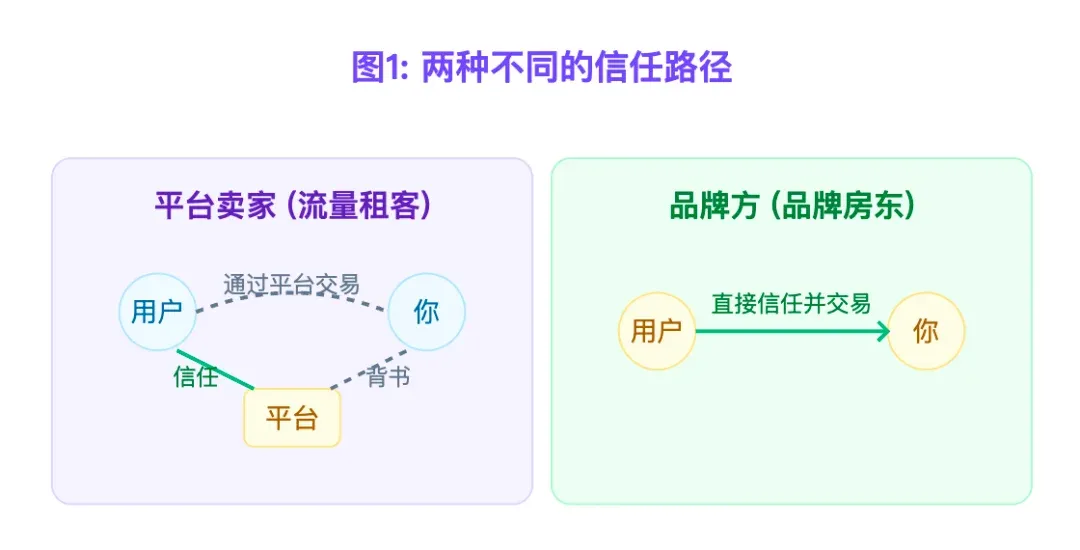
Brand’s ultimate value is precisely building “owned trust.” This trust is formed by users based on long-term stable expectations of your product quality, design philosophy, and service experience. It transcends individual transactions, becoming emotional connection.
When consumers say “I buy this brand with confidence” rather than “I buy on this platform with confidence” — that’s when brand truly exists.
Relying on platforms to solve trust problems is tantamount to handing brand’s lifeline to others’ control. Brand building’s core is establishing direct, continuous communication with users through independent sites, social media, communities, fan economy, email lists, and other owned channels — gradually converting “borrowed trust” into truly “owned trust.” Of course, using platforms as phase-specific leverage tools or growth channels is fine — just don’t bet everything on them.
4. Platform Dependency’s “Slow Poison”: Brand Path “Hijacked” by Algorithms and Rules
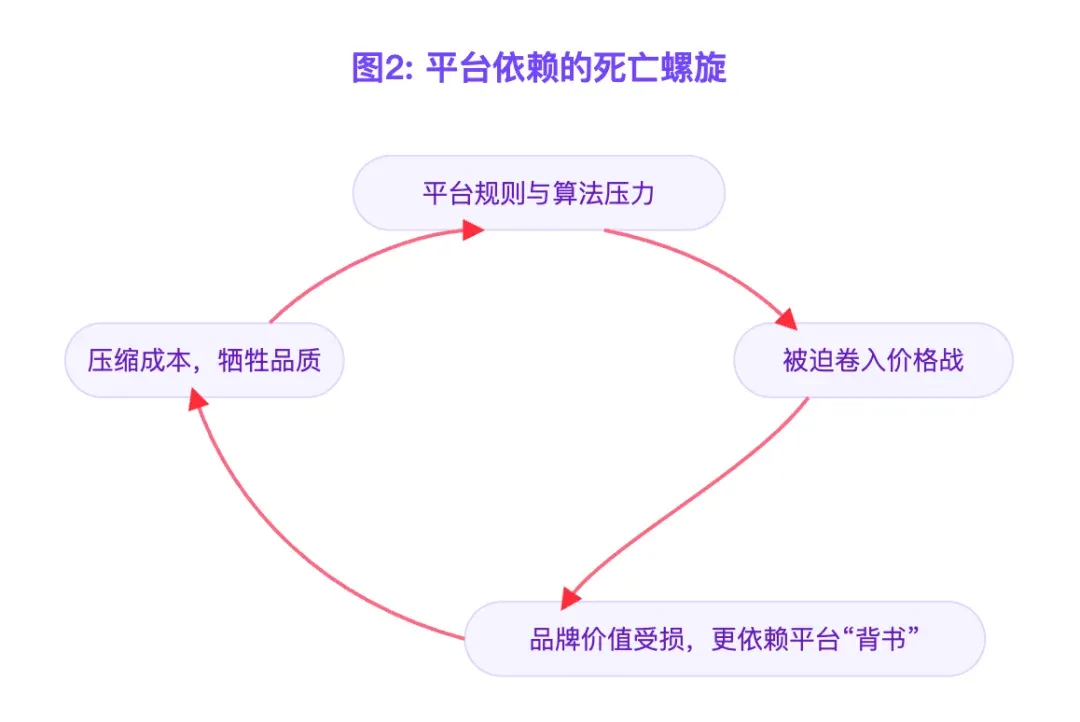
Brands completely dependent on single platforms have floating value foundations. More frightening: platform algorithms and rules are like slow poison, making you unknowingly walk a “hijacked” path, ultimately falling into “bad money drives out good” vicious cycles.
Platform A9 algorithms are highly price-sensitive — low prices get more exposure; “buy box hijacking” mechanisms instantly flood your hits with countless cheap imitators; lenient return policies amplify your operating costs. Under these rules, your operational focus inevitably shifts from “how to make good products, tell good stories” to “how to optimize keywords, how to price-war, how to handle review attacks.” To survive, you’re forced to cut prices; for profit, you’re forced to compromise on supply chain. This is an unsolvable death spiral, ultimately grinding away your brand value.
This “hijacking” effect also explains why I’ve seen so many successful Amazon sellers repeatedly fail at transitioning to independent sites. Because their thinking patterns have been “formatted” by platforms. They’re proficient in traffic buying and conversion optimization, but clueless about building brand value from zero, creating content and emotional connections with users. They try using tactical diligence to cover strategic laziness.
An extreme counter-example is Apple. I have friends who’d rather pay full price on Apple’s official website than go to subsidized e-commerce platforms. Because Apple as a brand provides trust value that transcends any platform, even at premium prices. It can completely not depend on third-party e-commerce, completing the full marketing-to-sales closed loop. Though this is hard to replicate, it clearly points to brand power’s ultimate form — becoming trust’s final destination.
5. Brand Globalization’s Growth Ladder: From Independent Survival to Cultural Resonance
So how should a truly global brand plan its growth path? In my view, it should be like climbing stairs — each step building more solid core barriers, ultimately becoming your own “landlord.”
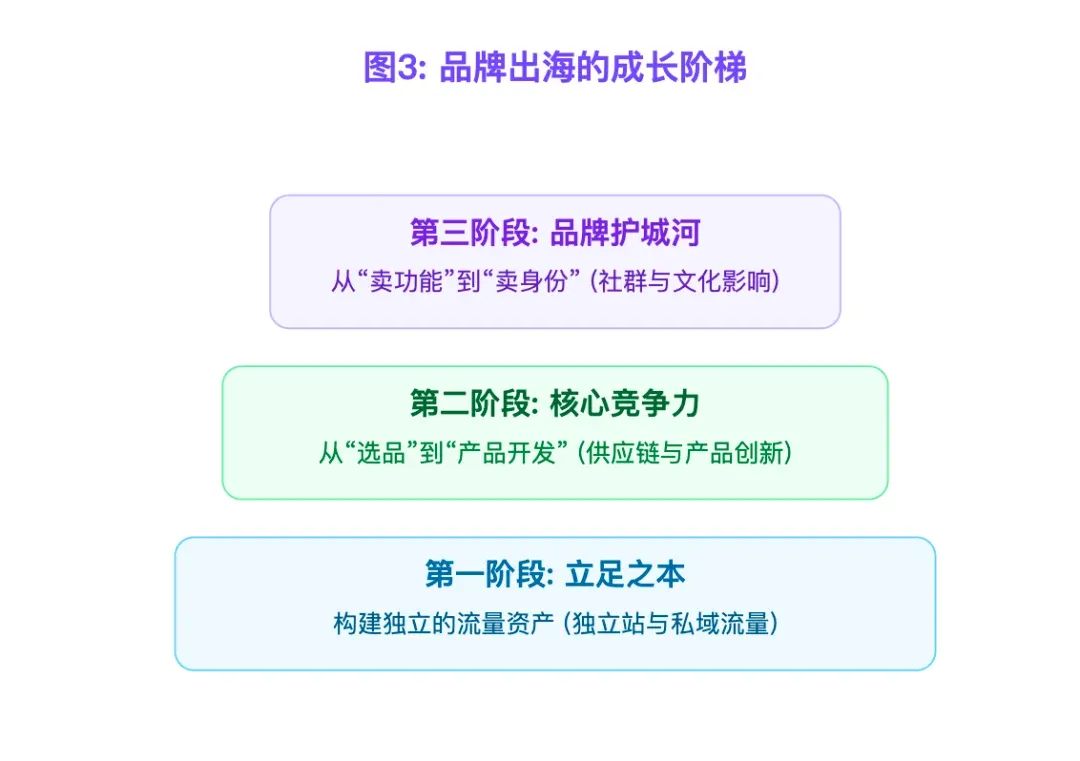
Phase 1 (Foundation): Build Independent Traffic Assets
This is why independent sites (DTC) are brand globalization’s first step. Its core isn’t “building a website” but constructing owned traffic pools not skimmed by platforms. This means mastering SEO so users find your official site on Google; operating social media, creating content that attracts followers; building email lists, maintaining direct user communication. These followers, these subscribers — these are truly your user assets that can be repeatedly reached. A brand that can survive without platform e-commerce has truly established a foothold.
Phase 2 (Core Competitiveness): From “Product Selection” to “Product Development”
Once traffic problems are initially solved, competition’s core returns to products themselves. Platform seller mindset is “product selection” — finding already-validated hits. Brand “landlord” mindset is “product development.” This means deeply understanding your users, collaborating deeply with supply chains, designing and creating products with true differentiation that solve their pain points. You need your own design, materials, and craftsmanship, building product moats competitors can’t easily imitate.
Phase 3 (Brand Moat): From “Selling Features” to “Selling Identity”
When products are good enough, brands begin transcending material functionality, building communities, outputting values, forming cultural identity. At this point, brand is no longer just a choice but an identity symbol. You need to create a “home” for core users — a space for them to communicate, share, find belonging (like Discord communities, Facebook groups). You need to encourage UGC (user-generated content), making users your best “salespeople.”
An important recognition: brands don’t need everyone to like them. Find your core tribe, serve them well, make them passionate about you. There will always be products mocked by masses as “IQ tax,” but in specific circles, they’re “faith recharges.”
6. Conclusion: Abandon Symbol Worship, Embrace Full-Journey Experience
Traditional brand theory often explains brands as semiotics’ external manifestation, over-obsessing on logos, slogans, and other visual elements. But in today’s global consumer environment, I believe “full-journey brand experience” better explains brand value.
From consumers’ first sight of your social media ad, to visiting your carefully designed independent site, to smooth checkout process, to surprise-filled unboxing experience, to professional and timely after-sales service — the sum of every touchpoint constitutes users’ comprehensive perception and trust in you.
Brand globalization isn’t simply selling goods overseas but delivering a complete, trustworthy experience to users worldwide. This is the true meaning of leaping from “traffic tenant” to “brand landlord.”
Found Mr. Guo’s analysis insightful? Drop a 👍 and share with more friends exploring the global path!
Follow my channel to explore AI, going global, and digital marketing’s infinite possibilities together.
🌌 In globalization’s tide, only brand is the ultimate harbor against all uncertainty.
