
Word count: ~4600 words
Estimated reading time: ~15 minutes
Last updated: July 16, 2025
Is this article for you?
-
If you’ve mastered keyword research methods and produced a “content map.”
-
If you’re not satisfied with scattered keyword rankings and want to establish absolute dominance in a specific area.
-
If you want to learn an advanced SEO strategy that builds long-term, sustainable traffic assets.
Chapter Contents
-
Preface: From “Hunting” to “Farming” — The Strategic Upgrade
-
Chapter 1: From “Scattered Guerrilla” to “Positional Warfare” — Why Topical Authority Is Your Strategic Nuclear Weapon
-
Chapter 2: Deconstructing the “Hub-and-Spoke” Model — The Golden Combination of Pillar Pages and Cluster Content
-
Chapter 3: Blueprint Drawing — How to Plan Your First Topic Cluster from Your Content Map
-
Chapter 4: Focusing on SaaS and AI Products: The “Three-Core Drive” Page Structure Analysis
-
Chapter 5: Weaving the Web — The Strategy, Tactics, and Art of Internal Links
-
Chapter 6: From Data to Insights: Building Your SEO Monitoring Dashboard with Looker Studio
-
Conclusion & Preview: Time to Start the “Content Factory”
Preface: From “Hunting” to “Farming” — The Strategic Upgrade
Hey, I’m Mr. Guo. In the previous article, we learned to draw a detailed “content map” like scouts, marking spots hiding high-value users like “prey.” That was “hunting” thinking — precise, efficient, aimed at capturing every fleeting opportunity.
However, a mature civilization can’t forever rely on hunting. For stable, sustainable output, we must learn “farming” — clear, plan, sow, irrigate, and finally harvest entire fertile fields.
This article is the strategic upgrade we’ll complete together — from “traffic hunter” to “asset farmer.” We’ll learn to plan those “scattered prey” on the content map into interconnected, mutually nourishing “thematic farmland.” This “topical authority” approach is one of today’s most important advanced SEO strategies, bringing stable, predictable, and hard-to-shake organic traffic.
This is another information-dense deep article — the design blueprint for building your “content moat.” I suggest you save it immediately and ensure you’ve followed my channel to unlock the complete growth system.
Chapter 1: From “Scattered Guerrilla” to “Positional Warfare” — Why Topical Authority Is Your Strategic Nuclear Weapon
Let’s face reality: if you write an “AI music composition” article today, a “VST plugin recommendations” article tomorrow, and a “how musicians file taxes” article the day after — even if each is high quality — they’re just “scattered guerrilla actions.” You might capture a few scattered keyword rankings, but never form an overwhelming force.
Why? Because in Google’s eyes, you’re a “jack of all trades” who knows a little about everything, not a “specialist” in any field. When users search for important questions, which does the search engine trust more? The answer is obvious.
Topical Authority strategy is SEO’s “positional warfare” thinking. Its core: we no longer pursue individual keyword wins and losses, but systematically and organizationally create a series of deeply connected content to clearly prove to Google and users: “On this specific topic, I am the most authoritative, comprehensive, and trustworthy information source.” Once established, this authority grants “ranking dividends” for hundreds or thousands of related keywords across the entire topic, building a solid “content moat.”
Chapter 2: Deconstructing the “Hub-and-Spoke” Model — The Golden Combination of Pillar Pages and Cluster Content
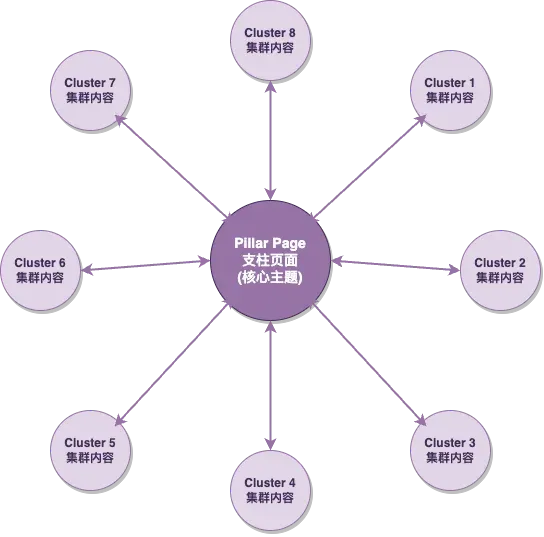
The tactical framework for building topical authority is the elegant and powerful “Hub-and-Spoke” model. Imagine it as a solar system:
-
The Hub - Pillar Page: This is the sun. An extremely detailed “ultimate guide” covering a broad core topic. For example, “The Ultimate Guide to AI Music Creation.” This page is usually long, aiming to become the topic’s 101 introduction and index. It doesn’t pursue deep dives into every detail, but breadth and comprehensive coverage.
-
The Spokes - Cluster Content: These are the planets. More specific, focused deep articles orbiting the “sun.” Each cluster page deeply explores a subtopic mentioned in the pillar page. For example, “Best AI Voice Generators Review,” “How to Use AI for Video Scoring,” “Suno V3 Tutorial,” etc.
This model’s magic: through precise internal linking (detailed in Chapter 5), the planets’ gravity (SEO value) passes to the sun (pillar page), while the sun’s rays illuminate every planet. They support each other, collectively elevating the entire “solar system’s” standing in the universe (Google).
Chapter 3: Blueprint Drawing — How to Plan Your First Topic Cluster from Your Content Map
Theory is clear; now it’s time for hands-on planning. Take out the “content map” we created in the previous article — it’s now our treasure map.
Planning process:
-
Step 1: Identify Topic Clusters. Browse your content map, looking for keywords that can be grouped under a larger topic. For example,
AI singer,AI rapper,AI cover song,text to musiccan all be grouped under “AI-Generated Music” as a larger topic cluster. -
Step 2: Choose Your Pillar Page Core Keyword. This keyword should have substantial search volume and be broad enough to accommodate at least 5-10 subtopics. In the above example, “AI music generation” or “AI music tools” are good pillar page candidates.
-
Step 3: Filter Your Cluster Content. From the content map, find all long-tail keywords and specific questions related to the pillar page topic. Each becomes an independent, deep cluster article. For example,
best AI singer for free,how to use AI rapper voice,Suno vs Udio comparison. -
Step 4: Validate and Iterate. Quickly search your pillar and cluster page core keywords to see what formats rank highly. This helps validate whether your content format planning is correct. A good topic cluster should be your content creation core for the next 2-3 months.
Chapter 4: Focusing on SaaS and AI Products: “Three-Core Drive” Page Structure Analysis 💡
The “Hub-and-Spoke” model is a content strategy, but it must be implemented in your website’s specific page structure. For SaaS and AI product developers, I’ve summarized an effective “Three-Core Drive” page structure that perfectly supports topical authority strategy.
Three Core Drivers
1. Product Landing Pages (The Conversion Core): Your website’s heart — where users ultimately convert and pay. Usually your homepage or core feature pages play this role. It’s all traffic’s final destination, corresponding to bottom-of-funnel “transactional” intent.
2. Scalable Template Pages (The Growth Core): Your website’s growth engine. These pages are generated at scale based on a unified template, capturing medium and long-tail niche demands by changing a few variables. In e-commerce these are Collection Pages; in SaaS, they can be “integration pages,” “use case pages,” “alternative comparison pages,” or “specific style template pages.”
3. Blog Article Pages (The Traffic Core): Your website’s traffic magnet. Through blogs, tutorials, guides, and other deep content, attract broad awareness traffic at funnel top, building brand trust and professional image.
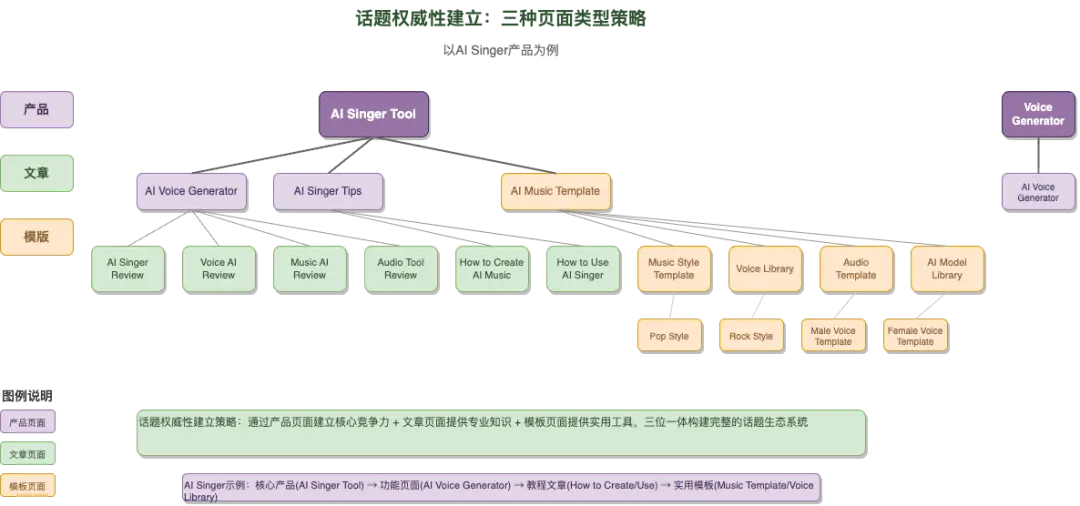
Case Study: AI Singer Product Page Structure
Using “AI Singer” as example, an ideal website structure might be:
-
Product Landing Page (Conversion Core):
/ai-singer— One of your core Pillar Pages, comprehensively introducing product features, advantages, pricing. -
Scalable Template Pages (Growth Core):
/ai-singer-styles/soul,/ai-singer-styles/metal,/ai-singer-styles/pop— These pages target specific style demands like “AI soul singer,” “AI metal singer.” They’re important Clusters linking directly to conversion. -
Blog Article Pages (Traffic Core):
/blog/how-to-create-ai-cover-songs— Another Pillar Page serving as the center for “AI cover songs” topic. It can link to more Cluster articles like/blog/best-tools-for-ai-vocals.
In this structure, product pages, template pages, and blog pages together form a powerful content and page matrix, systematically covering the complete user journey from awareness to conversion.
Chapter 5: Weaving the Web — The Strategy, Tactics, and Art of Internal Links 🕸️
If content is bricks and page structure is house layout, then internal links are the steel and networks connecting everything. Without proper internal linking, your topic cluster is just scattered sand. The tactics are simple, but the strategy behind them deserves deep thought.
Advanced Internal Linking Strategy: Silo Structure vs. Pyramid Structure
Two strategic approaches when linking your content:
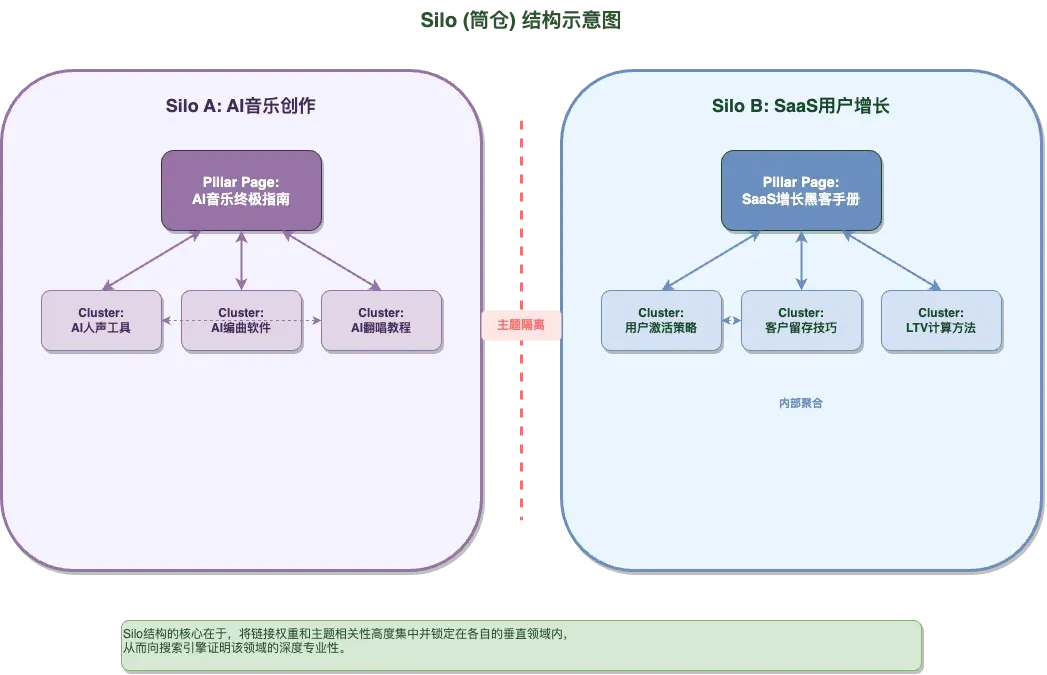
- Silo Structure: This is the “Hub-and-Spoke” model’s perfect embodiment at the linking level. Silo’s core thinking is “topic isolation.” Imagine independent silos on a farm, each storing only one type of grain. On a website, a Silo is a topic cluster. You keep all “AI Music Generation” links (between Pillar and Clusters) strictly within this “silo,” avoiding random links to unrelated topics like “SaaS User Growth.” The benefit: it greatly strengthens Google’s perception of your specific topic expertise, highly concentrating authority and relevance.
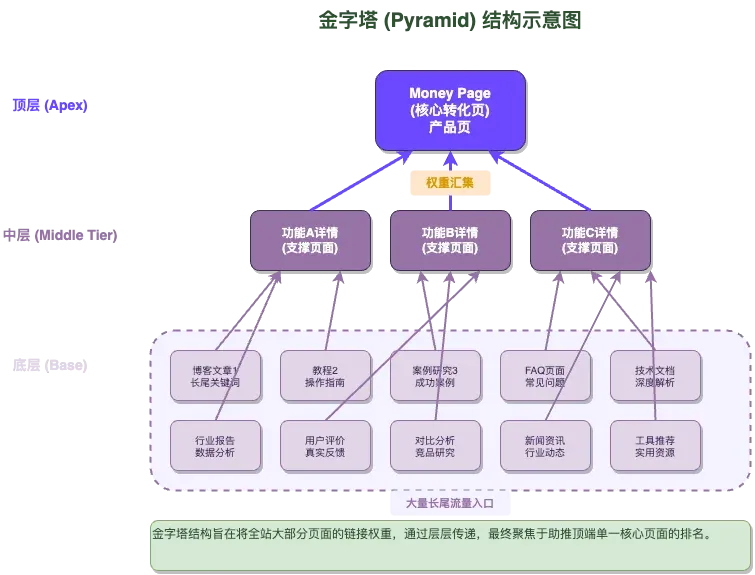
- Pyramid Structure: This structure focuses more on channeling the entire site’s authority (Link Equity) from bottom to top toward a core page at the pyramid’s peak — usually the homepage or most important “money page.” The base is massive blog articles linking to mid-level category or secondary product pages, with all links ultimately pointing to the top core page. Its goal: concentrate site-wide power to push one page’s ranking.
Mr. Guo’s Recommendation: Silo First, Pyramid as Supplement
For indie developers and SaaS founders, Silo structure is unquestionably the preferred strategy. It aligns completely with our goal of building “topical authority,” aiming to make us specialists in a vertical domain, building content moats for long-term, stable traffic. This is the right path for brand building and content marketing.
Pyramid structure is more of a tactical choice, suitable when you have an extremely important, competitive core page needing a strong push. My recommendation: build your website’s overall content with Silo structure, then strategically apply pyramid thinking without damaging Silos — for example, having all pages’ “footer links” and other global links point to your homepage for gentle authority concentration.
Key Tip: Regardless of structure, link anchor text is crucial. Don’t use meaningless phrases like “click here.” Use keyword-rich anchor text that clearly describes the target page content — for example, “AI soul singer template” as link text pointing to the corresponding template page.
Chapter 6: From Data to Insights: Building Your SEO Monitoring Dashboard with Looker Studio
An SEO strategy without data feedback is just blind guessing. You need a dashboard to tell you if your “farming” is effective. Google Search Console (GSC) is the data source, and free Looker Studio (now part of Google Cloud) is our visualization tool.
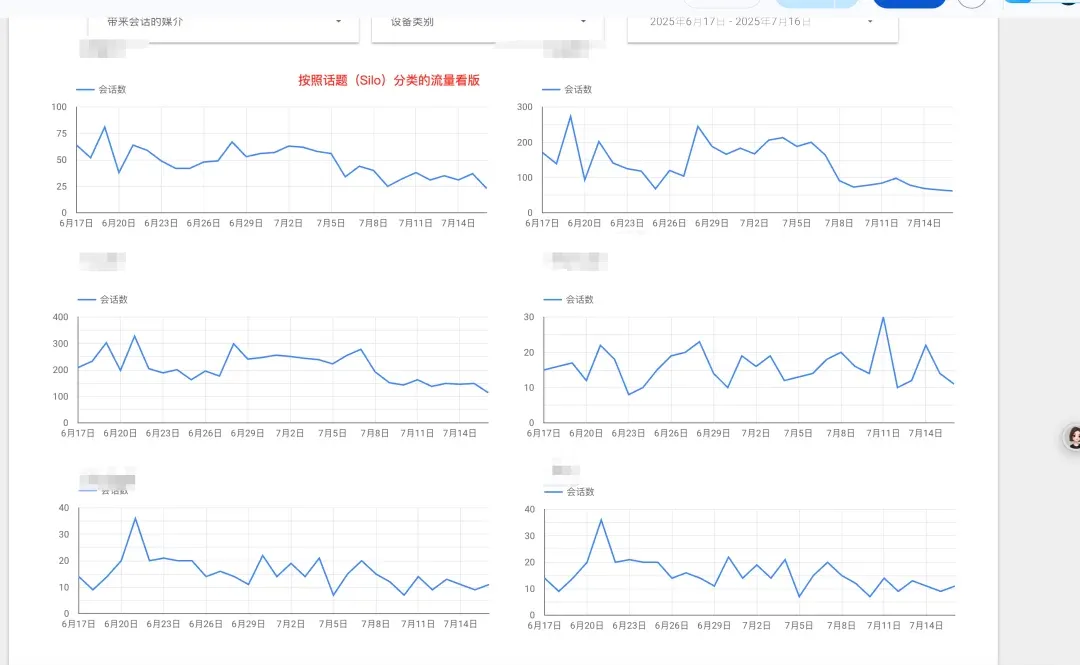
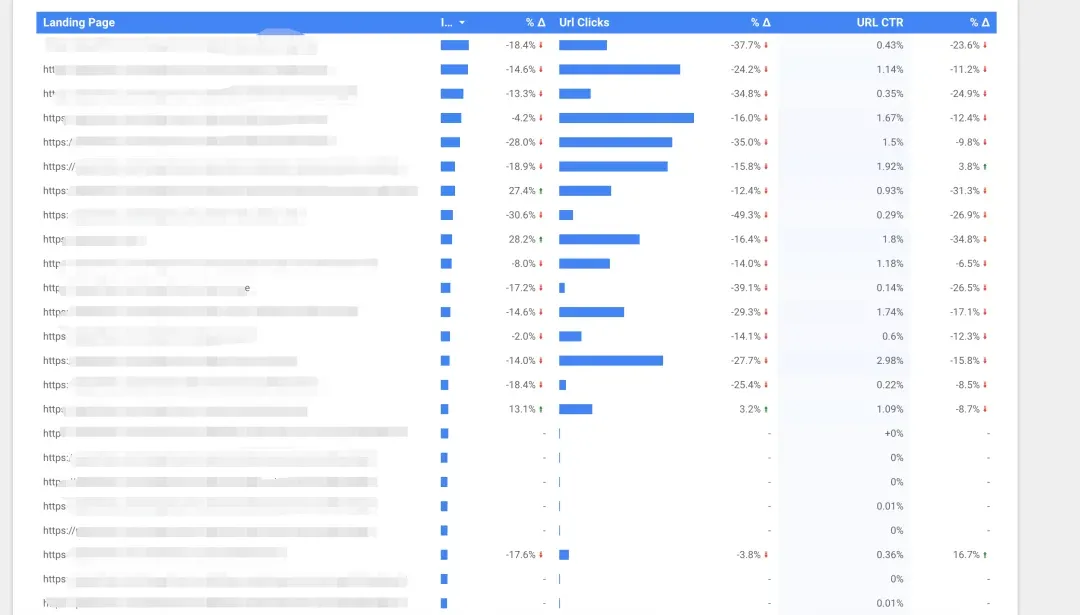
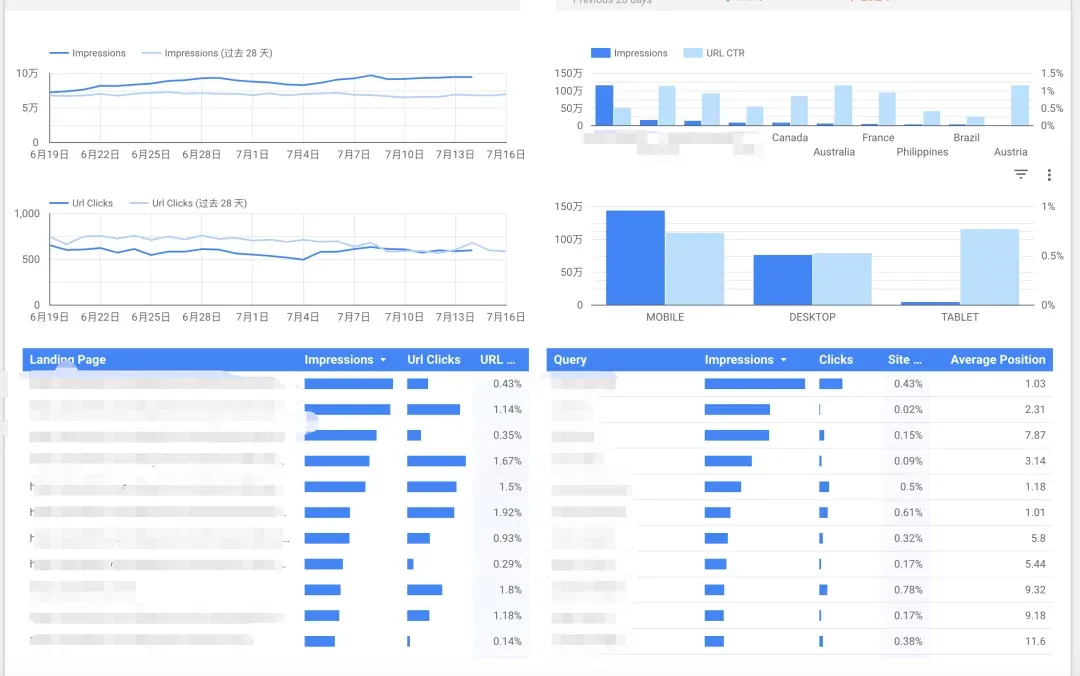
In Looker Studio, you can easily connect GSC as a data source and create these charts to monitor your topic clusters:
- Overview Trend Chart: Create a time series showing your entire topic cluster’s (filterable by URL, e.g., “contains /blog/ai-music/”) total clicks, impressions, and average CTR over time.
- Page Performance Table: Create a table listing all cluster pages with their individual clicks, impressions, and rankings. Helps quickly identify best and worst performing pages.
- Keyword Opportunity List: Create another table showing keywords bringing impressions to your cluster but ranking on page two (positions 11-20). These are your “low-hanging fruit” — usually just some content updates or internal link optimization can quickly push them to page one.
With such a dashboard, you transform from passively waiting for data to proactively discovering problems and opportunities, intervening at critical nodes, making your topical authority building a controllable, iterable systems engineering project.
Conclusion & Preview: Time to Start the “Content Factory”
Today we completed our second leap from tactics to strategy. Building “topical authority” is essentially establishing a kind of “knowledge monopoly” in your domain. This isn’t a one-day achievement — it requires patience, depth, and systematic execution. But once built, the “knowledge compound interest” and stable organic traffic become your most solid assets.
However, a perfect strategic blueprint is just paper talk if it can’t be executed efficiently. Now you have a content map and topic cluster plans, but a new bottleneck emerges: How do you efficiently, continuously, and at scale turn these plans into high-quality pages?
Preview: Scalable Content Production
To thoroughly solve the “last mile” from strategy to execution, the next chapter series will be a trilogy focusing on “content production.” I’ll separately explore:
-
(Part 4) Article Pages: How to leverage AI and SOPs to multiply content production efficiency while maintaining quality.
-
(Part 5) Product Pages: How to write high-converting SaaS product landing page copy.
-
(Part 6) Template Pages: How to do programmatic SEO for exponential page and traffic growth.
Recommended additional reading:
[Indie Developer SEO Handbook (Part 1): In the AI Era, How to Make Google and AI Both Love Your Website? (First Principles)]
[Indie Developer SEO Handbook (Part 2): From 0 to 1 User Semantic Intent Research (Keyword Research)]
Found this insightful? Follow my channel to explore AI, going global, and digital marketing’s infinite possibilities together.
🌌 Depth is the ultimate differentiation. In an era when AI can generate everything, only structured depth can build true moats.
