
Word count: ~5000 words
Estimated reading time: ~18 minutes
Last updated: July 17, 2025
Is this article for you?
-
If you’ve finished Part 1 and completed your website’s technical foundation optimization.
-
If you’re suffering from “good wine in a deep alley” — not knowing how to create compelling content for your product.
-
If you want to build a scientific, repeatable content strategy process rather than relying on inspiration and luck. Then save this article for repeated reading.
Chapter Contents
-
Preface: Fuel Your Growth Engine with High-Octane Fuel
-
Chapter 1: Keyword Research Is Dead — Semantic Intent Lives Forever
-
Chapter 2: Return to First Principles — Extracting Unique Value from Your “Product DNA”
-
Chapter 3: Drawing the Map — Building a 3D Battle Map with “Growth Funnel” and “User Personas”
-
Chapter 4: Arsenal Inventory and Tactical Supplements — Tools and Smart “Competitive Analysis”
-
Chapter 5: Practical Workflow — Four Steps to Your First “Content-Intent-Format” Map
-
Conclusion: From “Scattered Points” to “Matrix” — The Path Forward
Preface: Fuel Your Growth Engine with High-Octane Fuel
Hey, I’m Mr. Guo. In the previous article, we built an unshakeable technical foundation for your website — your precious digital asset. We ensured it’s search engine friendly, clearly structured, and high-performing. But it’s like assembling a powerful V8 engine: enormous potential, but without high-octane fuel, it can’t roar or drive your growth flywheel.
Content is this engine’s fuel.
Yet too many developers go wrong at the “fueling” stage. Based on their technical passion, they write tons of articles about product architecture and code implementation, only to find this content too niche, failing to attract real potential users. This is the classic “product-content-market” mismatch.
This article exists to solve this problem. It’s not a quick-tips short read but a systematic content strategy operating manual exceeding 5000 words. Together, we’ll learn to think, research, and plan content like a top product manager. After reading, you’ll have a repeatable, scalable process for continuously fueling your growth engine with the most precise, efficient “fuel.”
This article is information-dense — I strongly recommend clicking the save button for anytime reference. And don’t forget to follow my channel to ensure you don’t miss upcoming deep content in this series. Let’s begin.
Chapter 1: Keyword Research Is Dead — Semantic Intent Lives Forever
We must be clear upfront: the era of traditional keyword research focused on finding and stuffing individual keywords is completely over. If you’re still obsessing over a term’s monthly search volume (Volume) or keyword difficulty (Difficulty), your thinking is at least one generation behind. Example:
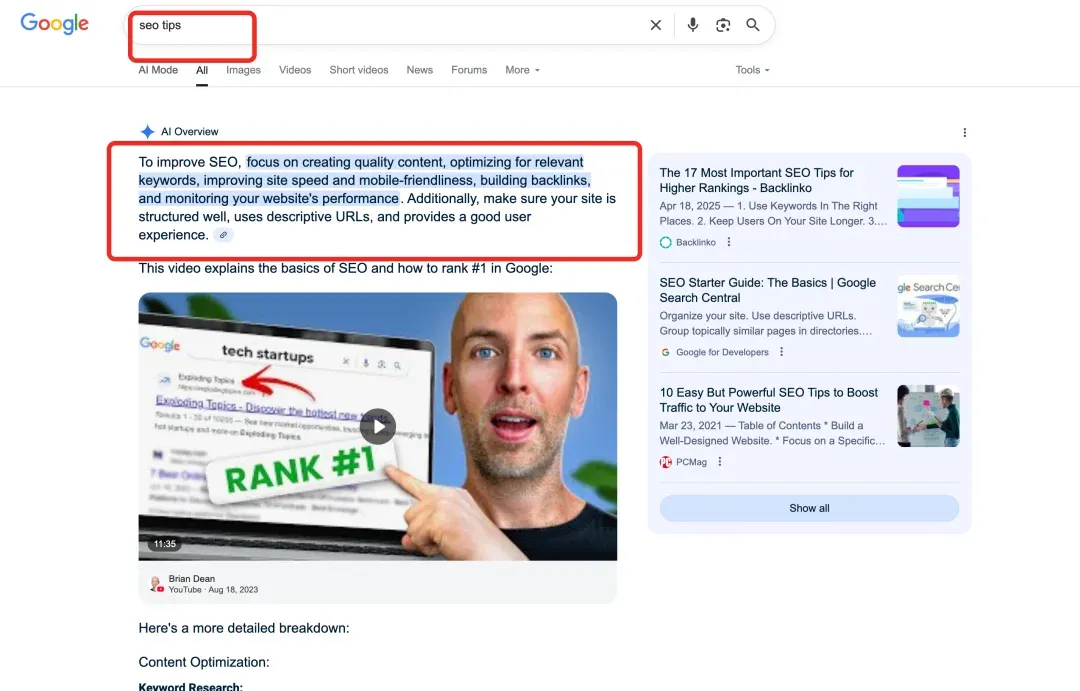
In the image above, I searched “SEO Tips,” but AI Overview gave me “To improve SEO,” with no exact-match “SEO Tips” keyword in the summary.
That’s because it understood the semantic intent behind my “SEO Tips” search: “I want to improve my SEO performance.”
With AI technology (like BERT, MUM, and latest generative engines), Google has evolved from a “string matching system” to an “intent understanding engine.” It no longer mechanically counts how many times “AI singer” appears in your article, but strives to understand what users actually want when searching this term — “learn what AI singer technology is”? “Find an online AI singing tool”? “Listen to AI covers of certain artists”?
Therefore, our task must also upgrade: from “Keyword Research” to “User Semantic Intent Research.” The former finds isolated words; the latter understands complete, contextual, real motivations hidden behind the search box. Only with this cognitive upgrade will your content be favored by both traditional search engines and future GEO (Generative Engine Optimization), because it answers “questions,” not just matches “words.” But remember, SEO remains GEO’s foundation — if you can’t even handle basic keywords, forget about semantic relevance, topic breadth, and content depth optimization.
Chapter 2: Return to First Principles — Extracting Unique Value from Your “Product DNA”
Before starting any research, we must establish an iron rule: Stop using competitor websites as your strategy’s starting point. This is an extremely common but extremely dangerous mistake. Directly using tools to analyze competitors’ hot pages and keywords, then copying them — it seems like a shortcut but is actually a dead end where you’re forever eating their dust. Your product has its unique value proposition and target users; your content strategy must originate from your own “product DNA.”
So how do you start from first principles to find your unique “seeds”? The answer is using the product manager’s sharp tool — Jobs To Be Done (JTBD).
JTBD theory’s core: users don’t buy products to own them, but “hire” them to complete certain “jobs.” A user isn’t buying “an AI singer SaaS” — they’re buying “a way to quickly make a high-quality song demo when I can’t sing” or “a way to hear my favorite idol sing a song they’ve never sung.”
These “jobs to be done” are users’ most authentic struggles and desires — the most fertile soil for your content creation. Before researching any keywords, first ask yourself and write down:
-
In what scenario would users need my product? (When…)
-
What core task do they want to complete? (I want to…)
-
So they can achieve what desired outcome? (So I can…)
The core words extracted from these answers are your most unique, authentic “Seed Keywords.” They are your entire content strategy’s DNA, determining your uniqueness and originality.
Next, we can use these Seed Keywords to expand our keyword breadth, building a topic matrix based on your product, simultaneously providing semantic fuel for AI search (GEO).
Chapter 3: Drawing the Map — Building a 3D Battle Map with “Growth Funnel” and “User Personas”
With first-principles-based “seeds,” we need a strategic framework to cultivate them into an entire forest. This framework is three-dimensional, composed of “Search Intent,” “Growth Funnel,” and “User Personas.”
Dimension 1: Search Intent → Determines Content Format
Every search query has a clear intent behind it. Identify intent to match the right content format.
-
Informational: Users want to learn. E.g., “what is an AI singer.” ➡️ Matching Content Format: Blog articles, tutorials, guides, white papers.
-
Commercial Investigation: Users are comparing and researching. E.g., “best AI singer software,” “Product A vs Product B.” ➡️ Matching Content Format: Comparison reviews, alternative product lists, case studies.
-
Transactional: Users are ready to buy or act. E.g., “buy AI singer software,” “AI singer free trial.” ➡️ Matching Content Format: Product landing pages, pricing pages, registration pages.
-
Navigational: Users want to visit a specific website. E.g., “OpenAI official website.” (Usually not our optimization focus unless it’s brand terms.)
Dimension 2: Growth Funnel → Determines Business Value
Map search intent to the classic growth funnel to judge its distance from “conversion.”
-
Top of Funnel (ToFu): Corresponds to “informational” intent. Users just realized a problem, far from purchase, but highest traffic potential.
-
Middle of Funnel (MoFu): Corresponds to “commercial investigation” intent. Users are actively seeking solutions — high-quality potential customers.
-
Bottom of Funnel (BoFu): Corresponds to “transactional” intent. Users have strongest purchase intent, most precise traffic, must-win core ground.
Dimension 3: User Personas → Enables Boundary Breakthrough
A common mistake: only focusing on keywords directly related to your product. But what else do your users care about when they’re not searching for your product? This is ToFu content expansion based on user personas.
For example, “AI singer” software users are likely music producers or hobbyists. Besides “AI singer,” they might also be interested in “AI music generator,” “free VST plugins,” “how to mix vocals,” “music production tips for beginners.” Creating this content doesn’t directly promote your product, but lets you enter their vision before they develop specific needs, building trust and professional image. This is key to breaking through circles and capturing broader ToFu traffic.
Summary: Deeply understanding your product and deeply understanding your users is the core foundation for this stage. SEO and product development share the same thinking logic.
Chapter 4: Arsenal Inventory and Tactical Supplements — Tools and Smart “Competitive Analysis”
Theory needs tools for implementation. For indie developers, key is “low cost” and “high efficiency.” Here’s your starter toolkit:
-
🧠 Your Brain + JTBD: Most important tool, free and unique.
-
🔍 Google Search: Auto-complete, “People Also Ask,” bottom “Related Searches” — goldmines for understanding users’ real phrasing.
-
📊 Google Search Console: In “Performance” reports, see what terms users already found you with — the best place to discover “high impressions but low ranking” opportunities. Also create new content for searched but uncovered keywords.
-
💬 Community Forums (Reddit, Quora): Directly infiltrate user communities, see what language they use discussing what problems.
-
💡 Keyword Tools: Ahrefs/Semrush/Ubersuggest all offer free keyword generators for expanding seed keywords. I recommend SEMRUSH — easy to use, large data volume. While precision may not match Ahrefs, SEMRUSH has lower barriers in the Chinese market (mainly pricing).
Tactical Supplement: How to Do Smart Competitive Analysis?
After completing first-principles-based core research, we can look at what competitors are doing. But the purpose isn’t copying — it’s “finding gaps.” Questions to answer:
-
What user intents did they cover that I overlooked in my research?
-
For the same user problem, what’s their content angle? Can I provide a newer, deeper, more unique angle?
-
Which of their ToFu content gets massive traffic? Does this validate some of my user persona assumptions?
Competitive analysis is the mirror validating and refining your strategy, not its source. Remember this priority relationship.
For implementation: Enter your competitor’s website in SEMRUSH, view their keyword rankings and ranking pages in Organic Research. Through such comparative analysis, you can complete the gap-filling.
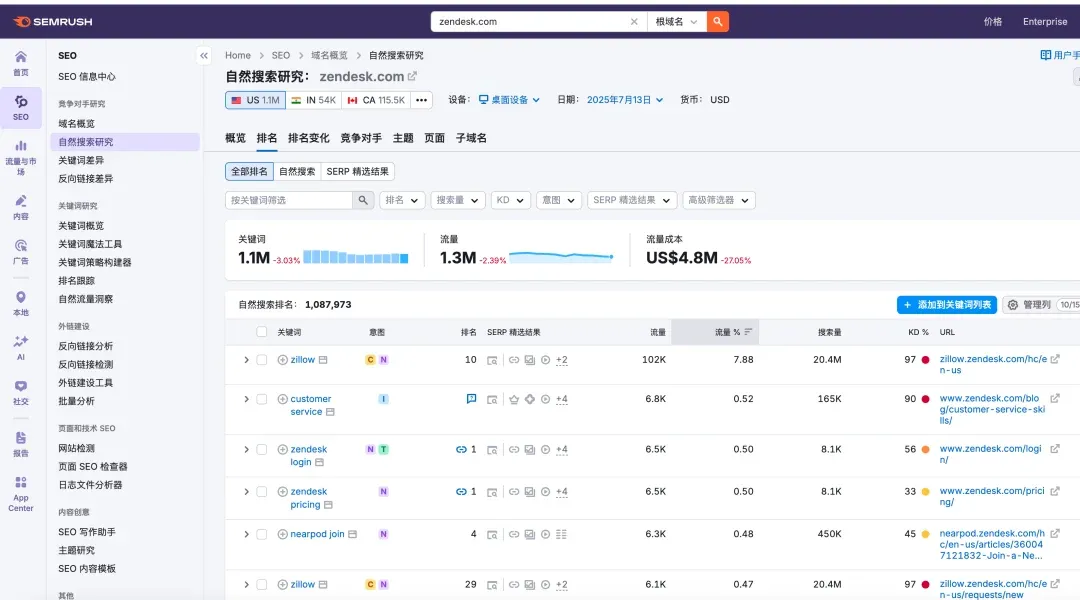
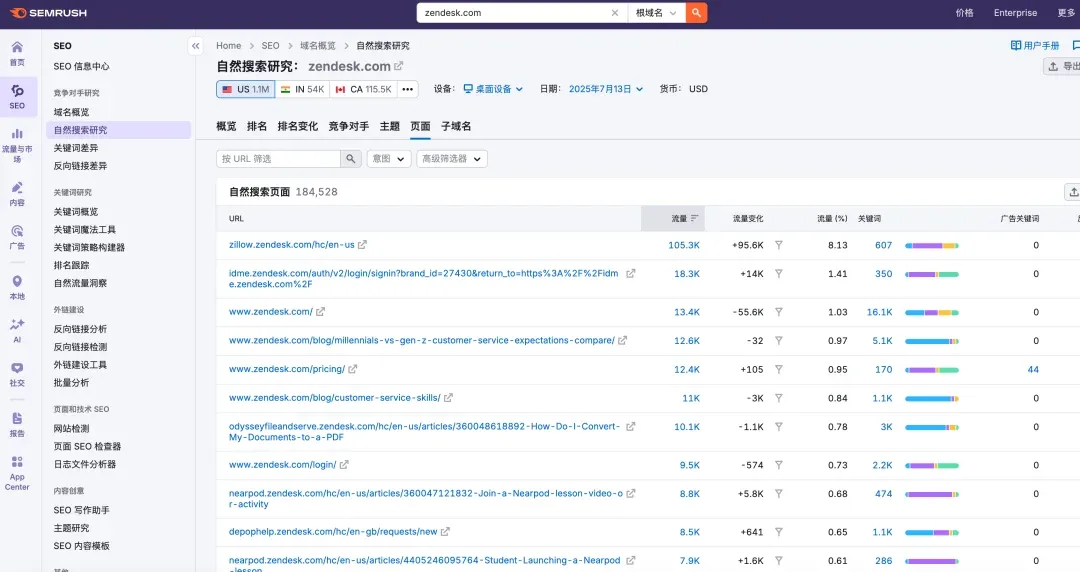
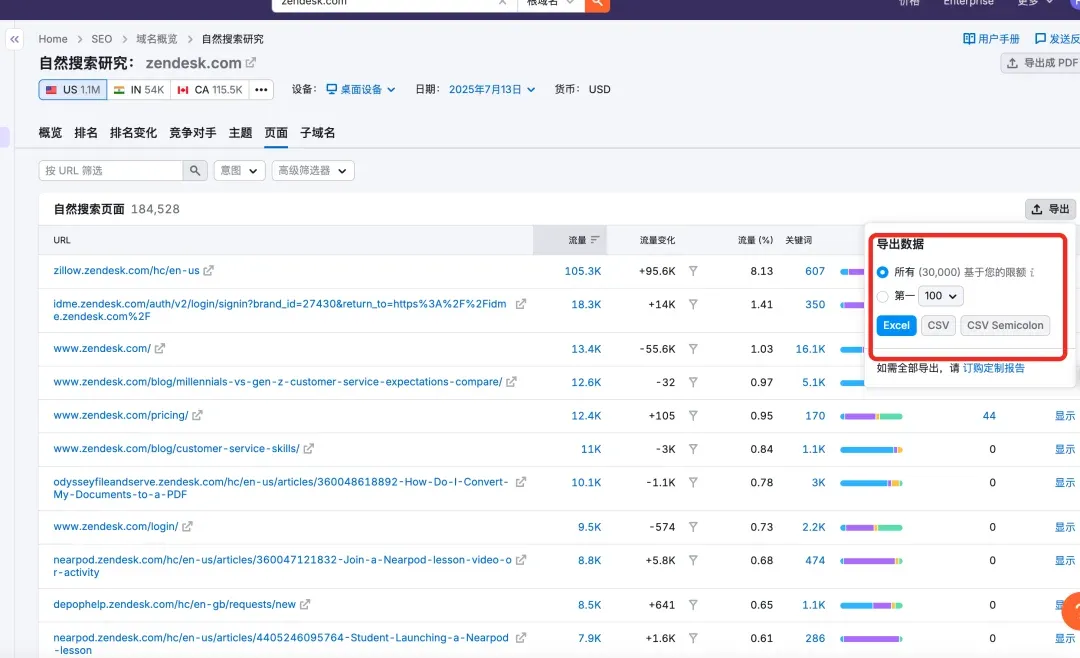
You can even export your site’s data and competitor site data to CSV, write a Python script for statistical analysis and competitive comparison.
Chapter 5: Practical Workflow — Four Steps to Your First “Content-Intent-Format” Map ✍️
Now we integrate all theory and tools into an executable four-step workflow. The final goal: produce a “battle map” guiding all your content creation.
-
Step 1: Define Jobs (JTBD) & Extract Seeds. Spend one undisturbed hour on JTBD thinking, list at least 10 user “jobs to be done,” and extract your “seed keywords.”
-
Step 2: Expand and Discover. Input your seed keywords and persona-based interest terms into Chapter 4’s toolkit, discovering as many related long-tail keywords and user questions as possible.
-
Step 3: Categorize and Grade. Tag all collected keywords with “intent labels” (informational/commercial/transactional) and “funnel labels” (ToFu/MoFu/BoFu) per Chapter 3’s framework.
-
Step 4: Plan Content Format and Priority. Based on intent labels, determine each keyword’s matching content format. Based on funnel position, set priority (usually recommended to complete BoFu and MoFu content first for quick high-quality traffic).
Case Study: Building a Content Map for an “AI Singer” Product
Let’s walk through the process with this excellent example:
1. Seed Research Based on Product:
Our core seed is AI singer. Put it into SEMRush etc., we might get AI singer generator, AI singing voice, AI cover song generator and other directly related terms. We can also do concept association, like AI + [Jay Chou], deriving new high-intent searches. These form our “Product Core” content.
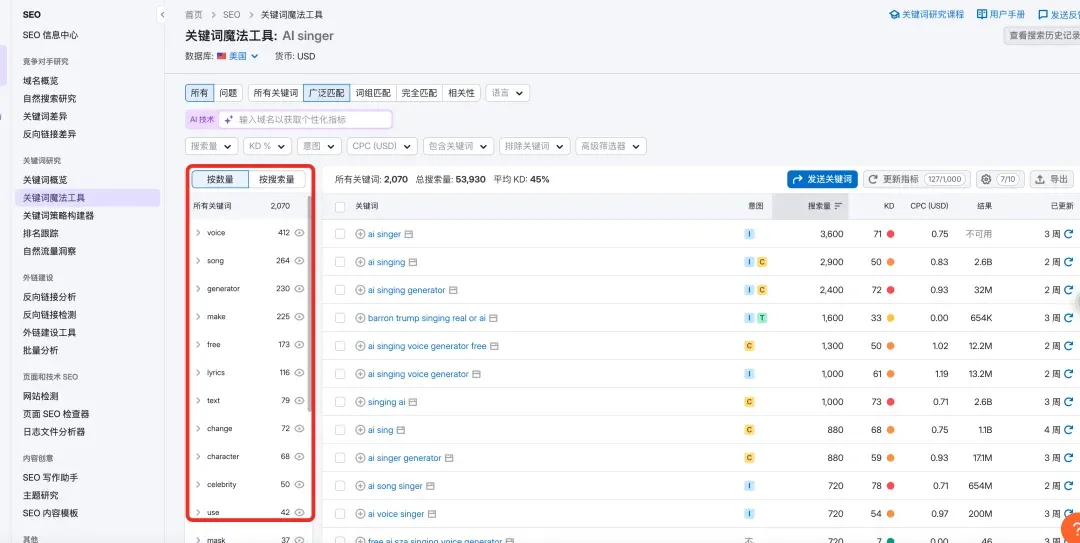
2. Expansion Research Based on User Personas:
Our user persona is “music production enthusiast/professional musician.” What are their interests? Probably AI music generator, AI mixer online, how to master a song for Spotify, best free DAWs. This content doesn’t directly mention “AI Singer” but attracts the exact same target audience. These form our “User Ecosystem” content.
3. Form Dual-Core Content Matrix: Through these two steps, we get a powerful “Dual-Core Content Matrix.” One core surrounds product features, aiming to “harvest” precise users with existing needs (MoFu/BoFu); another core surrounds user ecosystem, aiming to “cultivate” broad audiences with potential needs (ToFu). This gives our content strategy both depth and breadth.
4. Output Content Map (Excerpt):
| Keyword | Intent | Funnel | Content Format | Priority |
|---|---|---|---|---|
| AI singer free trial | Transactional | BoFu | Product Landing Page | High |
| suno vs udio | Commercial | MoFu | Comparison Review Article | High |
| how does AI music generator work | Informational | ToFu | Deep Blog Article | Medium |
Conclusion: From “Scattered Points” to “Matrix” — The Path Forward
“Those who can’t hear the music think those dancing are crazy.” I love this quote. If developers who don’t understand content strategy see a bunch of crazy, isolated hot topics, then through today’s learning, you now have the ability to hear “the music of user needs” behind it all. The “content map” in your hands is your sheet music for composing this melody. You’ve learned how to systematically create high-value “content points.”
But a new question follows: How do you combine these independent notes (content points) through chords and arrangement (strategic organization and linking) into a magnificent symphony (an unshakeable content matrix)? That’s the core we’ll explore next — How to build true “Topical Authority.” Follow me for the next deep dive.
Recommended reading:
[Indie Developer SEO Handbook (Preface)]
[SEO Growth Case: This Toy Indie Site’s SEO Was Stagnant Until the New Operator Pulled Out This “Growth Playbook”]
[Indie Developer Web App Going Global Pitfall Guide: From SEO Myths to Growth Illusions — How Many Did You Fall For?]
Found this insightful? Follow my channel to explore AI, going global, and digital marketing’s infinite possibilities together.
🌌 Strategy’s essence isn’t choosing what to do — it’s choosing what not to do. Your content map is your clear declaration of “what not to do.”
