
Word count: ~1500 words
Estimated reading time: ~6 minutes
Core Takeaways
✅ GEO is an “amplifier,” not a “savior” — it can’t rescue a fundamentally broken website.
✅ Real data shows American consumers’ general sentiment toward AI is concern, not excitement.
✅ Return to fundamentals — build solid technical and content foundations to reach the future faster.
Don’t Obsess Over GEO: Why Build a Rooftop When Your Foundation Is Shaky?
Hey, I’m Mr. Guo. Today’s a short piece sharing my thoughts on GEO. If you have different views or have achieved better results with GEO, I’d love to discuss with you.
Recently, I’ve received many questions about GEO (Generative Engine Optimization). It’s as if mastering GEO means seizing the next era of digital marketing. I can tell everyone’s excited, and anxious. Excited because a completely new traffic paradigm seems to be arriving; anxious because they haven’t figured out SEO yet, and now GEO’s here — are they falling behind again?
Today, I want to splash some cold water, or maybe offer a “sobering drink”: For 90% of indie developers and startup websites, I advise you not to worry too much about GEO for now.
This sounds a bit “contrarian,” but hear me out.
I don’t know how much those hyping “SEO is dead, GEO era has arrived” on social media have actually sold through AI. But I can show you real backend data from one of my projects.



During the same time period:
• Total revenue from AI engines like ChatGPT, Perplexity, Gemini combined was around $320.
• Total revenue from traditional Google organic search was $64,191. (Google only — not counting Bing, Yahoo, or other search engines)
Yes, you read that right. Although my project has achieved GEO sales, compared to traditional SEO revenue, the gap is over 200x.
My personal data isn’t an outlier. It reflects a broader reality: We tech circle folks easily fall into “survivorship bias,” thinking everyone is embracing AI like us. But the fact is, ordinary American consumers, especially the “red states,” have predominantly negative sentiments toward AI. And this is in America, which has the world’s best AI ecosystem — let alone Europe, which cares even more about privacy and security.
According to Pew Research Center data, a full 52% of American adults feel “more concerned than excited” about AI proliferation, while only 11% feel “more excited.” This widespread anxiety is rooted in real fears about job loss, deepfakes, and data privacy.
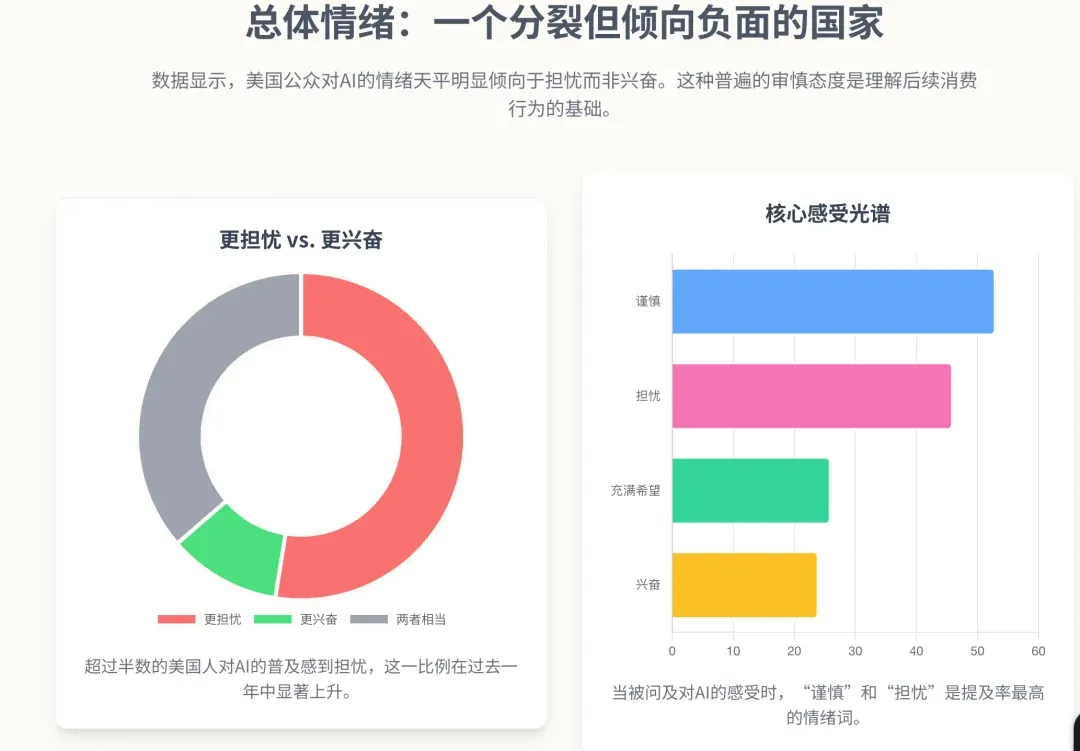

Want to see the original report? Follow Mr. Guo and send “AI Attitude Insights” to get it.
GEO is great — it represents the future of search, no question. It means our content has the chance to be directly cited by AI, becoming part of the “standard answer.” That’s tempting, like a new driver obsessing over F1 racing’s heat-cure tire formulas and aerodynamic kits.
But here’s the problem: When your car is still parked in the garage with four flat tires, one broken mirror, and engine oil leaking, does thinking about F1 tactics make sense?
GEO is that top-tier F1 aerodynamics kit. And your website full of 404 error links, duplicate pages, and low-quality content is that broken-down car.
We must approach this from first principles: GEO’s foundation is AI’s “open-book exam.” Before answering user questions, AI needs to first “flip through” existing “textbooks” on the internet.
So ask yourself:
-
A website full of 404 errors, in AI’s eyes, is a broken book with missing pages. Will it cite that?
-
A site with tons of duplicate pages, in AI’s eyes, is verbose literature repeating the same thing. Will it find that valuable?
-
A site filled with low-quality content without “Information Gain,” in AI’s eyes, is an outdated textbook with wrong viewpoints. Will it dare use that as an authoritative source?
The answer is obviously no.
GEO won’t save an already terrible website. It’s an “amplifier” (short-term, it barely qualifies as even that), not a “savior.” It only amplifies your site’s existing strengths. If your site is already full of clear, high-quality, structured content, GEO will amplify your authority. If your site is a mess, GEO will only amplify its chaos, or simply ignore it.
So before chasing the “rooftop” of GEO, look down and check if your “foundation” is solid. I urge you to invest 100% of your energy into the “boring but crucial” work we repeatedly emphasized in our beginner series:
-
Do a thorough technical SEO checkup — eliminate all 404s and duplicate content.
-
For every core user scenario, create one piece of deep content that truly provides “Information Gain.”
-
Use “topic cluster” thinking to build your professional moat in a vertical domain.
When you’ve done these fundamentals at 80% or above, you’ll happily discover your site is actually perfectly prepared for GEO. Because a site valuable to users and friendly to traditional search engines is also the “high-quality textbook” AI most wants to cite.
First learn to drive your car steadily on the road, then think about the racetrack.
AI and GEO are definitely the future — but you need to survive to reach that future first.
Found Mr. Guo’s analysis insightful? Drop a 👍 and share with more friends who need it!
Follow my channel to explore AI, going global, and digital marketing’s infinite possibilities together.
🌌 In any era, the sexiest strategy is always perfecting the fundamentals.
