
Google AI Search Has Begun Enforcing Traditional Search Penalties
Today I want to share a small but important Google AI Search update.
Search Engine Roundtable recently reported that Glenn Gabe noticed a change: in the past, when some pages were removed from the index or handled for manual actions, they could still appear for a few days in AI Overviews and AI Mode. That delay appears to be gone now.
This is what I mean by the title’s phrase, “collective enforcement”. It is not that Google is adding weird hidden penalties, but that Google AI Search is now plugging into the same indexing, punishment, and governance system as traditional search.
You may have seen many posts showing huge traffic spikes and assumed it means “if I do this, I can do it too”. What many creators do not show is this kind of chart:
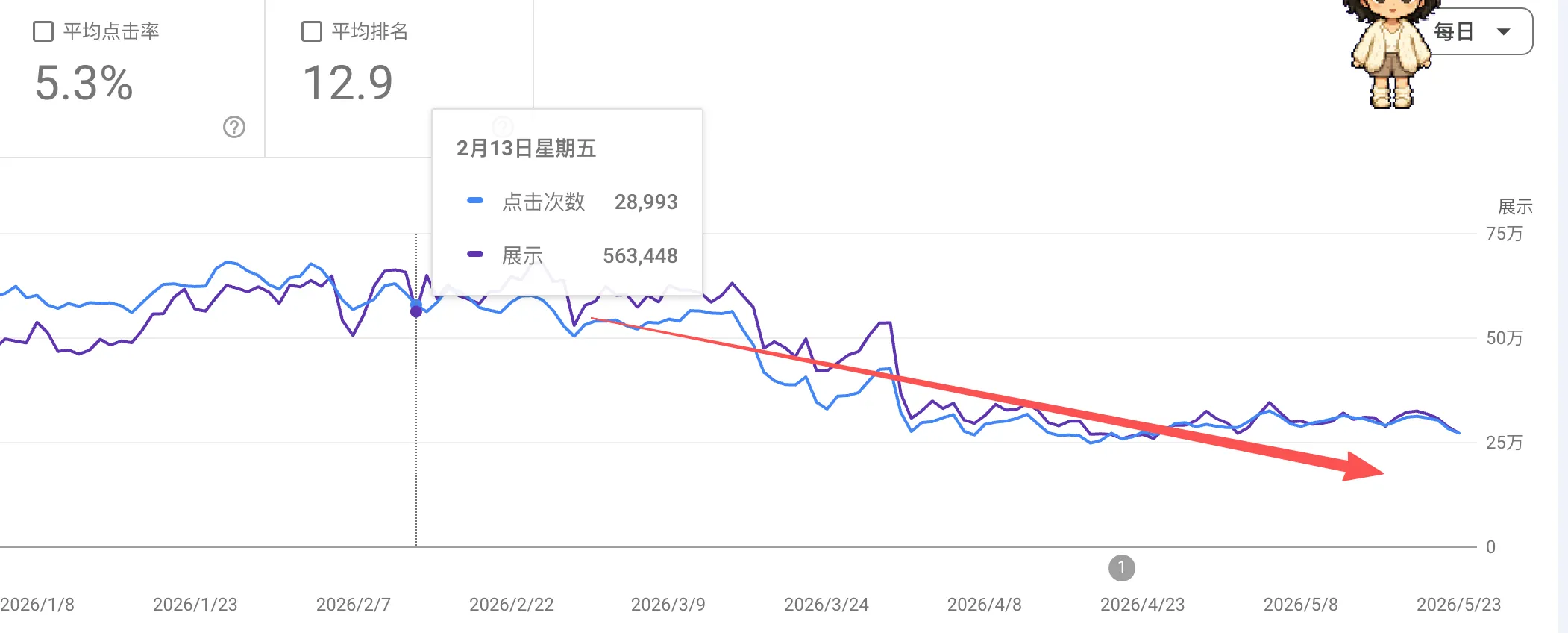
Honestly, does seeing repeated drops in traffic still qualify as being an experienced SEO practitioner? Does falling traffic mean bad SEO?
No, not necessarily. Each generation has its own heroes, and each generation of algorithms has its own cycle. What never changes is long-term discipline: only by doing the right thing consistently can you survive through cycles.
AI Search Is Not an Escape Hatch
Over the last year, terms like GEO, AEO, and AI Overviews were talked about in a very mystical way. Many people intuitively think traditional SEO is too competitive, and AI Search may be a fresh restart. If you write like an answer and format content so a model can quote you, maybe you can avoid the old SEO rules?
Now we know the truth.
In Google Search Central’s AI features documentation, Google is explicit: AI Overviews and AI Mode do not require special optimization rules; core SEO still matters. To appear as a supporting link in these AI features, a page must be indexable and eligible to show snippets in Google Search.
This statement has pulled many GEO myths back to the ground.
Old Rules Are Entering a New Interface
What is most notable here is not only the technical detail that pages no longer disappear with delay; it is the direction of the system.
First, Google clearly stated in documentation that AI features still depend on baseline search eligibility. Then Google spam policy started explicitly covering AI Overviews and AI Mode generative responses. Now, deindexed or penalized pages no longer keep showing in AI Search after manual actions for additional days.
Read together, the signal is clear: Google is pulling AI Search back into the original search governance framework.
Earlier, AI Overviews and AI Mode looked like a fast-built new interface with normal gaps. Now those gaps are being closed. Google is not planning to keep AI Search as a long-term gray zone with inconsistent rules.
So GEO should not be seen as a new trick to bypass legacy rules. It is more like old rules with a newer and less visible presentation layer.

GEO Is Not Mysticism, It Is Old Fundamentals in a New Skin
GEO is easy to misunderstand because it looks new on the surface, while the core is old. In the past, you competed for keyword rankings. Now you compete to become source material in AI answers. In the past you watched blue links; now you watch whether you are cited, recommended, and treated as a trustworthy source.
The display changed, but the underlying questions are not as mysterious as they seem.
Can your page be crawled normally? Can it be indexed? Is it blocked by noindex, nosnippet, robots, or rendering issues? Does your content include real experience, real cases, real comparisons, and real perspective? These sound old-fashioned, but they may be closer to the answer than flashier tactics.
If you treat AI Search as a brand-new territory, you naturally create lots of “AI citation bait”: mass FAQs, mass definition snippets, mass best-tool lists. This might help short term, but if Google is fixing synchronization issues between manual actions and deindexing, these gaps will not stay open forever.
What to Watch Is Eligibility, Not Tricks
When I evaluate GEO today, my first question is not “how to get AI to cite me”. It is “do I have permission to enter this system”?
The first layer is technical eligibility. A page must be crawlable, indexable, and understandable. robots, canonical, noindex, nosnippet, JavaScript rendering—these baseline settings cannot have basic mistakes.
The second layer is content eligibility. Your content should not just repackage public information or output AI paraphrasing. The more AI Search acts like an answer distribution layer, the more it demands verifiable, citable, source-backed material.
The third layer is brand eligibility. Users may ask AI less and less like this: “Which keyword ranks for this?” and more like this: “Which tool fits me?” or “Is this brand credible?” If your brand only exists on your own site and there is no outside discussion, no citations, no evidence, it will lose in AI-mediated discovery.
Do Not Bet on AI Search as New Territory
What happened with Google AI Search enforcing shared penalties is small in scale but meaningful. It reminds us that AI Search may appear new, yet is inheriting rules from the old search ecosystem. The old ranking logic will not be copied unchanged into AI Mode, and AI Overviews is not just a skin over blue links. There are still black boxes, uncertainties, and new opportunities there.
But one thing is becoming clearer: do not expect AI Search to be an escape route for old content, old manipulation, or old shortcuts.
A new entry point arrived, and the old knife came with it. For content creators, independent sites, and global projects, the more stable strategy is not chasing one GEO trick after another. It is rebuilding your basic eligibility in search systems: accessibility at the technical level, evidence in your content, and external trust at the brand level.
References
- Search Engine Roundtable: Google Removes Delay For AI Overviews & AI Mode Showing Content From Manual Actions/Deindexed
- Google Search Central: AI features and your website
- Google Search Central: Spam Policies for Google Web Search
