
Hi, I’m Mr. Guo.
The AI world has been chaotic lately. On one side, Musk’s Grok Imagine team is going all-in on X platform, using “infinite information feed,” “viral videos,” and “widest range of content” to grab attention, claiming to give humanity an all-encompassing AI truth encyclopedia.
On the other side, Google — the “nerdy engineer” — quietly released a new product on November 13th: Code Wiki.
Grok wants to use AI to explain the universe and humanity.
Google says: “Hold on, let me first use AI to explain that ‘dumpster fire code’ your colleague wrote last week.”
Gotta say, that’s very Google. Grok is still competing on “scale and buzz,” while Google already zeroed in on developers’ most painful point.
As a builder, I tried Code Wiki immediately. My conclusion: This thing might deliver far more practical value to developers than Grok’s “big and comprehensive” encyclopedia.
1. Code Wiki — A “Living Dictionary” for “Legacy Code”
First, we need to clarify what problem Code Wiki solves.
In Google’s official words, it tackles “one of the largest and most expensive bottlenecks in software development: reading existing code.”
Translated to plain speak: It cures all kinds of “legacy code.”
Every developer has experienced this despair: inheriting a “dumpster fire” project, documentation cleaner than their face, original code author long gone. New hires spend weeks just understanding the project code; senior engineers (like me) spending days “cracking” an old module is routine.
Developer time should be spent “building,” not “deciphering.”
Code Wiki appears to be that “decipherer.” It’s not another AI chat box — it’s a “living,” automated code documentation system.
Though honestly, what first blinded me wasn’t some feature — it was the frontend page design, absolutely stunning! Right up my alley! Super cyberpunk, super techy.
Pics or it didn’t happen:
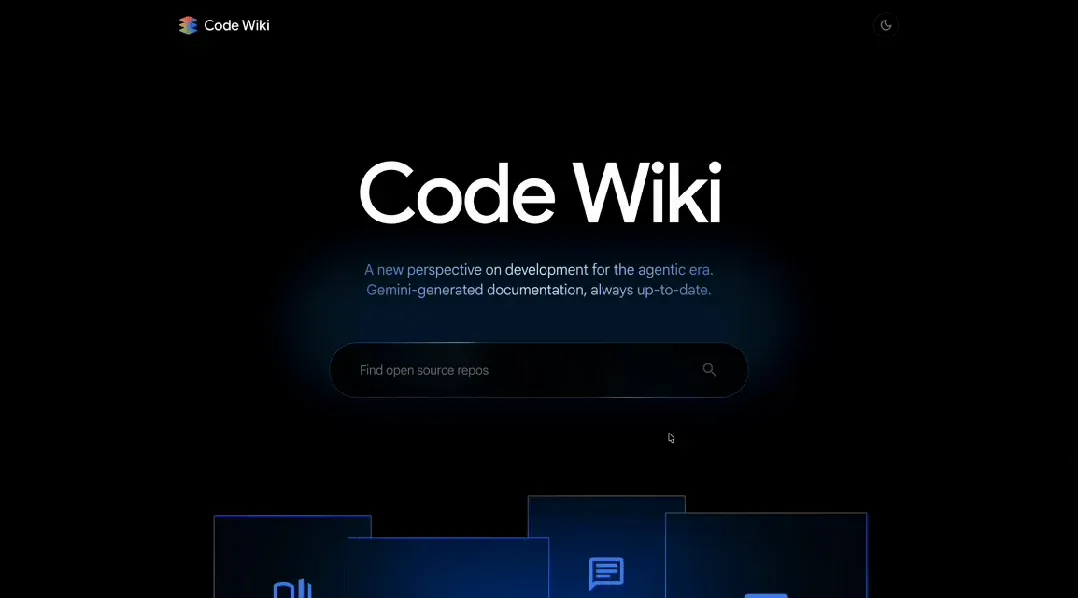
2. Google’s “Open Strategy”: First “Chew” Code, Then “Chat”
I dug into its working principles and found its “intelligence” is completely different from “general” AI on the market.
Automated & Always Up-to-Date
This is the most “deadly” point. Code Wiki scans the entire codebase 24/7. Every change your colleague commits, it auto-regenerates documentation. This means docs and code evolve in sync forever. Those “outdated the moment they’re written” crappy README.md files can be completely tossed.
Intelligent & Context-Aware
This is the core. You’re not chatting with a “general” Gemini — you’re chatting with a Gemini that has “digested” all the latest docs in your repo, “dedicated” to you. Its understanding of your repo, end-to-end, is stronger than most newly onboarded colleagues.
Integrated & Actionable
It’s not static text. All Wiki explanations and chat answers directly hyperlink to corresponding code files, classes, and functions. You seamlessly switch from “reading” to “exploring.”
Automatic Visualization
Text not enough? It also auto-generates “always up-to-date” architecture diagrams, class diagrams, and sequence diagrams. This is gunning for certain diagramming tools’ lives.
3. My Hands-On Experience (and Complaints)
Official claims are sky-high — I had to try myself.
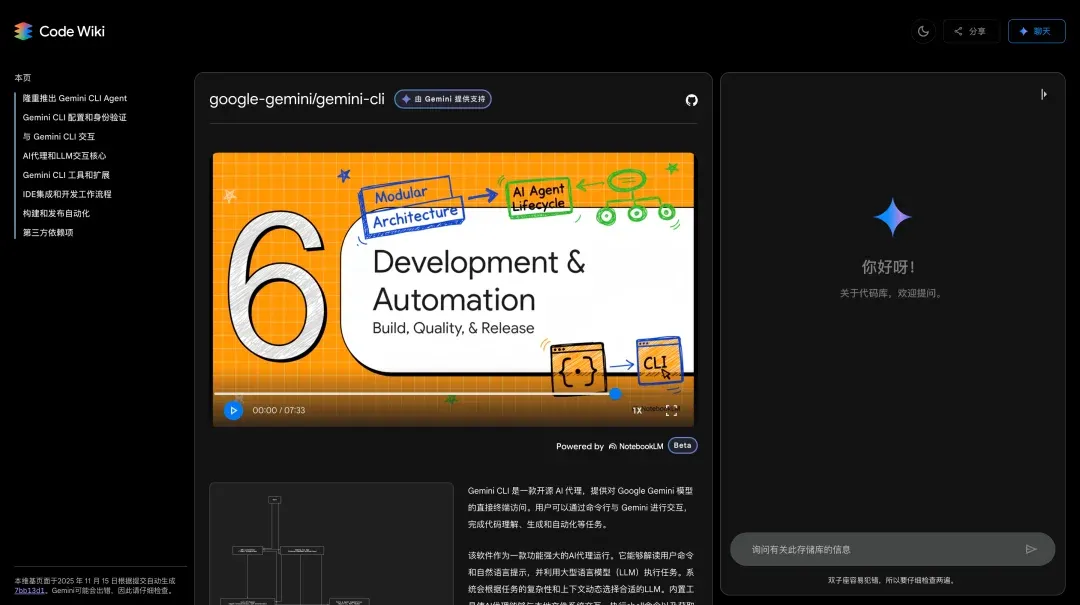
I immediately checked the Wiki it generated for the google-gemini/gemini-cli open-source project. Experience… how to put it… Very good.
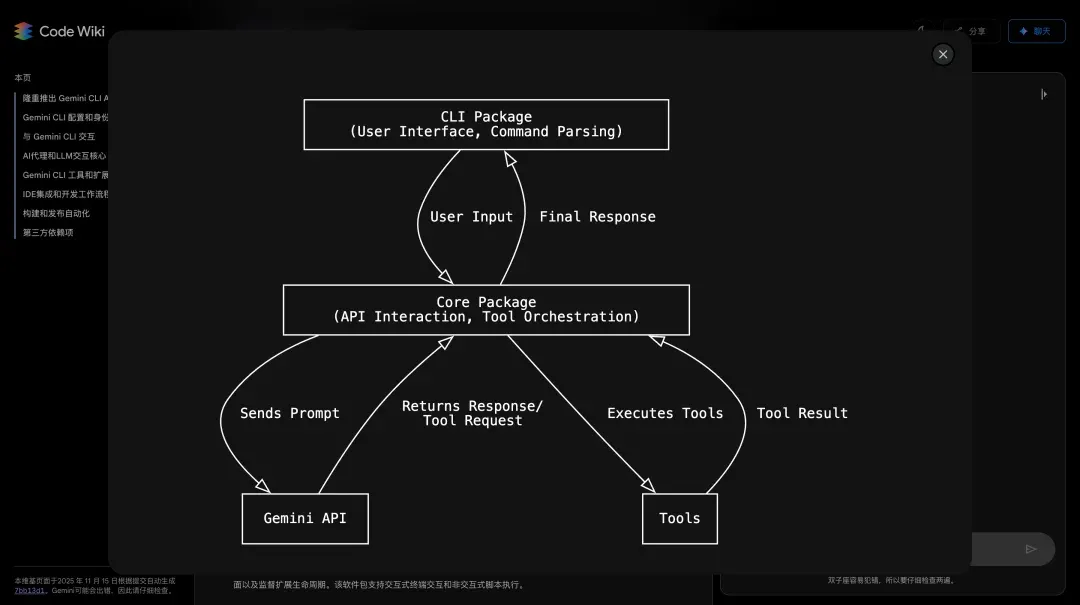
Content is extremely detailed, including flowcharts, even video tutorials made with Notebook LM. From high-level concepts to code definitions, all in one go, instantly bridging the gap between “learning code” and “exploring code.” New hires committing Day 1, senior devs understanding a new lib in minutes — no exaggeration.
But, there are obvious flaws. Currently, the open-source projects it covers are still too few. Many trending GitHub projects and cutting-edge tools simply aren’t indexed. I guess their crawler hasn’t finished running, or they’re prioritizing their own and top-tier big projects. Insufficient coverage is currently its biggest weakness.
4. Grok Is Still “Clowning Around,” Google Already Started “Dirty Work”
But what really excites me isn’t this public Wiki website. It’s what they mentioned at the article’s end — Code Wiki Gemini CLI Extension.
This is Google’s real “open strategy.”
Open-source projects are just “practice” and “muscle flexing” — those internal “legacy code dumpster fires” at enterprises are the real gold mine!
This CLI extension lets teams run this system locally and securely on internal private repos. Imagine that 10-year-old core module at your company that nobody dares touch, now having a “living dictionary” and 24/7 on-call “AI architect” to interpret… the value is simply incalculable.
Conclusion: Who’s Worth More?
So you see:
- Grok
wants to use AI to explain the universe, explain humanity. That’s grand, very Musk, very “fun.”
takes a different path, first using AI to solve the “how to understand Zhang San’s code” universal-level puzzle.
Grok is still “clowning around,” Google already started “dirty work.” They’re not “wrapping” — they’re using AI to restructure software development’s most expensive component — knowledge transfer.
As a builder, I don’t care whose “scale” is bigger — I only care who solves my problems. On this point, Code Wiki wins overwhelmingly.
Found Mr. Guo’s analysis insightful? Drop a 👍 and share with more friends who need it!
Follow my channel to explore AI, going global, and digital marketing’s infinite possibilities together.
🌌 “Fun” catches eyes, “Useful” creates value.
