
Digital Strategy Review | 2026
Google Discover February Core Update Complete: Content Distribution Enters a “Recalibration Phase” | Uncle Fruit’s SEO Daily
By Uncle Fruit · Reading Time / 8 Min

Foreword
If you only look at today’s SEO headlines, it is easy to get distracted by various AI-related topics. However, in terms of business impact and urgency, the most critical piece of information—though perhaps less “flashy”—is this: Google confirmed on February 27, 2026, that the February Discover core update has finished rolling out. This is not a routine minor fluctuation; it is a phased recalibration of the Discover distribution pool for US English content. For content teams reliant on Discover traffic, today is not a day to “wait and see,” but a day to “immediately review and overhaul your distribution strategy.”
01
Today’s Top Headlines
The conclusion first: The Google Discover February 2026 core update is complete. The rollout window spanned from February 5, 2026, to February 27, 2026—approximately three weeks—with the impact focused on US English content.
This event carries high signal strength for three reasons:
First, the time anchor is clear. Industry tracking sites confirmed the “rollout complete” on February 27, with prior observations indicating the update began on February 5. This means we are not dealing with a “sudden one-day tremor,” but a complete re-evaluation window: the system sampled broadly, recalculated in batches, and finally converged.
Second, the impacted scope is clear. The information explicitly points to Discover distribution for US-based English content. This “region + language” limitation indicates that Google is performing more granular content pool governance rather than a global, indiscriminate refresh. For international media or multi-language sites, this means performance across different markets should not be aggregated; you must analyze fluctuations by dimension.
Third, the business consequences are clear. Discover is not traditional “user-initiated search” traffic; it is “platform-initiated distribution” traffic. Once the distribution scoring function is recalculated, the impact is directly reflected in exposure opportunities, traffic stability, and content lifecycle. Many teams previously treated Discover as “bonus traffic,” but at this juncture, it acts more like a “volatility amplifier for content monetization.”
Why is this the top SEO headline today? It meets the four criteria for a lead story:
- 01 High Impact: It affects content teams, editorial teams, and monetization teams—it is not just a technical issue.
- 02 High Urgency: Completed on February 27, today is the window for review and strategy adjustment.
- 03 High Verifiability: At least two independent industry media outlets confirmed it simultaneously, and subsequent actions can be understood by referencing official Discover documentation.
- 04 High Reader Relevance: Both official accounts and content sites rely on distribution; Discover fluctuations directly change the explanatory framework for “why the same content performs inconsistently.”
Based on today’s confirmation, I suggest treating this update as a “content asset health check”: don’t try to guess the algorithm; instead, verify whether your current content system has the capability to enter the recommendation pool consistently.
02
Headline Analysis: Why This Matters More
Many teams underestimate Discover updates because they lack the intuitive “ranking rise and fall” associated with traditional keyword rankings. But precisely because it is recommendation-based, it is easier for teams to misjudge.
In search results, users have a need first, then click a result; in Discover, the system decides “what to show to whom” first. This means the core issue for Discover is not “what rank are you,” but “are you selected, and is that selection sustainable?”
Following this update, I believe there are three layers of change to interpret:
The first layer: Distribution logic is shifting from “having content” to “having signals.” Discover has always emphasized content quality, interest matching, timeliness, and credibility. In the past, many teams relied on high-frequency publishing to stack exposure, but during a recalibration cycle, volume-stacking strategies are often the first to fail. The system values topic focus, source consistency, page experience, and user feedback signals more. In other words, having a large content inventory does not equate to stable distribution.
The second layer: Operational rhythm is shifting from “daily volume” to “window operations.” This three-week rollout is highly representative: content strategies cannot remain the same before, during, and after the rollout. Before the rollout, you should clean up your structure; during the rollout, maintain core topics and high-quality updates; after the rollout, quickly review which content types were re-weighted. Those who operate according to these windows are less likely to be caught off guard by fluctuations.
The third layer: Organizational synergy is shifting from “editorial soloists” to “editorial + data + tech integration.” Discover fluctuations cannot be solved by a single department. Editors must control topic selection and headline style; data teams must break down performance by market and content type; technical teams must ensure page crawlability and experience baselines. If any of these three are missing, the problem will likely be blamed on “algorithmic mystery.”
Looking at this event over a longer cycle, it carries another implication: Google’s governance of recommendation scenarios is becoming more refined and regionalized. In the future, you will see more “local updates, local signal recalculation” patterns. For those focused on content growth, this is actually good news, as relying on systematic operations rather than luck is becoming more viable.
Simplified into an actionable mantra: Starting today, stop treating Discover as a random traffic pool and start treating it as a distribution channel that requires continuous management.
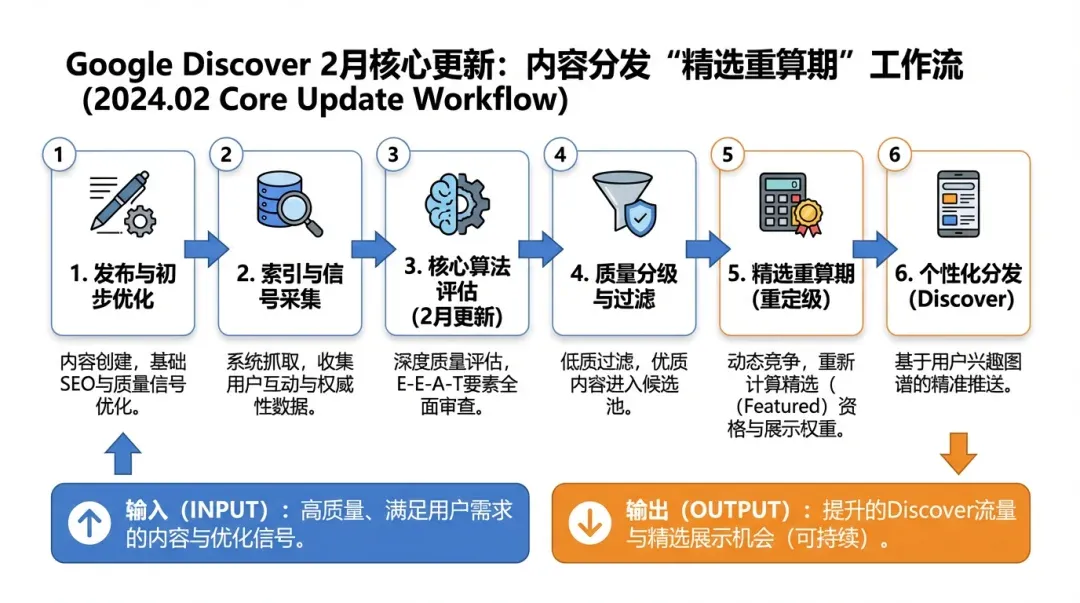
Flowchart used to explain the methodological execution path.
03
Uncle Fruit’s Perspective
I define this update as: not a crisis, but a filter.
A filter for what? A filter to see if a team has the capability to be “sustainably recommended.” Over the past two years, many sites have focused on production efficiency while neglecting the construction of distribution stability. Today’s juncture exposes these weaknesses.
I suggest dividing the next 14 days into three action packages:
-
01 Action Package A: Layered Review (Complete within 48 hours) Break down performance by four dimensions: “Market (US English/Other) + Content Topic + Page Template + Publishing Time.” Don’t just look at total traffic; look at whether “exposure opportunities have shrunk, click-through rates are distorted, or return visits have worsened.”
-
02 Action Package B: Content Rebalancing (Days 3-7) Reduce generic topics and concentrate firepower on 3-5 topic clusters. Ensure each cluster has: foundational explanatory articles, progress tracking articles, and case study reviews. Let the system see that you are not hitting targets by accident, but providing high-relevance content consistently.
-
03 Action Package C: Distribution Engineering (Days 8-14) Build a dedicated Discover dashboard—do not mix it with search traffic; conduct a weekly review of “common signals of promoted content”; perform small-scale A/B testing on headline strategies, cover strategies, and publishing time strategies.
One easily overlooked reality: Discover growth is not a “single viral hit game,” but a “signal combination game.” If no one in the organization is responsible for “topic continuity, entity consistency, and page experience,” it is difficult to replicate success after one viral hit.
So my view today is clear: when you encounter an update, don’t blame the algorithm first; look at whether your distribution engineering is built. Whoever builds this system first will turn volatility into a moat.
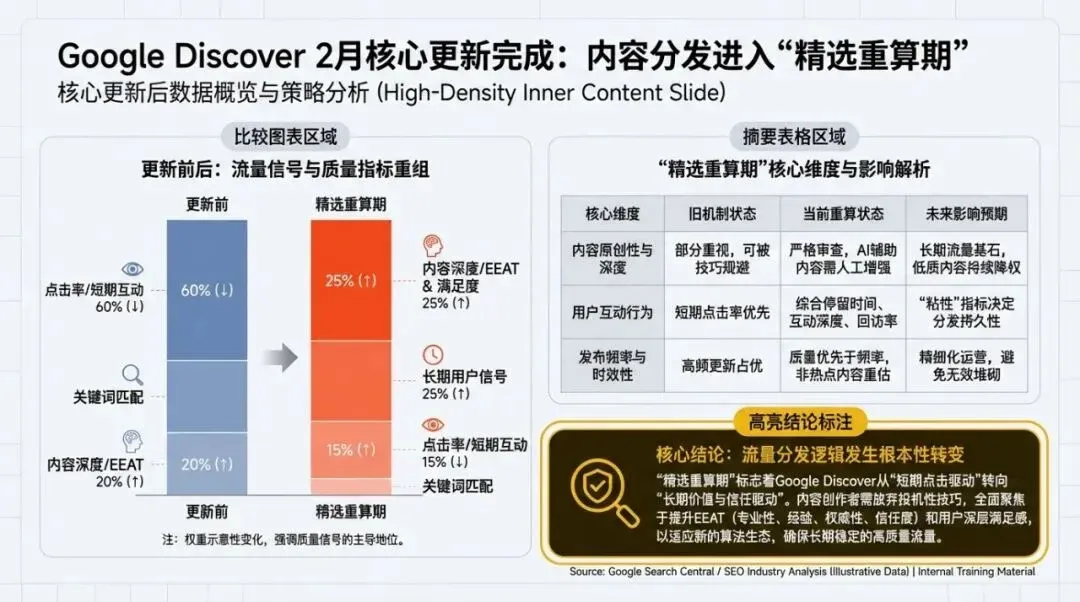
Data chart used to explain key comparisons and conclusions.
04
Quick Look at Other Key News
Google Clarifies: Resource Hints Do Not Affect Googlebot Crawling Decisions
Google publicly explained that Googlebot does not change crawling behavior based on resource hints like preconnect, prefetch, or preload, reiterating that technical SEO should not be built on misunderstandings.
One-sentence impact: Shift energy from “optimizing hints the crawler doesn’t use” back to information architecture and content quality for better ROI.
Source: https://www.searchenginejournal.com/google-explains-why-its-crawler-ignores-your-resource-hints/568321/
SEO Strategy Framework Upgrade: AI Response Pattern Optimization Becomes a New Lever
The industry is beginning to emphasize analyzing AI output through three layers: structural patterns, conceptual patterns, and entity patterns, replacing random “chasing single brand mentions” with systematic sample testing. One-sentence impact: AIO/GEO is moving from “visibility anxiety” to “repeatable optimization,” significantly increasing strategic execution. Source: https://searchengineland.com/use-ai-response-patterns-build-better-content-470213
Google to Test Search Result Changes in EU to Respond to DMA Regulatory Pressure
Google is pushing forward with search result display experiments in the EU market, adding more vertical service exposure to address regulatory demands for competitive fairness. One-sentence impact: Cross-regional operations teams need to prepare operational models with “different SERP rules for different markets.” Source: https://www.searchenginejournal.com/google-to-test-search-changes-in-eu-after-dma-charges-per-report/568275/
Search Behavior Continues to Migrate: From “Search Verb” to “Search Infrastructure”
Industry views point out that users are delegating search tasks to AI agents, with the traditional “query-click-compare” path being restructured into a new “ask-delegate-decide” link. One-sentence impact: Content teams must write to be “retrieved and reorganized by machines,” not just “clicked by humans.” Source: https://www.searchenginejournal.com/when-google-is-no-longer-a-verb-search-becoming-infrastructure/568135/
Research Methodology Evolution: LLM Ranking Experiments Move Toward Reproducible Modeling
Researchers are beginning to use reverse engineering and experimental frameworks to approach LLM ranking mechanisms, attempting to establish more reliable optimization foundations than experiential judgment. One-sentence impact: SEO will see more “scientific experimentation” methods; “gut-feeling” optimization will become harder to sustain. Source: https://www.searchenginejournal.com/how-researchers-reverse-engineered-llms-for-a-ranking-experiment/568275/
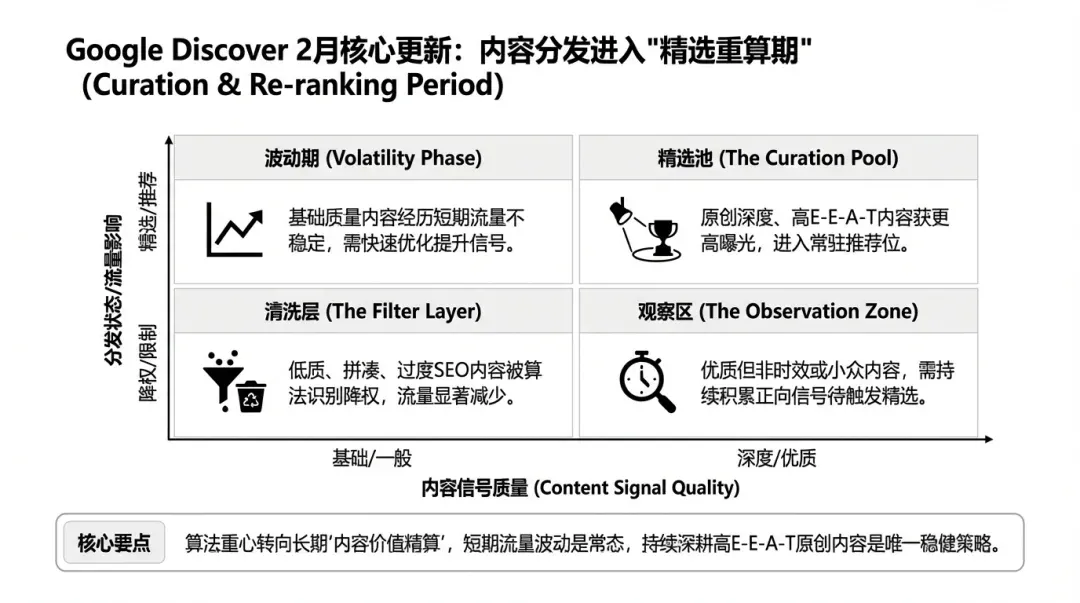
Matrix chart used to illustrate applicability boundaries and strategy selection.
05
Trends and Opportunities
The completion of this Discover update is not about “knowing what happened,” but “knowing what to do next.”
I believe that in the coming quarter, SEO will move along three parallel lines:
- 01 Channel Line: Manage search traffic and recommendation traffic separately to avoid indicator cross-contamination.
- 02 Content Line: Shift from keyword-page thinking to topic-cluster and entity-consistency thinking.
- 03 Engineering Line: Shift from experience-driven operations to experiment-driven operations, establishing a reviewable strategy library.
If you are a small or medium-sized team, this is actually an opportunity. Large teams are slow to pivot; as long as small teams are willing to do “topic convergence + data breakdown + rapid iteration,” it is easier to gain excess returns in the next round of distribution recalculation.
Today’s core action is simple: treat Discover as a main battlefield to be managed, not a bonus to be waited upon.