
Foreword
Hey, I’m Mr. Guo. I recently discovered an experimental tool called “Opal” from Google Labs. My first impression was that it takes traditional complex workflow tools like n8n and makes them dummy-proof — accessible to everyone.
These constantly emerging “AI LEGOs” — are they making our purpose as creators clearer and freer? Or are they turning us into more efficient, more obedient “means” and “parts” within the giants’ ecosystems?
This article isn’t meant to be a simple “tool review.” I want to take you from first principles, from a PM perspective, to deeply dissect Opal’s strategic intent, product value, and most importantly — how exactly should we leverage it to serve our own “purpose.”
1. What Is Opal? A “Toy” That “Offends” Everyone
Opal, simply put, is an AI Agent building tool incubated internally at Google. It was “unfortunately” leaked, giving us a glimpse into Google’s thinking on Agent democratization.
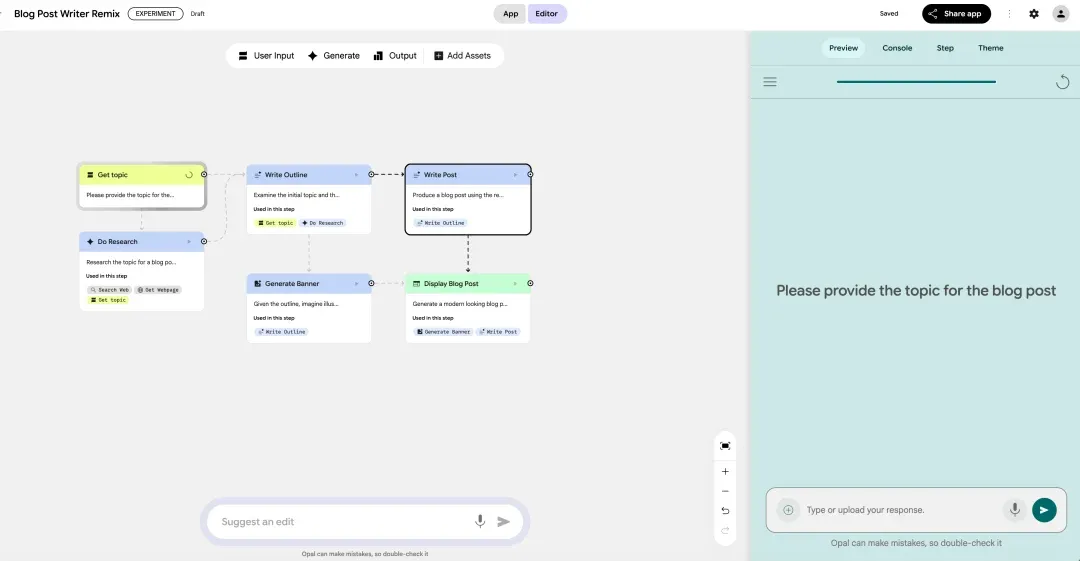
Its interface is familiar to anyone who’s used Zapier, Make, OpenAI’s Agentkit, or even Jiandaoyun or Notion Automation. It’s a visual workflow orchestration interface based on “nodes” and “connections.”
Opal breaks down complex AI task flows into draggable “LEGO” blocks:
-
Start: The flow’s entry point, defining how your Agent gets triggered.
-
Text Input: User input module — like a text box for users to provide prompts or data.
-
Model: The core “brain,” connecting to Google Gemini Pro. You define System Prompts here, telling the AI its role and task.
-
Choices: Logic judgment module. This is crucial — it lets Agents branch paths based on AI output (like “yes/no,” “positive/negative”) rather than being linear.
-
Output: The final “product” exit, presenting results (text, charts, JSON) to users.
What’s different is that you don’t need to adjust each node individually or write node scripts. Its core node functions are basically pre-packaged Agent sub-workflows — for example, Deep Research functionality is directly encapsulated and callable. If you were building an n8n from scratch and needed deep research, it’d be a headache. You’d have to find an open-source “Open Research” on GitHub, encapsulate it, write scripts, then call it. Opal takes “dummy-proof workflow” to the extreme.
So Opal’s arrival kind of “offends” everyone.
It “offends” senior developers: Developers will say, “Isn’t this just a toy? Can this do ReAct framework? Run Multi-Agent? Hook up complex Vector DBs? No? Then what’s the point.”
It also “offends” pure business users: Business folks will say, “What’s a Model? What’s Choices? I just want a tool that auto-writes my weekly reports. You’re showing me this?”
But this “double offense” precisely hits its real target users — the “middle layer” that understands business logic, knows some tech thinking, but doesn’t want to (or doesn’t have time to) get lost in code details.
This group is us: indie developers, product managers, growth hackers.
2. Activating the PMF Radar: Whose “Pain Point” Is Opal Actually Solving?
Whenever I analyze a new product, I activate my PMF (Product-Market Fit) radar. Let’s give Opal a “CT scan” with this framework.
Problem (Problem Size & Frequency)
What core problem is Opal solving? Not “writing code,” but “orchestrating AI.” In the Agent era, the biggest pain point is: the “last mile” connection problem between “AI capability” and “business process.”
I have Gemini, this powerful “brain” (capability). I have “SaaS subscription” as my “business process” (scenario). But how do I make the brain serve the process? For example, “when a user registers, automatically call AI to analyze their registration info and tag them as ‘high/medium/low potential’.”
This “connection” action currently either requires engineers to write a bunch of APIs (High-code), or configuration in Zapier (No-code, but weak AI capability). Opal is targeting this “AI-Native” Low-code process orchestration. This problem is big enough, and frequent enough.
Value Fit
Opal’s core value isn’t “powerful” — it’s “lightning fast.”
For indie developers, what’s most precious? Time. The opportunity cost of validating PMF. I have an “AI-driven Logo design” idea. I don’t need two weeks to build a heavy backend with Python, LangChain and Flask. I need to “drag” together the crudest MVP in 2 hours, send it to 10 seed users, and see if they’ll pay.
Opal’s Value Fit is compressing AI MVP TTM (Time to Market) from “weeks” to “hours.” It’s the Agent era’s “Lean Canvas,” a tool for “Vibe Checks.”
Monetisation & NPS (Commercialization & Reputation)
Opal is still experimental, so commercialization talk is premature. But the path is clear: become part of Google Cloud Platform (GCP), or like GPTs, part of Gemini Advanced subscription. Just like the now-generally-useful App Builder — that’s more geared toward directly making React native web app demos, but for visualization and Multi-Agent, App Builder clearly isn’t as good as Opal. Visual workflow Agent logic is actually more intuitive than coding with Agent frameworks directly, closer to business logic, easier to maintain. Product managers can even use this to make internal demo presentations showing entire business workflows. So I think this tool’s value is higher for PMs than other roles.
Its NPS (Net Promoter Score) will be very polarized. Developers will give low scores (“too weak”). But “Super-Individuals” empowered by it will give high scores. A growth-savvy operator uses Opal to build an “automated SEO content generation + publishing” Agent, improving efficiency 10x. They’ll become Opal’s most fervent “evangelist.”
🔑 Key takeaway: Opal isn’t an “all-purpose tool” — it’s a “PMF validator.” Its battlefield isn’t “feature depth” but “validation speed.”
3. Practical Drill: “Drag” a “Competitive Analysis Agent” in 15 Minutes
“Talk is cheap, show me the code.” — Here, it should be “Show me the Logic.”
Let’s “theoretically” walk through a practical case. I’ve recently been incubating an AI tool for automatically analyzing competitors on Product Hunt (PH). Let’s assume we implement this MVP with Opal.
My goal: Input a PH product URL, Opal Agent automatically outputs a SWOT analysis report.
The flowchart in Opal would look roughly like:
[ 🔵 Start ] ↓ [ ⌨️ Text Input ] (Label: “Please enter Product Hunt URL”) ↓ (Input: “https://www.producthunt.com/posts/xyz”) [ 🛠️ Tool: Web Scraper ] (Scrape the URL’s HTML content) ↓ (Output: “Raw HTML Content”) [ 🧠 Model: Gemini Pro ] ├─ System Prompt: “You are a top business analyst. You will receive PH page HTML. Extract the product’s core features, pricing, top comment, and maker description.” └─ User Input: (Pass “Raw HTML Content”) ↓ (Output: JSON_Result = features, pricing, top_comment, maker_bio) [ 🧠 Model (Chained): Gemini Pro ] ├─ System Prompt: “You are a SWOT analysis expert. Based on the provided product info, generate a concise SWOT analysis report.” └─ User Input: (Pass JSON_Result) ↓ (Output: “SWOT Report Text”) [ 📝 Output ] (Display “SWOT Report Text”) ↓ [ 🔴 End ]
Let’s analyze this workflow:
Pros:
-
Extremely fast: If tools are complete (like built-in Web Scraper), I could finish dragging this flow in about 15 minutes. Writing code — frontend + backend + API integration — at least a day.
-
Iterable: If SWOT analysis doesn’t work well, I can immediately swap the second Model to “generate a Jobs-To-Be-Done (JTBD) analysis.” This agility is incomparable to hardcoded solutions.
-
Vibe Check: I can immediately send this (even if ugly) interface to friends for a “vibe check” to see if this idea “makes sense.”
Cons:
-
Tool Dependency: The biggest bottleneck: does Opal have a built-in “Web Scraper”? What if PH has anti-scraping? Can Opal handle “Headless Browser”?
-
Reliability: This “HTML -> Gemini -> JSON” extraction method is very fragile. If PH page structure changes, my entire Agent “breaks.” It’s not suitable for 24/7 “production-ready” SaaS.
-
Scalability: This Agent processes one URL at a time. If I want to process 100 URLs at once, can Opal’s architecture support it? Does it support “Batch Processing”? These are unknowns.
-
Black Box Issue: Currently some core nodes are pre-packaged Google logic that’s hard to break apart directly. Otherwise I’d find it valuable to dissect their native DeepResearch — after all, the open-source Gemini CLI already shows Google is an excellent Agent development teacher.
Learning Agent Development from Google Gemini CLI (Part 1): How Is Gemini CLI’s Sandbox Implemented?
4. The Giants’ Agent “Open Strategy”: From Opal to GPTs
We must see the giants’ “open strategy.” Opal isn’t isolated — you must view it alongside OpenAI’s GPTs and Microsoft’s Copilot Studio on the same chessboard.
-
OpenAI GPTs: Takes the “C-end” (consumer) route. It’s more like an “App Store” where everyone can create and share “GPTs.” Its interface is pure “Prompt Engineering” with almost no “Flow” concept. They’re betting “natural language” is the ultimate “programming language.”
-
Microsoft Copilot Studio: Takes the “B-end” (business) route. Deeply tied to Power Platform and Dynamics 365. The goal is letting enterprise “business analysts” build their own Copilots to solve internal problems.
-
Google Opal: Takes a “B/C hybrid” route, or rather a “Prosumer” (producer-consumer) route. More “structured” than GPTs (has Flow), yet more “lightweight” than Copilot Studio (doesn’t require knowing the whole ecosystem).
The giants’ endgame battle isn’t about whose “model” is stronger — it’s about who can fastest build the “distribution network” for “model capability.”
Opal is Google Gemini ecosystem’s “capillaries” and “nerve endings.” It lets Gemini’s capability extend beyond the “Chatbot” chat box and penetrate into millions of “workflows.”
This is the real “open strategy”: They’re competing for the “iOS” and “Android” of the Agent era, competing for the right to define the next-generation “App Store.”
5. How Should Indie Developers “Dance with LEGO”?
OK, after all this analysis, back to us indie developers. Are tools like Opal a “benefit” or “threat”?
My answer: Absolute benefit.
It’s not here to “replace” you — it’s here to be your “Co-founder,” a “0 salary, 0 equity, 24/7 online” “technical prototype engineer.”
How should we “dance with LEGO”? My 4-point action checklist:
1. Treat It as an “MVP Validator,” Not a “Productivity Tool”
Don’t expect to build your next million-dollar SaaS with Opal. Its value is in the “0 to 0.1” phase. Use it to quickly validate your idea. Once PMF is initially validated, immediately rebuild a “production-ready” version with “heavy code.”
2. Focus on Workflow “Logic,” Not Code “Syntax”
Tools like Opal elevate our “value point” from “code implementation (Syntax)” to “logic orchestration (Logic).” Your core competitiveness is no longer “I know Python Flask,” but “I can design the most elegant, efficient ‘competitive analysis’ workflow.”
3. Your Value Is in “Defining Problems,” Not “Solving Problems”
AI handles “solving problems” (“help me scrape this webpage”). Your value is in “defining problems” (“why scrape? scrape what? what to do after scraping?”). Our role as indie developers is shifting from “Full-stack Developer” to “Full-stack Product Architect.”
4. Beware “Platform Lock-in,” But Embrace “Platform Dividends”
Agents you build with Opal probably only run in Google’s ecosystem. This is “Platform Lock-in” — be wary. But in the early platform dividend phase, using its built-in “Gemini Pro,” “Web Scraper,” or even “Google Ads” tools, you can “parasitize” on the giant’s shoulders at extremely low cost. Isn’t that also a Vibe Coder’s wisdom?
6. Conclusion: Tools Change, But Human Value Is Eternal
Schopenhauer said, “Man is a bundle of desires.” Opal, GPTs, Copilot… these tools are simply continuously lowering the threshold for “realizing desires.” They’re pulling “creation” costs from “expensive custom handcraft” (writing code) down to “cheap industrial assembly” (dragging LEGOs).
This is good.
Because it means we can finally release 90% of our energy from “How to build” to “What to build” and “Why to build.”
“What do you want to achieve?”
This ultimate question is one AI can never answer.
Found Mr. Guo’s analysis insightful? Drop a 👍 and share with more friends who need it!
Follow my channel to explore AI, going global, and digital marketing’s infinite possibilities together.
🌌 We’re not “using” tools — we’re “becoming” the orchestrators of tools.
