
Hello, I’m Mr. Guo.
The AI arena has been wild lately. On one side, Elon Musk’s Grok Imagine team is putting on a spectacle on X with “infinite information streams,” meme-heavy videos, and the most unfiltered content on the internet, promising an AI-powered encyclopedia of everything. On the other side, you have Google—the classic engineering nerd—quietly rolling out a new product called Code Wiki on November 13.
Grok wants AI to explain the universe and humankind.
Google says, “Hold up. Let me use AI to explain the spaghetti code your teammate shipped last week.”
That is peak Google energy. While Grok competes on edginess and attention, Google goes directly for the real pain point developers have. As a builder I tried Code Wiki immediately, and my quick conclusion is: this might deliver far more practical value to developers than Grok’s encyclopedic ambitions.
1. Code Wiki — a living encyclopedia for “ancestral code”
First, we need to clarify the problem Code Wiki is solving.
In Google’s words, it tackles “one of the biggest and most expensive bottlenecks in software development: reading existing code.”
In plain language: it is made for dealing with inherited codebases. Every developer has felt this pain. You inherit a legacy project, the docs are nonexistent, and the original author is long gone. New hires spend weeks just understanding the foundations; even senior engineers like me routinely burn days untangling an old module. Our time should go toward building, not deciphering. Code Wiki exists to be that deciphering assistant. It is not another chatbox—it is a living, automated documentation system.

Honestly, the first thing that grabbed me was not even a feature but its frontend. The page is gorgeously cyberpunk, insanely slick, and totally my vibe.
See it for yourself:
2. Google’s “open conspiracy”: understand code first, chat later
Digging into its mechanics, I realized Code Wiki’s intelligence is very different from generic AI assistants.
Automated & always up-to-date
This is the killer detail. Code Wiki scans the entire repo 24/7. Every single commit triggers a fresh documentation pass, which keeps docs evolving in lockstep with code. Those README files that age the moment they are written can finally be retired.
Intelligent & context-aware
This is the core. You are not talking to a generic Gemini instance, you are talking to a custom Gemini that has ingested every document in your repo and stays current. Its understanding of your code actually beats most newly onboarded teammates.
Integrated & actionable
Nothing is static. Every wiki explanation and chat answer links directly to the relevant files, classes, or functions. You can shift from reading to digging into implementation instantly.
Auto visualization
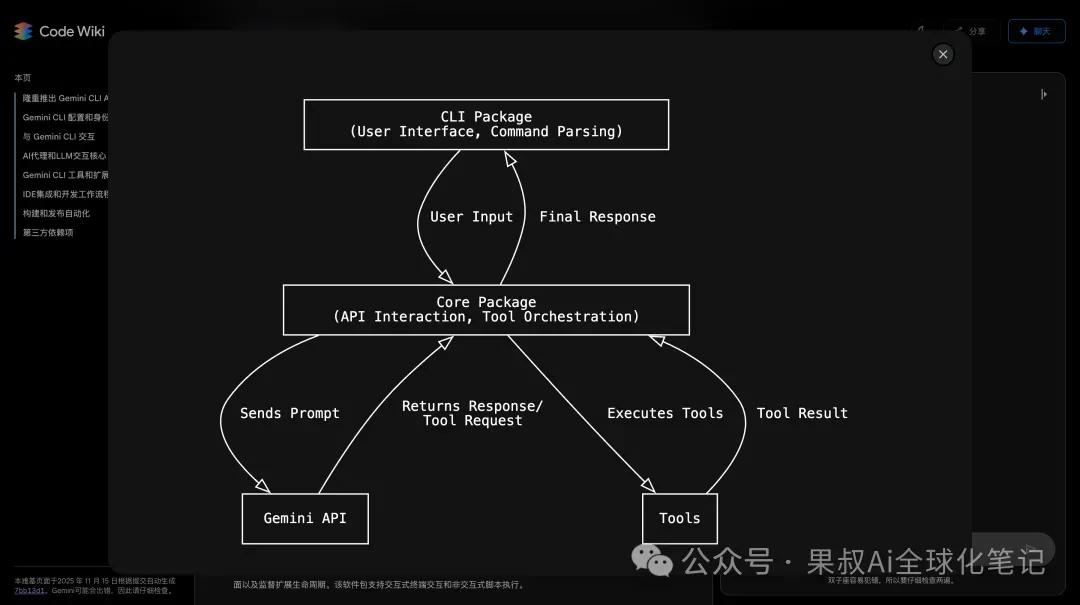
Not satisfied with text? Code Wiki autogenerates always-current architecture diagrams, class diagrams, and sequence diagrams. Some drawing tools should be worried.
3. Hands-on impressions (plus complaints)
The marketing copy sounded amazing, so I tried it myself.
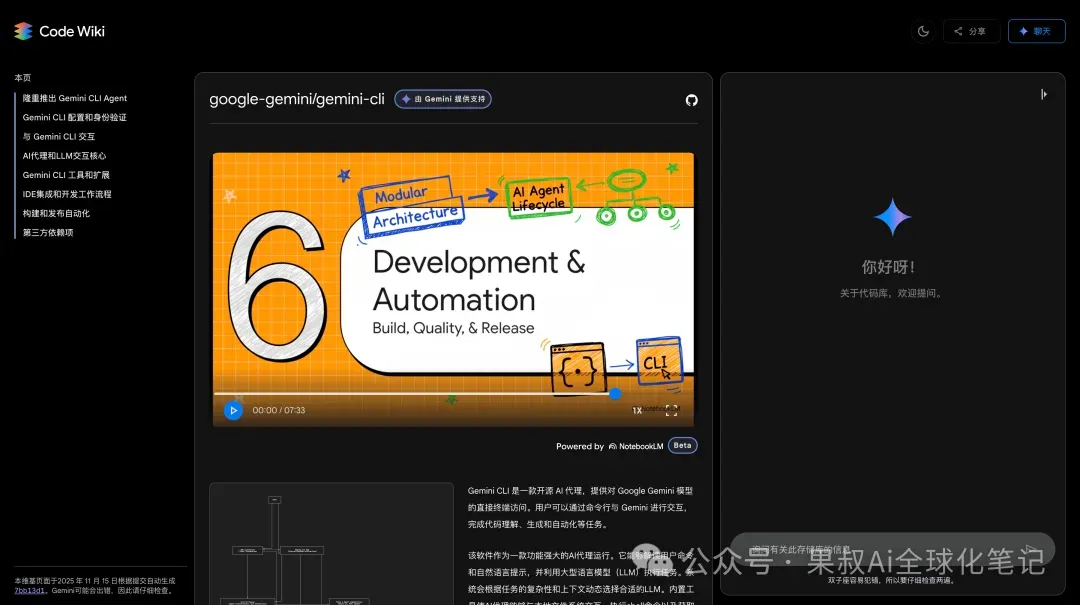
I opened the wiki it generated for the google-gemini/gemini-cli open-source project. The experience was… excellent.
The content is extremely detailed, with flowcharts and even Notebook LM–based video walkthroughs. It bridges the gap between learning and exploring code in one take. Whether it is a new hire committing on day one or a veteran scanning a new library in minutes, Code Wiki really delivers.
But the weaknesses are obvious. The catalog of open-source repos is still thin. Many trending or up-and-coming GitHub projects simply are not indexed yet. I suspect the crawler has not finished or is prioritizing Google-owned repos plus the big mainstream ones. Coverage is the biggest short-term limitation.
4. Grok is still doing showbiz; Google is already doing the dirty work
What really excites me is not the public wiki site but the mention at the end of the announcement—the Code Wiki Gemini CLI extension.
That is Google’s real “open conspiracy.”
Indexing open-source repos is just for practice and flexing. Enterprise legacy codebases are the true gold mine. The CLI extension lets teams run Code Wiki locally and securely on private repos. Imagine giving your company’s ten-year-old, mission-critical module a living encyclopedia plus an on-call AI architect—that value is off the charts.
Final thoughts: which one creates more value?
So here is how I see it:
- Grok wants to explain the universe and humanity with AI. That’s ambitious, very Musk, and super entertaining.
- Google takes a different path and applies AI to solve the universal headache of “understanding the code Zhang San left behind.”
While Grok keeps chasing spectacle, Google is already fixing the hardest, messiest part of engineering workflows. It is not repackaging; it is using AI to rebuild the most expensive layer of software development: knowledge transfer.
As a builder I don’t care who grabs more headlines. I care who solves my problems. On that front, Code Wiki wins by a mile.
If my breakdown was helpful, tap 👍 and share it with friends who need this.
Follow my WeChat official account so we can keep exploring the possibilities of AI, global expansion, and digital marketing together.
🌌 “Playfulness” grabs attention; “usefulness” creates value.
For related agent workflows, see Gemini CLI web tools and Claude Code’s simple control loops.
