
Decoding the “ingredients list” of successful indie developers—what are your odds of “going solo” in the AI era?
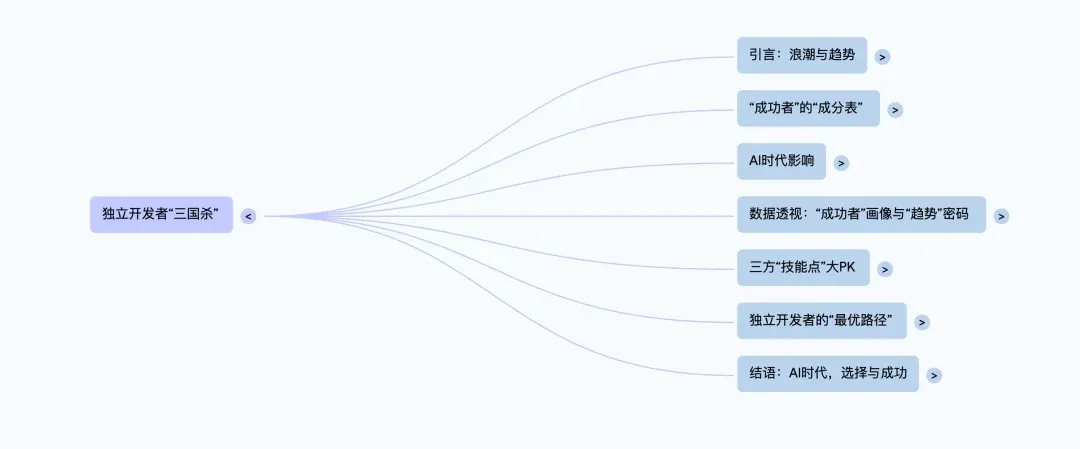
Introduction: The Indie Dev Wave Is Surging—Before “Going Solo,” Check This “Leaderboard”!
The indie development wind keeps blowing stronger! According to statistics, global indie developers exceeded 30 million in 2025, a staggering 217% growth from 2020, with Greater China developers accounting for 18%. Lower technical barriers (low-code platforms reportedly boost development efficiency 5x!), exploding long-tail market demand, plus diverse monetization channels—more and more “office workers” are getting ideas about “going solo” to make something happen.
In this mighty “individual entrepreneur” army, we noticed an interesting pattern: frontend engineers, backend (including full-stack) engineers, and product managers (or non-technical business roles)—these three “traditional big-company cogs” are becoming indie development’s main force. So how’s their “combat power”? Among those successful indie developers already hitting $10k+ MRR or dominating Indie Hackers and Product Hunt, what’s the “ingredient ratio” of these three? Who has better “solo” odds?
After deep-diving into data reports and community observations (thanks to Indie Hackers, MicroConf, Stack Overflow frontline dispatches), here’s the bottom line: Among those “successful” indie developers who’ve “made it,” roughly 70-80% are still capable engineers (backend/full-stack claiming about 45% as “martial arts alliance leaders,” frontend holding about 25% as “looks champions”). BUT! Key point! Product managers and business background “strategists” are rapidly capturing about 30% of “emerging territory” armed with No-Code and AI!
So this “Three Kingdoms” battlefield is far from static. Today, let’s dissect this “successful indie developer ingredients list” to see different backgrounds’ “martial arts secrets” and “Achilles heels,” plus how to plan your “solo” path in the AI era.
I. Data Perspective: “Winner” Profiles and “Trend” Codes
No data, no truth. Let’s see what several “insider reports” reveal:
-
MicroConf “State of Independent SaaS 2022”: Among 900+ indie SaaS founders earning $1k–$10m annually, 90% of teams have at least 1 developer. The report states bluntly that “Developer founder” is a core variable determining growth speed. Technical foundation—hard truth!
-
Stack Overflow Developer Survey 2024: Among nearly 90,000 global professional developers (11% indie developers or self-employed), self-identified full-stack is 31%, backend 17%, frontend about 12%. Full-stack + backend topped the charts for 6 consecutive years. The crowd’s eyes are sharp—tech generalists who can handle everything remain in demand.
-
UC Berkeley “No-Code Founders Dataset”: Surveying 100 No-Code startups earning $1k–$100k monthly, two-thirds of founders lack computer science backgrounds. What does this mean? “Non-technical folks can build products with tools” is no longer a dream—it’s a spreading wildfire!
In short: Technical background, especially backend/full-stack capability to handle “the whole process,” definitely helps you take fewer hits in indie development’s “Shaolin Temple bronze warrior gauntlet.” But the world is changing—AI and No-Code “power-ups” are opening new tracks for PMs with perhaps less “internal strength” but clever “moves” (product/market thinking). So don’t just look at “existing” advantages—watch “incremental” trends.
II. Three-Way “Skill Points” PK: Whose “Talent Tree” Better Suits Solo Dungeon Runs?
1. Frontend Developers: “Looks Are Justice” and “Backend Anxiety”
Core Strengths: Precise UI/UX control, rapid prototyping, “what you see is what you get” implementation. Like designer-turned-frontend Adam Wathan, who single-handedly created the phenomenal Tailwind CSS framework.
Typical Challenges: Complex backend logic, databases, server ops are weaknesses; business thinking needs deliberate cultivation.
AI Era Opportunities: Today BaaS/Serverless services are everywhere, and AI coding assistants (like AI helping write backend APIs) significantly lower the bar for frontend devs to achieve full-stack.
2. Backend/Full-Stack Developers: “Steady as a Rock” and “Engineer Aesthetic”
Core Strengths: Powerful logic construction, data processing, system architecture capabilities; product stability guaranteed. PHP full-stack legend Pieter Levels single-handedly grew Nomad List to $70k/month—profound internal strength indeed.
Typical Challenges: User interface and experience design might be “disaster zones”—things that “work but don’t look good”; relatively unfamiliar with marketing and user operations.
AI Era Opportunities: AI-assisted design tools keep emerging, frontend frameworks and UI libraries mature daily—backend masters face lower difficulty filling UI gaps.
3. Product Managers: “Strategic Command” and “Hands-On Struggles”
Core Strengths: Market insight, user needs grasp, business model design, project management abilities shine. Former PM Rob Fitzpatrick built the form SaaS product Yform to $15k/month using No-Code tools.
Typical Challenges: Technical implementation is the hard wound—easy to “think it but can’t do it.”
AI Era Opportunities: No-Code/Low-Code platforms everywhere, AI code generation tools (like GitHub Copilot, v0.dev) and various AI application wrappers greatly enhance PMs’ “hands-on” ability, letting them directly turn ideas into products.
So frontend is the “facade project” master making products “look delicious”; backend is the “anchor” ensuring products “really work and fill you up”; PMs are the “strategic persuasion bureau” chiefs (complimentary!) finding “hungry people” and making them “happy to pay.” All have weaknesses in solo battles, but AI’s arrival is like issuing everyone a “capability patch” and “smart navigator,” making this “Three Kingdoms” more fun and easier to find victory paths.
III. Indie Developer’s “Optimal Path”: No Standard Answer, Just “Right Medicine”
1. Match Your “Starting Line” to Choose Tactics:
-
Hardcore Backend: Embrace AI-acceleration, bundle infra value (security, compliance, data pipelines) → High ARPU but long sales cycles.
-
Visual/Frontend: Grab fast UI/UX iteration windows (Notion, FigJam ecosystems, WebFlow marketplace).
-
PM/Growth Type: Use No-Code + AI for low-cost MVPs, focus on positioning, channels, business model innovation.
2. Co-founders or Advisors to Fill Gaps:
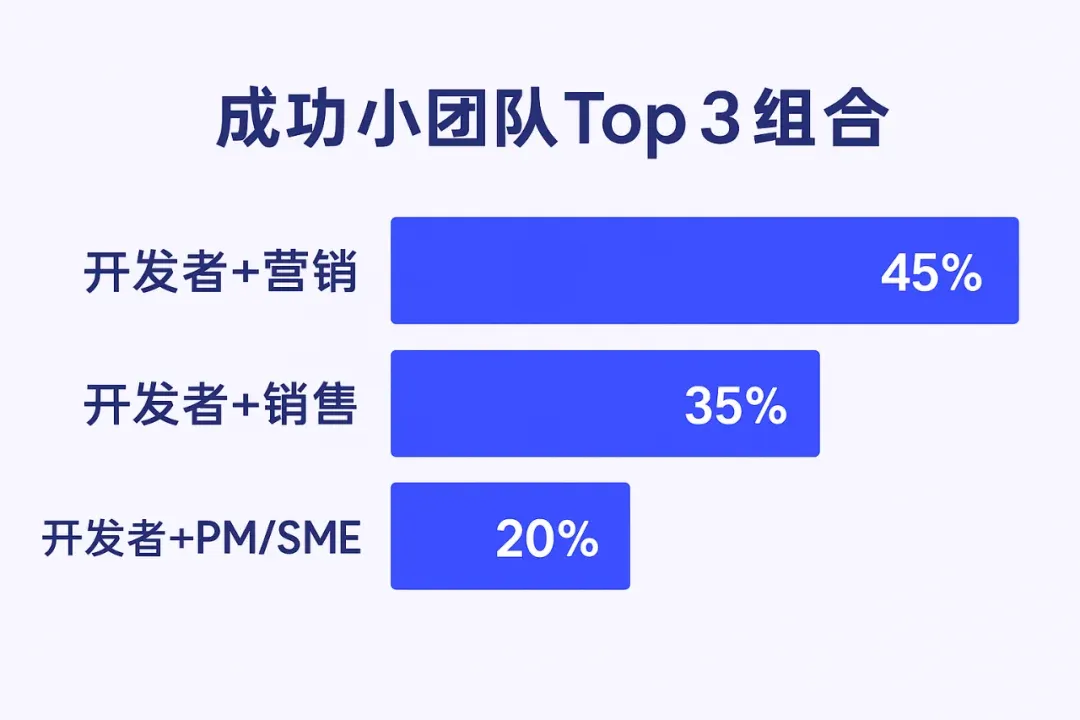
MicroConf data shows “Dev + Marketer/PM” as the fastest-growing combo; going solo is romantic, but “brothers united break through gold” still applies in startup land.
3. Use Public Data to Set Your Benchmarks:
Want $10k MRR? Reference MicroConf report veterans’ data: average weekly hours invested (like 28h/week), CAC to LTV ratio (like $0.6 CAC/LTV). Set small goals to avoid “self-moved” blind busyness.
Simply put: if technically strong, don’t just bury yourself in tech—look up at the market, think how to sell “good stuff”; if market-savvy, don’t just draw pies—learn to bake them with AI or No-Code, even small ones first. If neither works, learn from Liu Bei—visit Zhuge Liang’s cottage three times (or recruit a capable “Zhao Zilong”) to conquer together. Remember, indie development isn’t about becoming Superman—it’s about smartly leveraging and integrating resources to move mountains with minimal effort.
Conclusion: AI Is Here—Which Path Will You Choose?
So, aspiring solo heroes, stop obsessing over “background theories.” Technical backgrounds still advantage the 0-to-1 product implementation phase, but AI and No-Code tools are opening unprecedented doors for non-technical talent. Indie development success increasingly depends not on your “starting class” but on learning ability, adaptability, relentless pursuit of user value, and execution speed in turning ideas into reality.
In the AI era, everyone can become a “wizard”—the key is which “spellbook” you’re reading (market insight and product definition), which “wand” you’re using (tech stack or AI/No-Code tools), and how determined you are to “cast spells” (execute and iterate).
Found this rambling interesting? Give it a thumbs up and share with more “fellow travelers”!
The future is here, intelligence as companion—may your indie development path have less “involution” and more “magic”!
