
Word Count: ~2,600 words
Estimated Reading Time: 12 minutes
Last Updated: July 15, 2025
Is This Article for You?
-
If you’re an indie developer, SaaS product founder, or tech-background entrepreneur.
-
If you’re tired of burning money on paid ads and crave a sustainable, low-cost growth path.
-
If you believe in “long-termism” and want to build “traffic assets” that compound over time.
-
Then this “manual” is prepared for you.
Chapter Contents
-
Preface: Your product is great, but where are the users?
-
Chapter 1: Redefining SEO: It’s not marketing—it’s your product’s “Growth API”
-
Chapter 2: SEO’s Ceiling: From my SaaS project to Canva’s growth myth
-
Chapter 3: SEO’s Compound Art: Building your “traffic moat”
-
Chapter 4: SEO vs. GEO—Returning to first principles, seeing through “new bottles, old wine”
-
Chapter 5: A Sobering Reminder: Don’t worship “black hat SEO” poison
-
Chapter 6: Manual Overview: How we’ll build your “growth flywheel”
-
Conclusion: Finding unchanging growth foundations amid change
Preface: Your Product Is Great, But Where Are the Users?
This might be the question every indie developer asks themselves at midnight. We pour countless efforts into crafting what we believe is a great product, then release it into the vast internet ocean, only to find it makes no ripples—like a drop in the river.
We crave growth, but as resource-limited individuals, we neither have budget for ad-burning money pits nor energy to build sales teams requiring stepping outside comfort zones.
So where’s the way out? The answer lies in the oldest, fairest, and most indie-developer-friendly channel—SEO. It’s relatively low-cost and perfectly matches our developer strengths. This manual is your tailor-made, systematic SEO practice guide.
Chapter 1: Redefining SEO: It’s Not Marketing—It’s Your Product’s “Growth API”
Before starting, we must complete a mental “format.” Forget those complex marketing SEO terms. For us indie developers, SEO’s essence is extremely pure: it’s not marketing—it’s part of the product itself, an “API” you specifically designed for growth.
This is Product-Led Growth (PLG) thinking applied to SEO. Your documentation, tutorials, free small tools, even error pages—all are your product’s “features,” and precisely what Google loves and wants to rank. When users “call” these “APIs” through search, you’ve completed a zero-cost user acquisition.
Chapter 2: SEO’s Ceiling: From My SaaS Project to Canva’s Growth Myth
How much potential does this approach have? Its ceiling far exceeds imagination.
My Personal Case
I deeply participated in an overseas AI tool project. One important thing we did: analyze industry heat, find an extremely niche yet explosive “search trend,” then rapidly build a well-experienced, content-rich Online Tool Page around this point, supporting it with internal and external links. In subsequent time, this page, purely through hot-topic-driven organic search, brought us over 2 million organic search clicks in a single day.

Details in previous article: Deconstructing the secret behind 2M+ daily non-brand organic search traffic spike.
Canva’s Growth Epic
Look at giant Canva. Its growth myth is essentially an SEO epic. Its core strategy: create a corresponding “tool-type” landing page for thousands of user needs (long-tail keywords). From “birthday card templates” to “logo online maker,” Canva used this approach to become the “best answer” for countless niche needs, capturing immeasurable user traffic, ultimately making SEO the company’s most powerful, never-depleting growth engine.

Chapter 3: SEO’s Compound Art: Building Your “Traffic Moat”
The biggest difference from paid ads: SEO has an astonishing “snowball effect.”
Stop ads, traffic goes to zero. But SEO is different. Every piece of high-quality content you publish is a digital asset. It will continuously bring traffic over time. When your quality pages accumulate, they interlink, passing authority to each other, and the whole site’s authority snowballs larger and larger.
Ultimately, this accumulated authority forms your “traffic moat”—a solid, sustainable growth barrier competitors can’t quickly surpass with money.
Chapter 4: SEO vs. GEO—Returning to First Principles, Seeing Through “New Bottles, Old Wine”
Recently, circles are flooded with “SEO is dead, GEO rises” rhetoric. GEO (Generative Engine Optimization)‘s emergence makes many anxious. But I think this is precisely a “return test” for SEO’s first principles.
GEO’s essence: optimize content so AI (like Google SGE) can more easily adopt, cite, and integrate it into generated answers. So the question becomes: when AI generates answers, what “raw materials” does it trust?
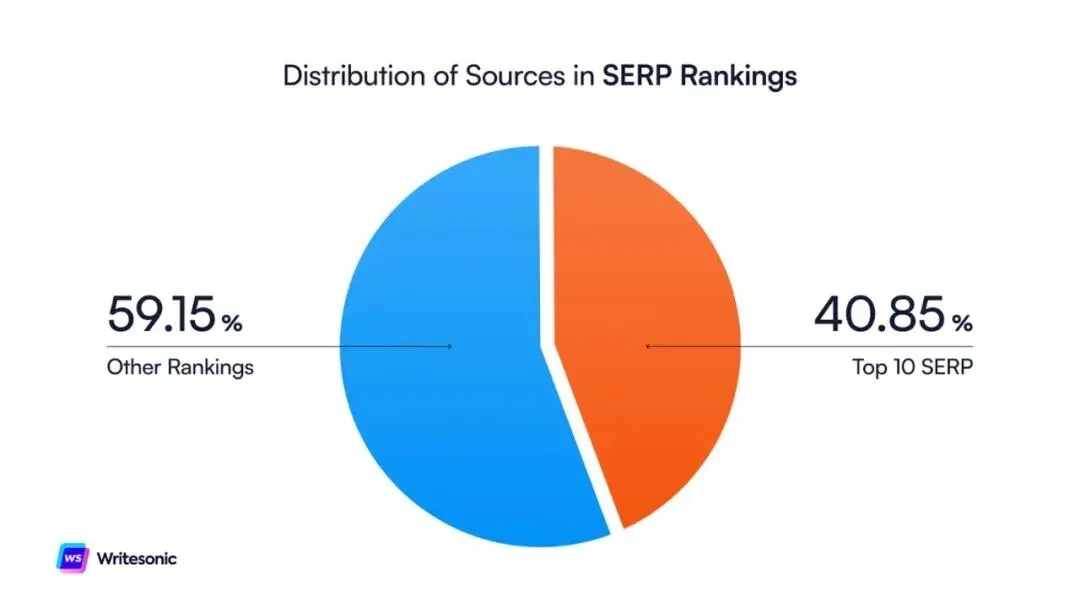
Answer: high-quality, high-authority, high-credibility information sources. Leading marketing content platform Writesonic found a stunning fact in research: over 40% of AI-generated answer citations come directly from Google’s traditional search results (SERP) top 10.
Also according to their research, there’s an 81.10% probability that at least one source from Google’s top 10 search results is cited in AI Overview.
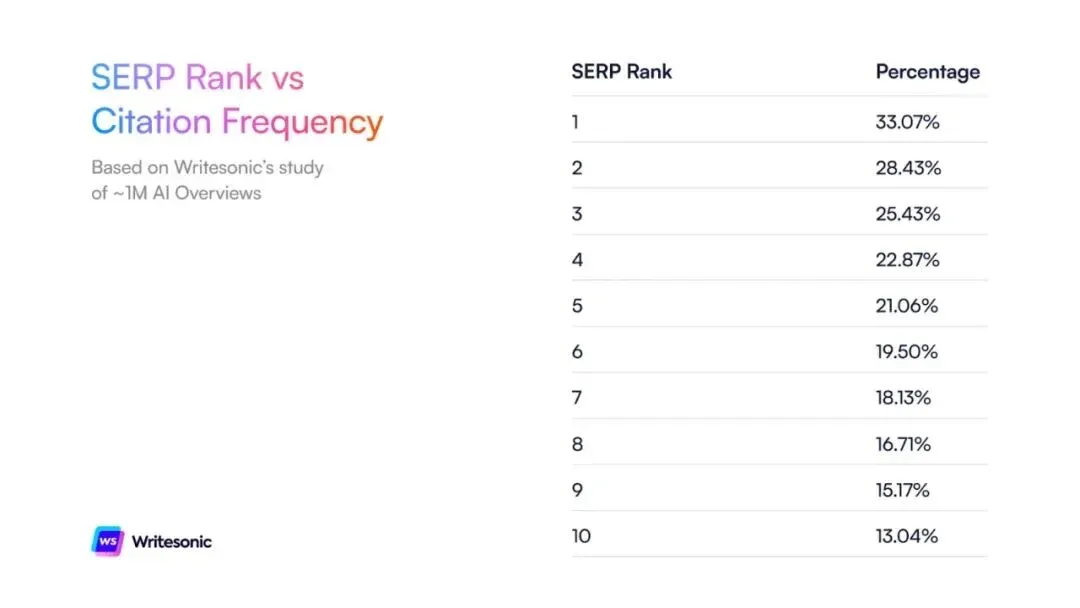
This data eloquently proves: GEO isn’t SEO’s gravedigger—it’s its evolved next form. Your content must first pass traditional SEO tests, achieve high rankings, to possibly get “admission tickets” into AI answers. Therefore, we shouldn’t anxiously chase the GEO buzzword, but more firmly master SEO “internal strength”—that’s the only path to winning present and future.
Chapter 5: A Sobering Reminder: Don’t Worship “Black Hat SEO” Poison
Before teaching “methods,” we must clarify “commandments.” In SEO’s world, there’s always a shortcut to “quick wins”—called “black hat SEO.”
I must emphasize: traffic hijacking, spider pools, parasite techniques—these aren’t impossible to achieve, but unsustainable. They’re like “devil’s bargains”—bringing brief, explosive false prosperity, but ultimately costing site penalties, destroyed brand reputation, and everything reset to zero.
I’ve attended some overseas SEO conferences (like Chiang Mai SEO Conference), where practitioners’ attitude toward black hat is universally “love-hate”—both craving short-term windfall and fearing long-term asset destruction.
So my advice is very clear: if, like me, you’re building a completely compliant product hoping for lasting success, there’s absolutely no need to obsess over black hat SEO. We should invest all energy into “white hat” work creating real value. Long-termism is the ultimate winner.
Chapter 6: Manual Overview: How We’ll Build Your “Growth Flywheel”
Having clarified SEO’s long-term value and confirmed our “white hat” righteous path, this manual officially begins. In the upcoming series, step by step, starting from solid foundations, we’ll ultimately build a growth flywheel competitive in both traditional search and generative engines.
-
Beginner Level: We’ll focus on Technical SEO and keyword research, helping you avoid 90% of common mistakes.
-
Intermediate Level: We’ll learn how to scale content production (including Programmatic SEO) and begin building site authority.
-
Advanced Level: We’ll explore building brand moats and finding new growth points in the AI era.
Conclusion: Finding Unchanging Growth Foundations Amid Change
Whether in the SEO era or GEO era, what remains constant is deep user insight and creating truly valuable content. What this manual will help you focus on is precisely these unchanging growth foundations. It’s a technical investment—a “perpetual motion machine” that, once built, continuously brings steady, low-cost streams of precise users long-term. Now, let’s begin building your first growth machine together.
Found this preface insightful? Give it a thumbs up and share with more friends who need it!
Follow my channel to join me on this exciting SEO growth journey.
Short-termists seek audiences; long-termists build systems.
