
Word count: ~3300 words
Estimated reading time: ~13 minutes
Last updated: July 28, 2025
Is this article for you?
-
If you’ve attracted some traffic to your site but struggle to convert it effectively.
-
If you want to learn how to write truly persuasive copy instead of talking to yourself.
-
If you want to deeply integrate SEO with product growth strategy to build a sustainable acquisition engine.
Chapter Contents
-
Preface: Is your landing page a “manual” or an “invitation”?
-
Chapter 1: Mindset — Sell the “Ideal Destination,” Not the “Vehicle”
-
Chapter 2: Strategy — From One Product to Multiple Landing Pages with PMF Thinking
-
Chapter 3: Structure — The “Nine-Section Golden Structure” of High-Converting Landing Pages
-
Chapter 4: Copywriting Framework — The “PAS Formula” Designed for Developers
-
Chapter 5: Psychological Nudges — 6 “Devil in the Details” Persuasion Boosters
-
Chapter 6: The Art of Action — Designing Irresistible CTAs
-
Conclusion & Preview: When One Page Becomes a Thousand
Preface: Is Your Landing Page a “Manual” or an “Invitation”?
Hey, I’m Mr. Guo. We’ve invested heavily in high-quality articles that act like magnets, attracting precious traffic. Visitors click with curiosity and anticipation, landing on your product page. The decisive battle begins.
Yet too many developers’ landing pages play the wrong role. They’re like cold, objective “product manuals” listing technical specs, thoroughly introducing what your product “is.” But users never really care about “what it is” — they care about “what it can do for me.”
Moreover, during development, many SaaS products focus heavily on “versatility” — the core hook for telling the SaaS story. But in marketing and operations, we should actually forget “versatility” because customers don’t care about industries or scenarios unrelated to them. They only care about your product’s value in “their scenario.” This is the logical core of why I emphasize planning product landing pages and SEO operations with PMF thinking!
A high-converting landing page should be a warm, sincere, alluring “invitation.” It invites users into a better world, to experience more efficient work methods, to become a more powerful version of themselves. This article is the “invitation” we’ll craft together — one that cannot be refused.
Chapter 1: Mindset — Sell the “Ideal Destination,” Not the “Vehicle”
Before typing a single word, we must complete a profound mindset shift. This is the first principle of all high-converting copy.
Your SaaS product is a vehicle. What users pay for is never the car itself, but the “poetry and distant places” it can take them to — that ideal destination.
Using the “Jobs To Be Done” theory from earlier articles, your copy focus must shift from:
- Features: “Our AI image tool has an advanced ‘background removal’ feature.”
To completely:
-
Benefits: “Get a clean, professional product photo ready for any e-commerce platform in 5 seconds — save 30 minutes of Photoshop work.”
-
Transformation: “Transform from a design assistant bogged down by tedious tasks into a visual strategist focused on core creativity.”
Features are about “you,” while Benefits and Transformation are about “the user.” A high-converting landing page should spend 90% of its space discussing the latter.
Chapter 2: Strategy — From One Product to Multiple Landing Pages with PMF Thinking
Now we introduce this article’s core strategic thinking, deeply binding SEO with Product-Market Fit (PMF) thinking. Traditional thinking: I have one product, so I make one landing page. PMF thinking: I have N user scenarios, so I should match N precise value propositions — meaning N landing pages.
This means learning to “deconstruct” and “recombine” a single underlying technology or product feature according to different user needs and search intents.
Case Analysis: An “AI Image Tool” Landing Page Matrix
Suppose your core product is a general AI image generation tool. The underlying technology is identical, but application scenarios vary widely. A smart growth strategy isn’t just making one generic ai-image-generator page, but building a landing page matrix:
-
General Core Page: Target keyword
AI image generator. This page showcases the product’s most comprehensive capabilities. -
Scenario 1: E-commerce Sellers: Target keyword
product background generator. Create a dedicated landing page titled “Generate Professional Backgrounds for Your Products in One Click” — all examples focus on e-commerce product images. -
Scenario 2: Designers: Target keyword
AI background remover. Create a dedicated page titled “5-Second Smart Cutout — Say Goodbye to Tedious Pen Tools” — all copy speaks to designers’ workflows. -
Scenario 3: Game Developers: Target keyword
game asset generator. Page title and content entirely focus on quickly generating game characters, props, and scenes.
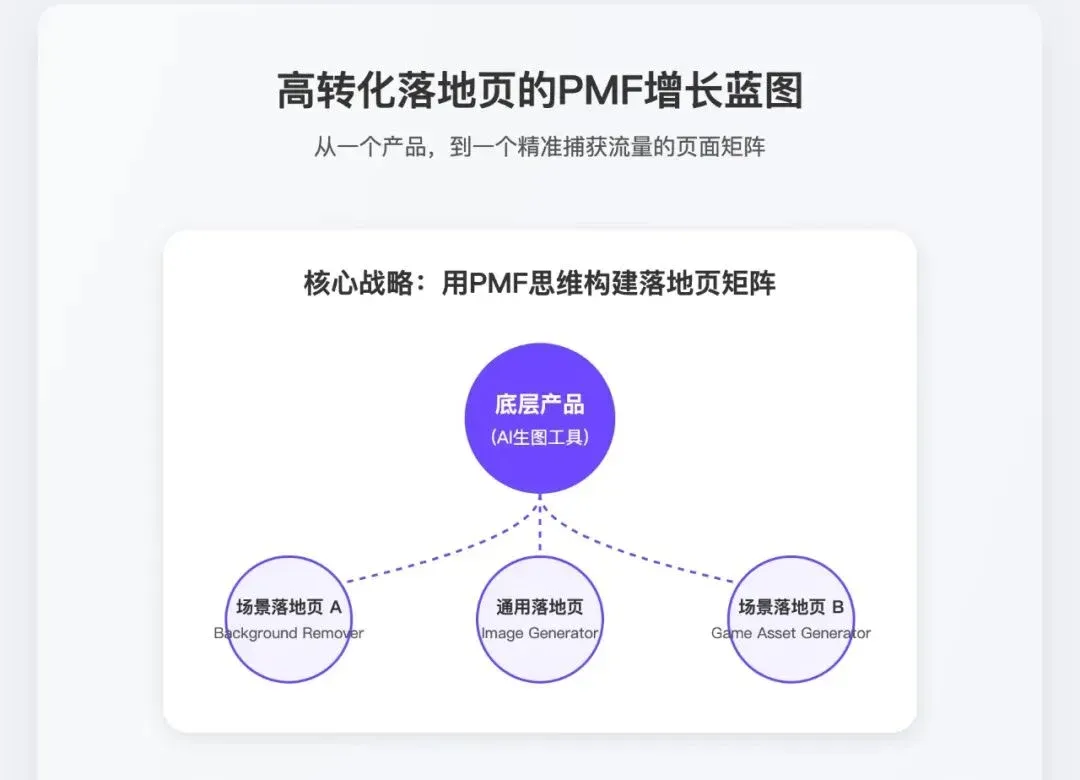
See the key? The underlying product unchanged, but by creating multiple precise “value slices,” we perfectly match product features to users’ real needs and intents at the moment of search. This not only captures broader, more precise long-tail traffic, but delivers conversion rates several times higher than generic pages due to ultra-high relevance.
Chapter 3: Structure — The “Nine-Section Golden Structure” of High-Converting Landing Pages
Regardless of scenario, the internal persuasion logic is shared. Here’s a validated “nine-section” golden structure you can use as the blueprint for all your landing pages.
-
Hero Section: First screen. Must communicate in 3 seconds with a precise H1 (matching target keyword), a powerful value proposition, and a clear CTA that says “you’ve come to the right place.”
-
Problem: Immediately describe the pain users are experiencing — create “yes, that’s me” resonance.
-
Solution: Present your solution, painting the “ideal destination” without pain.
-
How it Works: Use simple 3-4 steps to show how your product works — eliminate doubt and uncertainty.
-
Social Proof: Display client logos, user reviews, media coverage, or key data — let others vouch for you.
-
Features & Benefits: Translate core feature points one by one into specific user benefits.
-
Pricing: Show pricing clearly and transparently — remove decision barriers.
-
FAQ: Pre-answer users’ final lingering questions before purchase.
-
Final CTA: Give one more powerful call-to-action at page bottom for the final conversion push.
Chapter 4: Copywriting Framework — The “PAS Formula” Designed for Developers
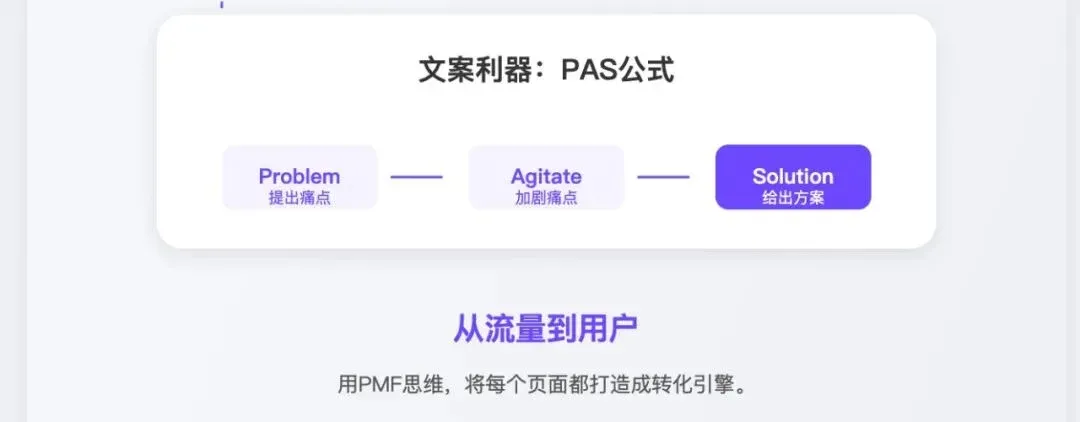
For those of us not naturally gifted writers, a good formula is productivity. The PAS (Problem-Agitate-Solution) formula is simple, powerful, and perfect for filling the core modules above.
Using “AI Singer” as example, here’s how to apply it:
-
P (Problem): “Want to make a high-quality demo for your new song but can’t find the right singer, or budget is tight?”
-
A (Agitate): “The project stalls, inspiration fades. Every delay takes you further from your music dream.”
-
S (Solution): “Now with AI Singer, you can generate professional-quality vocals for any melody in minutes. No more waiting, no more compromising — let your music be heard now.”
Apply this formula flexibly in hero sections, problem presentations, feature introductions, and more — it helps you stay focused on users’ core needs.
Chapter 5: Psychological Nudges — 6 “Devil in the Details” Persuasion Boosters
On a solid structure and copy foundation, subtle psychological techniques deliver outsized results. Here are 6 “boosters” you can use immediately:
-
Social Proof: “Already used by over 10,000 musicians.”
-
Authority: “Featured by TechCrunch.”
-
Scarcity: “First 100 registrants get lifetime 20% discount.”
-
Commitment & Consistency: Offer a free trial — let users take that first small step.
-
Liking: Use real, friendly user avatars and reviews.
-
Reciprocity: Before registration, provide a free, valuable small tool or resource.
Chapter 6: The Art of Action — Designing Irresistible CTAs
CTAs are the final kick for all your efforts. A good CTA must excel in these areas:
-
Copy should be specific and benefit-oriented: “Start Creating Free” beats “Submit.”
-
Visuals must stand out: Use colors that contrast sharply with the page’s main color scheme.
-
Reduce action friction: Add a line of small text below the button to dispel doubts, like “No credit card required” or “Cancel anytime.”
Conclusion & Preview: When One Page Becomes a Thousand
Today we completed a mindset leap from SEO to product growth. Through the PMF lens, we learned to deconstruct one product into a powerful “landing page matrix” that precisely captures different user intents. Through structure, copywriting, and psychology combined, we mastered making every page an efficient conversion machine.
We’ve learned to craft a high-converting “single point.” But the real growth magic lies in scaling. How do you replicate this “single point” capability at minimal cost into hundreds or thousands of pages, covering massive niche traffic you’ve never even considered?
In the next chapter — the final chapter of our “content production trilogy” — we enter a marvelous realm that’s enabled exponential growth for many indie developers: Programmatic SEO and template page construction. Stay tuned.
Found this insightful? Follow my channel to explore AI, going global, and digital marketing’s infinite possibilities together.
🌌 The best product isn’t the one with the most features — it’s the one that best understands what users are crying out for in their specific scenario.
