
GEO Visibility · 2025
How to Scientifically Measure Brand AI Visibility (Or Brand Mention Rate) in the GEO Era

Dual Track: Blue Links vs AI Direct Answers — Is Your Brand Mentioned?
A Quick Note
Kant discussed “phenomena” versus “things-in-themselves” in Critique of Pure Reason. In today’s search landscape, we’re facing a similar duality: Traditional SERP (Search Results Page) is the “phenomenon” — users see links, click, and synthesize information themselves; AI’s direct answer (Zero-click Answer) attempts to approach the “thing-in-itself” — trying to give the essential answer directly, skipping intermediaries.
Many content creators love shouting “SEO is dead” — that’s not only inaccurate, it’s lazy. Google still controls billions of traffic distributions globally; “ten blue links” remain commercial traffic’s bedrock.
But we must acknowledge an objective fact: User information-seeking behavior is stratifying.
- Fact A
: For navigational and simple informational searches, Google remains king.
- Fact B
: For decision-making, comparison, and solution searches (i.e., highest-value High-Intent Queries), more users are turning to ChatGPT, Perplexity, or Google AI Overviews.
In this new stratification, traditional Ranking metrics partially fail. You might rank #1 on Google but not exist in ChatGPT’s recommendation list.
Today’s article creates no anxiety — it just solves one engineering problem: In this dual-track era, how do we quantify and manage brand “Visibility” on the AI side?
01 The Phenomenon’s Essence: Traffic “Stratification” and Pre-Positioned Decisions
My last article In the GEO (ASO) Era, Make “Being Mentioned” Your Growth Strategy discussed making mention rate a brand marketing goal. This article covers how to scientifically evaluate this metric. After all, no metrics, no accountability.
First, we need to update our understanding of “search.”
In the traditional model, user decisions happened on your Landing Page.
In the AI model, user decisions are pre-positioned to the AI’s answer box.
A SaaS example:
User asks: “Best project management tool for creative agencies.”
Old World: User opens Google -> clicks top 3 links (probably Asana, Monday, ClickUp blogs or review sites) -> reads -> compares -> decides. New World: User asks AI -> AI synthesizes all web info, outputs a Summary, lists Top 3 recommendations with reasons -> User searches specific brands from this list or visits directly.
Key point: If your brand doesn’t appear in that AI-generated Summary, you’ve lost qualification to enter the user’s “Shortlist.” No matter how good your website is, you’re invisible in this scenario.
This is why we need a new North Star metric: Brand Visibility. It doesn’t replace ranking — it supplements it, measuring brand penetration in the “pre-positioned decision” phase.
02 Core Framework: Brand Visibility Score (BVS) Calculation Deep Dive
As a data-driven growth person, what can’t be quantified can’t be managed.
Brand Visibility Score (BVS) is currently the industry-recognized measurement standard. It reflects the probability of your brand being “mentioned” and “recommended” in a specific set of high-intent queries.
Calculation Formula: BVS = (Answers Mentioning Your Brand / Total Answered Queries) × 100%
Scenario Simulation: Suppose your product is an “Online Whiteboard Tool.”
-
You compile 50 core questions users might ask (like “Miro alternatives”, “Best whiteboard for remote teams”, “Free online whiteboard comparison”).
-
You input these 50 questions into ChatGPT, Gemini, Perplexity, and Google AI Overview.
-
Results: In 50 answers, your product was mentioned 15 times.
-
BVS = (15 / 50) × 100% = 30%
.
This means in 30% of high-intent conversation scenarios, your brand entered user awareness.
Advanced Dimensions: Beyond Just “Mentioned” For teams pursuing refined operations, just looking at BVS is too crude. Break out three sub-metrics:
- Citation Rate:
Did AI just name-drop, or provide footnotes/source hyperlinks? Citations with links = high-quality backlinks + trust endorsement + potential referral traffic.
- Share of Voice (SOV):
How much space in the answer? Are you the “top recommendation” with detailed intro, or buried in “Others” with one line? Formula: Answers mentioning your brand ÷ Total answers mentioning your brand or competitors.
- Sentiment:
Use NLP to check if evaluation is Positive / Neutral / Negative. Beware “negative visibility”: High BVS but tagged with “steep learning curve” or “slow customer service” kills conversions.

BVS Formula and Example
03 Practical Guide: Building Your “Visibility” Observatory
We’re moving from “gut-feel SEO” to “data-driven GEO (Generative Engine Optimization).” Here’s a phased implementation:
Phase 1: Establish Baseline (The Manual Audit) — Early exploration, low cost; Tools: Excel / Google Sheets. Don’t buy expensive SaaS immediately — build intuition first.
- Build Query Set:
Look beyond Head Keywords — dig for long-tail questions. Sources: Sales FAQs, GSC Query reports, Reddit/Quora hot questions. Keep complete question structures simulating conversation, like “How to evaluate [Your Category]?”
- Manual Sampling:
Every Friday, pick Top 20 high-value questions, manually run through major AI engines. Record: platform, was mentioned, was cited, which competitors appeared. My Insight: This phase focuses on sensing AI answer logic — which questions get fixed answers, which are random (Hallucination).
Phase 2: Automated Monitoring (The Automated Stack) — Scaled monitoring; Tools: Semrush, AirOps, custom scripts.
- Semrush AI SEO Toolkit:
Automatically runs baselines and outputs Visibility comparison charts vs. competitors — great for B2B management presentations.
- AirOps (or other Workflow platforms):
Build flows: Send Prompt → Capture answer → Use GPT-4o to analyze mentions and sentiment → Write to spreadsheet, forming automated intelligence collection.
04 Black Box Patterns: What Data Tells Us AI Loves
Based on Semrush and other test data, GEO differs significantly from traditional SEO: extreme preference for freshness and structure.
1. Freshness is the New “Backlink”
- Pages updated in the past 12 months get cited 2x more than outdated ones.
- 60% of commercial query citations come from content published in the last 6 months. Logic: LLMs have knowledge cutoffs and hallucinations; RAG prioritizes latest-timestamped information. Old product pages are considered potentially outdated.
2. Structure for Machines
- List-structured URLs get cited by ChatGPT 17x more often.
- Pages with Schema deployment get 13% higher citation rates. Conclusion: Write for humans, but also for machine extraction.
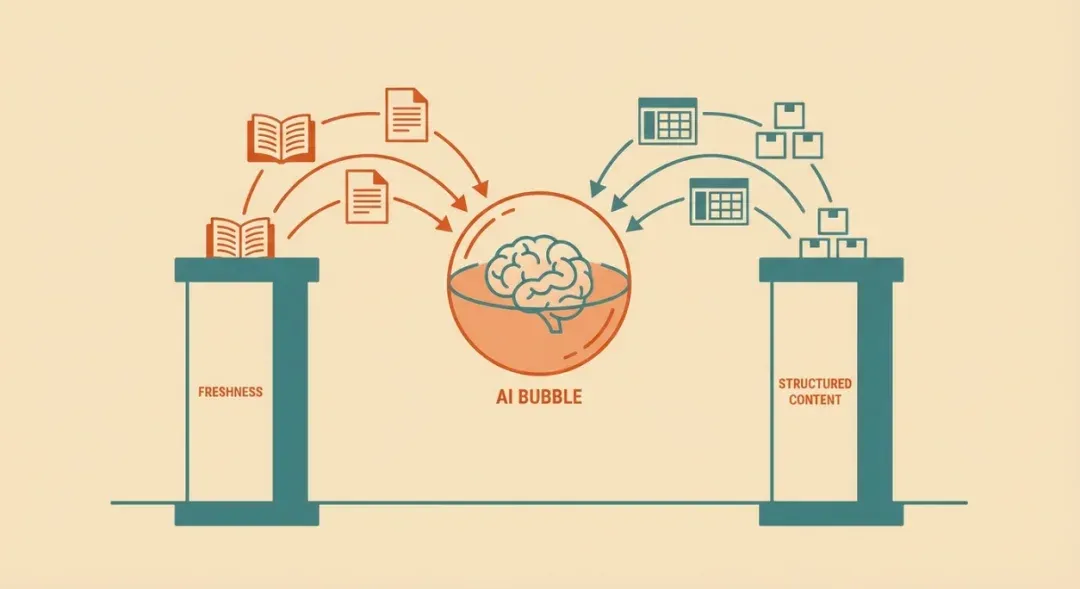
Freshness + Structure Makes AI More Willing to Cite
05 Action Checklist: 90-Day Optimization Roadmap for Developers
Rather than anxiety, break it into todos.
Month 1: Audit & Infrastructure
-
Build BVS Dashboard: Define Top 30 core questions, run manual baseline, calculate initial BVS.
-
Schema Audit: Use Rich Results Test to check Product / Pricing / FAQ pages for JSON-LD.
-
Competitive Recon: See which competitors appear in AI answers, study their page structures and comparison tables.
Month 2: Content Restructuring (The Great Refresh)
-
Content Freshness: Pick your 10 highest-traffic articles, update data/cases/year references, explicitly show update timestamps.
-
Structural Overhaul: Break long paragraphs into bullets; add Key Takeaways; add Pros & Cons comparison tables.
-
FAQ Placement: Turn Phase 1 long-tail questions into Q&A modules to feed AI.
Month 3: Verify & Compound
-
BVS Retest: Re-run Top 30, check mention/citation rate changes.
-
Attribution Analysis: Check GA4/Mixpanel for chatgpt.com, perplexity.ai traffic or Direct anomalies.
-
Sentiment Optimization: If negative, publish PR/technical blogs to correct, let AI read new content to revise old weights.

90-Day Loop: Audit → Restructure → Verify
Conclusion: Finding Order in the Chaos of Change
Objectively speaking, we’re in a “dual-track parallel” transition period. Ranking isn’t dead — it’s still the main battleground for existing competition; but Visibility represents the future of new competition.
Schopenhauer said: “Change is eternal, and our attitude toward change determines our freedom.”
For product and operations people, the most dangerous state isn’t “no traffic” — it’s “not understanding where traffic comes from or where it goes.”
By establishing a Brand Visibility measurement system, we’re essentially rebuilding order amid chaotic AI transformation. Don’t abandon SEO — just add another eye watching the future on top of your SEO foundation.
Stay rational, respect data, then optimize for the “reality” that machines can read.
Recommended Reading:
Content Chunking Strategy: Making UX, SEO Rankings, and AI Visibility Take Off Together
