
Word count: ~2200 words
Estimated reading time: ~8 minutes
Last updated: October 14, 2025
Introduction: A Truth That Should Send Chills Down Your Spine
Hey, I’m Mr. Guo.
The past two years, we’ve embraced AI with near-religious fervor. We marveled at its astonishing efficiency, using it to write, code, brainstorm… We seemed to be entering an unprecedented era of intellectual liberation.
But, late at night, when you close ChatGPT and try to recall that just-generated, seemingly perfect report — have you ever felt a moment of confusion: “What… did we just discuss?”
This “use and forget” feeling, many attribute to fatigue or information overload. But what if I told you this might not be an illusion, but a quantifiable weakening of neural connections happening in your brain? Before, this was just an unsettling hypothesis. But now, MIT Media Lab scientists have provided chilling brainwave evidence for this hypothesis for the first time.
1. Crime Scene Reconstruction — MIT’s “Cognitive Debt” Experiment
Before dropping bombshell conclusions, we must examine the crime scene like detectives.
- Information Source: Research report from MIT Media Lab’s Nataliya Kosmyna team, submitted to arXiv in June 2025 (ID: 2506.08872). The original is quite long — 206 pages. Those interested can chew through the paper themselves.
-
Core Motivation: Verify whether “outsourcing” thinking and writing to AI requires paying a hidden, long-term “cognitive interest” — namely “Cognitive Debt.”
-
Group Competition: 54 college students divided into three groups writing essays: Brain-only group, Search Engine group, and AI-assisted group (LLM, using GPT-4o).
-
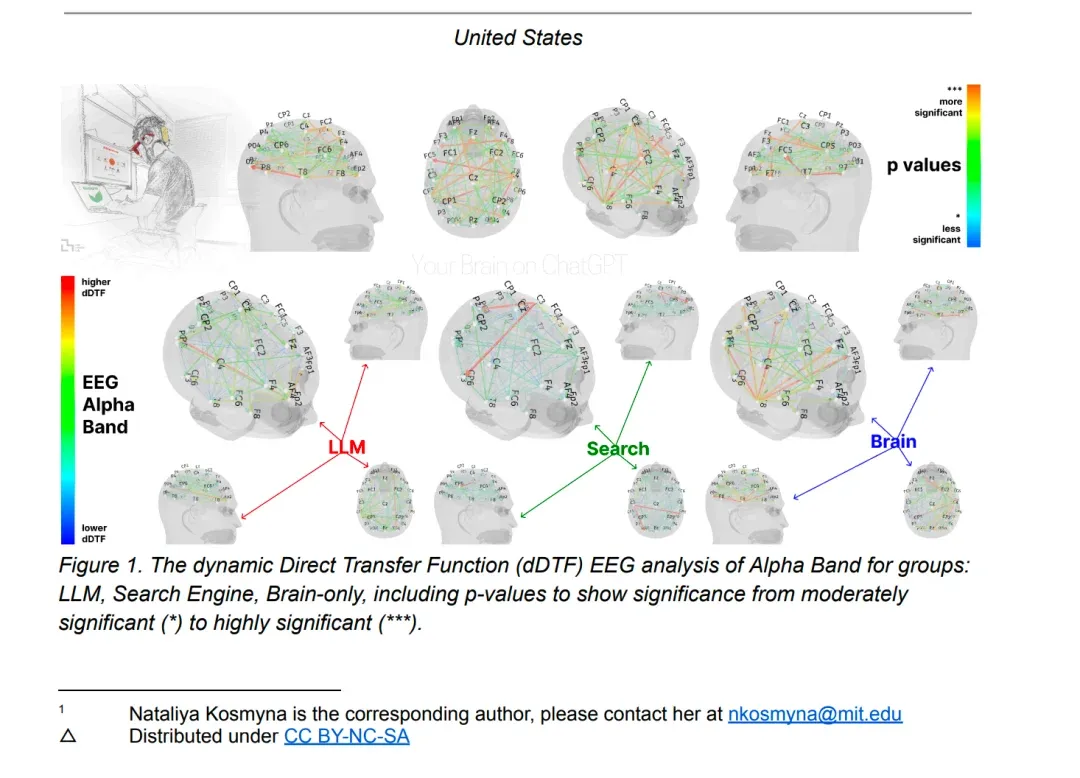
Measurement Method: Wearing 32-channel EEG (electroencephalogram) equipment, real-time recording network connection strength of α and β waves responsible for higher cognition — think of it as measuring how busy your brain’s “thinking highway” is.
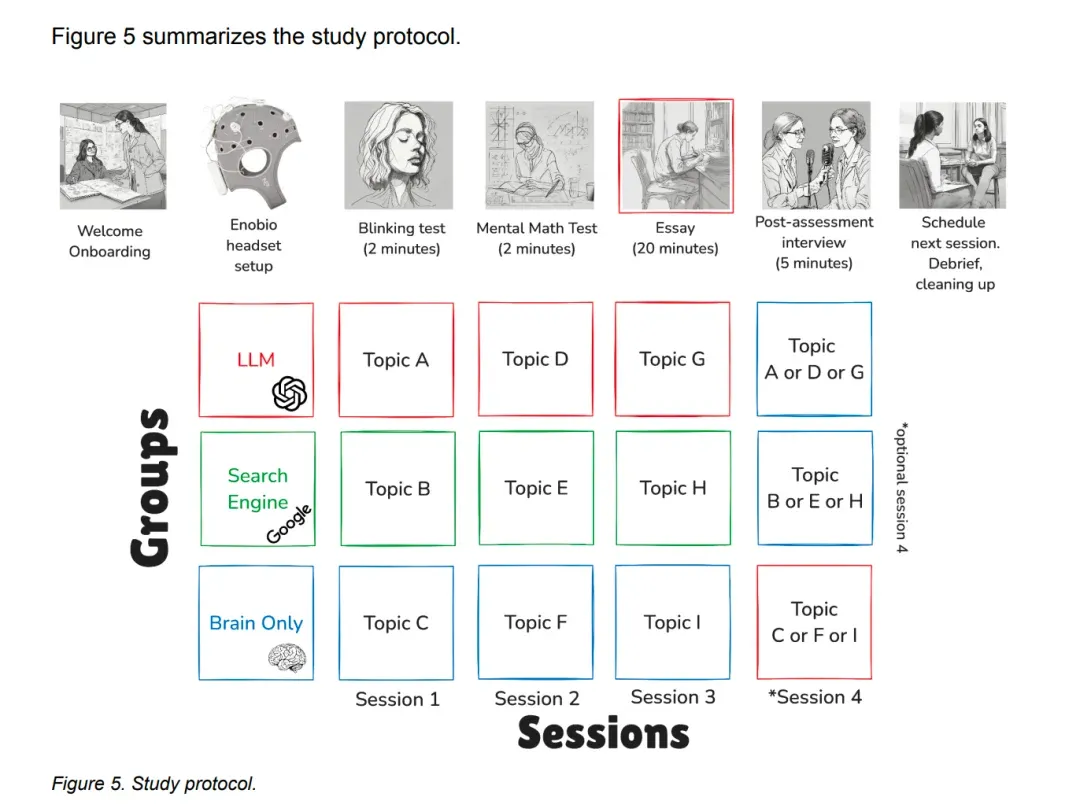
The key step was an “identity swap”: having some AI group members switch back to brain-only mode (LLM→Brain), and some brain-only members start using AI (Brain→LLM). This swap revealed the most shocking results.
2. Iron-Clad Evidence — Three Manifestations of “Cognitive Downgrade”
Evidence 1: Brain’s “Thinking Highway” Abandoned
EEG data shows clear brain neural connection strength “hierarchy”: Brain-only group > Search Engine group > AI-assisted group. Compared to pure self-thinking, when using AI assistance, the “highway traffic” responsible for critical thinking and creative connection plummeted by nearly 83%!
Evidence 2: “Cognitive Hangover” Effect — Brain Short-Term “Strike” After Leaving AI
The most terrifying result: when people accustomed to AI were suddenly “weaned off” and required to write independently, their brain’s neural connection strength didn’t return to normal levels, but was significantly lower than the brain-only group. It’s like someone who’s been in a wheelchair long-term suddenly asked to run — muscles no longer obey.
Evidence 3: “AI Amnesia” and “Soul Stripping”
Behavioral data also supports this: a whopping 83% of AI group members wrote and forgot, unable to recall core content (under 10% for brain-only group). Meanwhile, their articles showed lower originality, and they generally felt like just an “editor,” not a “creator.”
3. Brain Fitness Guide — The “Self-Rescue” Easter Egg Hidden in MIT Report
Reading this far, you might feel panic. But this research’s most valuable aspect is that it doesn’t just reveal problems — it hid the “antidote” in the data — that Brain→LLM group’s “easter egg.” The study found that when those who first engaged in independent thinking started using AI, their brain’s neural connections not only didn’t weaken, but actually strengthened!
This means AI’s impact on your brain completely depends on “how you use it.” Based on this, I’ve distilled a “Brain Fitness Guide for the AI Era” derived from MIT experiment essence.
Rule 1: The “Rough Draft First” Rule
When facing any complex cognitive task, force yourself to first do AI-free independent thinking, outputting a first draft “rough version” even if crude. This process forces your brain to take that “hiking up the mountain” path. After completing this 0-to-1 process, then hand the “rough version” to AI for optimization.
Rule 2: The “Role-Play” Rule
Redefine your relationship with AI. It shouldn’t be your “ghostwriter,” but should play your “Socratic sparring partner” (constantly questioning), “learned librarian” (precise information queries), or “top-tier text editor” (polishing after you finish).
Rule 3: The “Active Recall” Rule
The most effective method against “AI amnesia.” After completing work with AI, immediately close the dialog box, then use your own words to recall the core conclusions, logic, and information. This simple action forces your brain to actively encode and internalize passively received information, forming real memory.
4. Future Paradigm — “Think First, AI Second,” The Only Correct Posture for Next-Gen Human-Machine Collaboration
MIT’s research significance extends far beyond personal “self-rescue.” It actually defines the only correct paradigm for next-generation human-machine collaboration — “Human-First, AI-Second.”
This paradigm will profoundly reshape our future: from educational system transformation (focus shifting from “using AI” to “independent thinking in AI’s presence”), to product design pivots (truly responsible AI products perhaps should have built-in “forced independent conception” mechanisms). Just as car invention ultimately taught us how to “drive” rather than making us forget how to “walk” — what we need to do now is establish safe, sustainable “driving rules” for this overpowered “supercar” called AI.
Conclusion: Beware the “Cognitive Cable Car,” Rediscover the Joy of “Hiking Up the Mountain”
Before closing, we must objectively acknowledge this research’s limitations: small sample size, only tested one model (GPT-4o), single task scenario, etc. But this doesn’t diminish its pioneering value as a “whistleblower.”
It uses scientific language to clearly tell us for the first time: AI is a “cognitive cable car” to the mountaintop — efficient, convenient, but also making us miss scenery along the way while our legs gradually atrophy. Ultimately, our choice isn’t to tear down the cable car, but to learn how to, while enjoying cable car convenience, still occasionally shoulder our packs and personally walk that path — though more tiring, it makes our hearts race and muscles tense. Because every gasp and thought on that path is what truly shapes us, defines us, and makes us irreplaceable.
Found Mr. Guo’s analysis insightful? Drop a 👍 and share with more friends who need it!
Follow my channel to explore AI, going global, and digital marketing’s infinite possibilities together.
