
Word count: ~4100 words
Estimated reading time: ~13 minutes
Last updated: July 22, 2025
Is this article for you?
-
If you’ve completed SEO strategic planning but feel overwhelmed at the “execution” stage.
-
If you want to break free from “inspiration-driven” writing and build a repeatable, scalable content production process.
-
If you’re interested in AI writing but want to use it responsibly and effectively, not create garbage content.
Chapter Contents
-
Preface: From “Content Laborer” to “Content Architect”
-
Chapter 1: Strategic Reconnaissance — Decoding “User Intent” and “Content Format” Behind Keywords
-
Chapter 2: Deep Dissection — Reverse Engineering the Winning Formula of SERP Page One
-
Chapter 3: Blueprint Design — Injecting “Information Gain” and Building a Solid Outline
-
Chapter 4: Content Alchemy — From First Draft to the Art of Marketing Integration
-
Chapter 5: Page Enrichment — Internal Links, Media, and Structured Data’s Finishing Touches
-
Chapter 6: Final Review — Pre-Launch SEO Checklist
-
Chapter 7: AI Empowerment — “Progressive Depth” to Accelerate Your Workflow
-
Conclusion & Preview: From “Traffic Magnet” to “Conversion Core”
Preface: From “Content Laborer” to “Content Architect”
Hey, I’m Mr. Guo. In the previous three articles, we built foundational SEO cognition together, learned to craft content strategy, and even planned our site’s “content moat.” The blueprint is crystal clear, but a more serious challenge awaits: Execution.
Many developers fall into the “content treadmill” trap: writing hard every day, yet feeling like it’s never enough. Content output becomes a heavy burden, with quality and quantity hard to balance. This is essentially a “handicraft workshop” model with obvious efficiency ceilings.
This article’s purpose is to help you complete an identity transformation — from a passive “content laborer” to an active “content architect” who designs and directs the entire process. We’ll establish a rigorous, repeatable, human-intelligence-centered systematic production SOP. Then we’ll explore how to precisely inject AI, this powerful tool, into every stage of this system.
Remember: AI cannot amplify a chaotic process — it only amplifies excellent systems. Let’s first build this system.
Chapter 1: Strategic Reconnaissance — Decoding “User Intent” and “Content Format”
A high-quality SEO article begins not with opening a blank document to write, but with opening Google for “strategic reconnaissance.” When you select a core keyword from your content map (e.g., “AI video generator”), your first action should be: Search it in Google’s incognito mode.
This reconnaissance’s core mission is decoding two crucial pieces of intelligence:
-
Decode User Intent (Search Intent): When users type this term, what do they actually want? To understand “what AI video generators are” (informational)? To find “the best AI video generators” (commercial investigation)? Or to directly “try an AI video generator online free” (transactional)? Observing search result titles and descriptions quickly reveals the dominant user intent.
-
Decode Content Format: Google uses actual “rankings” to tell us what content format best satisfies this intent. Are top results “Top 10 Tools” listicles? “Step-by-step tutorial” guides? Deep technical principle analyses? Individual tool reviews? This observation directly determines your article’s genre.
Plan before action. Thirty minutes spent here is far more valuable than three hours of blind writing. It ensures your effort starts in the right direction.
Chapter 2: Deep Dissection — Reverse Engineering SERP Page One’s Winning Formula
After clarifying dominant intent and content format, the next step is dissecting page-one success cases like precision instruments through reverse engineering. Our goal: answer “Why did they win?”
A crucial principle: Don’t just stare at #1, especially if it’s from giants like Forbes or Wikipedia. Much of their ranking comes from unparalleled Domain Authority. We should pay special attention to “dark horse” sites with low domain authority but still ranking near the top. They’re our best models, because their success is built almost entirely on exceptional content and page experience.
Systematically dissect from these dimensions:
-
Article Structure: How are H2, H3 headings organized? Is the logic clear? Does it provide a “summary” or “key points” at the beginning?
-
E-E-A-T Signals: Who’s the author? Is their professional background displayed? Does the article cite authoritative data or first-hand experience screenshots?
-
Content Depth and Breadth: Approximately how many words? What subtopics does it cover? Does it answer “People Also Ask” questions?
-
Multimedia Use: Are there original images, charts, or embedded tutorial videos enhancing understanding?
-
Readability and Interactivity: Is the layout clean? Are paragraphs short? Are there tables, blockquotes, or FAQ sections?
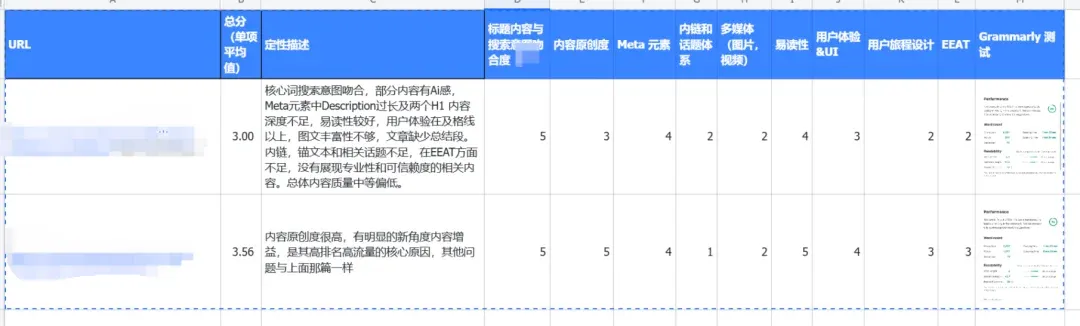
(Above image is a scoring sheet I once used for content analysis)
Chapter 3: Blueprint Design — Injecting “Information Gain” and Building a Solid Outline
With reverse engineering complete, you have a “competitive analysis report.” Now we enter blueprint design. Our goal isn’t imitation but transcendence. The core concept here is “Information Gain.”
Simply put, your article must provide “new information value” for all existing content already on SERP page one. You must answer: “After reading all existing articles, what questions remain unanswered for users? What pain points aren’t addressed? What can I provide?”
Several effective ways to achieve Information Gain:
-
Provide deeper insights or unique perspectives. For example, when others evaluate features, you evaluate from a “workflow efficiency” angle.
-
Share unreplicatable first-hand experience. Share your real project process using these tools, pitfalls encountered, and lessons learned.
-
Create entirely new data or visual assets. Make a clear comparison table, or a summary diagram (like the Silo structure diagram we discussed earlier).
-
Provide stronger timeliness. Include reviews of latest software versions, or cite the newest industry report data.
Based on your Information Gain thinking, now build your article’s final outline. This outline should be logically clear, containing all planned H2 and H3 headings, with key sections marked where you’ll inject “information gain.”
For deeper Information Gain knowledge, read:
[Indie Developer SEO Handbook (Bonus): Information Gain Practical Guide]
Chapter 4: Content Alchemy — From First Draft to Marketing Integration Art
With a solid outline, writing becomes “content alchemy” — transforming thoughts and materials into clear, flowing, valuable text.
At this stage, beyond basic writing skills (short paragraphs, clear headings), I want to emphasize the art of content marketing integration. Especially for new sites, excessive, awkward selling is fatal. Like an excellent teacher, naturally introduce your tool while imparting knowledge.
”Help, Don’t Sell” Principle
Wrong approach: “Our AI video generator is the best on the market — buy now!”
Right approach: “When adding subtitles to videos, you can do it manually, but the process is tedious. In this case, we used our product [Your Product Name] to auto-generate and align subtitles, saving about 30 minutes. If you want to try, visit [link]. Of course, you can also use [another free tool], just requires more manual adjustment.”
This “provide solutions, not product pitches” writing style demonstrates your product’s actual value while maintaining objective neutrality — tremendously building user trust.
Chapter 5: Page Enrichment — Internal Links, Media, and Structured Data’s Finishing Touches
The first draft is complete, but work isn’t finished. Now we “renovate” this “rough house” — page enrichment. This not only improves user experience but is key to sending more positive signals to Google.
-
Internal Links: Following the Silo structure from article three, strategically link this article to related pillar pages or cluster content.
-
Media Content: Add high-quality images or hand-drawn charts. Ensure all images are compressed and have descriptive Alt text. If suitable, embed a short tutorial video to greatly increase page dwell time.
-
Structured Data (Schema): Add
ArticleSchema; if there are Q&As, addFAQPageSchema. This helps Google better understand your content and potentially earn “rich snippets” display in search results, improving click-through rates.
Chapter 6: Final Review — Pre-Launch SEO Checklist
One last-minute comprehensive check before clicking “Publish” separates professional from amateur. Here’s a minimal Checklist:
-
Does the Title contain the core keyword and stay under 60 characters?
-
Is the Meta Description compelling, naturally incorporating keywords?
-
Is the URL short, clear, containing the core keyword?
-
Is there only one H1 tag?
-
Do all images have descriptive Alt text?
-
Are there at least 2-3 relevant internal links?
-
Is there at least 1 authoritative external link?
-
Does the mobile preview show friendly layout?
Also providing a comprehensive On-Page SEO Checklist for reference. See: [Indie Developer SEO Handbook (Bonus): On-Page SEO Ultimate Checklist]
Chapter 7: AI Empowerment — “Progressive Depth” to Accelerate Your Workflow
Now we have a rigorous, complete manual workflow. Time to discuss making AI a “turbocharger” for this process. Please follow the “progressive depth” principle — don’t rush it.
Basic Assistance (AI as Personal Assistant)
This is the safest, most efficient starting point. Ask AI for help anytime during writing:
-
“Give me 10 attractive titles for this article.”
-
“This sentence is awkward, rewrite it more concisely.”
-
“Provide a vivid metaphor for ‘Information Gain.’”
Intermediate Assistance (AI as Research Analyst)
Once you’ve mastered prompting, have AI handle more complex work:
-
Chapter 2: Feed competitor article links or text to AI, ask it to “summarize core points, structure, and E-E-A-T signals from the following articles.”
-
Chapter 3: Feed your research results and “Information Gain” thinking, “Please create a detailed article outline about [topic] that includes [your unique perspectives].”
-
Chapter 4: Use segmented generation, “Please write the content first draft for ‘[Chapter Title]’ section based on this outline and key points.”
Advanced Application (AI as Automated Agent)
This is content production’s future direction, requiring deeper technical and prompt engineering skills. It means building or using specialized agent applications to automate multiple SOP stages. For example:
-
Automated Research Analysis Agent: Input a keyword, automatically complete SERP analysis and output structured report.
-
Automated Outline Generation Agent: Automatically complete research and combine your “Information Gain” points to generate final outlines.
-
Automated Content Enrichment Agent: After draft generation, automatically recommend or generate images, add internal links, write Schema code.
This requires deep knowledge base construction and workflow integration. For beginners, direct attempts easily lead to frustration. Therefore, these advanced techniques will be systematically deconstructed and practiced in our “Advanced Series.” For now, understanding the possibilities and mastering intermediate assistance skills is enough to multiply your efficiency.
Conclusion & Preview: From “Traffic Magnet” to “Conversion Core”
Schopenhauer believed style is “the physiognomy of thought.” The SOP we’ve built today shapes your content’s “physiognomy” — ensuring logical clarity, exceptional value, and professional details. This human-intelligence-centered system is your power source as “content architect.” AI is the amplifier executing your will efficiently.
We’ve now mastered how to scalably produce blog articles as “traffic magnets,” bringing continuous awareness traffic to the site. But traffic itself isn’t the goal — business closure requires conversion.
Therefore, in the next chapter, we shift focus from traffic-attracting “magnets” to conversion-driving “cores” — How to write high-converting SaaS product landing page copy, efficiently converting hard-won visitors into loyal product users.
Found this insightful? Follow my channel to explore AI, going global, and digital marketing’s infinite possibilities together.
🌌 An excellent system lets ordinary people achieve extraordinary results. And AI lets excellent systems create incredible miracles.
