
Word count: ~2900 words
Estimated reading time: ~10 minutes
Last updated: July 21, 2025
Is this article for you?
-
If you want to know what SEO experts actually analyze before writing.
-
If you want to learn a systematic method for crafting “winning” content strategies.
-
If you want to move beyond blind worship of “domain authority” and learn to find opportunities in the content itself.
Chapter Contents
-
Preface: From Imitation to Transcendence — SERP Analysis’s Strategic Value
-
Chapter 1: Core Mindset — From “Imitator” to “Reverse Engineer”
-
Chapter 2: Starting Point — Decoding Search Intent Through SERP Composition
-
Chapter 3: Core Framework (Part 1) — Deep E-E-A-T Evaluation
-
Chapter 4: Core Framework (Part 2) — Comprehensive Content Quality and Page Experience Analysis
-
Chapter 5: Advanced Analysis — Finding Optimization Opportunities in Quantitative Metrics
-
Conclusion: From Analysis to Strategy — Crafting Your Content Action Plan
Preface: From Imitation to Transcendence — SERP Analysis’s Strategic Value
Hey, I’m Mr. Guo. A common misconception is that SEO success begins the moment you start writing. But the truth is, a top-tier SEO article’s fate is largely sealed before the author types a single word.
The key to success lies in a seemingly dull but critically important task: SERP (Search Engine Results Page) Competitive Analysis. Think of a top chef who, before creating a new dish, first tastes all the best similar dishes in town. Not to copy recipes, but to understand diners’ tastes, ingredient combinations, and where innovation can surpass the competition.
This bonus article provides a systematic “tasting” methodology. We’ll learn how to scientifically analyze SERPs, shifting from an imitator mindset to a transcender mindset. Master this SOP, and you’ll learn to pre-set victory trajectories for your articles before writing a single word.
Chapter 1: Core Mindset — From “Imitator” to “Reverse Engineer”
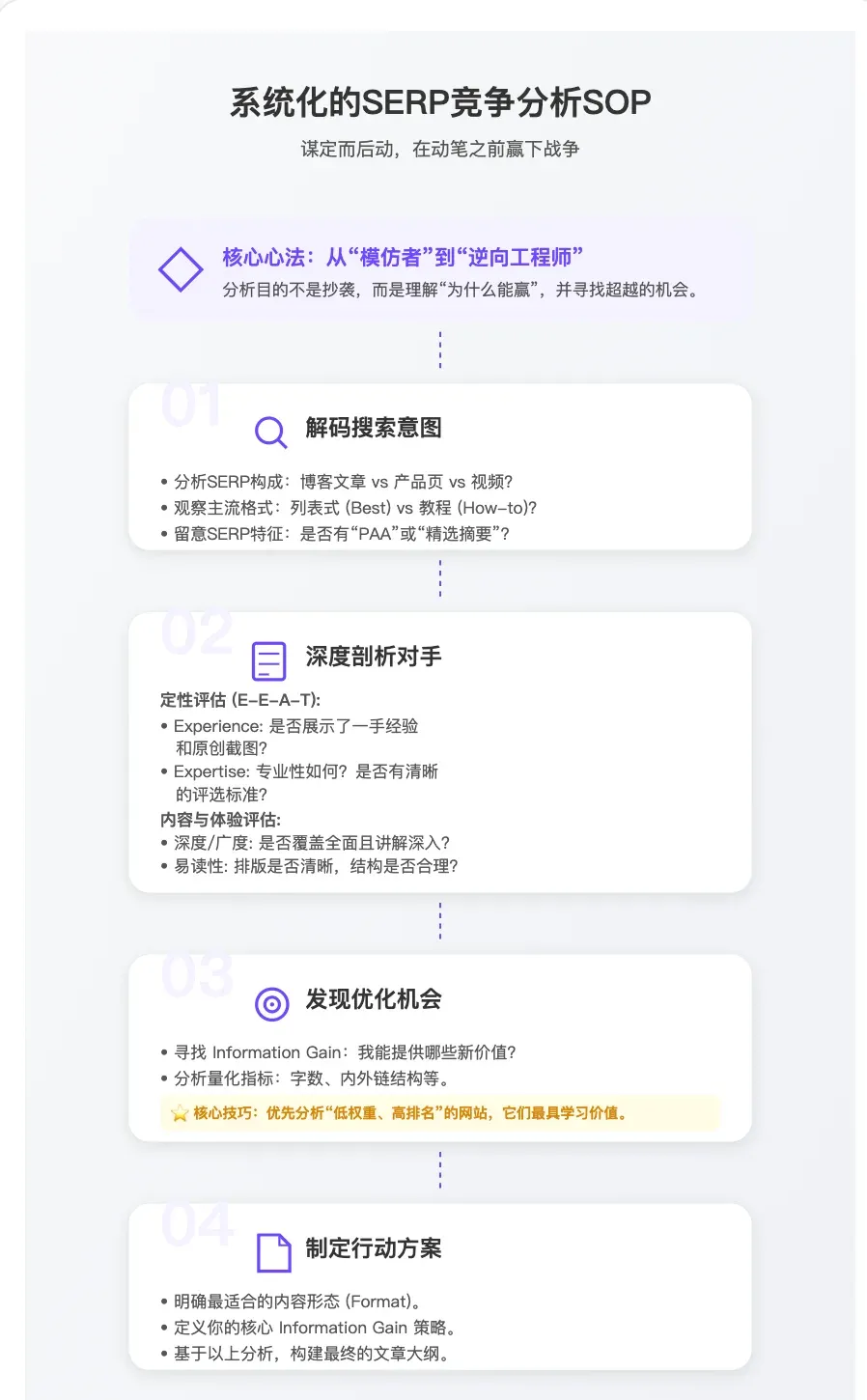
Before learning specific methods, we must undergo a crucial mindset upgrade. The low-level goal of SERP analysis is “imitation” — “see what others wrote, write the same.” The advanced goal is “reverse engineering” — “understand why Google rewards these pages, then create something more deserving of reward.”
This means breaking free from obsession with “domain authority.” When seeing a high-authority site ranking well, our reaction shouldn’t be “I have no chance,” but “How much of its success comes from content itself versus domain reputation?” Conversely, when you see a low-authority site breaking onto page one, your reaction should be “There’s treasure here!” — because its success is almost 100% due to high-quality content and masterful page optimization.
With a “reverse engineer” mindset, SERP analysis becomes less anxious searching for imitation targets and more calm deconstruction of successful products, seeking design highlights to learn from and surpass.
Chapter 2: Starting Point — Decoding Search Intent Through SERP Composition
All analysis starts with precise intent judgment. The SERP itself is Google’s most authoritative “user intent report.” Observe the results page’s “content composition.”
Open a keyword’s search results and ask yourself:
-
What are the page types? Of the top 10 results, how many are blog articles? Category pages? Product pages? Videos or forums (like Reddit/Quora)? If most are blog articles, write a blog article. If most are listing pages, a deep guide will struggle.
-
What’s the dominant format? Among blog articles, are “Top 10 Best…” listicles dominant? Or “How to…” tutorials? Or “What is…” definition articles? This determines your article format.
-
What SERP features appear? Are there “People Also Ask,” “Featured Snippets,” image packs, or video carousels? Google is explicitly telling you what other dimensions users are interested in — your article must attempt to cover and answer these. Also consider whether a separate article might strengthen topic completeness.
Answering these three questions precisely sets your content’s tone: what type of page, what format, and what core points to cover.
Chapter 3: Core Framework (Part 1) — Deep E-E-A-T Evaluation
After confirming content format, we enter core analysis. First, use E-E-A-T as a scalpel to dissect competitor content. Build a brief evaluation profile for each competitor page.
E-E-A-T Audit Checklist
-
Experience: Does the author demonstrate first-hand experience? Are there descriptions like “I personally tested these 5 tools”? Original screenshots or videos? Does the article read like a real user or someone who just aggregates information?
-
Expertise: Does the article demonstrate knowledge beyond common sense? For “Best” articles, are there clear, reasonable selection criteria? For “How-to” articles, are steps clear, accurate, and reproducible?
-
Authoritativeness: Who is the author? Is there a clear author bio showing credentials and background in this field? Is the site itself focused on this vertical?
-
Trustworthiness: Is the site secure (HTTPS)? Is the design professional? Are claims backed by authoritative external data sources? Are there clear contact information and about pages?
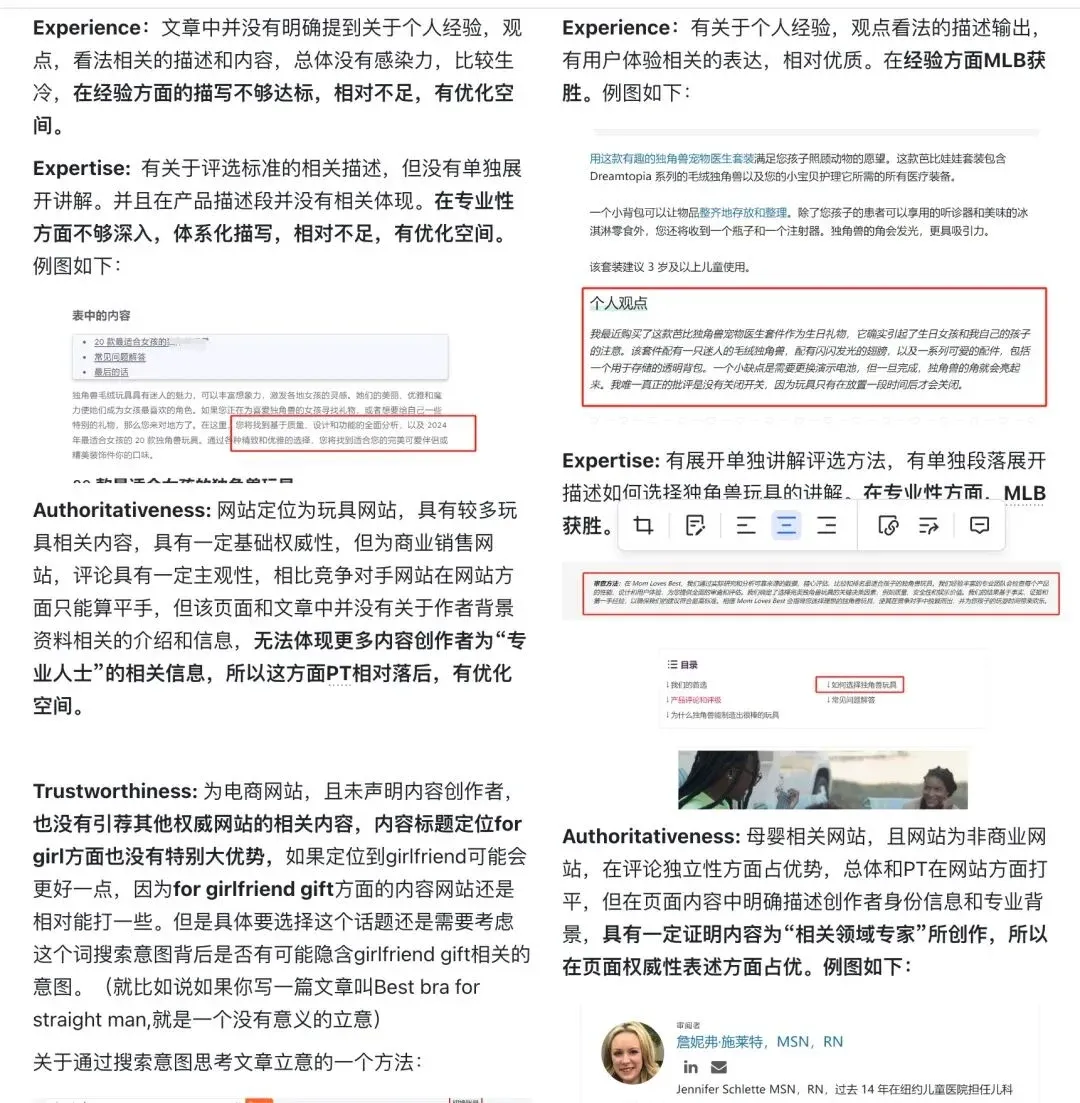
Through this checklist, you can quickly assess that “Site A” might excel in “experience” but has unknown author authority; while “Site B” might have strong expertise discussion but lacks personal experience sharing. These assessments inform your own E-E-A-T optimization strategy.
Chapter 4: Core Framework (Part 2) — Comprehensive Content Quality and Page Experience Analysis
E-E-A-T is the trust foundation; content quality and page experience are core to user satisfaction. Continue evaluating:
Content & Experience Audit Checklist
-
Content Breadth: Does the competitor cover all important subtopics under this theme? Are key “People Also Ask” questions missed?
-
Content Depth: For each subtopic, does it just scratch the surface or dive deep?
-
Information Gain: Does this article provide truly new knowledge? Or just restate known facts?
-
Readability: Is the layout clear? Are paragraphs appropriate length? Are lists, bold text, and blockquotes used effectively to highlight key points?
Through this analysis, you might find “Site A” has clear structure but doesn’t go deep in each section; while “Site B” has diverse perspectives but dense text that’s hard to read. These are your opportunity points — create an article that’s deep, multi-perspective, clearly structured, and easy to read.
Chapter 5: Advanced Analysis — Finding Optimization Opportunities in Quantitative Metrics
After qualitative assessment, examine some quantitative metrics to aid judgment.
-
Content Length (Word Count): Not a decisive factor, but provides reference. If page-one articles average 2000+ words, competing with an 800-word piece will be very difficult. But 3000 words isn’t automatically better — balance information volume with information density.
-
Internal Link Structure: What other pages does the competitor’s article link to? Product pages or other blog articles? This reflects site structure and content strategy.
-
Backlink Strength: Use Ahrefs or Semrush’s free tools to roughly gauge a page’s backlink quantity and quality. This isn’t something we can control initially, but awareness is important.
Re-emphasizing the “beating giants” analysis principle: In all analysis, your primary focus should always be pages that achieved page-one rankings with lower domain authority and fewer backlinks. They’re your best teachers, because they won Google’s favor almost entirely through content and page optimization.
Conclusion: From Analysis to Strategy — Crafting Your Content Action Plan
Analysis’s ultimate purpose is forming a clear action plan. After completing all steps above, you should clearly write:
-
For [core keyword], the most suitable content format is [e.g., listicle].
-
Current SERP competitors generally lack in [e.g., E-E-A-T “experience” dimension].
-
My core Information Gain strategy is [e.g., providing a detailed original case study or user interview based on first-hand experience].
-
Based on this analysis, my article outline will be […].
This document is your final output transitioning from “reverse engineer” to “content architect.” Once complete, writing is no longer blind exploration but precise execution. A skilled content strategist typically completes such high-quality analysis in 15-30 minutes. This SOP is your best path to that goal. In the future, I’ll discuss how to automate and programmatize this work with AI.
Finally, something interesting happened during this article’s creation. For details, see my full record here:
[I Meant to Write an Article, But AI Gave Me an Application: An Unexpected Insight on Human-AI Collaboration]
Found this insightful? Follow my channel to explore AI, going global, and digital marketing’s infinite possibilities together.
🌌 Strategy isn’t the map itself — it’s the ability to draw the map.
