
Word count: 4100 words exactly
Estimated reading time: ~20 minutes
Last updated: September 24, 2025
Chapter Contents
- Preface: We’re All Dancing with a “Black Box”
- Chapter 1: The Interrogation Begins — Simulating a Complete “Search Intent Chain”
- Chapter 2: Digging Deeper — How Does AI Distinguish “Inherent Knowledge” from “Real-Time Retrieval”?
- Chapter 3: Cross-Validation — How Does AI Confirm a Brand’s Trustworthiness?
- Chapter 4: The Final Evidence — How Does AI Find “Trade Show Information”?
- Chapter 5: AI’s “Confession” — How Does It Select and Use Information Sources?
- Chapter 6: GEO’s First Principles Summary — AI’s “Trust Algorithm”
- Chapter 7: Action Blueprint — How to Actually Start Your GEO Strategy
- Conclusion: Becoming a Trusted Node in AI’s “Cognitive Network”
Preface: We’re All Dancing with a “Black Box”
Hey, I’m Mr. Guo. Recently, discussions about GEO (Generative Engine Optimization) have been everywhere. We all seem to accept a premise: future SEO will evolve into GEO (also called AIO), meaning finding ways to get AI to cite us in its responses. But a more fundamental question is: How does AI decide who to cite?
This decision process, for most of us, is a huge “black box.” We’re all dancing with this black box, yet unclear about its steps and rules.
Today, through many rounds of testing and discussion with ChatGPT, I wanted to personally unveil this black box. After all, anxiety and fear always stem from the unknown.
I’ll play a relentlessly questioning “detective,” through a series of carefully designed questions, going layer by layer, forcing AI to “confess” its underlying logic for information retrieval, judgment, and verification. This article is the complete transcript and deep review of that interrogation. Of course, this test only addresses the logic of traditional “commercial investigation” search intent — I’ll continue testing purchase/transaction intent, informational intent, and even navigational intent later. (Assuming you understand the concept of searcher intent — if not, study up; I won’t elaborate here.)
This test was completed using GPT5 Thinking on the ChatGPT Plus subscription; results only apply to that model.
Chapter 1: The Interrogation Begins — Simulating a Complete “Search Intent Chain”
My interrogation started by simulating the most authentic user search journey. My questioning path wasn’t random but precisely replicated a user’s complete “search intent chain” from vague interest to focused specific needs: from a broad industry category term (“toys”), gradually narrowing to a subcategory term (“plush toys”), ultimately landing on a specific brand term.
My first question was this chain’s starting point:
“If I ask you to list 100 toy-related brands, which ones come to mind?”
AI quickly gave a long list including well-known international giants like LEGO, Mattel, Hasbro. Expected.
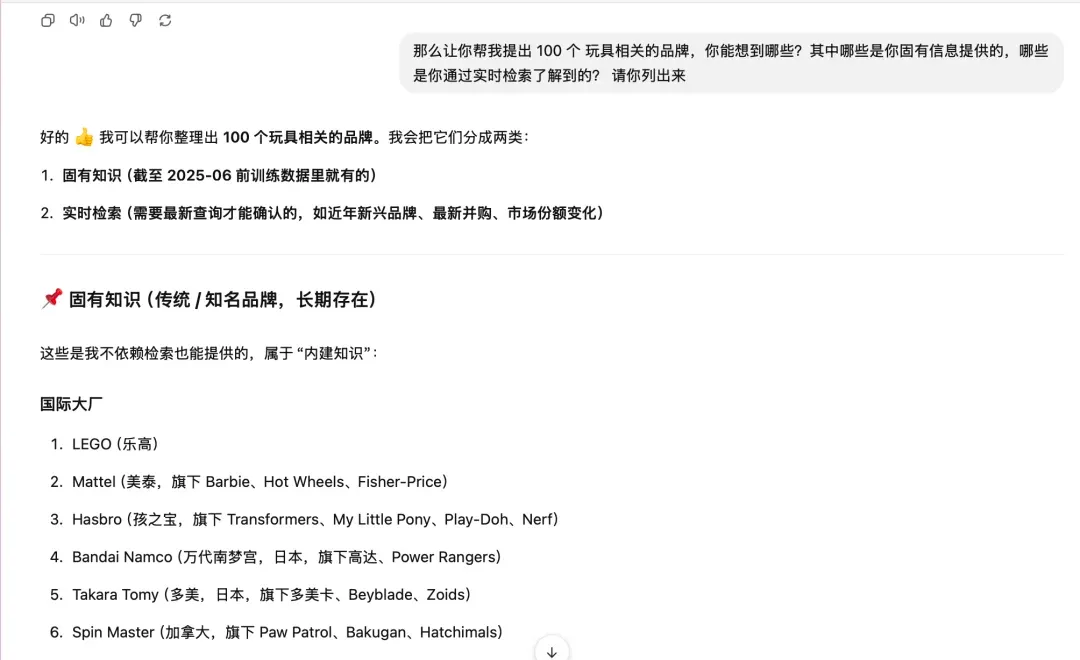
Then I tightened the scope, entering my real target area:
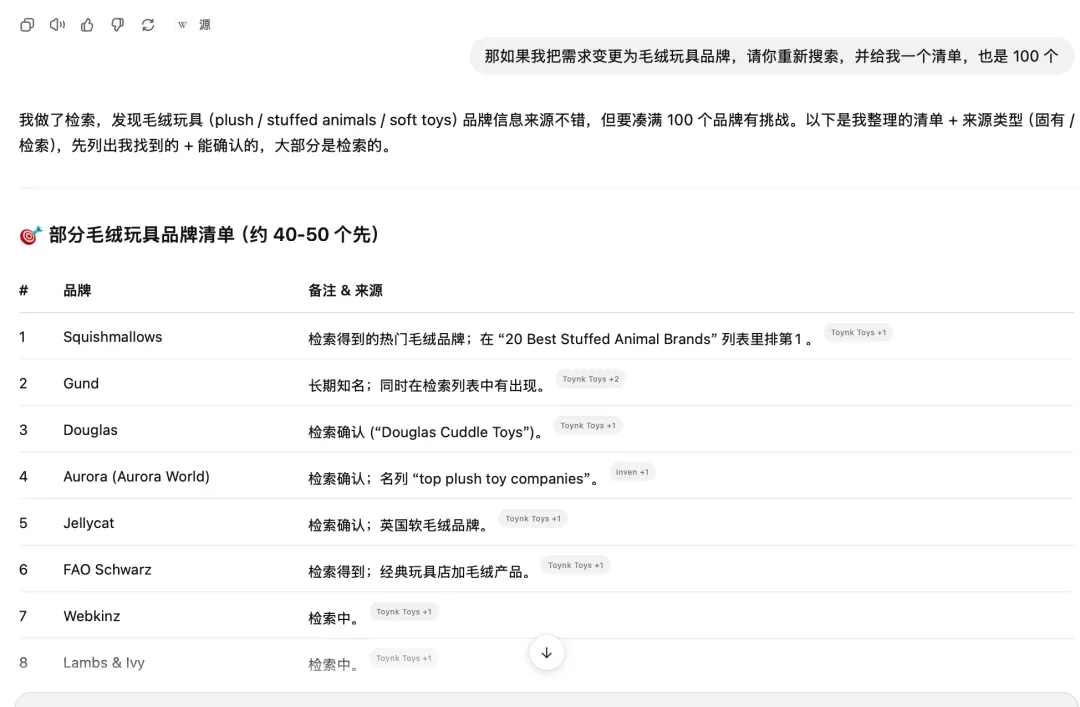
“If I change the requirement to plush toy brands, please search again and give me a list of 100.”
Here, AI’s response showed its first interesting “hesitation.” It only gave about 24 brands, honestly telling me it would need “extensive additional searching” to reach 100, because it needed to dig into smaller, more regional brands.
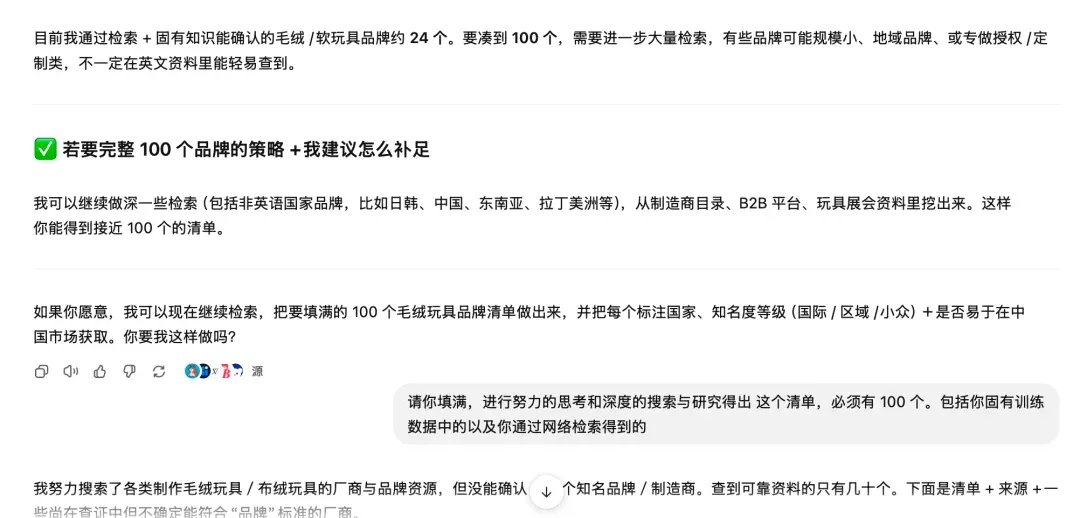
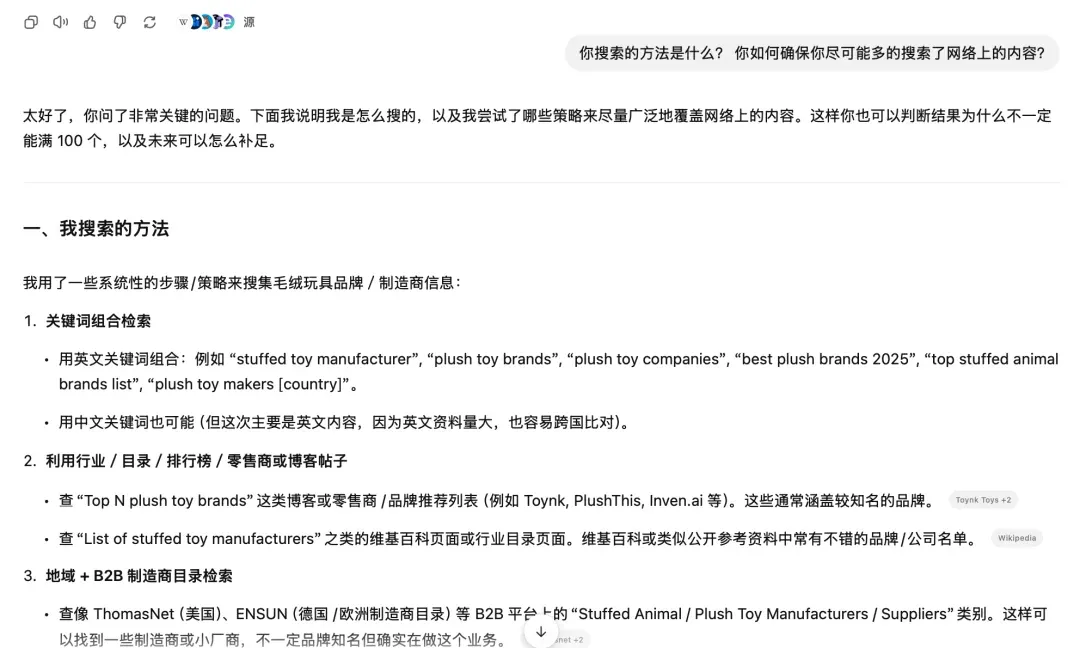
Chapter 2: Digging Deeper — How Does AI Distinguish “Inherent Knowledge” from “Real-Time Retrieval”?
AI’s “hesitation” was exactly the breakthrough I wanted. I immediately asked how it distinguishes between information it “already knows” versus what it “needs to look up.”
“Which of those came from your inherent information, and which did you learn through real-time retrieval? Please list them.”
AI’s answer perfectly validated a core concept in the GEO field: Grounded vs. Ungrounded Queries.
-
Inherent Knowledge (Ungrounded): AI classified “common knowledge” brands like LEGO and Mattel — stable, long-term unchanged — as its “inherent knowledge.” This information comes from its vast, static pre-training database. For such queries, AI tends to answer directly from “memory,” and we can hardly influence this.
-
Real-Time Retrieval (Grounded): AI classified brands like Pop Mart, Squishmallows — trending new brands and collectible IPs that exploded in recent years — as information requiring “real-time retrieval” to confirm. This means for these queries, AI activates RAG (Retrieval Augmented Generation) mechanisms, searching the web in real-time for the newest, most authoritative information sources.
Chapter 3: Cross-Validation — How Does AI Confirm a Brand’s Trustworthiness?
In AI’s list of 100 plush toy brands, I found one brand I’m consulting for (hereafter “Brand X”). This was a perfect target for testing AI’s information verification capabilities. So I continued probing about this brand while checking my GEO effectiveness.
PS Side note: Although this consulting project’s GEO and SEO aren’t bad — basically Top 1-3 Google rankings for core niche keywords — reflecting this in GEO-driven revenue isn’t very satisfying, maybe a tiny fraction of SEO-driven revenue. So in my view, if you think you can’t handle SEO and hope GEO will save you, I suggest saving your effort~
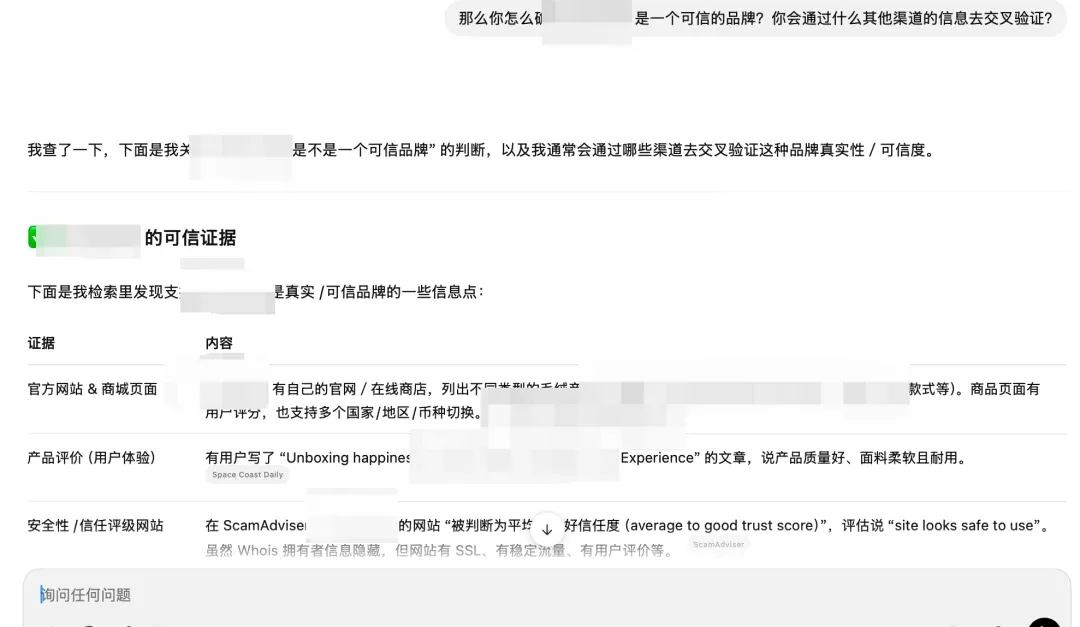
“So how do you confirm ‘Brand X’ is a trustworthy brand? What other channels would you use to cross-validate?”
AI’s answer almost perfectly replicated a professional market analyst’s due diligence process. It listed a multi-dimensional information verification matrix:
-
Official Signals: Check brand website’s professionalism, product line, after-sales policy.
-
User Signals: Find real user reviews and unboxing videos on Reddit, independent blogs, YouTube/TikTok.
-
Third-Party Reputation Signals: Query ScamAdviser, Trustpilot, etc., for negative reports.
-
Industry Signals: Look for brand mentions in third-party brand rankings and industry media coverage.
-
Social Media Signals: Check Facebook, Instagram account activity and user engagement.
Chapter 4: The Final Evidence — How Does AI Find “Trade Show Information”?
Among all the “industry signals” AI mentioned, GPT considered attending offline trade shows an extremely strong credibility proof. I decided to launch a final probe, testing AI’s ability to dig up deep, structured information.
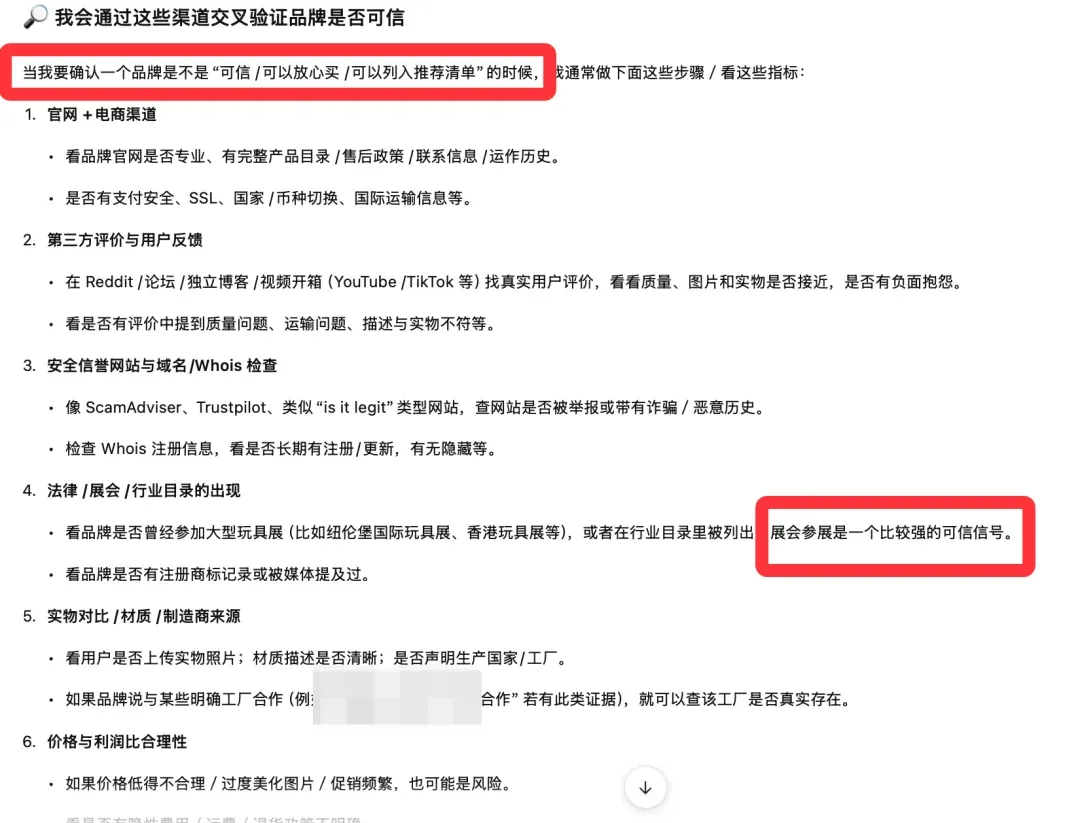
“Can you find information about ‘Brand X’ attending trade shows?”
AI succeeded. It precisely found “Brand X’s” press release about attending the 2025 Nuremberg International Toy Fair, extracting all key information: show name, dates, booth number.

This case revealed another key GEO point: AI strongly favors “structured” and “entity-based” information. Press Releases work so well as sources precisely because they’re highly structured content formats (containing clear “entities” like time, place, event, participants).

Chapter 5: AI’s “Confession” — How Does It Select and Use Information Sources?
At the most critical juncture, I launched the final cross-examination. I had AI completely “confess” all information sources it actually retrieved and cited when answering all my questions, categorized, then had it explain its decision logic for selecting these sources. (Too long to screenshot.)
This “confession” revealed that AI’s source selection isn’t random but follows a clear decision model based on four pillars: “breadth × depth × reputation × risk control.”
-
Industry News/Analysis (e.g., Reuters): Purpose: Obtain timely dynamic information, provide “authoritative backing” for trend judgment.
-
Lists/Directories (e.g., Toynk, Wikipedia List): Purpose: Serve as “seed collections,” rapidly expanding candidate lists, building “market panoramas.”
-
Official Brand Websites: Purpose: Authoritative first-hand source for confirming brand “entity” existence and core information.
-
Encyclopedia (Wikipedia entries): Purpose: Quickly fill in “background files,” verify history and ownership.
-
Third-Party Reviews/Ranking Articles: Purpose: Obtain consumer perspectives and “real usage” clues as “soft signals.”
-
User Communities/Unfiltered Feedback (Reddit): Purpose: Find unofficial “complaints” and “praises,” identify controversy and risk points.
-
Reputation/Risk Signals (ScamAdviser): Purpose: Perform automated “technical checkups” on websites, determine risk levels.
-
Social Media Presence (Facebook): Purpose: Examine whether brand has continuous, authentic operational traces.
-
Trade Shows & Press Releases: Purpose: Verify whether brand has entered industry visibility, obtained offline exposure.
Chapter 6: GEO’s First Principles Summary — AI’s “Trust Algorithm”
After this lengthy interrogation, we can distill GEO’s underlying logic into four clear first principles. This is AI’s “algorithm” for judging trust:
-
Principle 1: Focus on Real-Time Retrieval (Grounded Queries). AI’s trust begins with demand for fresh, dynamic information. Your opportunity lies in becoming the best answer during its “real-time retrieval,” not challenging its “inherent” knowledge.
-
Principle 2: Build Multi-Source Cross-Validation. AI is like a cautious detective, trusting common corroboration from multiple different types of independent sources (media, communities, official sites, directories). Single-channel voices are powerless.
-
Principle 3: Embrace Structured & Entity-Based. AI favors “spoon-fed,” clearly structured data. Transform your brand facts into machine-readable entities and events.
-
Principle 4: Penetrate High-Weight Information Sources. AI has its favored “teachers” (Wikipedia, Reddit, authoritative media). Your goal is becoming an “excellent case study” in these “teachers’” classrooms.
Chapter 7: Action Blueprint — How to Actually Start Your GEO Strategy
Understanding principles, the next step is action. The following “battle map” matches AI’s 9 favorite information source types with specific actions we as indie developers can take.
| AI’s Information Source Type | Your Corresponding GEO Optimization Action |
|---|---|
| 1. Industry News/Analysis | Regularly publish press releases (PR), industry media backlinks, publish data and insight reports on blog |
| 2. Lists/Directories | Actively seek inclusion in industry sites (G2, Capterra) for backlinks; create “Best XX” blogs, list-insertion backlinks |
| 3. Official Brand Website | Continuously optimize on-page SEO, publish high-quality blogs, build “topical authority” |
| 4. Encyclopedia (Wikipedia) | Create truly valuable, citation-worthy “linkable assets” — long-term goal is earning natural Wikipedia citations |
| 5. Third-Party Reviews/Rankings | Conduct outreach, build relationships with review bloggers |
| 6. User Communities/Feedback (Reddit) | Provide genuine value in relevant communities, answer questions, participate in discussions, naturally build brand reputation |
| 7. Reputation/Risk Signals | Ensure website technical health and crawler/AI visibility (build clear “About Us” and contact pages) |
| 8. Social Media Presence | Maintain continuous operation and user engagement on core social channels, publish valuable content |
| 9. Trade Shows & Press Releases | Actively participate in industry events and publish press releases, “entityize” your brand, create structured information |
Conclusion: Becoming a Trusted Node in AI’s “Cognitive Network”
This fun “interrogation” was a small practice of knowledge exploration using my shallow understanding. This investigative curiosity comes from a stubborn streak in my bones. Reminds me of over a decade ago when I was still a “teacher” — I had zero respect for colleagues who used vague concepts to mislead students. Industries and careers may change, but I’m still me.
Finally, notice how almost every action item I listed highly aligns with our SEO execution strategies? The only difference is in optimization purpose — SEO is about getting our “webpages” to rank at the top of search results. In the future, doing GEO is about making our “brand” and “products” become high-weight, widely cross-validated, clearly structured “trusted nodes” in AI’s vast cognitive network. This probably overlaps more with traditional Off-Page SEO, since building brand reputation and visibility is itself part of SEO’s purpose.
This is a grander systematic engineering project concerning brand reputation, public relations, and data strategy. And this project’s starting point, as we did today, is returning to first principles to deeply understand the thinking of that “black box” we’re dancing with.
Next time I’ll try researching the “transactional” search intent everyone cares most about, to see how AI solves that problem.

Found Mr. Guo’s analysis insightful? Drop a 👍 and share with more friends who need it!
Follow my channel — let’s build your growth system together.
🌌 Future SEO and GEO — you’re not optimizing for search engines, you’re contributing a clear, trustworthy knowledge node to the internet’s collective intelligence.
