
When a grand dream crashes into reality, its echoes linger particularly long.
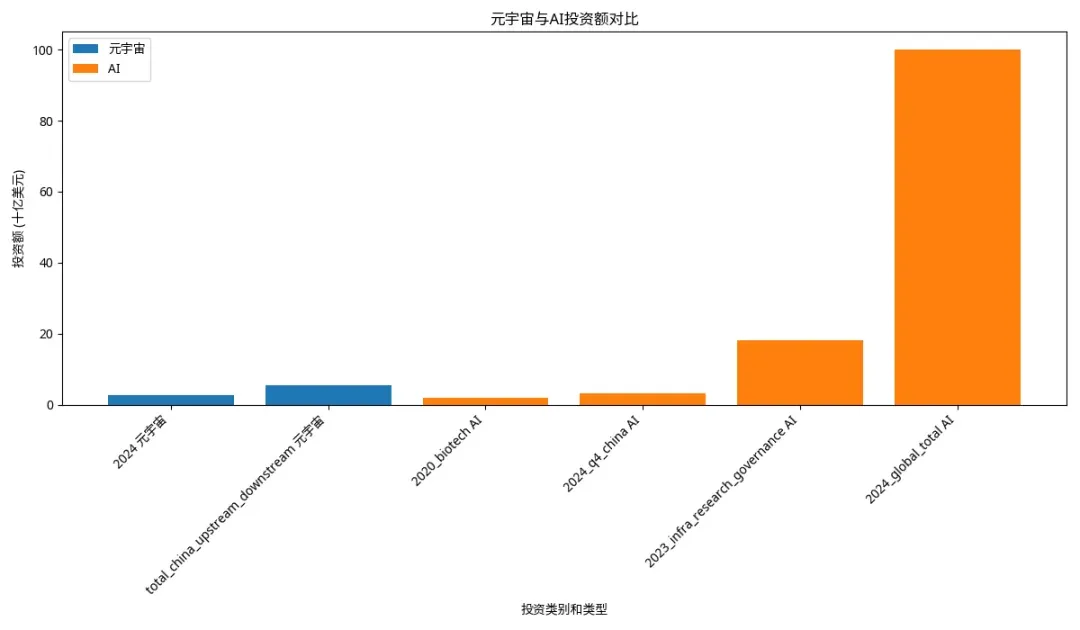
Looking back at the past few years of internet and investment world hot topics, it’s been quite the magical realism drama. On one side, the Metaverse—once hailed as the “ultimate form of the internet”—quickly fell from capital’s darling, with even giant Meta facing scrutiny over billions in losses. On the other side, AI swept the globe with overwhelming force, attracting a staggering $100 billion in investment in 2024 alone. Why do two tracks seemingly leading to the future show such stark contrasts of ice and fire? In my view, this goes far beyond differences in technical maturity—behind it lies a clash between two fundamentally different product philosophies and value delivery logics.
The Metaverse’s “Achilles Heel”: When Grand Narrative Meets Reality’s Gravity
The Metaverse’s vision is enchanting—building a persistent virtual space parallel to the physical world. This “worldview-level” product conception was destined for difficulty from the start. It attempted to arrive fully formed, requiring users to make a costly “space-time leap.” Behind this are three immovable forces of reality: immature technology, high hardware barriers, and unclear business models. As Nietzsche said, “What doesn’t kill me makes me stronger,” but the Metaverse faces multiple potentially fatal challenges simultaneously.
High-fidelity rendering, low-latency interaction, massive concurrency… any shortcoming in these foundational technologies makes immersion vanish. More critically, it requires users to purchase an expensive, bulky, and potentially nausea-inducing VR/AR headset as an “entrance ticket.” When entering this new world costs so much while its “citizen value” (whether work, social, or entertainment) is so scarce and uncertain, user exodus becomes inevitable. Meta’s massive losses are the expensive tuition paid for this chasm between “grand narrative” and “stark reality.”
AI’s “Leverage Power”: From Swiss Army Knife to Everything-Enabling Operating System
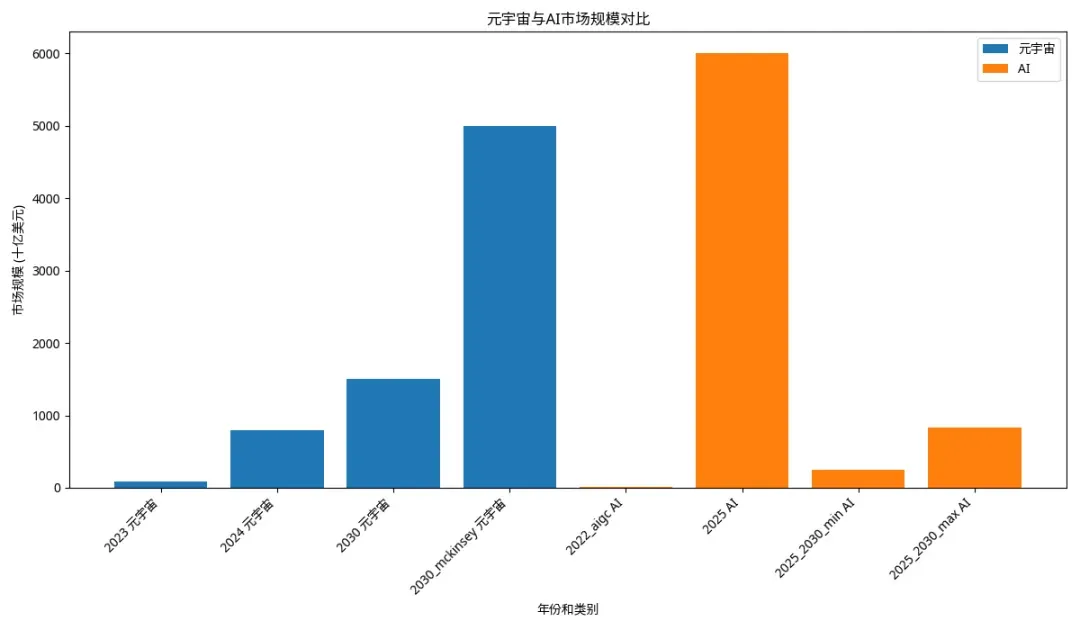
Unlike the Metaverse, AI’s explosion stems from its “tool” nature. It doesn’t ask you to move to a new world—it hands you a sharper hoe on your existing land. AI’s core is “empowerment”—like an invisible operating system, silently integrating into our existing workflows and life scenarios. From AlphaGo to ChatGPT, every stunning AI debut comes with immediately perceptible value—it either solves your problems or enhances your efficiency.
You don’t need new devices for AI—your phone and computer are the best carriers. Want to write code, draw a picture, polish an email? AI responds almost instantly. This low-friction, high-value characteristic gives AI powerful “leverage.” It pries open not some ethereal future but real, present-moment needs. This is a classic “bottom-up” victory—solving countless small problems first, eventually accumulating into enormous world-changing energy.
The Terminal Chasm: Why Phones Are AI’s Incubator While Headsets Are the Metaverse’s Fortress
If one factor most directly determined their fates, it’s terminal devices. AI’s success largely comes from riding the smartphone super-carrier with billions in circulation. This screen we touch and interact with most daily became AI services’ perfect penetration channel. AI apps can be easily downloaded and instantly used like other apps—user barrier nearly zero.
The Metaverse, meanwhile, is besieged in a “fortress” by its chosen terminal—XR headsets. According to reports, global XR device shipments even declined in 2024. High prices, poor experience, and scarce content together built this high wall. When target users must cross such a huge chasm to reach you, no matter how beautifully you paint your world, it’s destined to be scenery for the few. The vast difference in terminal penetration directly caused cloud-and-mud disparities in user reach efficiency, determining who could faster form network effects.
Investment’s Cold Calculus: Certainty vs. Possibility
Product logic differences ultimately manifest in capital market votes. Investment is essentially weighing “certainty” against “possibility.” In this dimension, AI and Metaverse are two extreme samples.
-
AI offers “Certainty”: Cost reduction, efficiency gains, empowering all industries, clear SaaS or API business models. Investing in AI has a visible return path—it solves “today’s” and “tomorrow’s” problems.
-
Metaverse sells “Possibility”: A disruptive future, a whole new digital civilization. But its return cycle is extremely long, with technology paths and business models full of unknowns. It describes “the day after tomorrow’s” grand blueprint.
In current economic cycles favoring pragmatism, capital clearly prefers the former. That $100 billion investment isn’t so much invested in AI the concept as in countless specific applications generating quick commercial value through AI.
Individual Breakthrough Path: Become an “AI-Enhanced” Individual, Not a “Metaverse Wanderer”
Hearing enough grand narratives, we ultimately return to individual development. For each of us—product people, developers, operators—what’s the lesson from this song of ice and fire? My answer: Proactively become an “AI-enhanced” individual while avoiding becoming an aimless “Metaverse wanderer.”
Rather than investing precious time in virtual worlds that are still mirages and can’t provide immediate positive feedback, immediately integrate AI into your personal workflow. Use AI to help write code, design, analyze data, write copy. It’s like installing a cognitive extension that tangibly improves your output efficiency and capability boundaries. In this era, true competitiveness isn’t how many concepts you have but your ability to effectively solve problems using tools.
Conclusion: Farewell Technology Worship, Return to Value Itself
AI’s boom and Metaverse’s slow burn are essentially the market’s referendum on “value delivery efficiency.” It reminds us that any technology, no matter how grand its narrative, must ultimately return to whether it creates perceptible, easily accessible value for users. AI did it, so it won the present. Of course, I still believe in Metaverse’s long-term potential—when AI is powerful enough to cost-effectively generate entire worlds, when hardware shackles break, the two will eventually meet at the summit. But that needs time and patience. Until then, use the AI at hand well, and take each step on solid ground.
Found this analysis insightful? Give it a thumbs up and share with more friends who need it!
Follow my channel to explore the infinite possibilities of AI, going global, and digital marketing together.
We’re not choosing technology—we’re choosing a way to interact with the real world.
