
Atlas Is Going Away, but OpenAI Should Not Push People Out of the Browser
Atlas may really be going away.
On July 9, 2026, OpenAI announced that it would gradually discontinue the standalone version of Atlas. According to its official help documentation, it is scheduled to stop working on August 9. My first reaction was not surprise, but regret. That regret is even stronger than what I felt when Sora 2 went away.
This is not because Atlas was perfect. It was not fast enough, started out on Mac only, and many ordinary users never understood what problem it solved. OpenAI’s replacement—putting a browser directly inside the ChatGPT desktop app and letting Codex take over web tasks—is in many ways stronger if automation is the only measure. In my own work, almost 90 percent of what I need to do in a browser can now be handled by ChatGPT’s built-in browser and Codex.
So this is not nostalgia, and it is not an attempt to resurrect a product that the company has decided no longer needs to exist independently. I want to discuss something else:
Are “an agent owning a browser” and “an agent living inside my browser” really the same thing?
My answer is no.
Atlas Was the First Time I Saw the Browser as a Workbench
I was among the first people to use Atlas when it launched on October 21, 2025. What impressed me was not its page summaries or sidebar chat. The remarkable part was that Agent mode could take over a task directly inside a web page. I asked it to open Feishu Base, operate on documents, and continue in the pages where I was already working. I even wrote about that experience at the time.
That moment gave me a concrete vision: perhaps future work would not require finding a separate automation interface for every piece of software. We could simply hand the browser to an agent. A huge amount of digital work already happens in browsers: data, spreadsheets, customer back offices, email, documents, CMSs, social media, and advertising platforms. If an agent can understand the page, interpret my intent, and continue within the current context, it has an extremely general-purpose work interface.
For a long time I used a rough but effective workflow. I asked Codex to analyze a task and generate operating instructions, then handed those instructions to Atlas’s Agent mode to execute in the browser. One practical reason was to save Codex tokens. Codex figured out what to do; Atlas clicked, filled, switched, and submitted things. It was not elegant, but it solved real problems.
That is why I felt attached to Atlas. It was not an AI product I installed for two days and forgot. I put it into my workflow, and I saw the next step of browser automation through it.
I Admit That the New Approach Is Better at Doing the Work for Me
If we compare only an agent’s ability to execute tasks, folding browser capabilities into ChatGPT is not a simple step backward. The new desktop app has a built-in browser with multiple tabs, downloads, logins, autofill, password management, and extensions. Codex can obtain context across tabs and operate web pages. The entry point is more concentrated, the model capabilities are more unified, and the automation chain is easier to improve.
From OpenAI’s product perspective, the choice is easy to understand. Instead of maintaining a standalone product with a limited user base while carrying the full cost of browser engineering, it can bring the agent, Codex, browser, and ChatGPT account into one super app. Users do not need to understand Atlas; they can open ChatGPT and ask AI to work online. That is easier to distribute and may be easier to scale.
I am willing to admit that if today’s goal is simply “finish this web task,” the new approach is usually more convenient. But that is exactly where the problem lies. OpenAI seems to understand the browser mainly as an execution environment for agents, while I still need it to be my own information environment.
An Agent Can Take Over the Work, but It Should Not Drive People Out of the Browser
A browser is not an ordinary tool. For people living in the real world, it is a basic medium for entering the digital world. I want an agent to search, turn pages, fill forms, organize data, and operate back-office systems. But I cannot outsource all information gathering. I still need to read some information myself, observe how a website expresses an idea, notice subtle contextual differences, and decide what is credible and worth pursuing.
Atlas offered a natural division of labor. I sat in the driver’s seat and browsed while AI stayed beside me. When I saw complex content, I asked it. When I needed a summary, it read the current page. When repetitive work appeared, I handed over the wheel. Afterward, I took control again. The person was in the browser, and the agent was in the browser too.
The default relationship in “ChatGPT has a browser” is different. It feels more like I first hand a task to AI, then inspect what AI opened and did. Both designs can complete web operations, but they make different assumptions about the person’s position. The first adds an agent that can take over to the person’s workbench. The second opens a viewing window for a person inside the agent’s workbench.
Consider browser state. Official migration notes say that Atlas bookmarks, open tabs, and history will not automatically migrate to the new ChatGPT browser. The built-in browser uses a separate state rather than directly reusing an existing Chrome configuration. When users need their Chrome logins, tabs, and extensions, the official direction is to use Codex’s Chrome extension.
This does not mean the new browser cannot improve. It shows that the valuable thing is not merely “being able to open a web page.” My login state, extensions, tabs, habits, and context together form a working scene. Atlas let AI enter that scene. The current change feels more like moving the scene into ChatGPT.
Atlas’s Biggest Failure May Have Been That Nobody Knew What It Was For
To understand the shutdown, I looked at public Reddit discussions. This was not a rigorous survey of all users, only a collection of comments for observing reactions across communities. Of 610 comments, 453 were miscellaneous or off-topic, while 157 entered the emotion and opinion categories. Even so, the sample revealed a painful signal.
Discussion was concentrated in r/ChatGPTAtlas. Away from that core community, attention dropped quickly. r/technology, r/ChatGPT, and other technology communities discussed Atlas too, but with much smaller comment volumes.
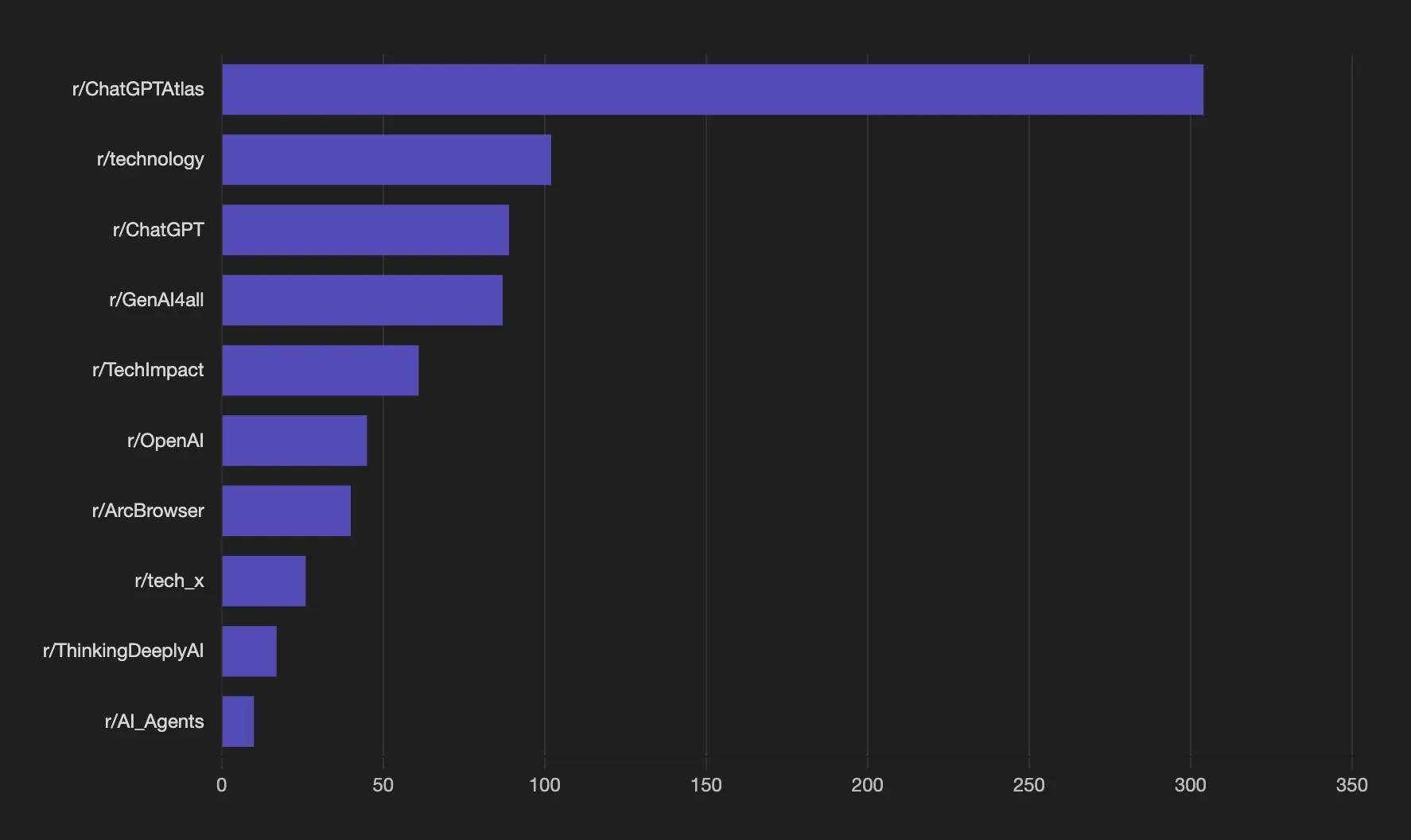
Atlas’s shutdown first shook people who were already using it, rather than the technology community as a whole. The average agreement attached to different opinions was more brutal still.
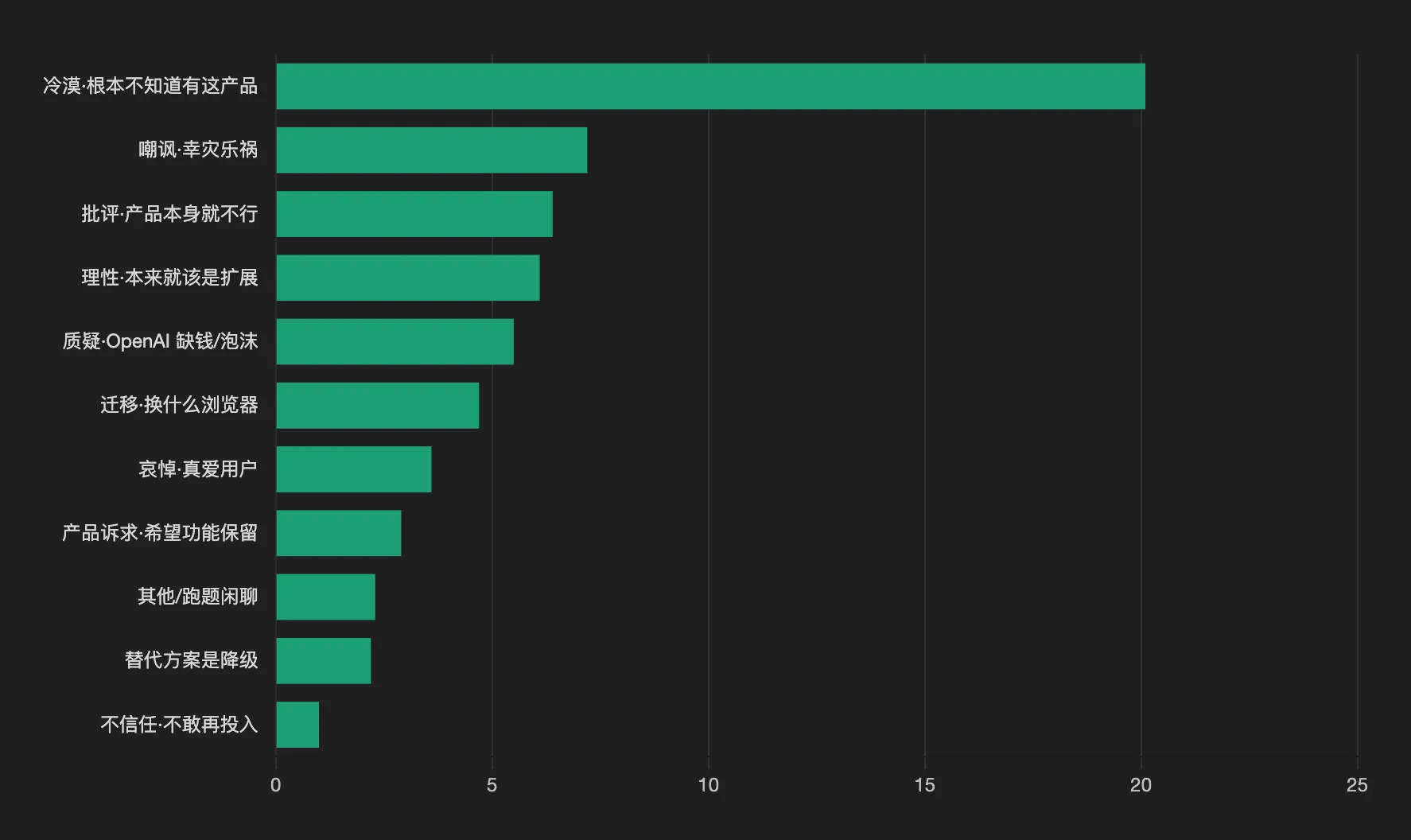
The highest average upvotes went not to regret or product requests, but to indifference. Many people did not know the product existed, or never found a reason it was more valuable than an ordinary browser. One comment with 82 upvotes said:
Never found a use for it beyond an inferior version of the browser. Focus on the stuff that matters.
Another comment mocked its user base with “There were dozens of users!” and received 39 upvotes. This is more dangerous than complaints about a bug. A bug means people entered the product and found the experience poor. Indifference means the product never entered most people’s lives.
Atlas’s Agent mode amazed me, but to more users it was an unfamiliar browser that launched slowly, had unclear positioning, and was available only on Mac. Some complained that after searching in the address bar they still had to wait for ChatGPT, making the browser feel sluggish. These criticisms cannot be dismissed as users failing to recognize a good product. If a product’s strongest value requires a few highly engaged users to spend a long time discovering it, its positioning and distribution have a problem.
Users do not first understand a long-term strategy and then tolerate immediate slowness. They ask: Why not use Chrome? Why not install an extension? Why move all browsing habits here? Atlas did not give most people a strong answer quickly enough.
What People Who Truly Regret Atlas Are Regretting Is Not an Icon
Core users in r/ChatGPTAtlas showed a different emotion. One comment thanked the team for building an excellent browser and asked for the same complete experience in the new ChatGPT app. Others found that continuing work with Gmail in the new app produced this message:
I can’t access the thread because the browser and Gmail connection aren’t available in this session.
This is what devoted users mean when they call the replacement a downgrade. They are not opposed to a ChatGPT browser, nor do they insist that the Atlas name live forever. They worry that a continuous browser-level workflow will become a set of capabilities that appear to exist but require logging in again, authorizing again, and rebuilding context from scratch.
The opposing view is reasonable: this could have been a Chrome extension, so why maintain a browser? I agree that an extension is a more realistic distribution method. It does not require users to migrate browsers, build habits from zero, or leave a huge existing ecosystem.
But “just make it an extension” has a prerequisite. The extension must preserve the key experience of a browser-level agent rather than leaving only a chat sidebar. It needs to know which page I am viewing, understand relationships among tabs, take over after explicit authorization, and return control at any time. It should show what the agent is doing, which permissions it uses, which data stays local, and what goes to the model. If it can do that, I do not care whether it is called Atlas or remains a standalone browser. I care that this human-agent collaboration does not disappear.
Why Did OpenAI Abandon Atlas? I Have a Less Dramatic Judgment
Reddit offered dramatic explanations: perhaps OpenAI was running out of money; perhaps Atlas and Sora changes showed the AI bubble contracting; perhaps it was a browser burning taxpayers’ money. These comments create emotion, but there is not enough evidence to prove that OpenAI could not afford a browser team. The browser is a frontline traffic gateway in competition with Google, and Atlas used ChatGPT as its default search engine, suggesting that traffic was part of its original ambition.
My judgment is only a hypothesis: Atlas more likely lost on product organization and commercial efficiency than on technology.
First, its entry point was too narrow. A macOS-only launch kept many potential users outside the door. Second, it asked users to replace high-frequency infrastructure. Moving a chat app is easy; moving bookmarks, passwords, extensions, history, login state, and muscle memory is not. Third, its valuable agent capability was not expressed directly enough. Many people saw “another browser with ChatGPT,” not “an execution layer for real web work.” Fourth, OpenAI now wants to concentrate everything inside ChatGPT. A unified entry point reduces duplicated work and makes a loop around subscriptions, usage, and agent tasks easier.
Atlas’s fate does not prove that AI browsers have no value. It may mean that a valuable AI browser does not necessarily become a browser business worth operating independently. Those are different questions.
I Hope OpenAI Preserves These Five Things
I do not want Atlas simply resurrected. I want these experiences preserved in ChatGPT or a Codex extension:
- Keep people in the driver’s seat. I should be able to browse, read, and judge instead of turning every goal into a task and waiting for a result.
- Keep the persistent sidebar and page context. I should not repeatedly copy links, screenshots, and text. AI should know what I am viewing, with clear permission boundaries.
- Allow handoffs at any time. I can let the agent take over; when it encounters a CAPTCHA, payment, ambiguous choice, or high-risk action, it should return control.
- Inherit the browser ecosystem. Login state, tabs, extensions, and configuration are the user’s digital work scene.
- Optimize presence as well as completion. Finishing a task matters, but reading, comparing, and forming judgment matter too.
A browser is not merely a container for AI to collect data. It is a window through which people understand the world.
Atlas Can Die, but This Direction Should Not
As someone who used Atlas seriously, I will regret it. I am not grieving a purple icon or a product name rejected by commercial results. I am grieving a way of working that Atlas came close to delivering: I could read and judge things myself while an AI that understood the current page stayed beside me. When I needed it, it answered. When I no longer wanted to click, it took over.
That experience should not be reduced to “AI can open web pages too.” An agent can turn pages, fill forms, and click buttons, but it cannot understand the world in my place.
As a standalone product, Atlas may have failed to find a reason to survive. Its scale, positioning, speed, and platform strategy may not have justified continued investment. But the relationship it validated—people responsible for direction and judgment, with an agent ready to execute—still deserves to continue.
So if I had to leave one sentence for this shutdown, it would be this:
Atlas can disappear, but the victory of the super app should not become the moment people lose their seats in the digital world.
