
Hi everyone, this is Guo Shu.
Today I read a fairly brutal study titled The Great Blogging Collapse. Its author, Daniel Stanica, tracked 100 blogs that had once been treated as success cases, following them from 2022 all the way to 2026.
These 100 blogs were not random scraps picked from the web.
Back then, they were the kind of cases that appeared in lists like blogs earning six figures a month or ordinary people making money with content sites. To put it plainly, these were not failure samples. They were the success samples most useful for storytelling, selling courses, writing income reports, and hanging on the wall of indie-site players.
The result is ugly.
Median SEO traffic fell 85%.
Out of 100 blogs, only 21 were still growing. 55 were damaged, emptied, or dead. 20 sites fell by more than 99%, and 12 sites had almost zero organic search visits.
When I saw that number, my first reaction was not that blogging is over.
That conclusion is too lazy.
My first reaction was that many people over the past decade thought they were building a content business, when in reality they had treated Google as a free distributor with an indefinite renewal clause.
Now the contract has expired.
It was not renewed.
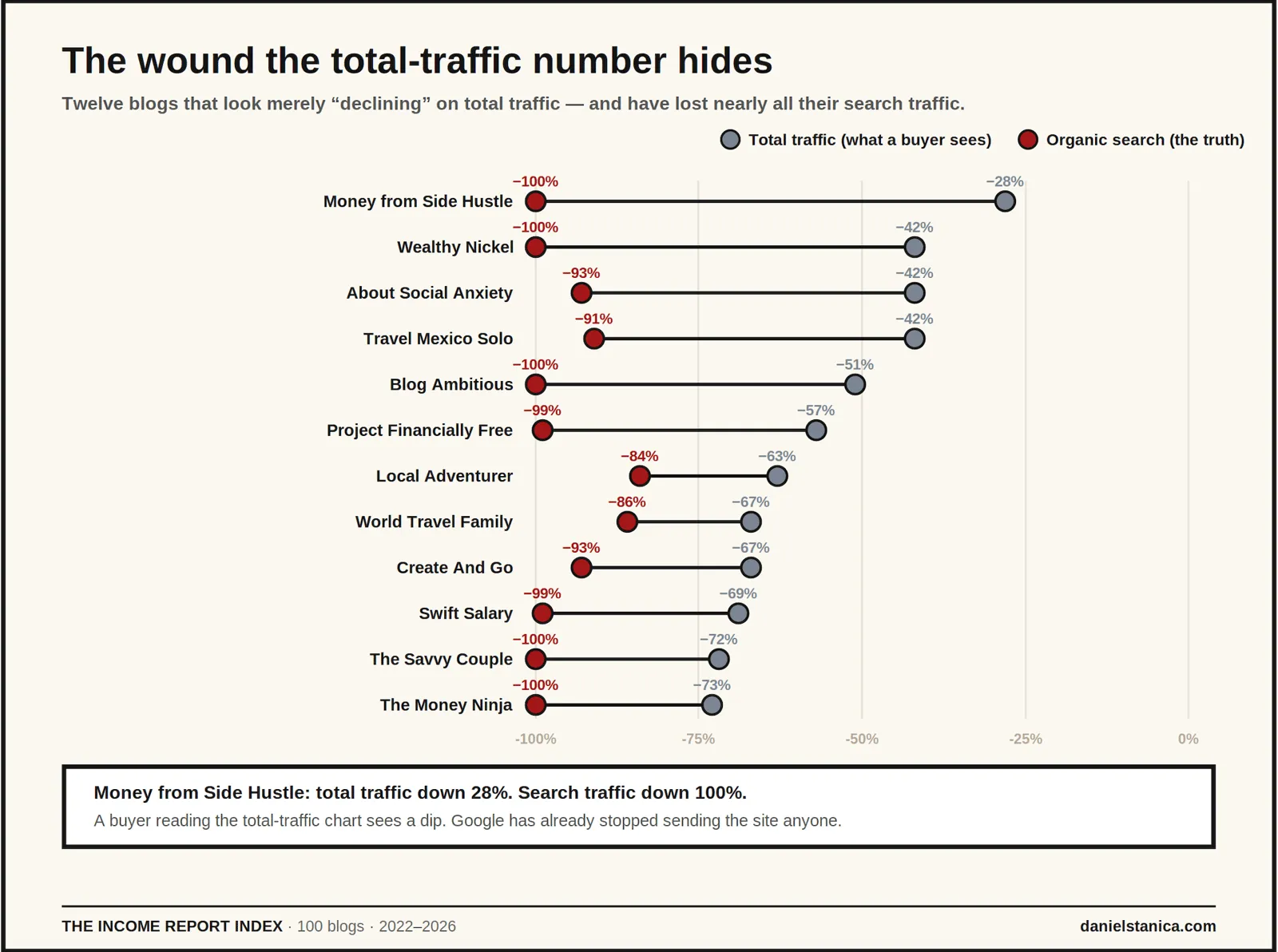
Image source: Daniel Stanica, The Great Blogging Collapse
Why did the most successful blogs collapse together?
First, let us clarify what this study is saying.
It is not saying that two-thirds of all blogs on the internet are dead. The author also emphasizes that this is not a random sample representing the whole internet. It is a narrower and sharper sample: websites once publicly promoted as successful blogging business models, most of which lost their main search traffic four years later.
That definition makes the finding even more lethal.
Because it does not hit casual diary blogs. It hits an industry myth that was packaged as a business model.
From around 2015 to 2022, the English-language internet had a very mature content-site formula: find keywords, write helpful content, capture Google search traffic, then monetize with ads, affiliate marketing, courses, and sponsorships. Many people used that formula to sell courses, sell tutorials, sell sites, and build site portfolios.
At the time, this playbook was not a scam. It really worked.
The problem is that it worked on a very narrow premise.
It assumed Google would keep sending free clicks to these sites for a long time. It assumed that after users asked questions, the search results page still needed to direct people to an external article. It assumed that articles like best budgeting apps, how to build an emergency fund, or top things to do in Dubai still deserved a user click.
Then after 2022, several things stacked together and broke that premise.
Google added Experience to E-E-A-T. The Helpful Content Update began clearing out content that served search engines more than people. The 2024 core updates continued pushing down low-quality content. Later, AI Overviews began answering many informational questions directly on the search page.
At that point, the old blogging business model became awkward.
It was not that the articles were not long enough.
It was not that the headlines were not clicky enough.
It was not that schema was configured poorly.
The real issue was that a lot of content never had a strong reason why it needed to be done by you.
It merely described something.
AI is very good at description. Search engines increasingly do not need to give you a click for descriptive answers.
That is the brutal part.
In the past, you thought your assets were 500 articles, 1,000 keywords, and hundreds of thousands of organic visits per month. Looking back, the real asset may have been only a temporarily rented entrance. Once the entrance changes its algorithm, the asset begins to melt.
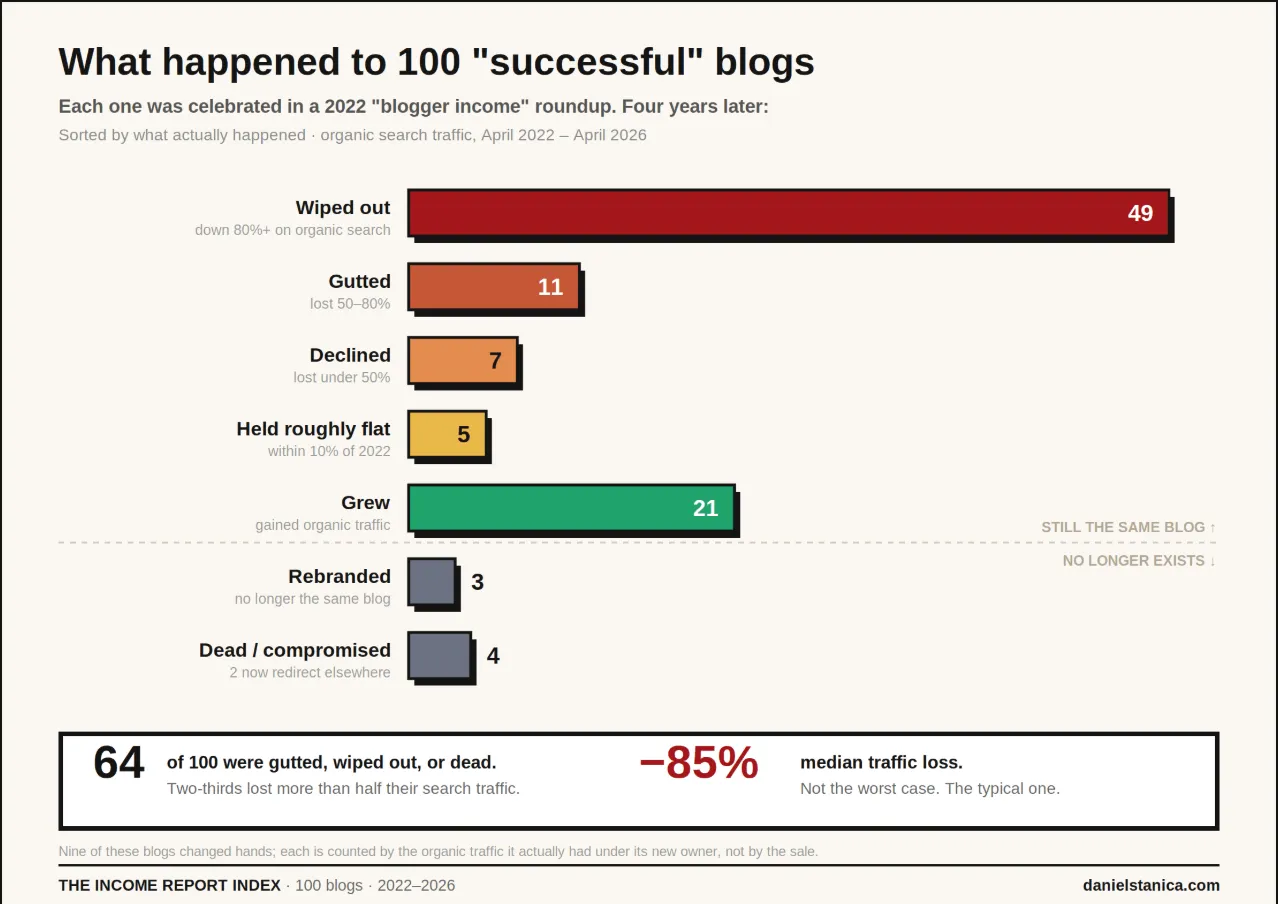
Image source: Daniel Stanica, The Great Blogging Collapse
What died is not writing, but summarizing what others already know
One of the most important charts in the study shows median change by niche.
Parenting: +108%.
DIY and crafts: +2%.
Food: -44%.
Travel: -74%.
Lifestyle: -90%.
Make-money and entrepreneurship: -93%.
Health: -93%.
Fashion: -95%.
Finance: -99%.
At first glance, it is tempting to conclude that parenting is safe, crafts are safe, food is okay, and finance is dead.
But that is another lazy conclusion.
The real dividing line is not the industry. It is whether the content contains proof that someone actually did the thing.
Why can recipes still survive?
Because a recipe made by someone who truly cooked it does not merely tell you to add 200 grams of flour. It tells you that the batter may look too thin but not to panic, that the edges begin browning around minute 18, that the center still jiggles slightly, and that it sets only after cooling. It has photos, steps, failure corrections, and a person who actually made the thing in a kitchen.
Crochet, DIY, and crafts work the same way.
Readers are not there to read a definition. They are holding yarn, needles, wood boards, baking trays, children’s homework, or garden tools, and they are stuck in reality. They need someone who has truly done it to explain the exact point where things get stuck.
AI can summarize how to make a scarf.
But it is much harder for AI to replace a specific pattern that documents each stitch, step by step, and has been repeatedly verified by readers in a community.
The keyword here is not originality.
That word has been worn out by the content industry.
A more accurate phrase is irreplaceable evidence of practice.
Did you personally do it, test it, run it, fail at it, and correct it? Does your content contain moments that make readers say, only someone who has done this would know that?
Without that, the article is only secondary processing of information.
Secondary processing used to survive because search engines needed many web pages to satisfy long-tail demand. Now AI can process the secondary processing one more time, and the user may not need to click through at all.
This is not a small fluctuation in the content industry.
It is a collapse of trust in descriptive content.
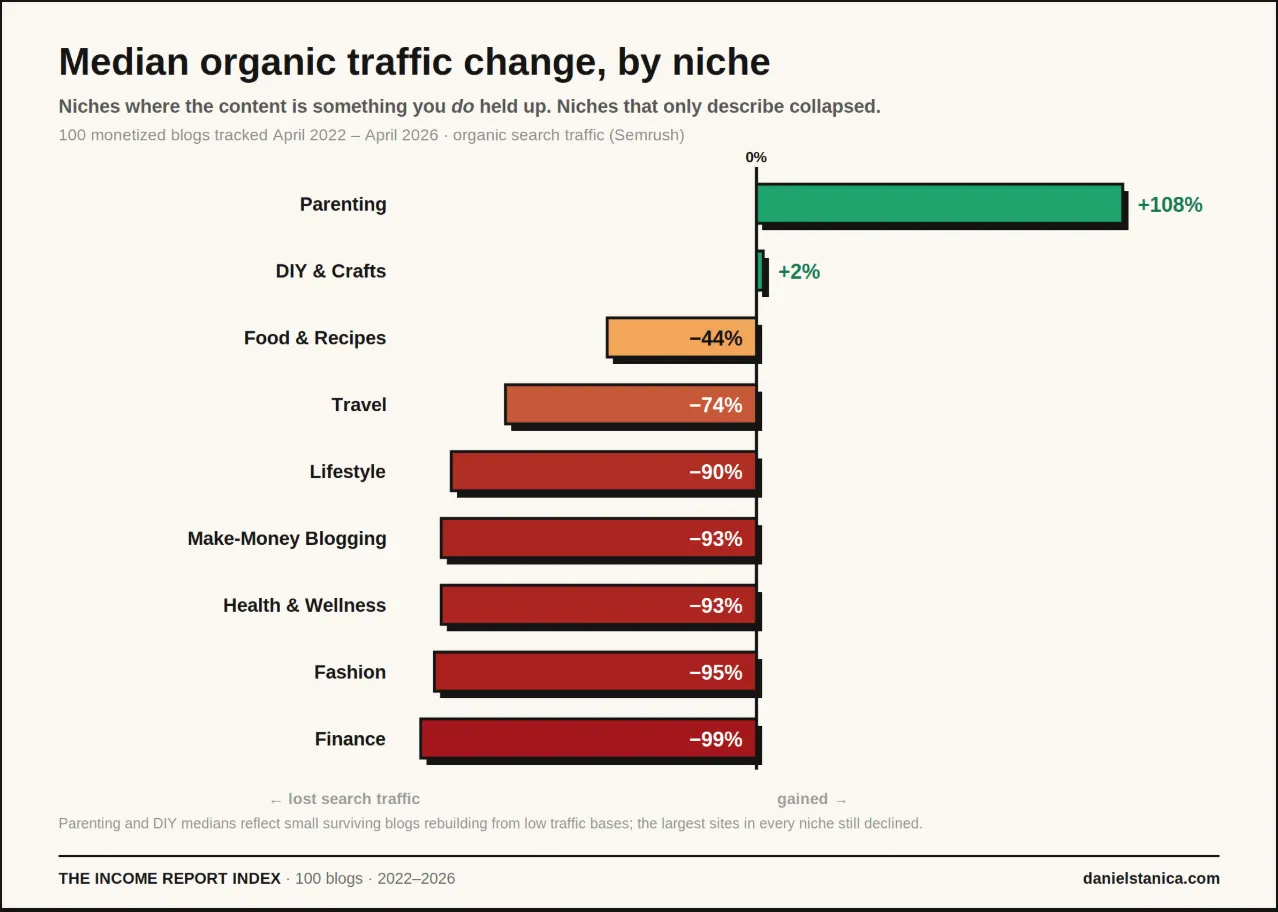
Image source: Daniel Stanica, The Great Blogging Collapse
The most ironic part: blogs teaching people how to make money were among the first to stop making money
There is one especially darkly humorous part of the study.
The make-money-online category fell hard.
In other words, websites that taught people how to make money blogging, how to do affiliate marketing, and how to build passive income were themselves punished by the playbook between 2022 and 2026.
This is not just an industry joke.
It exposes a deeper problem: many content businesses do not have products, only articles explaining products. They do not have real capabilities, only articles explaining capabilities. They do not have real business outcomes, only articles explaining how others got business outcomes.
This kind of content looked like an asset in the search era.
It could cover keywords, build internal links, host affiliate links, and monetize through ad networks. As long as Google kept sending clicks, it looked like a small machine that quietly printed money every month.
But once the AI era arrived, its fragility was exposed.
Because it had no irreplaceable production process.
It does not cook, travel, build things, test products, operate a community, deliver services, or take responsibility for outcomes. It only reorganizes public information into an article better suited for search.
To put it harshly:
Many content sites were not killed by AI. AI simply revealed that they had not been doing much work all along.
In the past, Google did not care that much. If a page was complete enough, well-structured enough, had enough links, and matched enough keywords, it had a chance to receive traffic.
Now Google and AI are asking a different question: why you?
Not whether this article answers the question.
But why this question needs this author to answer it.
Once that question appears, many sites have nothing to say.
AI Overview is not a second Google; it is less stable than Google
Many SEO people now naturally move to another topic: if I no longer do Google rankings, then I should do AI citations, GEO, AEO, answer engine optimization.
The direction is not wrong. But if this is only the old dream with a new name, it is dangerous.
The original article mentions an important data point: according to Semrush analysis of LLM citation sources, Reddit is one of the most cited domains, and Wikipedia is also high. Another study covering 30 million sources found Reddit, YouTube, and LinkedIn ranking highly across multiple AI platforms.
What hurts even more is that AI citation is no longer the same as traditional Google ranking. The data cited in the original article says the share of AI citations drawn from Google’s top 10 organic results fell from 76% in mid-2025 to around 38%.
In other words, ranking first does not guarantee that AI will cite you.
That sentence hits SEO people very hard.
For more than a decade, there was at least one relatively clear target: get the keyword to page one, then top three, then number one. The process was difficult, but the rules were at least somewhat legible.
AI search is not like that.
It is more like a content portfolio that constantly reweights itself. Today the model may value Reddit. Tomorrow it may value YouTube. The day after, a change in retrieval logic may push a source downward. The original article also mentions Semrush observing Reddit’s share in ChatGPT citations dropping from around 60% to 10% in roughly six weeks.
This is not a more stable Google.
It is a more floating Google.
So if someone tells you that old SEO meant renting land from Google, but future GEO lets you own traffic again, calm down first.
GEO is worth doing, but it is not a new perpetual-motion machine. It is more like a distribution layer you must participate in, but cannot bet everything on. You can improve the probability that machines understand, cite, and verify you, but you cannot rebuild your entire business on a more opaque, more dynamic, and less controllable answer system.
That is the real warning this study gives to AI globalization builders and content entrepreneurs.
Do not move from betting everything on Google to betting everything on AI.
That is not evolution.
It is switching landlords while staying exposed.
What did the 21 growing blogs have in common?
The original article summarizes several traits of the survivors at the end. I think they are worth putting on the wall for anyone making content today.
They usually have at least two things in common, and truly growing sites often have three or four.
They have real first-hand experience.
They have an audience they can reach directly, such as an email list, community, or branded search.
They have real products, not just ad revenue from page views.
They have a name readers are willing to search for directly.
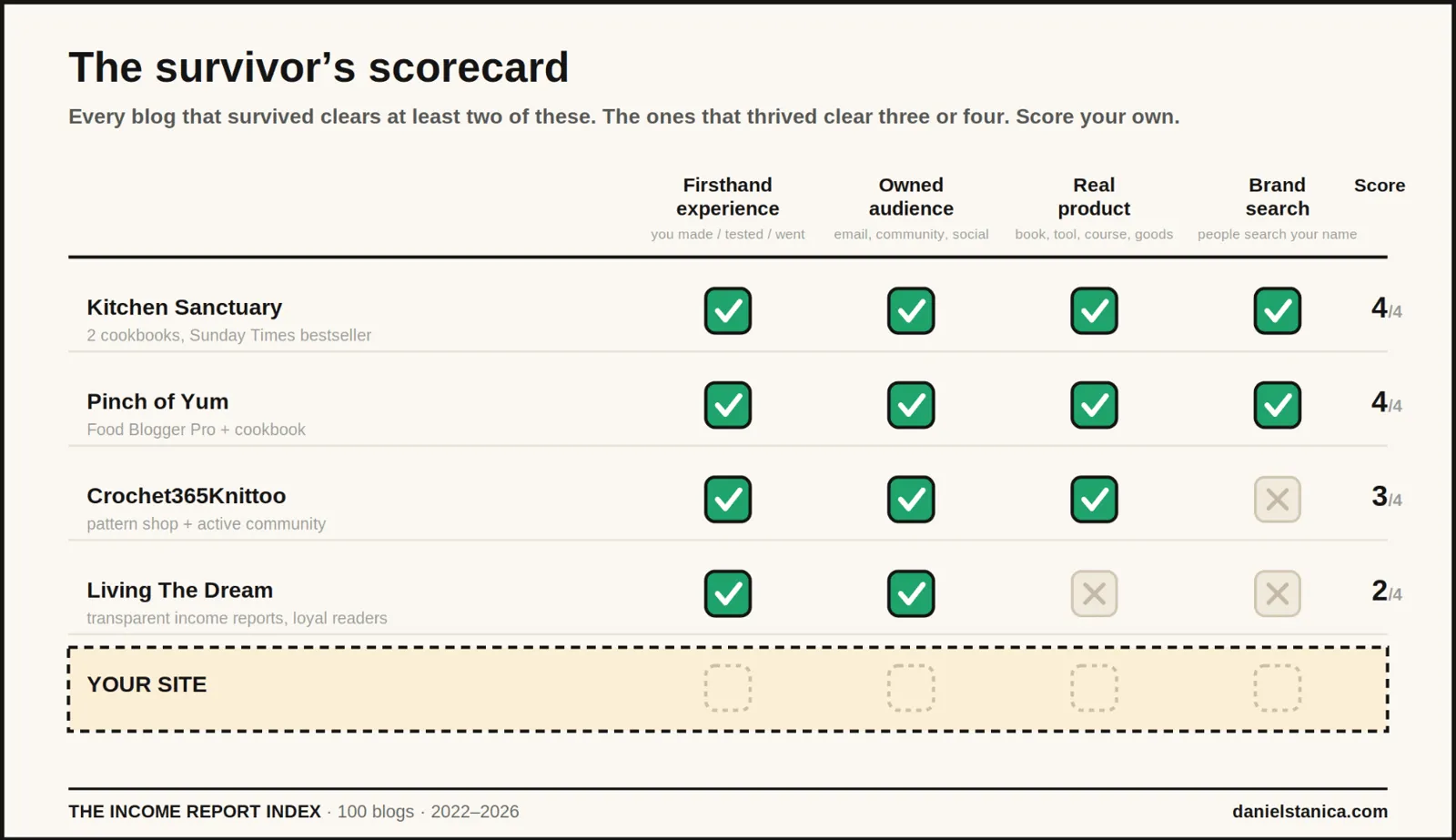
Image source: Daniel Stanica, The Great Blogging Collapse
None of these points look new.
But in the AI era, they become very hard.
Real first-hand experience answers the question why you.
An owned audience answers whether you can still speak when platforms stop sending traffic.
A real product answers whether you can turn trust into business results.
Branded search answers whether users remember you, instead of only remembering a question.
If a content site lacks all of these and has only the ability to write many SEO articles, it is now in danger.
More accurately, it was always in danger. The risk was simply hidden by Google’s traffic dividend.
AI forces that risk to settle earlier.
What does this have to do with AI content, global websites, and GEO?
Someone may say this is just about the English blogging world.
It is not.
This is relevant to everyone doing AI content, global SaaS, indie-site SEO, GEO, public-account writing, YouTube, and product documentation today.
Because the underlying question is the same: are you producing irreplaceable experience, or are you producing descriptions that can be summarized?
If you write an article titled What Is an AI Agent, that is dangerous.
If you write 10 Best AI Agent Tools in 2026, that is also dangerous.
If you write What Is GEO, Why It Matters, and How to Do It, still dangerous.
It is not that these topics cannot be written. It is that if the article does not contain your real testing, your project context, your failure process, your data changes, and your specific judgment, it easily becomes feed for answer engines.
It feeds the model, but it may not feed you.
I increasingly believe content in the AI era is not becoming impossible. Quite the opposite: content becomes more important.
But content value will move from covering information to proving you actually did something.
In the past, SEO people often asked: does this keyword have volume? How hard is it? Can I rank?
Now you need to ask a few more questions.
Why does this question need me to answer it?
Do I have practice evidence others do not have?
After reading, will the reader remember my name, instead of only taking away an answer?
Can this article lead people to my email list, community, product, service, tool, or case library, instead of letting them leave immediately?
If you cannot answer these questions, writing 100 articles will not help.
It may even become more dangerous the more you write.
Because you will manufacture an illusion of assets for yourself.
The backend has article counts, GSC has impressions, Ahrefs has keywords, Semrush has estimated value, and the ad dashboard occasionally has revenue. It looks like a business, but it may only be a traffic pipe temporarily tolerated by platforms.
Once the pipe closes, you discover you have no well.
Do not treat adding an AI tool as a lifeboat
There is another reminder from the original article that I really like.
The author says to be careful of two noisy pivots in the market: courses and coaching funnels, and adding an AI tool to your blog.
Because in this study, these two were among the worst-performing business archetypes.
That judgment stings a little.
When traffic falls, the natural response of many content sites is: then I will sell courses, then I will do consulting, then I will add a small AI tool.
This is not to say these are always wrong.
The problem is that if your original content has no real experience, no trust, no brand, and no owned audience, selling a course merely repackages the same fragility at a higher price point.
If your original blog has no product capability, adding an AI tool may simply be installing decorative lights on a sinking ship.
It looks lively.
But the ship is still going down.
The steadier path is much plainer: cut thin content, turn the remaining content into evidence-backed content, convert search traffic into an owned audience as quickly as possible, productize the audience relationship, and if none of this can be done, honestly evaluate whether to sell while the asset still has some warmth.
This does not sound sexy.
But many truly useful business suggestions are not sexy.
Blogging is not dead; search-arbitrage content sites are dead
So let us return to the opening question.
Is blogging dead?
My judgment is no. Blogging is not dead.
What died is a business model: mass-produce summarizable information, bet on Google distributing free traffic for a long time, then convert clicks into money through ads and affiliate links.
That model is not dying.
Judging from these 100 former success cases, it is mostly already dead.
But writing itself is not dead. Long-form writing is not dead. Content-led acquisition is not dead either.
What survives looks more like what content should have been at the beginning: a specific person did a specific thing, left experience and evidence that others cannot easily copy, and used that to build trust.
It is just that the old traffic dividend was so large that many people forgot this point.
We always thought the core of a content business was content.
Looking at it now, maybe not.
The core of a content business is trust, and content is only the carrier of trust.
Summarizable information will be summarized.
Replaceable authors will be replaced.
Rented traffic will be taken back.
What remains is what you have done, what you have proven, who remembers you, and who is willing to bypass the search engine to find you directly.
This sounds a little old-fashioned.
But the harshest part of the AI era is exactly this: it does not only eliminate old things; it also forces us to admit old common sense again.
You must really do things.
You must have evidence.
You must have your own readers.
You must make people need you, not just need an answer.
That is the internal strength content needs to survive in the AI era.
As for how to apply that strength to a site, a content system, or a global product, that is another topic worth slowly unpacking.
Reference material: Daniel Stanica, The Great Blogging Collapse: What Happened to 100 Successful Blogs?
